

The cement industry is the backbone of infrastructure development, providing the essential building blocks for our modern world. However, this vital sector faces a significant environmental challenge – air pollution. The cement industry is accountable for approximately 8% of the global carbon dioxide (CO2) emissions, surpassing the collective carbon emissions from aviation worldwide. Were the cement industry to be regarded as a nation, it would rank as the third highest emitter globally, following China and the United States.
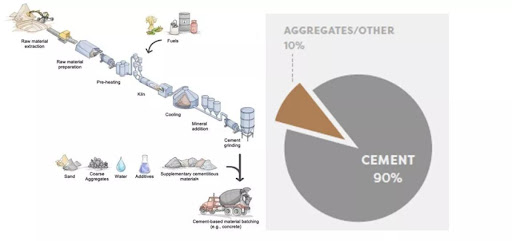
Source: Carbon 180
Cement production processes release a cocktail of pollutants into the atmosphere, posing a threat to both the environment and public health. As air pollution control equipment manufacturers, our mission is to tackle this issue head-on by offering cutting-edge solutions to the cement industry. By addressing key environmental concerns and utilizing advanced technologies, we aim to transform cement plants into eco-friendly and sustainable operations.
Understanding the Cement Industry's Air Pollution Challenges
Before we dive into the solutions, it's crucial to see the need for air pollution control in cement industry. Cement production involves several processes, from mining raw materials to the final cement product. Along this journey, various pollutants are generated, including dust, particulate matter, sulfur dioxide (SO2), nitrogen oxides (NOx), and volatile organic compounds (VOCs). These emissions can have detrimental effects on air quality and contribute to respiratory issues and environmental degradation.
The manufacturing of cement involves mining; crushing and grinding of raw materials (mostly limestone and clay); calculating the material in rotary kiln; cooling the resulting clinker; mixing the clinker with Gypsum; and milling, storing and bagging the finished cement. The cement manufacturing process generates a lot of dust, which is captured and recycled to the process. Gasses from the clinker cooler are used as secondary combustion air. The process, using pre-heaters and pre-calciners, is both economically and environmentally preferable to wet processes because of techno-economic advantages of the energy saving dry system over wet. Certain other solids such as pulverized fly ash from power plants, slag, roasted pyrite residue and foundry sand can be used as additives to prepare blended cement.
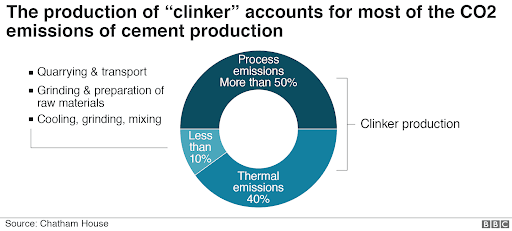
- Dust generation: Generation of fine particulates and dust are inherent in the process; but most are recovered and recycled. The sources of dust emission include clinker cooler, crushers, grinders and material-handling equipment. Material-handling operations such as conveyors result in fugitive dust emission.
- Prevention and control of dust: The priority in the cement industry is to minimize the increase in ambient particulate levels by reducing the mass load emitted from the stacks, from fugitive emissions, and from other sources. Collection and recycling of dust in the kiln gases is required to improve the efficiency of the operation and to reduce atmospheric emissions. Units that are well designed, well operated, and well maintained can normally achieve generation of less than 0.2 kilograms of dust per metric tonne (kg /t) of clinker, using dust recovery systems.
- Mechanical systems for controlling dust: Several mechanical equipment are used in cement manufacturing plants to control / collect dust. As leaders in air pollution control, we offer a range of state-of-the-art products tailored to combat the specific challenges encountered in cement plants.
Techflow’s Air Pollution Control Products for Cement Plants
1. Electrostatic Precipitator (ESP) for Cement Industry
Electrostatic Precipitators (ESPs) are formidable weapons in the battle against air pollution. ESP are used in Raw Material Crusher, Cement Mill, Coal Mill, Rotary Kiln & in Cyclone Preheater Tower. ESPs utilize electrostatic forces to capture and remove particulate matter from exhaust gases. In the cement industry, ESPs are indispensable for mitigating dust emissions from processes like crushing, grinding, and clinkerization.
2. Bag Filter (B-TPJF) for Cement Industry
Bag filters are a type of air filter that uses a series of bags to trap dust and other particulate matter. They are used in a variety of industries, including cement manufacturing, to improve air quality and protect human health. Our high-quality Filter Bags are made from a durable material that can withstand the harsh conditions of a cement plant. They are also very efficient at trapping dust, which helps to keep the air clean and safe for workers.
Emission level : less than 5 mg/Nm3 with 99.9% efficiency
Bag filters play a vital role in multiple stages of cement production, including grinding, calcining, and clinker grinding. They help to improve the quality of the cement by removing impurities, and they also help to reduce emissions of dust and other pollutants into the environment.
3. Dense Phase Pneumatic Conveying System for Cement Industry
Material handling is a critical aspect of cement manufacturing. The Dense Phase Pneumatic Conveying System provides efficient and dust-free transport of materials within the plant. This system uses a high-pressure air stream to transport materials, which minimizes spillage and dust emissions. This contributes to a cleaner and safer working environment.
Conveying capaciy: upto 50 tons per hour
The system also reduces the risk of accidents and injuries, and improves the overall efficiency of the plant.
4. Centrifugal Fans & Blowers for Cement Industry
To maintain optimal airflow and ventilation in cement plants, our Centrifugal Fans and Blowers are tailored to the industry's specific needs. They ensure that air circulation remains efficient and that pollutants are effectively captured and extracted from the production area.
Design range
- Airflow : up to 10,00,000 m3/hr
- Pressure: 1500 mmWC
- Motor Capacity: 1500 kW
5. Lean Phase Pneumatic Conveying for Cement Industry
Lean Phase Pneumatic Conveying solutions are versatile, efficient, and environmentally friendly ways to move bulk materials. They are a cost-effective option for a variety of industries, including cement plants, food processing, pharmaceuticals, and manufacturing. Lean Phase Pneumatic Conveying systems use a low-pressure airstream to transport materials, which reduces wear and tear on equipment and minimizes the risk of product contamination. They are also very energy-efficient, which can save businesses money on their energy costs. In addition, Lean Phase Pneumatic Conveying systems are environmentally friendly because they do not produce any emissions.
Applications Across the Cement Production Spectrum
Our range of air pollution control products finds applications at various stages of cement production, enabling comprehensive pollution management:
- Mining: Dust control during the extraction of raw materials.
- Crushing: Minimizing dust emissions during the crushing of raw materials.
- Stacking and Reclaiming: Effective dust control for materials storage and retrieval.
- Drying and Blending: Reducing emissions during the drying and blending of raw materials.
- Calcining and Kilns: Capturing pollutants generated during the calcination process.
- Clinkerization and Cement Grinding: Controlling emissions during clinker production and cement grinding.
- Fly Ash Conveying: Ensuring environmentally responsible handling of fly ash.
- Packing: Preventing dust emissions during the packaging of cement products.
The Transformational Impact of Air Pollution Control Systems
In August, 2014 Government of India notified revised emission norms for Particulate Matter (PM) and also introduced emission norms for SO2 and NO2 for cement industry.
In a reciprocal action, the cement industry in recent years has made significant strides in adopting advanced air pollution control systems. These technologies not only meet stringent regulatory requirements but also contribute to a more sustainable and responsible industry. To gain further insight into how air pollution control systems are revolutionizing cement plants, we invite you to read our in-depth article here.
In conclusion, as air pollution control manufacturers, we are committed to helping the cement industry reduce its environmental footprint while continuing to provide the essential building materials for our growing world. By investing in innovative solutions such as Electrostatic Precipitators, Bag Filters, Dense Phase Pneumatic Conveying Systems, and more, cement plants can play a pivotal role in achieving cleaner air and a more sustainable future. Together, we can build a greener and healthier world.
FAQs
The primary source of air pollution in the cement industry is the release of various pollutants during the different stages of cement production. These pollutants include particulate matter, sulfur dioxide (SO2), nitrogen oxides (NOx), and volatile organic compounds (VOCs).
ESPs are highly efficient in capturing and removing particulate matter from exhaust gases. In cement plants, ESPs are used to mitigate flue gas emissions generated during processes like crushing, grinding, and clinkerization.
Filter Bags are critical components in bag filters, designed to enhance filtration efficiency. They capture fine particles and dust, preventing them from escaping into the atmosphere. These bags are used in multiple stages of cement production, from mining to packing.
Dense Phase Pneumatic Conveying Systems are used for efficient and dust-free material handling within cement plants. They minimize material spillage and dust emissions, contributing to a cleaner and safer working environment.
Centrifugal Fans & Blowers are essential for maintaining optimal airflow and ventilation within cement plants. They help capture and extract pollutants from industrial spaces, ensuring that air quality remains high. Fans are used as suction fans, pollution cotrol or ESP fans or process fans like for Kiln.
Air pollution control products find applications at various stages of cement production, including mining, crushing, stacking, reclaiming, drying, blending, calcining, kilns, clinkerization, cement grinding, fly ash conveying, process fans, and packing.
Air pollution control systems, such as ESPs, bag filters, scrubbers, help cement plants meet stringent environmental regulations. They reduce emissions of harmful pollutants, leading to a more sustainable and responsible cement industry.