
Key Takeaways
- A fume extraction system captures fine metal fume at its source, filters it, and discharges clean air, protecting workers and supporting legal compliance.
- Welding fume is an IARC Group 1 carcinogen linked to lung cancer, which makes effective extraction a health necessity, not an optional upgrade.
- India's Factories Act, 1948 sets an eight-hour exposure limit of 5 mg/m³ for welding fume and requires exhaust to be applied as near as possible to the fume source.
- The Air (Prevention and Control of Pollution) Act, 1981 and CPCB standards govern what furnaces and foundries may release; arc and induction furnaces must collect fume before discharge.
- Source capture uses the least airflow for the greatest protection, because capture velocity falls off sharply as the hood moves away from the source.
- Bag and cartridge filters capture fume down to about 0.3 micron at efficiencies above 99 per cent; cyclones only pre-clean coarser dust.
- The right FES depends on fume type, temperature, airflow, source layout, and the emission standard you must meet, not on a catalogue.
An industrial fume extraction system (FES) captures airborne fume, smoke, and fine particulate at or near the point where it is generated, cleans the contaminated air through a filtration stage, and discharges safe air back into the workplace or the atmosphere. On any shop floor that welds, melts, cuts, or grinds metal, it is among the most important pieces of plant a factory can install: it protects worker health, keeps the plant compliant with Indian law, and preserves the productivity that polluted air quietly erodes.
This guide explains what these systems are, how they work, the types available, the filtration technologies behind them, the Indian regulations that govern them, and how to select the right configuration for your process. It is written for plant managers, EHS heads, and project engineers who need to make an informed procurement decision rather than a rushed one.
What Is an Industrial Fume Extraction System (FES)?
A fume extraction system is a purpose-built assembly that removes hazardous gases and metal fume from a work area before they can accumulate in the breathing zone or settle across the plant. In Indian industry, it is commonly abbreviated FES, short for Fume Extraction System.
Fume is not the same as ordinary dust. It is made up of extremely fine solid particles, often well below one micron, that form when metal is vaporised at high temperature and then condenses in air. Because these particles are so small, they travel deep into the lungs and stay airborne far longer than coarse dust. That is precisely why a dedicated extraction system is needed rather than general cleaning or open ventilation.
Key Components of a Fume Extraction System
A complete system is built from five functional stages that work in sequence:
- Capture device (hood): A hood, nozzle, arm, or enclosure positioned at the fume source to draw contaminated air in.
- Ducting: Sized to carry the captured air at a velocity high enough to keep particulate in suspension so it does not settle inside the pipe.
- Air-cleaning device (filter): A cyclone, bag filter, cartridge filter, or precipitator that separates the pollutant from the airstream.
- Fan (ID fan / centrifugal blower): The induced-draft fan that generates the suction driving the whole system.
- Discharge and collection: A stack or clean-air outlet, plus a hopper and rotary airlock or screw conveyor that removes the collected material.
Get any one of these stages wrong, and the system underperforms. A powerful fan behind an undersized hood, or an excellent filter fed by leaking ducting, will still fail to protect the workforce. Good FES design treats all five stages as a single hydraulic system.
Why Are Industrial Fumes Hazardous to Workers?
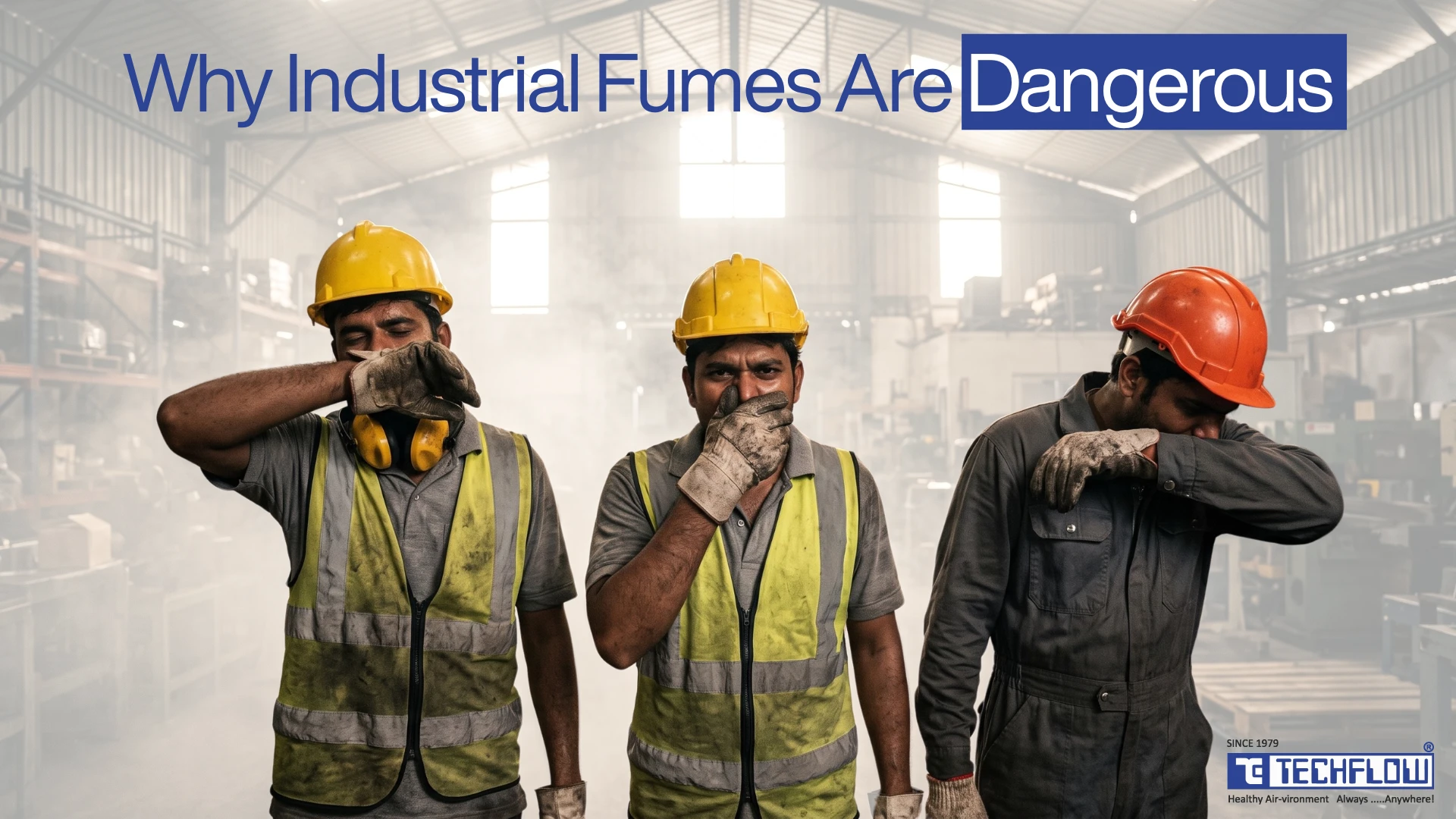
Fume control in India is not optional housekeeping. It sits at the intersection of occupational health law, environmental law, and basic operational efficiency.
Which Industrial Processes Generate Fumes?
Many everyday industrial operations release fumes. The most common are welding in all its forms MIG, TIG, SMAW (stick), and SAW (submerged arc) along with induction furnaces, electric arc furnaces (EAF), AOD furnaces, cupolas, steel melting shops, gas and plasma cutting, brazing, soldering, oil quenching, buffing, and grinding. Anywhere metal is melted, joined, or cut, respirable fume is produced.
Health Effects of Fume Exposure
The health case for extraction is backed by top-tier evidence. In 2017, the International Agency for Research on Cancer (IARC), the specialised cancer agency of the World Health Organisation, reclassified welding fume as a Group 1 carcinogen, carcinogenic to humans, upgrading it from the earlier "possibly carcinogenic" (Group 2B) category. The classification rested on sufficient evidence linking welding fume to lung cancer, with a positive association also observed for kidney cancer. Ultraviolet radiation from welding was classified as a Group 1 carcinogen in the same evaluation.
Beyond overall cancer risk, specific fume constituents carry their own well-documented dangers:
- Manganese, present in most steel welding fume, is a neurotoxin. Chronic overexposure can cause manganism, a Parkinson's-like syndrome with tremors, difficulty walking, and muscle rigidity.
- Zinc oxide, released when welding or cutting galvanised steel, is the most common cause of metal fume fever, a self-limiting, flu-like illness with fever, chills, and a metallic taste that typically appears a few hours after exposure.
- Hexavalent chromium and nickel compounds, generated when working stainless steel, are recognised carcinogens.
- Iron oxide, which makes up the bulk of mild-steel fume, can deposit in the lungs over years and cause siderosis.
Impact on Productivity and Equipment
Uncontrolled fume also carries a commercial cost that is easy to underestimate. Workers find it uncomfortable and tiring to operate in a haze-filled environment, which lowers output. Settled particulate fouls machinery, contaminates product, and shortens the life of electrical and electronic equipment. Clean air is not just a compliance line item; it protects both the workforce and the assets around them.
How Does an Industrial Fume Extraction System Work?
At its core, a fume extraction system moves through four steps: capture, conveyance, cleaning, and discharge.
The most important and most frequently misunderstood step is capture. The single most effective strategy in industrial ventilation is to control the contaminant at the source, before it can disperse into the room. This is achieved by positioning a hood as close as practical to the point of origin, so the incoming air captures the fume the moment it is created. Indian law encodes this principle directly, requiring that any exhaust appliance be applied "as near as possible to the point of origin" of the fume.
Positioning matters so much because of a basic law of airflow: the velocity of air pulled into a plain hood falls off very rapidly with distance from the opening. A hood that captures fume effectively at 150 mm may be almost useless at 450 mm. Designers therefore work to a target capture velocity, the air speed needed at the actual fume source to overcome cross-drafts and pull the contaminant in.
For low-velocity fume released into reasonably still air, such as most manual welding, the widely used ACGIH industrial-ventilation guidance points to capture velocities around 0.5 metres per second (roughly 100 feet per minute) at the source; more toxic fume calls for higher values, typically 0.6 to 0.75 m/s. The system must then be sized to deliver that velocity at the working distance, not just at the hood face.
Once captured, the air is carried through ducting kept fast enough to hold particulate in suspension, passed through the air-cleaning stage, and drawn onward by the ID fan before discharge. For hot furnace applications, a cooling stage is added ahead of the filter, because fabric and cartridge media have temperature limits that raw flue gas would exceed.
Types of Industrial Fume Extraction Systems
There is no single "best" system. The right choice depends on how many sources you have, how mobile the work is, how hot the fume is, and how the plant is laid out. The main categories are set out below.
Source Capture vs General Ventilation
Source capture, also called local exhaust ventilation, removes fume at the point of generation. It uses the least airflow to achieve the greatest protection and is the preferred approach wherever the source is fixed or semi-fixed. General or ambient ventilation dilutes and removes fume across the whole workspace and is used as a supplement, or where many scattered, moving sources cannot be captured individually. Most well-designed plants use source capture as the primary control and general ventilation as a backup.
Portable Fume Extractors
Portable units are self-contained, mobile extractors fitted with a flexible articulated arm that a welder or operator can reposition over the work. They suit workshops with a small number of stations, variable job locations, or jobbing work where the source keeps moving. Their strength is flexibility; they can be wheeled to wherever the work is and have no impact on the welding process itself.
Centralised Fume Extraction Systems
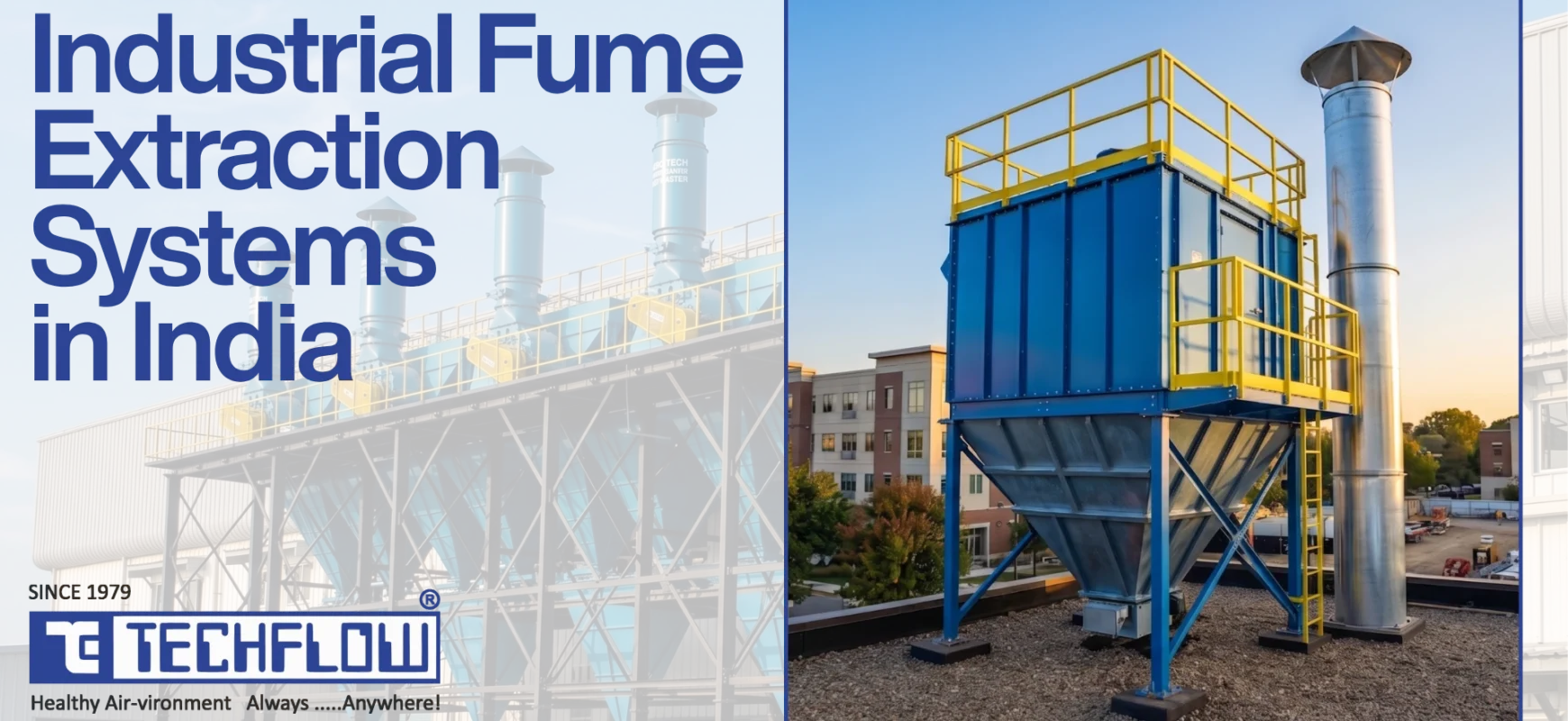
A centralised system connects multiple hoods or capture points across the plant to a single large filtration unit and fan through a network of ducting. It is the right answer for facilities with many permanent workstations or continuous high-fume processes, because it delivers consistent extraction at every point and centralises maintenance. TECHFLOW designs both centralised and decentralised fume extraction and filtration systems, along with the ducting and stack, to match the site layout and the number of sources.
Primary vs Secondary Furnace Fume Extraction (FES)
Furnace applications are a specialised field. Fume from induction and arc furnaces is hot, high in volume, and often flame-laden, so the system architecture differs from a simple welding extractor.
- Primary FES captures fume directly at the furnace using water-cooled or swivelling hoods, or through fourth-hole and side-draft arrangements, capturing the densest fume at the moment of melting.
- Secondary FES captures the fugitive fume that escapes during charging, tapping, and pouring, typically using large canopy or side-draft hoods over the furnace bay, and is common in steel melting shops (SMS).
A typical TECHFLOW furnace pollution-control train takes the extracted hot gas through a primary cyclone and an air-to-air or air-to-water cooler, then through a pulse-jet or reverse-air bag house, before a powerful ID fan sends the cleaned gas up the stack. For more detail on how these systems vary by furnace type, see TECHFLOW's furnace fume extraction systems.
Fume Extraction Systems by Application
Different processes generate different fume loads at different temperatures, which changes the capture method and the filter that suits them. The table below summarises common applications.
|
Application |
Typical processes |
Suitable extraction approach |
|
Welding |
MIG, TIG, SMAW, SAW, robotic and spot welding |
Portable arm extractors or centralised source capture with cartridge or bag filtration |
|
Furnace melting |
Induction furnace, EAF, arc, AOD, cupola, SMS |
Primary and secondary FES with cooling ahead of a bag house |
|
Cutting |
Plasma, laser, and gas cutting |
Down-draft tables or hooded capture with cartridge filtration |
|
Grinding and buffing |
Metal finishing, deburring |
Down-draft benches and hooded capture into a bag or cartridge filter |
|
Brazing and soldering |
Assembly, joining |
Localised arm or bench capture |
Filtration Technologies in Fume Extraction Systems
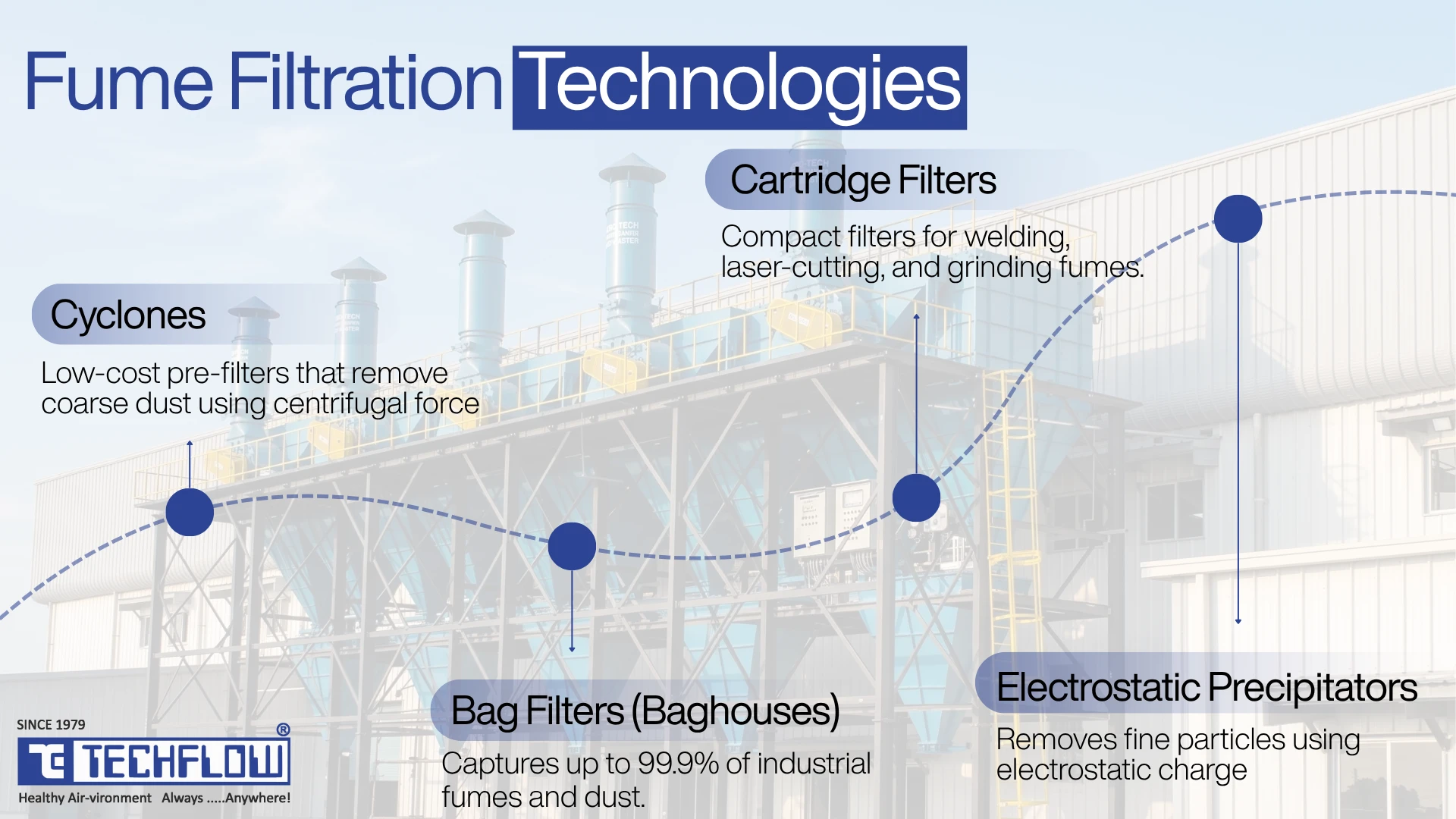
The capture stage brings the fume in; the filtration stage is what actually cleans it. Choosing the right air-cleaning device is central to both compliance and running cost. The main technologies are compared below.
Cyclones and Multiclones
Cyclones use centrifugal force to spin heavier particles out of the airstream. They are simple, robust, and inexpensive, and they excel at removing coarse particulate. On fine fume, however, their efficiency drops sharply, so in fume applications they are usually used as a pre-cleaner ahead of a finer filter rather than as the final stage. TECHFLOW manufactures cyclone dust collectors in single, twin, and quad-cylinder configurations.
Bag Filters and Pulse-Jet Baghouses
The bag filter, or baghouse, is the workhorse of industrial fume filtration. Contaminated air passes through fabric filter bags that trap the particulate on their surface, and the bags are periodically cleaned, most efficiently by pulse-jet cleaning that fires a short burst of compressed air to dislodge the collected cake into a hopper. Well-designed fabric filters achieve very high collection efficiencies, commonly cited at up to 99.9%, and with membrane media can capture particles down to around 0.3 micron. This combination of high efficiency and large gas-handling capacity makes the bag house the standard choice for furnace and high-volume fume applications.
Cartridge Filters
Cartridge collectors use pleated filter media, which packs a large filtration area into a compact footprint. They are especially well suited to fine, dry fume such as welding smoke, laser-cutting fume, and grinding dust, capturing particles down to about 0.3 micron at efficiencies above 99%. Their compact size makes them ideal for indoor and space-constrained installations, and TECHFLOW has manufactured pulse-jet cartridge filters for central welding fume extraction for decades.
Electrostatic Precipitators (ESP)
An ESP charges particles electrically and collects them on oppositely charged plates. Precipitators handle very large gas volumes at high efficiency with low pressure drop, which suits certain high-throughput applications, though they carry a higher capital cost.
There is no universally correct filter. The selection depends on fume characteristics, temperature, volume, and the emission standard the plant must meet. TECHFLOW's engineering team specifies the filtration stage to match the process rather than fitting the process to a standard product.
Fume Extraction Regulations and Standards in India
Two distinct legal streams govern fume extraction in India. One protects the worker inside the factory; the other protects the environment outside it. A compliant plant satisfies both.
The Factories Act, 1948 (Worker Protection)
The Factories Act, 1948 is the primary occupational-health statute. Section 14 ("Dust and Fume") requires that where a manufacturing process gives off fume likely to be injurious to workers, effective measures must be taken to prevent its inhalation and accumulation, and that any exhaust appliance be applied as near as possible to the point of origin of the fume. This is the legal basis for source-capture extraction in Indian factories.
The Act's Second Schedule (referenced under Section 41F) sets permissible exposure limits for airborne substances in the work environment. Several are directly relevant to welding and metalworking fume.
|
Substance |
Permissible limit (8-hour TWA) |
|
Welding fumes |
5 mg/m³ |
|
Iron oxide fume (as Fe) |
5 mg/m³ |
|
Manganese fume (as Mn) |
1 mg/m³ |
|
Zinc oxide fume |
5 mg/m³ |
|
Copper fume |
0.2 mg/m³ |
|
Lead, inorganic dusts and fumes (as Pb) |
0.15 mg/m³ |
|
Chromic acid and chromates (as Cr) |
0.05 mg/m³ |
TWA means time-weighted average over an eight-hour shift. Source: Second Schedule, Factories Act, 1948.
These are legal ceilings, not aspirations. A factory that keeps workplace fume concentrations below these values, verified through air monitoring, is meeting its statutory duty of care.
The Air (Prevention and Control of Pollution) Act, 1981
The Air Act governs what a plant is allowed to emit into the atmosphere. Under it, industries operating in air pollution control areas must obtain consent to operate from their State Pollution Control Board and must install and run approved control equipment. The Central Pollution Control Board (CPCB) sets the framework that the State Boards enforce.
Emission Standards for Furnaces and Foundries
For metal-melting operations, the Environment (Protection) Rules, 1986 set specific particulate matter limits at the stack.
|
Source |
Particulate matter limit |
|
Cupola (foundry), melting rate below 3 t/hr |
450 mg/Nm³ |
|
Cupola (foundry), melting rate 3 t/hr and above |
150 mg/Nm³ |
|
Arc furnaces (all sizes) |
150 mg/Nm³ |
The rules also specify that for arc and induction furnaces, provision must be made to collect the fume before it is discharged through the stack, which is precisely what a furnace FES does. Some regions and pollution control authorities have been moving toward tighter, uniform limits, so plants in sensitive airsheds should confirm the current local standard with their State Board before finalising a design.
How to Choose the Right Fume Extraction System
Selecting an FES is an engineering decision, not a catalogue purchase. Use the following framework to structure it.
- Identify the fume: Establish what metal and process you are dealing with, and therefore what the fume contains and how hot it is. Stainless steel, galvanised steel, and induction melting each demand different handling.
- Quantify the airflow: The required airflow, expressed in cubic metres per hour (CMH) or cubic feet per minute (CFM), depends on the number and type of sources and the capture velocity needed at each. This calculation drives the size of the fan and filter.
- Map the sources: A few fixed stations point toward centralised source capture; scattered, mobile work points toward portable units; a hot furnace points toward primary and secondary FES with cooling.
- Match the filtration: Choose the air-cleaning device against fume characteristics and the emission standard you must meet, as set out in the filtration section above.
- Account for temperature: Hot furnace gas needs a cooling stage ahead of any fabric or cartridge filter.
- Plan for energy and maintenance: Fan power and filter cleaning are the main running costs. A slightly larger, well-designed system often costs less to run than an undersized one pushed hard.
- Confirm compliance: Cross-check the design against both the Factories Act exposure limits and the applicable CPCB emission standard.
Working through these steps with an experienced manufacturer avoids the two most common outcomes: a system that does not capture enough, and a system that is oversized and expensive to run.
Installation and Maintenance Best Practices
Even a well-specified system underperforms if it is installed or maintained poorly. The following practices protect performance over the long term.
- Capture close to the source: Keep hoods and arms as near the fume as the process allows, because capture efficiency collapses with distance.
- Size ducting for transport velocity: Ducts must be fast enough to keep particulate airborne; if the air slows, fume settles inside the duct and eventually blocks it.
- Avoid leaks and sharp bends: Both waste fan energy and reduce capture at the hood.
- Clean filters on schedule: Pulse-jet and reverse-air cleaning maintain airflow; a clogged filter starves the whole system.
- Monitor pressure drop: A rising pressure drop across the filter is the earliest warning that media need cleaning or replacement.
- Verify with air monitoring: Periodic workplace air testing confirms that exposure stays within the legal limits and that the system is doing its job.
The most frequent mistake in the field is treating extraction as an afterthought bolted onto an existing process. Designed in from the start, and maintained as a system rather than a collection of parts, an FES pays for itself in health, compliance, and uptime.
Which Industries Need Fume Extraction Systems?
Fume extraction is essential across a wide range of Indian industry, including steel and foundry operations, TMT and rolling mills, sponge iron and steel melting shops, automotive and engineering manufacturing, fabrication and structural workshops, non-ferrous metallurgy, and general heavy engineering. Any facility that melts, welds, cuts, or grinds metal is a candidate for a properly engineered system.
Why Choose TECHFLOW for Fume Extraction in India
TECHFLOW Enterprises Pvt. Ltd. is an air pollution control equipment manufacturer based in Ahmedabad, Gujarat, with roots in the field going back to 1979. The company designs, manufactures, installs, and commissions the complete range needed for fume control under one roof, including fume extraction and filtration systems, bag filters, pulse-jet and cartridge filters, cyclones, wet scrubbers, electrostatic precipitators, centrifugal blowers and ID fans, and the ducting and stack that tie them together.
Because TECHFLOW builds every stage of the system, it can engineer the hood, filter, and fan as one integrated whole and tailor the design to your process, your site layout, and the emission standard you have to meet. That systems approach, rather than an off-the-shelf mindset, is what separates extraction that merely runs from extraction that actually protects your people and keeps you compliant.
Conclusion
Clean air on the shop floor is no longer a discretionary investment. Between the health evidence, which now classifies welding fume as a known carcinogen, and India's dual legal framework under the Factories Act and the Air Act, a well-engineered fume extraction system has become fundamental to running a safe, compliant, and productive plant. The right system is never a generic box; it is the one matched to your fume, your temperature, your airflow, and your layout, with every stage from hood to stack designed to work together.
That engineering judgement is where a specialist manufacturer earns its place. With decades of experience across welding, furnace, and process fume control, TECHFLOW designs, builds, and commissions complete systems tailored to the way your plant actually runs. To size an industrial fume extraction system for your facility, talk to the TECHFLOW team.
Frequently Asked Questions (FAQs) :
Both clean industrial air, but they target different contaminants. A fume extraction system is designed for very fine fume and smoke, often sub-micron particles created when metal vaporises during welding or melting. A dust collector typically handles coarser, heavier particulate from processes such as grinding, cutting, or material handling. In practice, many systems combine both, using a cyclone to remove coarse dust before a fine filter captures the fume.
Under the Second Schedule of the Factories Act, 1948, the permissible limit for welding fumes is 5 mg/m³ as an eight-hour time-weighted average. Individual constituents have their own, often lower, limits; manganese fume, for example, is limited to 1 mg/m³. A fume extraction system is the standard engineering control used to keep concentrations below these values.
Effectively, yes, wherever hazardous fume is produced. The Factories Act, 1948 requires factories to take effective measures to remove injurious fume at the point of origin, and the Air (Prevention and Control of Pollution) Act, 1981 requires plants to control what they emit and to obtain consent from their State Pollution Control Board. For arc and induction furnaces, the Environment (Protection) Rules further require that fume be collected before discharge. A fume extraction system is the accepted means of meeting these obligations.
It depends on your layout. Portable extractors suit workshops with a small number of stations or mobile, jobbing work, because they can be moved to wherever the welding is happening. Centralised systems suit plants with many permanent workstations or continuous high-fume processes, because they deliver consistent extraction at every point and centralise maintenance. Many facilities use a mix of both.
Primary FES captures fume directly at the furnace as the metal melts using water-cooled or swivelling hoods or fourth-hole extraction where the fume is densest. Secondary FES captures the fugitive fume that escapes during charging, tapping, and pouring, usually through large canopy or side-draft hoods over the furnace bay. Larger steel melting shops often need both to stay compliant and keep the workplace clear.
For dry welding fume, pleated cartridge filters and pulse-jet bag filters are the usual choices, because both capture very fine particulate down to around 0.3 micron at efficiencies above 99%. Cartridge units are compact and well suited to indoor and space-limited installations, while bag houses handle larger gas volumes and hotter applications. The right pick depends on volume, temperature, and available space.
There is no fixed calendar. Filter life depends on fume load, cleaning frequency, and media type. The practical indicator is pressure drop: when the pressure drop across the filter rises and stays high despite normal cleaning, the media are reaching the end of their service life. Monitoring pressure drop is the most reliable way to schedule replacement before performance falls off.