

Key Takeaways
- Sugar dust is a confirmed explosion hazard, not a housekeeping nuisance. The 2008 Imperial Sugar refinery explosion at Port Wentworth, Georgia killed 14 workers and injured 36. The U.S. Chemical Safety Board found it was caused by ongoing sugar releases from inadequately designed and maintained dust collection equipment, compounded by poor housekeeping.
- A sugar mill produces at least five physically distinct dusts. Fibrous cane trash, wet bagasse fines, abrasive boiler fly ash, alkaline lime and filter cake dust, and dry crystalline sugar fines. No single collector type is efficient across all of them.
- Centrifuging, drying, and grading are the highest-risk zone. Sugar leaves the centrifugals at roughly 0.1 to 0.4 per cent moisture and is dried to around 0.04 per cent for safe storage. That is the driest, finest, most readily airborne material in the plant.
- In India, the boiler house carries the heaviest compliance load. Bagasse-fired boiler stacks are governed by CPCB particulate standards, and boilers of 10 tonnes per hour (TPH) capacity and above must carry Continuous Emission Monitoring Systems (CEMS) reporting to the regulator.
- NFPA 660 replaced six separate combustible dust standards on 6 December 2024, consolidating NFPA 61, 484, 652, 654, 655 and 664 into one document, with agricultural and food processing requirements now in Chapter 21.
- A Dust Hazard Analysis (DHA) is the design input, not the closing audit. It should be complete before collector sizing is frozen, and revalidated on roughly a five-year cycle.
- Housekeeping failure, not equipment failure, is the recurring root cause. Uncontrolled accumulation on beams, cable trays, duct elbows and bin tops is what turns a small primary event into a plant-wrecking secondary explosion.
Sugar is one of the few industrial materials that is simultaneously a food product, a combustible dust, a hygroscopic powder and, in the form of its own by-product, a boiler fuel. That combination is why dust control in a sugar mill cannot be solved by buying one large dust collector. A single plant generates fibrous cane trash at the tippler, wet fibre and juice mist at the mills, abrasive fly ash at the boiler, alkaline lime dust in the process house, and explosible crystalline fines at the dryer and the bagging line. Each of those demands a different capture strategy, a different filtration medium and, in several cases, a different regulatory response.
This guide maps the sugar production process stage by stage, explains what dust each stage produces and why, and sets out which control technology is engineered for it. It also covers the two regulatory frameworks that matter most to Indian sugar mills: the Central Pollution Control Board (CPCB) stack emission regime that governs the boiler house, and the combustible dust standards that govern the process house and packing floor.
What Is Sugar Industry Dust Collection?
Sugar industry dust collection is the engineering practice of capturing, conveying and separating airborne particulate at each stage of sugar manufacture, from cane or beet reception through milling, boiler firing, clarification, crystallisation, drying, storage and packing, using stage-matched equipment such as cyclones, multiclones, pulse jet bag filters, cartridge collectors, wet scrubbers, electrostatic precipitators and silo vent filters, so that the plant meets stack emission limits, occupational exposure limits and combustible dust safety requirements simultaneously.
The defining characteristic is heterogeneity. The material changes physical state four times as it moves through the plant, and the dust changes with it.
| Dust type | Where it is generated | Physical character | Primary risk |
|---|---|---|---|
| Fibrous cane trash and soil | Cane yard, tippler, carrier, preparation | Coarse, light, stringy, high fire load | Fire load, plugging, poor housekeeping |
| Wet bagasse fines and juice mist | Mill tandem, diffuser, transfer chutes | Moist, sticky, prone to blinding filter media | Filter blinding, high differential pressure |
| Bagasse fly ash | Boiler furnace, flue gas path | Fine, abrasive, carbon-bearing | Stack emission breach, abrasion, community complaint |
| Lime and filter cake dust | Milk of lime preparation, sulphitation, filter station | Alkaline, fine, irritant | Skin and eye irritation, corrosion |
| Crystalline sugar fines | Centrifugals, dryer, cooler, grader, silos, bagging | Very dry, fine, free-flowing, hygroscopic | Combustible dust explosion, product loss, respiratory exposure |
That table is the whole argument for stage-specific design. A cyclone sized for cane trash will pass sugar fines almost untouched. A cartridge filter sized for sugar fines will be abraded and blinded within one season if it is asked to handle bagasse ash.
Why Sugar Dust Behaves Differently From Other Industrial Dusts
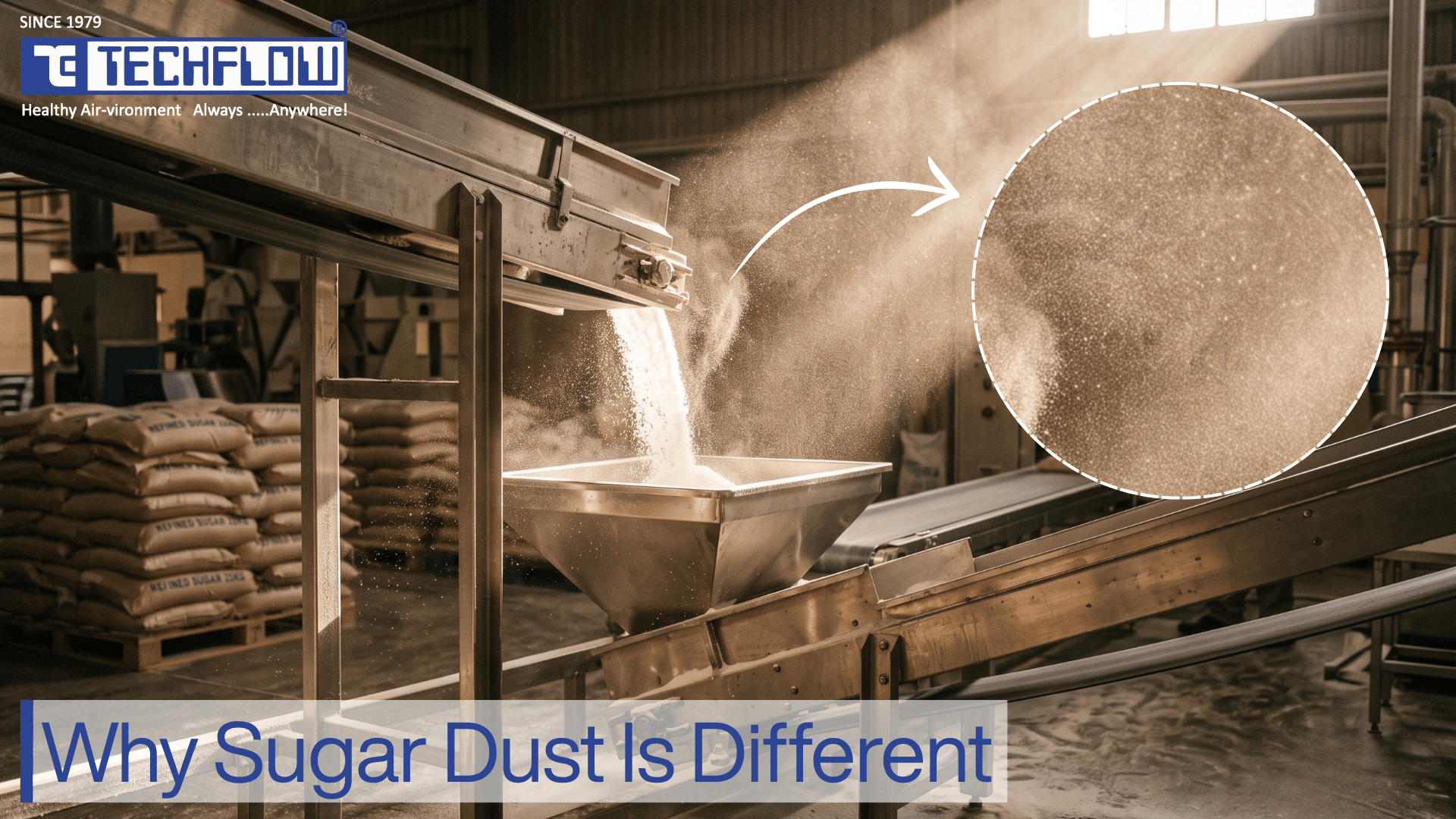
Three properties of sugar dust drive nearly every design decision in a sugar mill dust collection system.
It is combustible when finely divided and dispersed: Bulk granulated sugar will not explode. Sugar dispersed in air above its minimum explosible concentration (MEC), inside a confined volume, with an ignition source present, will. OSHA's combustible dust guidance places sugar in explosion class St 1, meaning a deflagration index (KSt) greater than zero and up to 200 bar·m/s. St 1 is labelled a "weak" explosion class, and that label has proved dangerously misleading: the Port Wentworth event that killed 14 people involved an St 1 material. Published test data also indicates granulated sugar ignites at roughly 480 °C as a suspended cloud and at a lower temperature as a settled layer on a hot surface, which is directly relevant to overheated bearings, hot boxes and drive assemblies inside enclosed conveyors.
It is hygroscopic: Sugar absorbs ambient moisture readily. In a dust collector, this causes filter cake to become tacky rather than friable, which defeats pulse cleaning, drives differential pressure up, and eventually blinds the media. In ductwork, it causes build-up on elbows and horizontal runs, which reduces conveying velocity and creates the accumulation the housekeeping programme is meant to eliminate. In an Indian mill running from November through April, ambient humidity swings across the crushing season are large enough that a system sized in a dry week will struggle in a damp one.
It carries static charge: Dry sugar picks up electrostatic charge readily during handling, and the effect is most severe during pneumatic conveying. Earthing and bonding of pipework, collector housings, hoppers and receiving vessels is therefore not an electrical formality in a sugar plant. It is a primary ignition control.
A fourth property matters on the bagasse side rather than the sugar side: bagasse fines and boiler fly ash are abrasive. Ductwork elbows, cyclone inlets, fan impellers, and airlock rotors in that circuit wear at a materially higher rate than the equivalent components on the sugar side of the plant.
The Two Hazard Frameworks a Sugar Mill Must Satisfy
Sugar mills face two distinct dust-related obligations, and they are frequently confused. One is about catastrophic events. The other is about chronic exposure and stack emissions. A system that satisfies one can still fail the other.
Explosion and fire prevention
This is governed internationally by NFPA 660, Standard for Combustible Dusts and Particulate Solids. The 2025 edition took effect on 6 December 2024 and consolidated six previously separate standards, NFPA 61 (agricultural and food processing), NFPA 484 (combustible metals), NFPA 652 (fundamentals), NFPA 654 (combustible particulate solids), NFPA 655 (sulfur) and NFPA 664 (wood processing), into a single document. Chapters 1 to 10 carry the fundamentals that apply to every facility, including the Dust Hazard Analysis requirement. Agricultural and food processing content, which is where sugar sits, now lives in Chapter 21.
Two structural points matter for Indian and export-market mills. First, NFPA 660 is a voluntary consensus standard on its own. It becomes binding when a local code or Authority Having Jurisdiction adopts it, when an insurer makes it a condition of cover, or when a regulator cites it as evidence of a recognised hazard. Many international insurers and export customers now do exactly that. Second, NFPA 660 removed the grandfathering allowances that older equipment previously relied on. A dust collector installed in 1998 is held to the same expectations as one installed last year.
Occupational exposure and stack emissions
OSHA regulates sucrose dust under its air contaminant tables at an 8-hour time-weighted average of 15 mg/m³ measured as total dust and 5 mg/m³ measured as the respirable fraction. Respirable dust is the fraction fine enough to reach the gas-exchange region of the lung, and it carries the greater long-term risk despite being the smaller mass.
In India, the equivalent enforcement pressure sits on the stack rather than the breathing zone, and it falls almost entirely on the boiler house. Details are set out in the regulatory section below.
Stage 1: Cane Reception, Unloading and Preparation
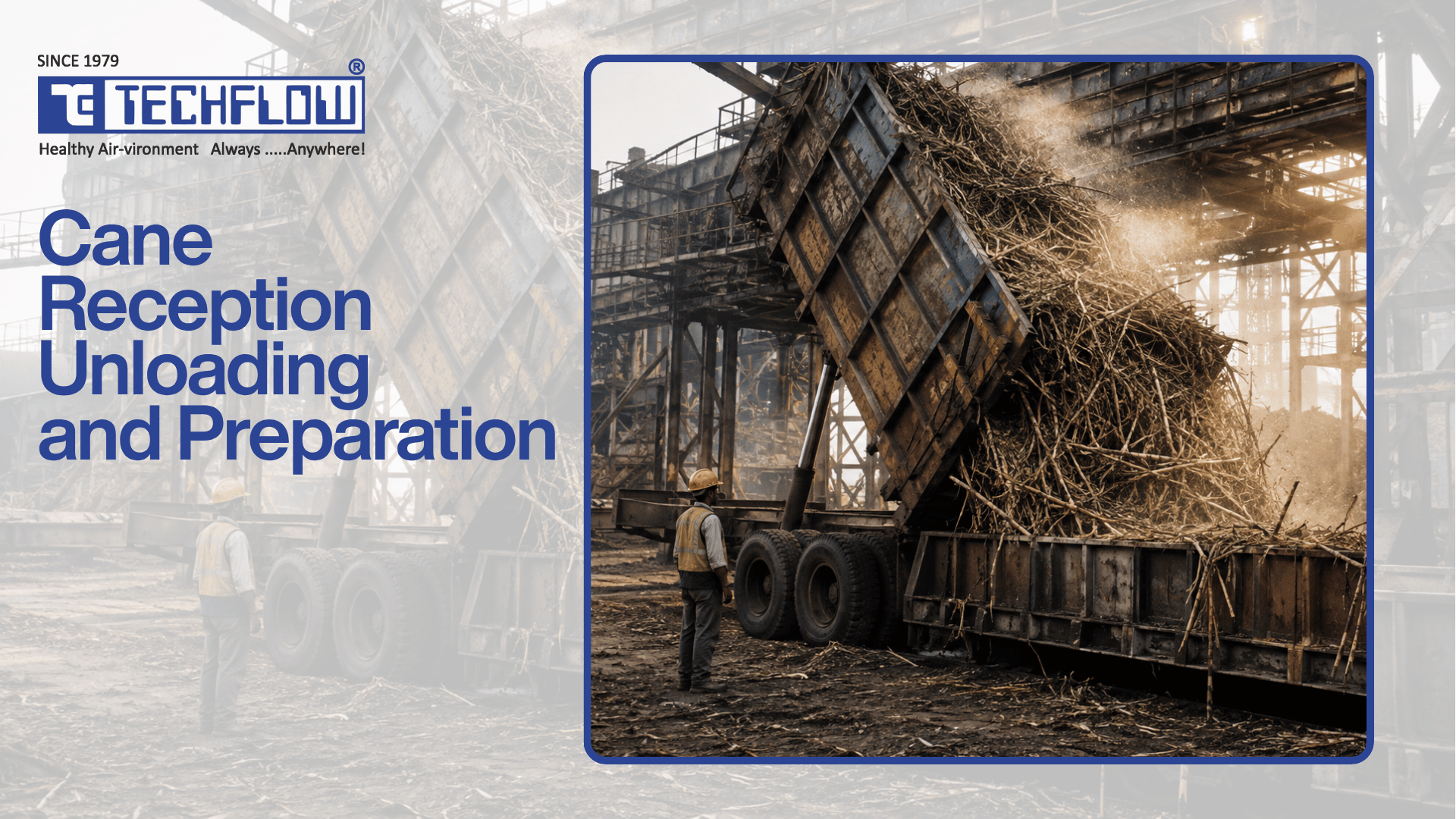
The first dust in a sugar mill is not sugar. It is agricultural debris.
Cane arriving by trolley, truck or trailer carries dry leaves, cane tops, soil and grit. Unloading at the tippler, transfer onto the cane carrier, and the shredding and levelling operations that follow all liberate this material as a coarse, light, fibrous cloud. It plugs screens, coats structural steel, accumulates around drives and, because it is dry vegetable matter sitting close to motors and bearings, it constitutes a real fire load even though its explosion potential is low.
Control approach at this stage:
- Enclosed or hooded tippler and unloading zones, with capture designed for the burst nature of the release rather than a steady average.
- Water misting or fogging at the tippler and at cane carrier transfer points, where the process tolerates added moisture. This is the cheapest control available and is frequently underused.
- Covered cane carriers and enclosed transfer chutes. Open transfer points are the single largest fugitive dust source in bulk handling anywhere, and cane handling is no exception.
- Cyclone or multiclone pre-separation on shredder and leveller exhaust. The particulate here is coarse, light and fibrous, which is exactly the duty a mechanical separator is built for and exactly the duty that ruins fabric media if it is presented untreated.
Design note: capture velocity at the tippler must be set for the moment of discharge, not for average conditions. Systems sized on averages visibly fail during peak arrivals, which in an Indian mill is most of the day for five months of the year.
Stage 2: Milling and Juice Extraction
The mill tandem produces a hybrid dust that is mechanically awkward: fine bagasse fibre mixed with soil particulate and a fine juice mist thrown off the rollers. Residual moisture makes this material clump. Presented to an undersized fabric filter, it forms a cake that will not release on pulse, and differential pressure climbs until airflow collapses.
Control approach at this stage:
- Local exhaust hoods over roller discharge points, intercarrier chutes and the trash plate area, positioned to capture at the point of release rather than to dilute the room.
- Cyclone separation as first stage, removing the coarse fibre fraction before anything reaches fabric media.
- Downstream bag or cartridge filtration sized on a conservative air-to-cloth ratio, with media selected for moisture tolerance and good cake release rather than for headline efficiency alone.
Design note: size the milling-area system for peak crushing rate, not for seasonal average tonnage. Undersized ductwork and inadequate filter area are the most common causes of visible dust escape from a mill house, and both are decided at the design stage, not the maintenance stage.
Stage 3: Bagasse Handling, Storage and Boiler Feed
Bagasse is the highest-volume solid stream in the plant. Crushing one tonne of sugarcane yields roughly 280 to 300 kg of wet bagasse at around 50 per cent moisture. In India, where more than 500 mills operated during the 2025 to 2026 crushing season, that translates into an enormous internal materials handling operation running continuously through the campaign.
Bagasse conveying, stacking, reclaiming and furnace feeding generate a persistent fugitive dust that is fibrous, light and easily carried on wind across the plant boundary. Bagasse stored in open yards adds a wind erosion source that most dust budgets ignore entirely.
Control approach at this stage:
- Enclosed belt conveyors with hooded and skirted transfer points on the feed to the boiler house.
- Abrasion-resistant cyclone or multiclone pre-cleaners on conveying and reclaim aspiration, with wear liners at inlets and elbows.
- Rotary airlock valves at all hopper and cyclone discharges to maintain the pressure seal and prevent uncontrolled air ingress into the collection circuit.
- Attention to bagasse yard wind erosion, which is a community and consent-condition issue as much as a plant issue.
Design note: bagasse dust is a fire risk in storage as well as a dust risk in handling. Keep aspiration ductwork routed away from hot surfaces, and treat spark ingress from the boiler side as a live hazard on any circuit that connects the two.
Stage 4: The Boiler House and Bagasse-Fired Flue Gas
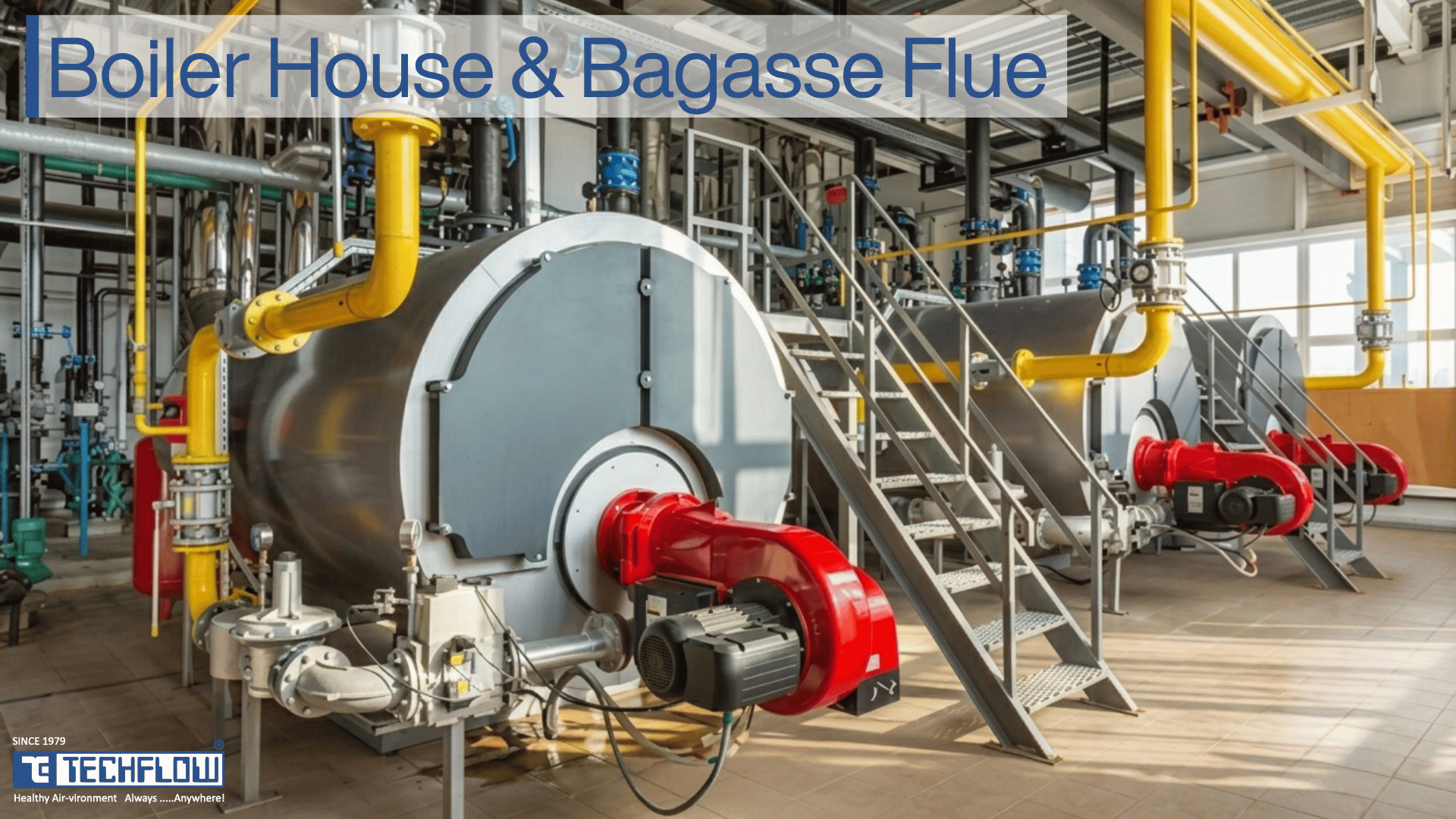
This is where the largest air pollution control investment in a sugar mill is made, and where the regulator looks first.
Bagasse combustion produces a fine, abrasive, carbon-bearing fly ash carried in a high-volume, high-temperature, moisture-laden flue gas stream. Because bagasse burns at around 50 per cent moisture, the gas volume per unit of fuel is high, and moisture content in the flue gas is materially higher than for coal firing. Both facts drive equipment selection.
Three technologies are used, singly or in combination:
Mechanical dust collectors (cyclones and multiclones) serve as the primary separation stage. They are simple, have no filter media, tolerate abrasion, and handle the bulk of the coarse ash load. What they cannot do is meet a modern fine-particulate limit on their own. Cyclones are effective on particles above roughly 10 to 15 microns and have limited capture capability for the fine fraction that regulatory monitoring actually measures. A cyclone stage is a load-reducer for the polishing stage, not a substitute for one.
Wet scrubbers, including venturi and packed bed designs, have historically dominated Indian and Brazilian bagasse boiler installations. They handle abrasive, sticky, high-moisture particulate that would blind dry media, and they tolerate the thermal excursions typical of grate-fired biomass. A field mass balance published in Clean Technologies and Environmental Policy on a Brazilian sugar-ethanol plant processing an average of 114.8 t/h of bagasse found that 68 per cent of the total particulate was collected dry in the grate, heat exchangers and multicyclone, 25 per cent in the wet scrubber, and 7 per cent was emitted, within the applicable standard. The same study documented the trade-off that now drives retrofits: significant water and heat losses, and high operating cost in the associated wastewater treatment station.
Electrostatic precipitators (ESPs) and Pulse Jet Bag Filters are the polishing technologies where tighter limits apply. ESPs offer the lowest pressure drop of the common options, which directly reduces induced draught (ID) fan power consumption over a long campaign, and they cope well with high gas volumes and temperature variation. Bag filters generally offer lower capital cost and excellent fine-particulate performance, at the price of higher pressure drop and ongoing media replacement.
Design note: the correct selection is not a general answer; it is a site answer, and it turns on gas volume, inlet temperature, moisture, target outlet concentration, available plot area, water availability and the cost of ID fan power across a five-month campaign. TechFlow's comparison of electrostatic precipitators against bag filters for sugar mills works through that decision in detail.
Boiler ash handling
Ash removal is a dust source in its own right and is regularly treated as an afterthought. CPCB's Charter for the sugar sector records boiler ash generation at approximately 1.5 to 2 per cent of bagasse fired, and notes that disposal practice across the industry has frequently been unscientific, with hot ash discharged into open areas without prior cooling, accidental fires reported, and poor record keeping of quantities generated and disposed.
Controlled ash handling means enclosed or pneumatic conveying to a silo, silo vent filtration, controlled cooling before discharge, and covered transport. Because bagasse ash is widely applied to agricultural land as a soil amendment, uncontrolled handling exports the problem beyond the plant boundary through wind re-suspension.
Stage 5: Clarification, Sulphitation and Filtration
The process house is a lower-volume but chemically distinct dust source.
Milk of lime preparation, lime silo venting, lime dosing and, in mills using sulphitation, sulphur handling, all release fine alkaline or reactive particulate. The filter station adds a second source: dried press mud or filter cake crumbles during discharge and disposal, releasing a fine organic dust.
Evaporation and vacuum pan crystallisation, by contrast, generate almost no dust. The material is liquid or massecuite throughout.
Control approach at this stage:
- Silo and bin vent filters on lime storage, sized for intermittent, low-volume displacement air rather than continuous duty, and configured to return captured material to the vessel.
- Local extraction at lime dosing and slurry preparation points, with materials selected for alkali resistance.
- Enclosed filter cake discharge and covered cake conveying or transport.
Design note: alkaline dust is corrosive to standard carbon steel housings and to some filter media. Specify materials for the chemistry, not just for the particle size.
Stage 6: Centrifuging, Drying, Cooling and Grading
This is the highest combustible-dust-risk zone in the entire plant, and it deserves engineering attention out of proportion to its footprint.
Sugar discharged from the centrifugals sits at roughly 0.1 to 0.4 per cent moisture at 60 to 80 °C. It is then dried and cooled to a safe storage condition, typically around 0.04 per cent moisture, because higher residual moisture causes lumping in the silo and supports microbial growth. Fluidised bed installations commonly take material from around 1 per cent down to 0.02 to 0.03 per cent. Some references cite an operating target closer to 0.2 per cent depending on grade and destination.
The engineering consequence is unambiguous. The material leaving the dryer and cooler is the driest, finest and most readily suspended solid in the plant, and screening at the grader liberates fines continuously with every pass. This is also where over-drying becomes counterproductive: pushing moisture too low makes crystals brittle and directly increases fines generation, which is why well-designed dryer-coolers are run under slight negative pressure to hold dust inside the drum rather than letting it into the building.
Control approach at this stage:
- Fully sealed dryer and cooler discharge, elevators and conveyors, operated under negative pressure.
- Pulse jet bag filters or cartridge collectors on dryer and cooler exhaust, sized for a fine crystalline particle size distribution and specified in food-grade construction.
- Deflagration venting sized to the material's KSt and Pmax, or explosion suppression where venting to a safe outdoor location is not achievable.
- Flame and explosion isolation on ductwork, so that an event inside a collector cannot propagate back into the process.
- Spark detection and abort gates on any circuit carrying dried sugar, particularly pneumatic lines.
- Dedicated containment on bucket elevators, which are a documented high-risk accumulation and ignition point.
- Earthing and bonding across all conveying pipework, housings and receiving vessels.
Design note: this is the area of a sugar plant most likely to require hazardous location electrical classification for combustible dust. Confirm the classification against the Dust Hazard Analysis before electrical design is frozen, not after equipment has been ordered.
Stage 7: Storage, Silos and Bulk Handling
Storage silos are large enclosed volumes into which dry, fine, charge-carrying material is pneumatically or mechanically injected. During rapid filling, displaced air carries entrained fines, a phenomenon operators know as silo breathing. That displaced air must go somewhere, and the only acceptable destination is a filter, not the atmosphere and not the silo headspace at an uncontrolled concentration.
Control approach at this stage:
- Silo vent filters mounted directly on the silo roof, returning captured fines to the stored product rather than discharging to atmosphere. Pulse jet cleaned conical designs are well suited because they maintain airflow through the media while returning product by gravity.
- Rotary airlock valves at silo and hopper discharge to prevent uncontrolled air exchange during transfer.
- Explosion venting engineered into the silo itself, sized on the enclosed volume and the material's explosion characteristics.
- Temperature and humidity control in the storage building, since sugar caking is driven by temperature swings and moisture pick-up, and caked sugar that must be reprocessed generates yet more fines.
Design note: treat the vent filter as a process device, not a nuisance-control accessory. If it blinds, the silo cannot be filled safely.
Stage 8: Packing, Bagging and Palletising
Packing generates dust through three separate mechanisms that are often conflated: air displacement at the filling nozzle as the bag volume fills, spillage and re-entrainment at transfer points between hopper and bagging machine, and residual surface dust shed during repeated bag handling and stacking.
This stage matters for three reasons at once. It is a worker exposure zone, it is a direct product-loss zone, and it is the most visible part of the plant to auditors, customers and regulators walking the floor.
Control approach at this stage:
- Bag-filling nozzle hoods connected to dedicated low-volume, high-capture extraction, rather than tapping a shared main.
- Cartridge dust collectors positioned close to the line, which suits the compact footprint typical of a packing hall.
- Return-to-process filtration, reintroducing captured fines into the product stream to recover yield.
- Explosion protection carried through to the packing hall. Port Wentworth's packing buildings, not its refinery, were the buildings that were destroyed.
Design note: return-to-process is where the commercial case for a properly engineered sugar dust collection system is usually made. Fines captured at the dryer, grader, and bagging line are saleable product, and recovering them shortens payback considerably.
Matching Collector Technology to Process Stage
The selection logic below reflects how systems are actually built in sugar plants, which is almost always as a layered train rather than a single device.
| Collector type | Best-fit duty in a sugar mill | Why it works there |
|---|---|---|
| Cyclone and multiclone separators | Cane preparation, milling, bagasse handling, boiler flue gas pre-cleaning | No filter media to blind or abrade; handles coarse, fibrous and abrasive loads; minimal maintenance; reduces load on the downstream stage |
| Pulse jet bag filters | Dryer and cooler exhaust, grading, boiler flue gas polishing | High efficiency on fine particulate; self-cleaning suits continuous campaign operation; wide capacity range |
| Cartridge dust collectors | Packing lines, weighing, mixing, lime handling | High filtration area in a compact housing; efficient on fine dry dust where floor space is constrained |
| Wet scrubbers and venturi scrubbers | Bagasse boiler flue gas | Handles abrasive, sticky, high-moisture particulate that would blind dry media; tolerates temperature excursions |
| Electrostatic precipitators | Bagasse boiler flue gas at high volume and tight outlet limits | Lowest pressure drop of the common options, which reduces ID fan power across a long campaign; high efficiency on fine particulate |
| Silo and bin vent filters | Sugar silos, lime silos, ash silos, dump hoppers, weigh bins | Purpose-built for intermittent displacement air with product return to the vessel |
| Rotary airlock valves | Under every cyclone, filter hopper and silo discharge | Maintains the pressure seal that the whole collection circuit depends on |
Two-stage design, coarse mechanical separation followed by fine filtration, is standard practice across most sugar mill circuits. Routing dust-laden air through a cyclone before fabric or cartridge media reduces the load reaching the fine stage, extends media life and stabilises differential pressure across the campaign.
The Regulatory Framework in India
For an Indian sugar mill, the binding requirements sit in three places.
Stack emissions from the bagasse-fired boiler
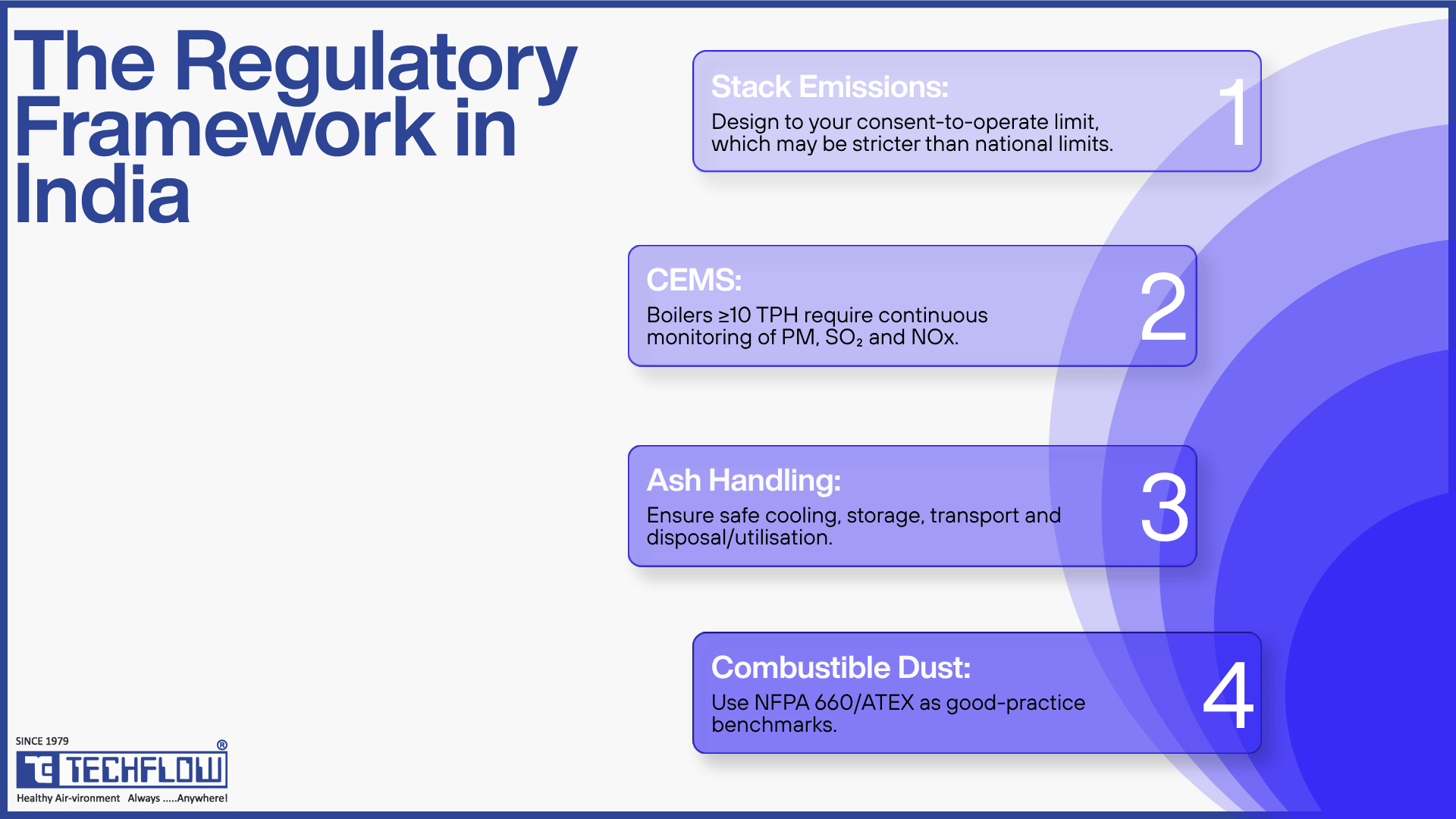
The Environment (Protection) Rules schedule specific particulate matter limits for bagasse-fired boilers by grate type, with 250 mg/Nm³ applicable to step grate boilers and 500 mg/Nm³ (corrected to 12 per cent CO₂) to horseshoe and pulsating grate designs. CPCB's Charter for the sugar sector references a general stack particulate requirement below 150 mg/Nm³, and notes the Ministry of Environment, Forest and Climate Change notification G.S.R. 373(E) dated 16 May 2023 setting 250 mg/Nm³ for agro-based fuel fired in boilers above 10 TPH.
Two practical cautions follow:
- First, state pollution control boards and site-specific environmental clearance conditions frequently stipulate values tighter than the national standard, with 50 mg/Nm³ appearing in recent clearances for new bagasse-fired capacity.
- Second, the Commission for Air Quality Management issued a statutory direction in February 2026 prescribing a uniform particulate standard of 50 mg/Nm³ for identified industries across Delhi and the National Capital Region, based on CPCB recommendations and studies by the Indian Institute of Technology Kanpur.
Always design against the limit written in your consent to operate, not against the headline national figure.
Continuous monitoring
CPCB guidelines require Continuous Emission Monitoring Systems on process stacks for industries including sugar, with boilers of 10 TPH capacity and above covered for particulate matter, sulphur dioxide and oxides of nitrogen. Once CEMS data is transmitted to the regulator in real time, an excursion is no longer a quarterly stack test problem. It is a same-day problem, and it changes how much design margin is worth buying.
Ash and effluent
CPCB's sugar sector charter identifies unscientific ash handling and disposal as a recurring source of public complaint and litigation, with hot ash disposed in open areas without cooling and inadequate record keeping of generation and disposal quantities. Standard operating procedures for cooling, storage, transport and utilisation of boiler ash now form part of what regulators expect to see.
Combustible dust
India has no single combustible dust standard equivalent to NFPA 660. In practice, mills apply NFPA 660 (and, for European customers, the ATEX directives) as the recognised good-practice benchmark, driven by insurer requirements, export customer audits and corporate EHS policy. Occupational dust exposure sits under Factories Act obligations and state factory rules, administered by the relevant Directorate of Industrial Safety and Health.
The Dust Hazard Analysis: Design Input, Not Closing Audit
A Dust Hazard Analysis is a systematic review, carried out by a qualified person, of where combustible dust is generated and accumulates in a facility, what could ignite it, what the consequences would be, and what safeguards are required. Under NFPA 660, it applies to any facility that handles or generates combustible dust, and it is expected to be revalidated on approximately a five-year cycle and after significant equipment or layout change.
The sequencing point is the one most often missed. A DHA completed after collectors have been selected and installed can only produce a retrofit list. A DHA completed before selection determines the following, all of which are expensive to add later:
- Whether a given collector must be vented, suppressed or located outdoors
- Where isolation devices are required and of what type
- Which conveying circuits need spark detection and abort gates
- Which areas require hazardous location electrical classification
- What housekeeping frequency each area needs, area by area
Laboratory testing of your actual dust underpins all of this. Published values for "sugar" are a starting point, not a design basis, because KSt, MEC, minimum ignition energy (MIE) and minimum ignition temperature (MIT) all shift with particle size distribution and moisture content, and a mill's fines are not the same material as a reference sample of granulated sugar.
On the 1/32-inch rule
The widely quoted screening threshold, a dust layer of 1/32 inch (about 0.8 mm) over more than five per cent of a room's floor area, is worth understanding properly rather than repeating.
It originates in NFPA guidance and OSHA's Combustible Dust National Emphasis Program (directive CPL 03-00-008, revised January 2023). The layer depth criterion assumes a nominal bulk density of 75 lb/ft³ (about 1,200 kg/m³), and the allowable depth scales for materials of lower bulk density. OSHA issued a memorandum in April 2015 clarifying that accumulation of 1/32 inch does not by itself justify a citation, and that inspectors must consider both the area of accumulation and the bulk density of the specific dust.
The practical reading for a sugar mill: treat 1/32 inch as a prompt to investigate and to review housekeeping frequency, not as a pass mark to operate up to. The layer that matters most is rarely the one on the floor. It is the one on beams, joists, cable trays, duct exteriors and bin tops, where nobody looks and from where a pressure wave will loft it instantly.
Design Considerations Specific to Sugar Plants
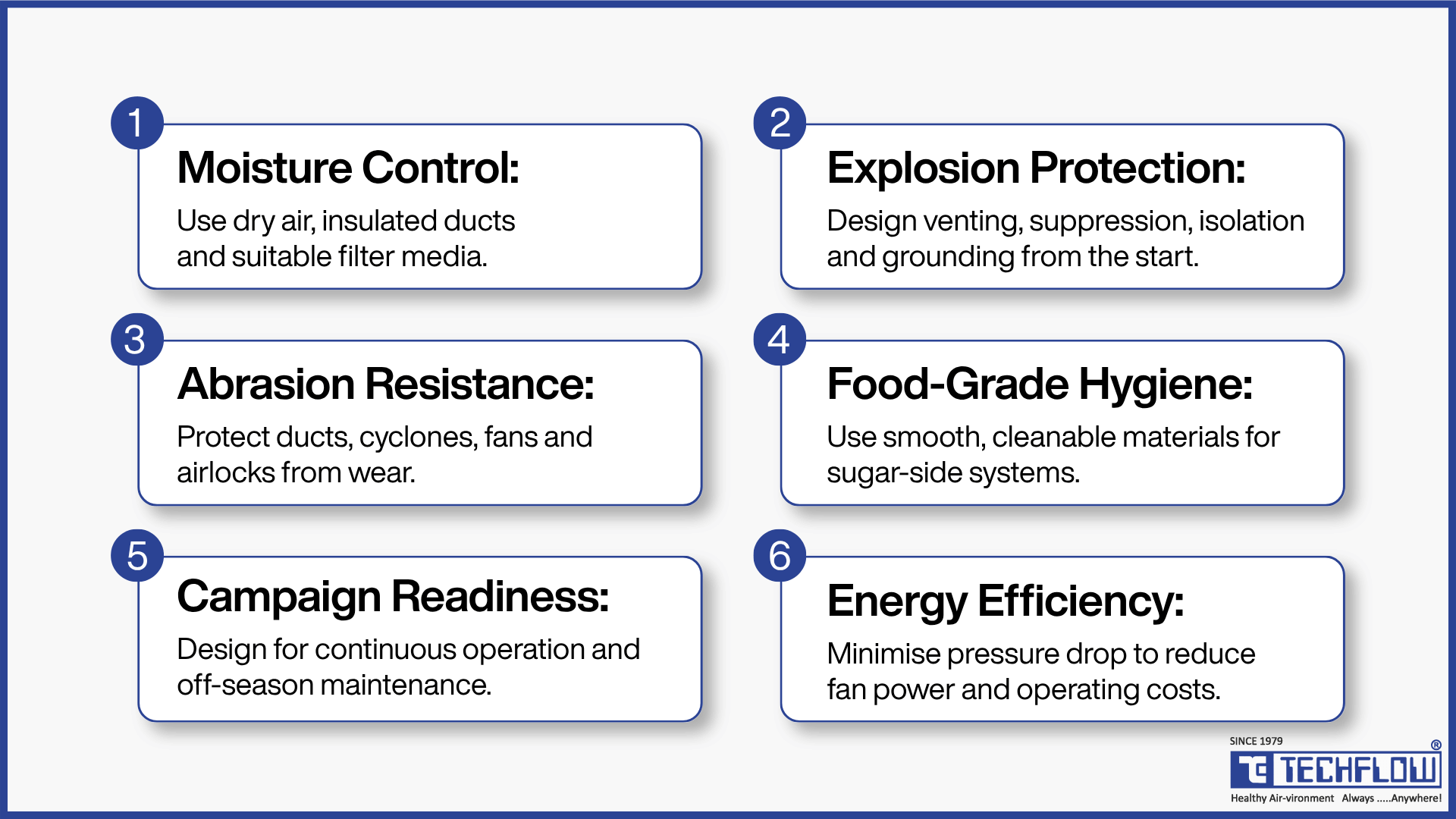
Generic industrial dust collection equipment, dropped into a sugar mill without adaptation, underperforms in predictable ways. Six factors distinguish equipment engineered for the duty.
1. Moisture management: Because sugar dust is hygroscopic, systems in humid conditions or near the evaporation and drying stations need heated or insulated ductwork, dehumidified purge air, or media selected for release under damp cake conditions. Compressed air used for pulse cleaning must be genuinely dry; a failing air dryer will blind a collector faster than any process upset.
2. Explosion protection engineered in, not added on: Deflagration venting per NFPA 68, suppression and isolation per NFPA 69, spark detection and grounding must be part of the ductwork and housing design from the first layout, particularly on drying, grading, silo and pneumatic conveying circuits. Retrofitting isolation into an installed duct run is always more expensive and usually more compromised.
3. Abrasion resistance in the bagasse and ash circuits. Wear liners at cyclone inlets, duct elbows and fan casings, and hardened or replaceable airlock rotor tips, pay for themselves over a few seasons in a circuit handling bagasse fines and fly ash.
4. Food-grade and hygienic construction on the sugar side: Collectors serving crystallisation, drying, grading and packing should use food-contact-appropriate materials with smooth internal surfaces, accessible inspection points and designs that can be cleaned out fully rather than merely blown down.
5. Campaign operation and the maintenance window: Indian mills typically crush for roughly 150 to 210 days, running continuously through the season, with all significant maintenance compressed into the off-season. This has two consequences. Dust collection equipment must be specified for continuous duty across the whole campaign, because there is no convenient mid-season shutdown to change bags. And filter media, wear parts and instrumentation replacement must be planned into the off-season overhaul, not improvised when differential pressure starts climbing in February.
6. Energy cost across a long campaign: Pressure drop is not a specification detail; it is an operating cost. Across a five-month continuous campaign, the difference in ID fan and system fan power between a well-designed low-resistance circuit and an undersized one is a substantial recurring number, and it compounds every season.
Maintenance and Housekeeping
Investigation after investigation reaches the same conclusion: uncontrolled accumulation, not equipment failure, is the dominant root cause of combustible dust incidents. A correctly engineered system still leaves a plant exposed if it is not maintained to a defined schedule.
A complete programme for a sugar mill includes:
- Cleaning frequencies set by measured accumulation rate, area by area. A packing hall and a mill house do not need the same interval, and setting one interval for the whole plant guarantees that one of them is wrong.
- Vacuum removal with appropriately rated industrial vacuum equipment. Compressed air blow-down re-suspends dust into a cloud rather than removing it, and in a combustible dust area that is precisely the condition to avoid.
- Hidden accumulation points inspected on a fixed list. Structural beams, joists, bin tops, cable trays, duct exteriors, elbows, motor housings, elevator boots and the underside of platforms.
- Filter media inspection and replacement driven by differential pressure trend, not by calendar. A rising baseline that will not respond to pulse cleaning indicates blinding, and in a hygroscopic dust that is usually a moisture problem upstream, not a media problem.
- Airlock and rotary valve clearance checks. Worn rotor tips leak air, which degrades the whole collection circuit's pressure balance and quietly reduces capture at every hood on the system.
- Ignition source control as a standing programme. Bearing temperature monitoring on enclosed conveyors and elevators, hot work permitting with dust clean-down beforehand, and verified earthing continuity on conveying circuits.
- Documented DHA review after equipment or layout change, and on the standing revalidation cycle.
- Worker training on what early accumulation looks like and on correct respiratory protection use, because operators see the plant far more often than any auditor.
Common Design Mistakes in Sugar Mill Dust Systems
From assessing installed systems, the same errors recur:
- Sizing on average load rather than peak. Almost always visible at the tippler and the mill house.
- One collector asked to serve incompatible duties. A shared main connecting the mill house and the packing hall is both a filtration problem and a flame propagation path.
- Cyclone treated as a final stage rather than a pre-cleaner. Common on boiler circuits facing a tightening limit, and not correctable by maintenance.
- Explosion protection specified at commissioning rather than at layout. Produces compromised vent locations and isolation that cannot be positioned correctly.
- Ductwork routed for convenience rather than for transport velocity. Long horizontal runs and shallow elbows in a hygroscopic dust build up internally and become the accumulation the system was installed to prevent.
- No provision for return-to-process. Discards saleable product and weakens the internal business case for maintaining the system properly.
- Airlocks omitted or undersized. The cheapest component in the circuit, and the one whose absence most reliably degrades everything upstream of it.
TECHFLOW: Stage-Matched Dust Control Engineering for Sugar Plants
TECHFLOW Enterprises Pvt. Ltd. is an Ahmedabad-based designer and manufacturer of industrial air pollution control and dust collection systems, founded in 1979 by D. K. Parikh and operating today from a purpose-built manufacturing facility at Kubadthal, Ahmedabad, Gujarat.
The relevance to sugar plants is that TECHFLOW manufactures across the full width of the equipment train a sugar mill actually needs, rather than a single product category:
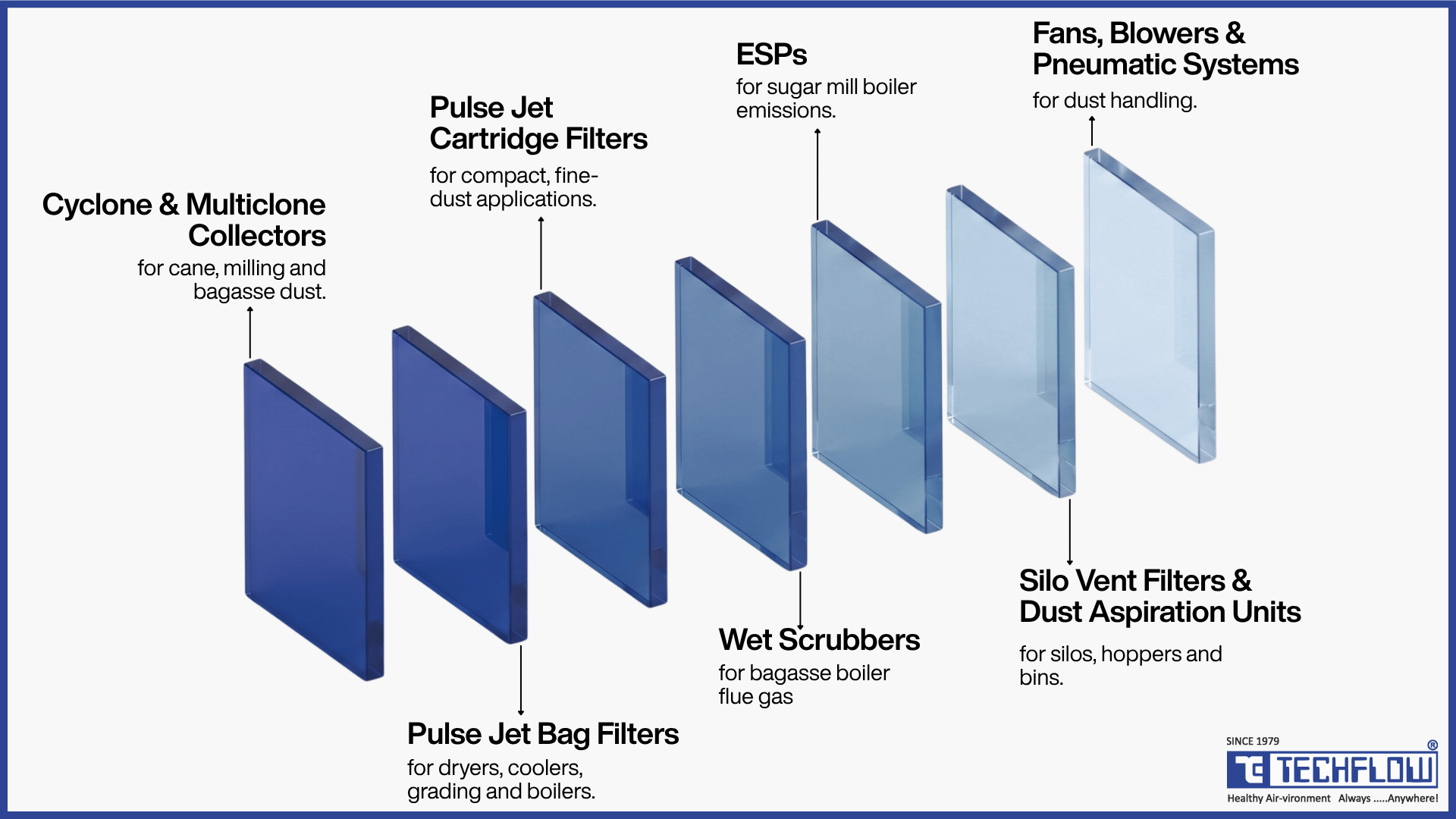
- Cyclone and multiclone dust collectors for cane preparation, milling and bagasse circuits, available in single, twin, quad and modular configurations, and engineered for heavy, fibrous and abrasive particulate.
- Pulse jet bag filters for dryer, cooler, grading and boiler flue gas polishing duty, supplied in online and offline cleaning configurations.
- Pulse jet cartridge filters for packing lines, weighing and mixing points where a compact footprint and fine dry dust efficiency are the governing constraints.
- Wet scrubbers, including venturi and packed bed designs, for bagasse boiler flue gas where moisture and abrasion rule out dry media.
- Electrostatic precipitators engineered specifically for sugar mill boilers, covering stoker-fired, circulating fluidised bed combustion (CFBC) and biomass boiler flue gas, with a design range spanning 20,000 to 600,000 m³/hr and guaranteed emission levels in the 10 to 50 mg/Nm³ band.
- Silo vent filters and dust aspiration units for sugar silos, lime silos, ash silos, dump hoppers and weigh bins, with product return to the vessel.
- Centrifugal fans and blowers and pneumatic conveying systems, including rotary airlock valves, which is what allows a complete circuit to be engineered as one pressure-balanced system rather than assembled from parts.
TECHFLOW's food processing, grain and flour plant practice covers the closely comparable duty of fine, dry, hygroscopic organic dust in a hygienic environment, and its dust collection and air pollution control systems portfolio spans the coarse-fibrous end of the plant through to the fine-crystalline end.
The engineering position is the one this guide has argued throughout. Map the plant stage by stage, characterise the dust each stage actually produces, design the capture and separation train for that dust, and let the Dust Hazard Analysis and the applicable stack limit drive the specification before a collector is selected.
Talk to TECHFLOW About Your Plant
Every sugar mill's dust profile is specific to its cane variety, grate design, crushing capacity, layout and consent conditions. A stage-by-stage assessment, tied to your Dust Hazard Analysis and to the emission limit written in your consent to operate, is the only reliable basis for equipment selection.
TECHFLOW engineers dust collection and air pollution control systems for the full sugar process train, from cane yard cyclones through boiler house ESPs, wet scrubbers and bag filters, to dryer, silo and packing-line filtration, with the fans, pneumatic conveying and airlocks needed to make the circuit work as one system.
Share your process stages, airflow volumes, boiler capacity and target outlet concentration, and TECHFLOW's engineering team will map the equipment train stage by stage.
Explore TECHFLOW dust collection and air pollution control systems
Frequently Asked Questions (FAQs)
Sugar dust explosions almost always follow a two-stage sequence. A small primary event, such as an overheated bearing, a spark or a static discharge, ignites a dust cloud inside a confined space such as an enclosed conveyor or an elevator casing. The pressure wave from that primary event lofts dust that has settled on beams, ledges, ducts and equipment, creating a much larger cloud that ignites in turn. The 2008 Imperial Sugar refinery explosion at Port Wentworth is the definitive documented case: the U.S. Chemical Safety Board concluded that the primary explosion occurred inside a recently enclosed steel belt conveyor beneath the sugar silos, most likely ignited by an overheated bearing, and that the resulting secondary explosions through the packing buildings caused the 14 fatalities.
Centrifuging, drying, cooling and grading. Sugar leaves the centrifugals at roughly 0.1 to 0.4 per cent moisture and is dried to around 0.04 per cent for safe storage, making it the driest and finest material in the plant. Screening at the grader liberates fines continuously, and the elevators, conveyors and silos downstream keep that material suspended and moving. This zone should receive the most rigorous explosion protection, including deflagration venting or suppression, flame isolation, spark detection and full earthing of conveying circuits.
Bulk sugar is not the hazard. Finely divided sugar dispersed in air above its minimum explosible concentration, inside a confined volume, with an ignition source present, is. OSHA's combustible dust guidance places sugar in explosion class St 1, meaning a deflagration index above 0 and up to 200 bar·m/s. St 1 is described as a weak explosion class, which has proved misleading in practice: the material that destroyed the Port Wentworth packing buildings and killed 14 workers sat in that class. Explosion severity determines how much protection is needed; it does not determine whether protection is needed.
A Dust Hazard Analysis is a systematic review by a qualified person of where combustible dust is generated and accumulates, what could ignite it, what the consequences would be, and what safeguards are required. It is required under NFPA 660 for any facility that handles or generates combustible dust, and it should be revalidated on approximately a five-year cycle and after significant equipment or layout changes. In India, NFPA 660 is not a statutory instrument in itself, but it is routinely applied as the recognised benchmark through insurer conditions, export customer audits and corporate safety policy.
No. NFPA 61 was consolidated into NFPA 660, Standard for Combustible Dusts and Particulate Solids, effective 6 December 2024, along with NFPA 484, 652, 654, 655 and 664. The agricultural and food processing content that was NFPA 61 now sits in Chapter 21 of NFPA 660, with universal fundamentals including the Dust Hazard Analysis requirement in Chapters 1 to 10. Documents or analyses still citing NFPA 61 or NFPA 652 by number should be reconciled to the new chapter structure rather than simply relabelled.
The Environment (Protection) Rules schedule particulate limits for bagasse-fired boilers by grate type, with 250 mg/Nm³ for step grate boilers and 500 mg/Nm³ (at 12 per cent CO₂) for horseshoe and pulsating grate designs. CPCB's sugar sector charter references a general stack requirement below 150 mg/Nm³ and cites the Ministry of Environment, Forest and Climate Change notification G.S.R. 373(E) dated 16 May 2023 setting 250 mg/Nm³ for agro-based fuel in boilers above 10 TPH. Because state boards and environmental clearance conditions frequently stipulate tighter values, and because the Commission for Air Quality Management has prescribed 50 mg/Nm³ for identified industries in Delhi and the National Capital Region, the operative number is always the one in your consent to operate.
Yes, above the applicable capacity threshold. CPCB guidelines require Continuous Emission Monitoring Systems on process stacks for listed industries including sugar, covering boilers of 10 TPH and above for particulate matter, sulphur dioxide and oxides of nitrogen, with data transmitted to the regulator. The design implication is that emission performance is visible continuously rather than at a quarterly stack test, which materially raises the value of design margin and of a maintenance regime that holds outlet concentration stable across a full campaign.
Cyclone or multiclone separators are the standard first stage for bagasse handling, because the material is coarse, fibrous and abrasive and would rapidly damage or blind filter media. For boiler flue gas, the mechanical stage must be followed by a polishing stage. Wet scrubbers, including venturi and packed bed types, suit the moist abrasive ash typical of bagasse firing. Electrostatic precipitators and pulse jet bag filters are used where outlet limits are tighter, with ESPs favoured for low pressure drop and high gas volume and bag filters for lower capital cost and fine-particulate performance. A cyclone alone will not meet a modern fine-particulate limit.
Because the material changes character four times across the process. Cane trash is coarse, light and fibrous. Mill house dust is moist and prone to blinding filter media. Boiler fly ash is fine and abrasive. Lime dust is alkaline. Sugar fines are dry, fine, hygroscopic and explosive. A cyclone optimised for coarse abrasive material passes fine dust almost untouched, and a cartridge filter optimised for fine dust is damaged by coarse abrasive particulate. A shared main between incompatible areas also creates a flame propagation path between them, which is a safety objection on top of the filtration one.
Sugar is hygroscopic, so it absorbs ambient moisture readily. Inside a collector, that turns filter cake tacky rather than friable, so pulse cleaning stops releasing it, differential pressure climbs, and the media eventually blinds. Inside ductwork, it causes build-up on elbows and horizontal runs, reducing transport velocity. Systems operating in humid conditions or near the evaporation and drying stations need heated or insulated ductwork, genuinely dry compressed air for pulse cleaning, and media selected for release under damp cake conditions.
Yes, and it is standard practice in well-designed plants. Fines captured at the dryer, cooler, grader, and bagging line are saleable product, and return-to-process filtration reintroduces them into the product stream rather than sending them to waste. Silo vent filters similarly return captured fines to the stored product. Recovered yield is usually the single largest line item in the commercial case for a properly engineered sugar dust collection system.
Crushing one tonne of sugarcane yields roughly 280 to 300 kg of wet bagasse at around 50 per cent moisture, which is why bagasse handling is the highest-volume internal materials movement in the plant and one of its largest fugitive dust sources. Combustion then produces boiler ash at approximately 1.5 to 2 per cent of the bagasse fired, according to CPCB's sugar sector charter, creating a second handling and disposal dust stream that is frequently under-engineered and is a recurring source of public complaint where hot ash is discharged into open areas without prior cooling.