


Key Takeaways
- Welding fume is a confirmed human carcinogen. In 2017, the International Agency for Research on Cancer (IARC) moved welding fume from Group 2B ("possibly carcinogenic") up to Group 1, "carcinogenic to humans", the same evidence tier as asbestos and tobacco smoke.
- Each of the three processes needs its own capture method. Welding suits close-proximity source capture, cutting suits downdraft or machine-integrated extraction, and grinding suits shroud or on-tool capture. Treating the three as interchangeable is where most systems underperform.
- Legal compliance and real protection are different numbers. The ACGIH health-based limit for respirable manganese is roughly 250 times stricter than OSHA's legal ceiling, so a shop can pass an inspection while still running exposures well above what industrial hygienists consider protective.
- Grinding carries a hazard of its own. Respirable crystalline silica, released whenever grinding or cutting meets concrete, stone, or mineral-coated steel, sits under a dedicated standard with an exposure limit far below what is visible to the eye.
- Cutting fume behaves differently by process. Plasma and laser cutting concentrate ultrafine particulate along a narrow, moving cut, which is why most computer numerical control (CNC) cutting tables extract downward through the bed rather than relying on room air.
- Source capture wins on physics. The airflow needed to hold a given capture velocity rises roughly with the square of the distance from the hood, so an arm a few inches from the arc needs a fraction of the airflow a distant overhead hood requires for the same protection.
- Equipment performance is independently testable. The EN ISO 21904 series defines how extraction hardware is tested and marked, including a top filtration class of 99% or better for equipment whose cleaned air is returned to the workspace.
Every spark, arc and grinding wheel leaves a signature in the air above it: a cloud of metal, gas and mineral particles fine enough to slip past the body's natural defences and settle deep in the lung. For a long time that cloud was treated as an unavoidable cost of metalwork. The science no longer allows that reading, and the practical lesson has changed too. Welding, cutting and grinding each produce their contaminant differently, so a single extraction approach cannot serve all three well.
This guide explains why fume control belongs at the centre of a fabrication shop, then gets specific about the mechanics of doing it properly: the capture methods, filtration and positioning that actually work for welding, for cutting and for grinding, along with the exposure limits and equipment standards that define what "adequate" means.
Why Fume Extraction Sits At The Centre Of A Modern Fabrication Shop
Metalworking produces two things at once: the part on the bench and the plume above it. That plume is not ordinary smoke. It is a mixture of ultrafine metal-oxide particles, many below one micron across, suspended alongside gases such as ozone, nitrogen oxides and carbon monoxide, all generated by a process hot enough to vaporise metal and re-condense it into solid particulate within milliseconds. Because the particles are so small, they do not settle the way sawdust or grit does. They stay airborne, drift on the room's currents, and travel straight into the deepest part of the lung, where the body has the least ability to clear them.
This is why fume management is not a housekeeping task, and equally why it cannot be treated as one hazard with one fix. Welding, cutting and grinding release their contaminant at different heights, in different concentrations and in different directions relative to the worker. The equipment built for each looks different for that reason.
What Is Actually In The Fume, And Why One Solution Cannot Cover Three Processes
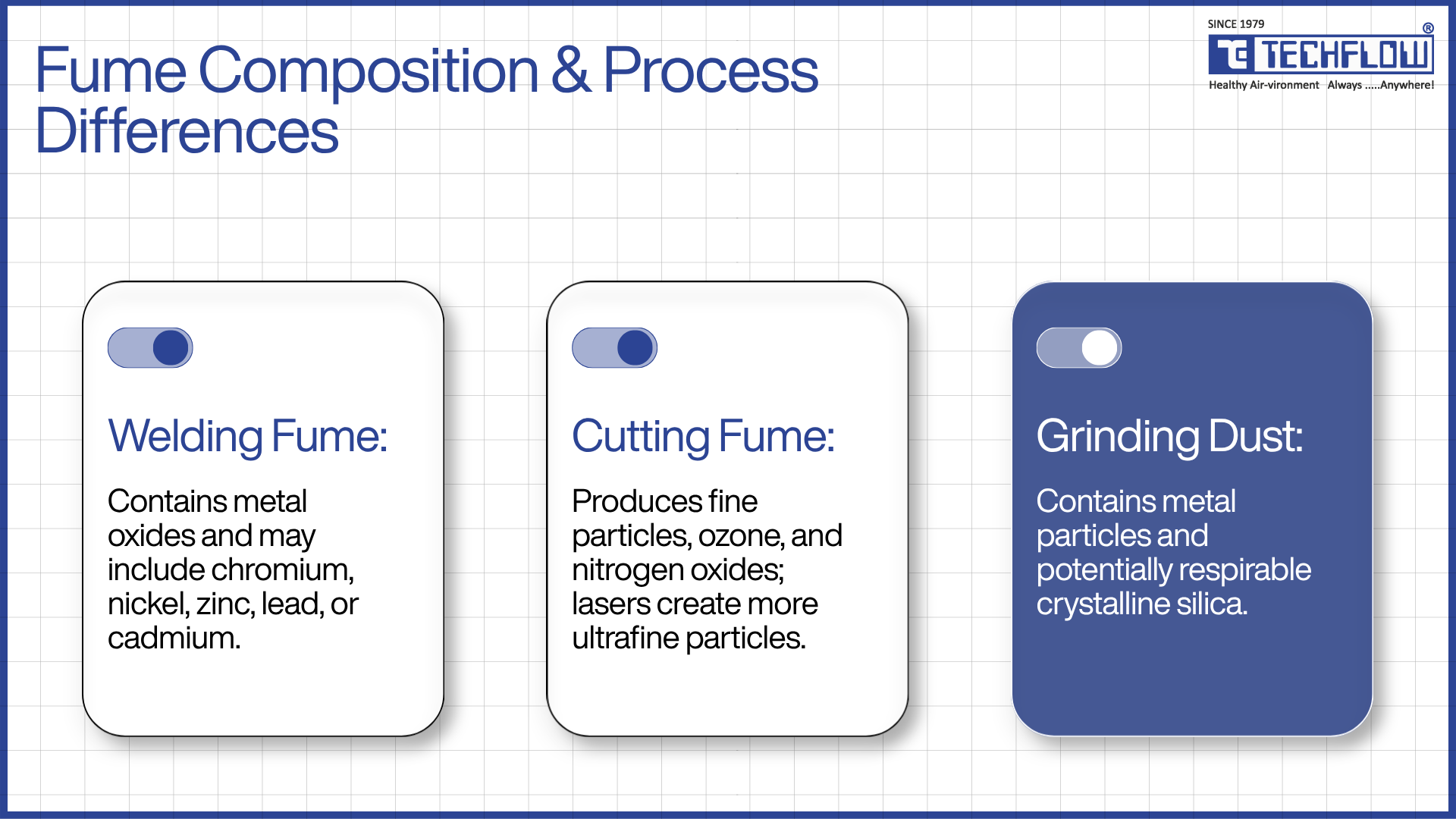
No two processes produce the same cloud, and treating "fume" as a single generic hazard is the quickest route to an under-engineered system.
Welding fume:
Welding fume depends on the base metal, the filler wire or electrode, any coating on the workpiece, and the shielding gas. Welding mild steel by metal inert gas (MIG, also called gas metal arc welding or GMAW), stick (shielded metal arc welding, SMAW) or flux-cored methods produces fume dominated by iron oxide and manganese. Even fume that contains no carcinogenic metal at all has been shown to promote lung tumours: a National Institute for Occupational Safety and Health inhalation study found that iron-rich mild-steel GMAW fume drove lung tumours in mice, aligning with epidemiology that puts mild-steel welders, despite lower carcinogenic-metal exposure, at raised lung-cancer risk. Welding stainless steel adds hexavalent chromium and nickel, both separately regulated carcinogens. Coated and plated metals add whatever sits on the surface: zinc from galvanising, lead or chromate from primers, cadmium from plated joints, each with its own ventilation trigger.
Cutting fume:
Cutting fume concentrates differently by process. Plasma cutting generates very fine particulate along with ozone and nitrogen oxides from the high-temperature arc, tightly along the cut line. Laser cutting produces an even higher share of ultrafine, sub-micron particles, plus whatever comes off coatings, oils, or coolant residue. Oxy-fuel cutting on coated or alloyed steel is specifically flagged in the welding standard, which requires mechanical ventilation when cutting uses a chemical flux, iron powder, or shielded-arc methods on stainless steel.
Grinding dust:
Grinding dust carries metal grinding particulate and, wherever grinding meets concrete, stone, or mineral-coated steel, respirable crystalline silica: particles fine enough to remain invisible under normal shop lighting and to reach deep into the lung. Grinding also throws larger manganese particles than welding does, which is why ACGIH sets a separate, higher limit for that coarser inhalable fraction.
Welding Fume Extraction: Methods That Hold Up At The Arc
Most extraction hardware is designed around welding, so it pays to be precise about what performs at the arc.
- Fume extraction arms are the default for manual MIG, stick, and tungsten inert gas (TIG, or gas tungsten arc welding) work. An articulated arm is positioned close to the arc, angled roughly 45 degrees above it and about one and a half duct diameters away. Positioning decides everything: an arm rated for high airflow but aimed poorly delivers a fraction of its capture velocity, while a smaller arm placed correctly can outperform it.
- On-torch extraction guns build a capture nozzle directly around the contact tip of the MIG gun, pulling fume away at the source without the welder repositioning a separate arm. This is the practical answer for high-repetition production welding, at the cost of a heavier torch.
- Robotic and semi-automated cells integrate extraction into the cell enclosure or torch mount, since there is no operator to reposition an arm and the weld path is fixed and repeatable.
- Mobile extraction units suit confined-space and field welding where a fixed arm or central duct is impractical. A unit connected by flexible hose keeps source capture available even where the station itself moves from job to job.
Cutting Fume Extraction: Methods Built Around The Cut, Not The Operator
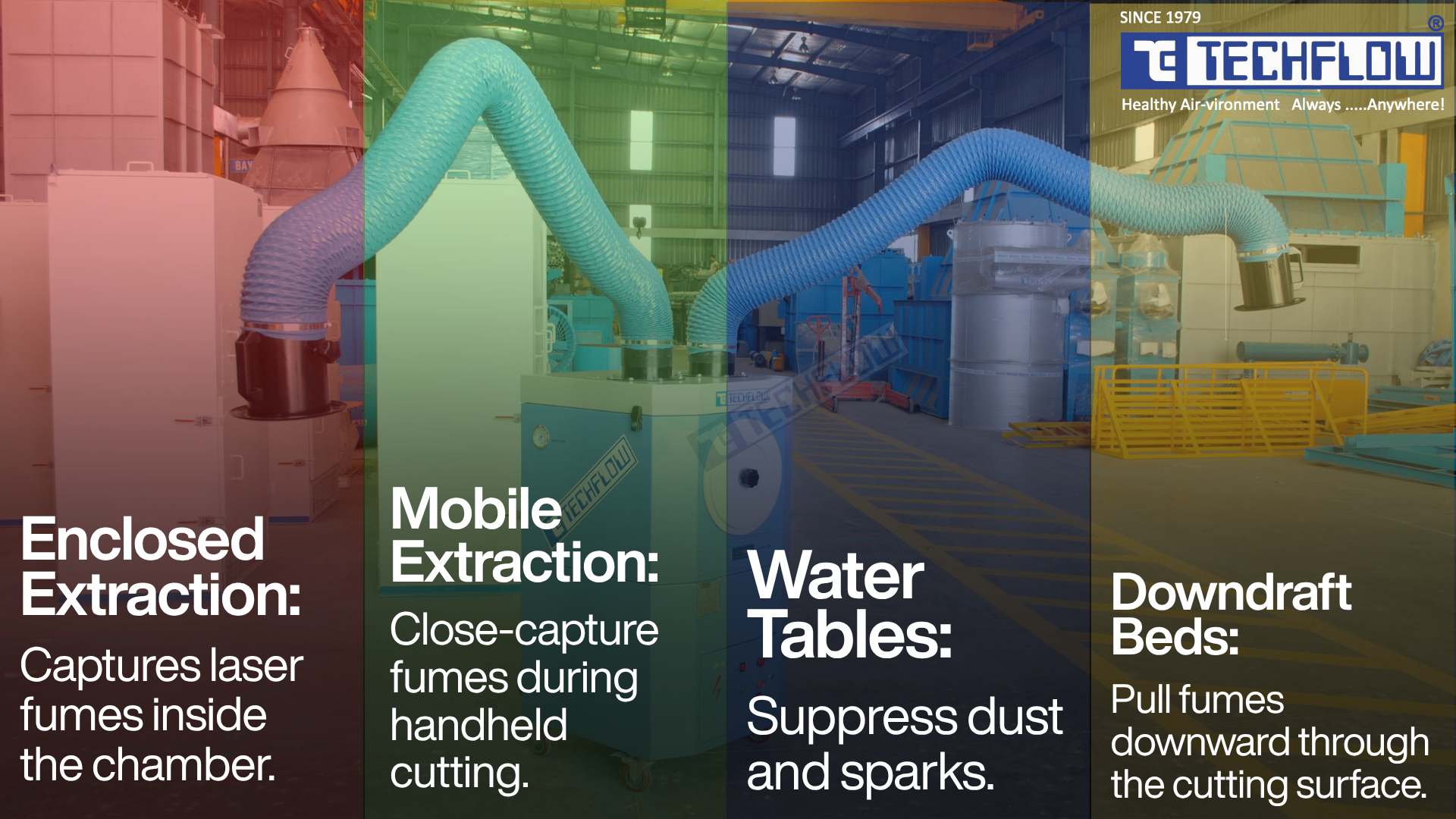
Cutting fume differs from welding fume in one decisive way. It is usually generated along a moving line rather than a fixed point, so extraction is built around the table or the cutting head rather than a hovering arm.
Downdraft cutting beds are the standard for CNC plasma and laser tables. The cutting surface is a perforated or slatted grid over a plenum, and contaminated air is drawn straight down through the material as it is cut, away from the operator. Because the cut travels across the table, extracting beneath the whole working area solves the positioning problem by design.
Water tables are sometimes fitted beneath a plasma bed as a secondary control, suppressing fine particulate and quenching sparks, though they do not replace mechanical extraction for fume that does become airborne.
Mobile extraction for handheld cutting relies on the same close-proximity principle as welding: where no table system exists, a mobile arm or portable extractor is positioned near the cut and repositioned frequently as it moves along the workpiece.
Enclosure-integrated extraction is typical of laser machines, which draw air continuously from inside a fully enclosed cutting chamber, with filtration built for the unusually high share of sub-micron particulate that laser cutting produces.
Grinding Dust Extraction: Capturing What Falls, Not What Rises
Grinding extraction depends heavily on whether the tool is handheld or fixed, because the dust source moves with the tool.
- Shroud-based, on-tool extraction fits a dust shroud around the wheel of a handheld angle grinder, connected by a hose to a portable or central vacuum, capturing dust at the point of contact before it becomes airborne. This is grinding's equivalent of a fume arm, and it consistently outperforms overhead systems for heavy weld dressing and deburring, because grinding dust is heavier than welding fume and falls rather than rises.
- Integrated hoods on bench and pedestal grinders are built into the tool rest or wheel guard and ducted to a dust collector, effective because the grinding point is fixed at the wheel.
- Downdraft tables are the standard for smaller parts worked on a bench, drawing air down through a perforated top, which works with gravity for both metal dust and heavier respirable silica.
- Rear-mounted hoods suit buffing and polishing, catching material thrown off the back of the wheel, where the debris profile differs from straight grinding dust.
- Combination extraction for cut-off saws pairs a downdraft or rear hood at the station with a blade shroud where the saw design allows, since chop saws throw both airborne dust and heavier particulate that an overhead system alone will miss.
The Health Case, With The Numbers That Matter
In 2017, the International Agency for Research on Cancer reclassified welding fume as a Group 1 carcinogen, its highest evidence category, drawing on pooled epidemiology covering an estimated 110 million workers worldwide who incur welding-related exposures. The working group's meta-analysis found a relative risk for lung cancer of about 1.43, an increase of roughly 40%, and the effect held after adjusting for smoking and asbestos, the two factors most likely to explain such a result. Ultraviolet radiation from welding was classified as Group 1 in the same review, linked to ocular melanoma, and positive associations were noted with kidney cancer.
The gap between legal compliance and real protection is widest with manganese. The Occupational Safety and Health Administration (OSHA) keeps a ceiling of 5 mg/m3, a figure dating to a 1970s-era table set to prevent acute respiratory irritation, not neurological harm. The American Conference of Governmental Industrial Hygienists (ACGIH) cut its own respirable manganese limit tenfold in 2013, to 0.02 mg/m3 for the respirable fraction and 0.1 mg/m3 for the inhalable fraction, tied to evidence linking manganese to Parkinsonism-like neurological damage. A shop can be fully compliant on paper while running manganese exposures many times above what industrial hygienists now consider protective.
Where grinding or cutting meets silica-bearing material, chronic exposure is linked to silicosis, chronic bronchitis, emphysema, lung cancer, and kidney disease. Those effects are irreversible, and silicosis is incurable.
Exposure limits at a glance
| Contaminant | Typical source process | OSHA permissible exposure limit (legal) | ACGIH threshold limit value (health-based) |
|---|---|---|---|
| Iron oxide fume | Mild steel welding | 10 mg/m3, 8-hour TWA | 5 mg/m3 (respirable) |
| Manganese, respirable | Mild and stainless welding | 5 mg/m3, ceiling | 0.02 mg/m3 |
| Manganese, inhalable | Grinding of steel | Covered by the 5 mg/m3 ceiling | 0.1 mg/m3 |
| Hexavalent chromium | Stainless welding and cutting | 5 µg/m3, 8-hour TWA (action level 2.5 µg/m3) | Substantially lower; set by compound form |
| Nickel | Stainless and nickel-alloy welding | 1 mg/m3, 8-hour TWA | Lower; varies by compound form |
| Zinc oxide fume | Galvanised steel work | 5 mg/m3, 8-hour TWA | Lower (health-based) |
| Respirable crystalline silica | Grinding or cutting silica-bearing material | 50 µg/m3, 8-hour TWA (action level 25 µg/m3) | Lower (health-based) |
TWA denotes time-weighted average. The OSHA column lists the legally enforceable United States limits. ACGIH and the National Institute for Occupational Safety and Health generally publish stricter, health-based limits, several of which vary by chemical form. Only the iron-oxide and manganese health-based figures are shown, as the ones most relevant to the compliance-versus-protection gap.
The Regulatory Framework You Are Building Toward
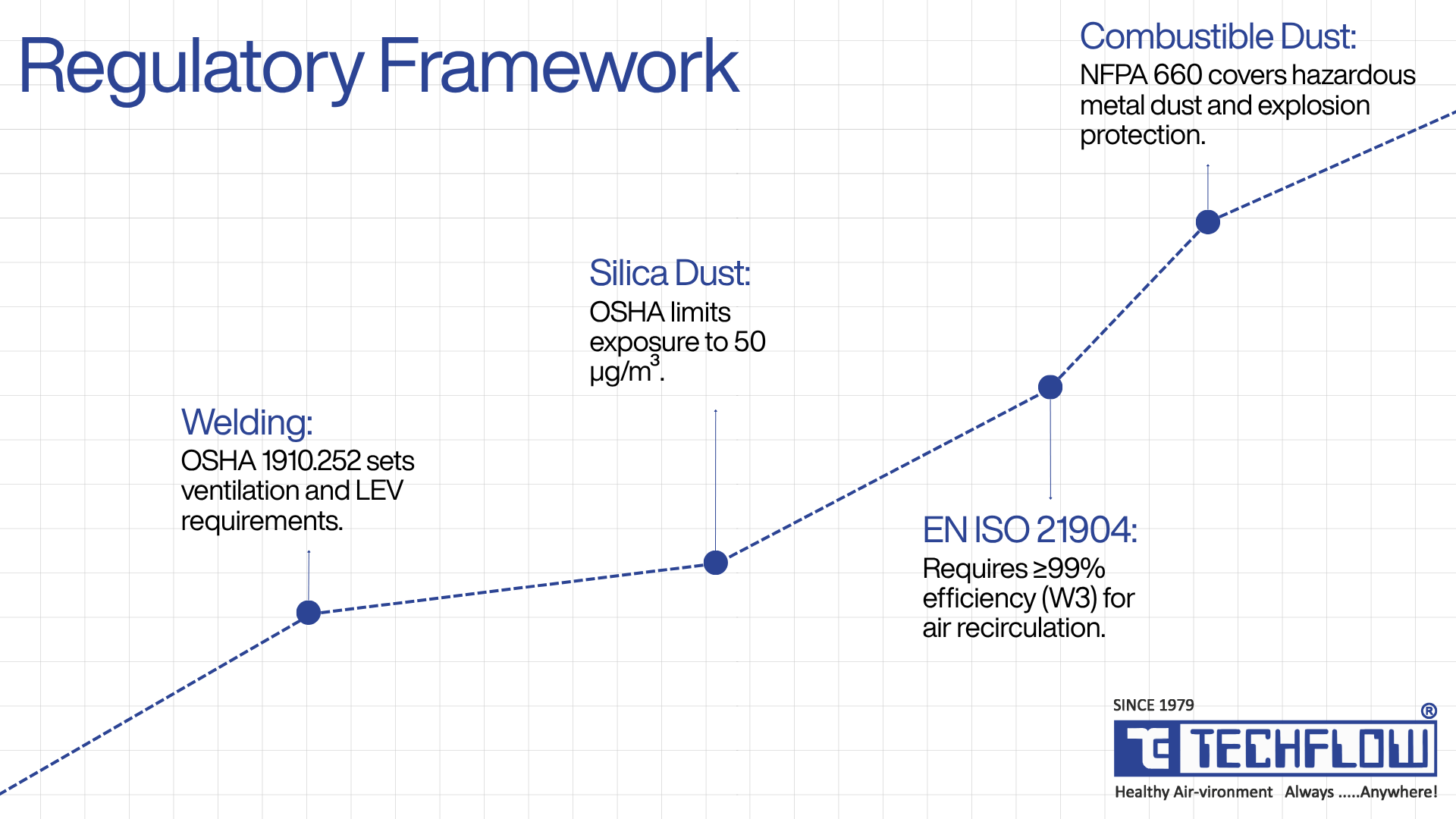
Fume control does not sit under a single rule. Three separate strands matter, and they apply to different parts of the shop.
Welding: OSHA 1910.252 and its triggers
OSHA's core welding standard, 29 CFR 1910.252, requires mechanical ventilation for confined-space welding, for welding on hazardous coatings, and for any workspace of less than roughly 10,000 cubic feet per welder or with a ceiling under 16 feet. Where general ventilation is used, the practical benchmark is around 2,000 cubic feet per minute (CFM) per welder. Where local exhaust ventilation (LEV) is used instead, the aim is roughly 100 feet per minute (fpm) of capture velocity at the point of welding, high enough to draw fume in but not so high that it disturbs the shielding gas. Construction work falls under a parallel set, 29 CFR 1926.350 through 1926.354.
Grinding and cutting: the silica standard
Respirable crystalline silica has its own rule. OSHA's construction silica standard, 29 CFR 1926.1153, and the matching general-industry standard, 29 CFR 1910.1053, both set an 8-hour permissible exposure limit of 50 µg/m3 and an action level of 25 µg/m3, roughly half the limit they replaced. The 2016 final rule in the Federal Register built an entire compliance apparatus around that figure. Employers either follow the prescribed controls listed for specified tasks in the standard's Table 1, or measure exposure directly and keep it under the limit. Exposure at or above the action level triggers monitoring and medical surveillance.
Equipment standards: EN ISO 21904 and the W3 (99%) class
Internationally, the EN ISO 21904 series (Parts 1 to 4, issued in 2020) is the reference for how extraction hardware itself is designed, tested, and marked. It sets out general design requirements, filtration-efficiency testing, on-torch capture testing, and the method for calculating minimum hood airflow.
The most important provision for buyers: cleaned air may be returned to the workspace only when the separation efficiency is tested at 99% or better, the level marked W3. The same standard has recently been adopted in Australia and New Zealand as the AS/NZS ISO 21904 series, and it also underpins the positioning rule used throughout this guide, since the suction field of a capture hood should extend at least one and a half duct diameters in one direction, which is where the "1.5 duct diameters" arm guidance comes from. No unit reaches 100% capture, because that would mean drawing in the shielding gas and every stray spark, so extraction is designed to reduce the hazard, not erase the plume.
Combustible metal dust: NFPA 660 (formerly NFPA 484 and 654)
Fine dust from grinding aluminium, magnesium or titanium is a fire and explosion hazard in its own right, distinct from any toxicity. In the United States, this falls under the National Fire Protection Association (NFPA) combustible-dust standards. The former NFPA 484 (combustible metals) and NFPA 654 (combustible particulate solids) have now been consolidated into NFPA 660, the single combustible-dust standard. Filtration handling aluminium, magnesium or titanium dust needs to be rated for combustible-dust service, which usually means wet collection rather than a dry collector, together with deflagration protection on the equipment and ductwork.
The Hierarchy Of Controls, Applied To Fume
Fume management follows four tiers, in order of preference.
Elimination or substitution comes first because it reduces fume at source rather than managing it afterwards. A lower-manganese filler wire or a different shielding gas cuts what is generated in the first place, which makes every downstream control cheaper and easier.
Engineering controls carry most of the protective weight in practice, because they do not depend on a worker remembering to do something correctly each shift. This is where the process-specific methods above- the arms, on-torch systems, downdraft beds, and shrouds- do their job.
Administrative controls include job rotation, scheduling high-fume tasks for lower-occupancy periods, and training workers to stand so that airflow carries fume away from them rather than through them. These cost little and reduce exposure meaningfully.
Personal protective equipment (PPE) sits last, not first. Respirators fail silently on a poor seal or an expired cartridge, so PPE belongs as a backstop for what extraction cannot reach, not as a substitute for it.
Why Proximity Beats Volume: The Physics Of Capture
The airflow required to hold a given capture velocity rises roughly with the square of the distance from the extraction point, so doubling that distance can demand close to four times the airflow to maintain the same protection. That is why an arm positioned inches from an arc can deliver a strong capture velocity on only a few hundred CFM, while a canopy hood several feet up often needs well over a thousand CFM for a fraction of the velocity at the arc.
Distant extraction carries a second problem. An overhead hood pulls fumes up through the very space where the worker is standing, so some exposure happens before capture. Ambient and dilution systems still have a place, because large or constantly moving workpieces sometimes leave no fixed point to capture from, but they are a compromise dictated by geometry, not a first choice. Cross-draughts from open doors or nearby fans disrupt any distance-dependent system, which is why door placement and shop layout are part of extraction design rather than an afterthought.
Filtration: What Happens After Capture
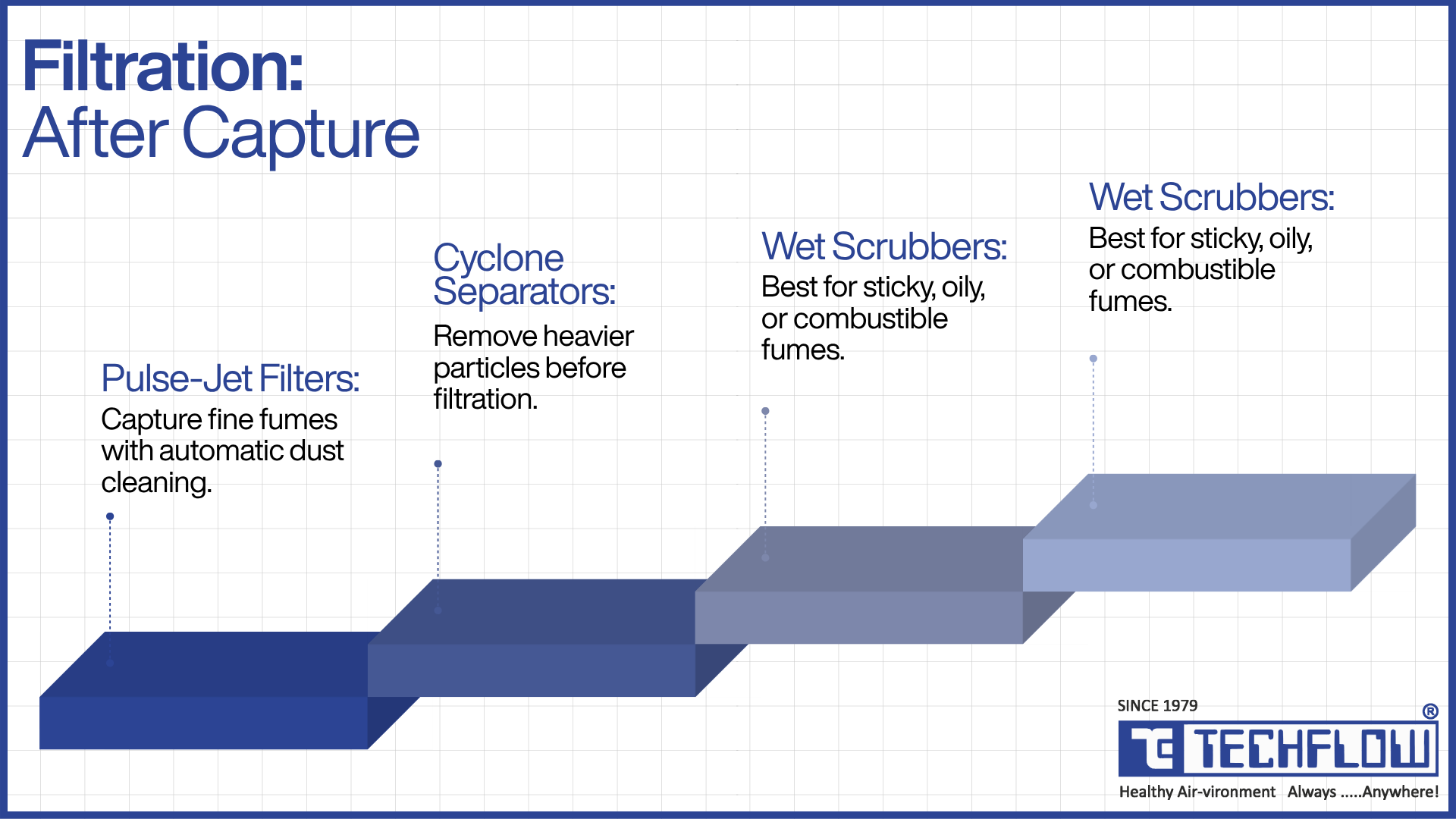
Capturing fume solves only half the problem. The extracted air still has to be cleaned, and the technology chosen affects efficiency, running cost, and how well it handles a specific contaminant.
- Pulse-jet cartridge filters are standard across welding, cutting, and grinding. Pleated cartridges trap particulates, and periodic reverse-air pulses knock the accumulated dust cake into a hopper, keeping efficiency steady without manual downtime. Their compact media area suits fine, dry fumes such as weld smoke, laser-cutting fume, and grinding dust, capturing down to around 0.3 micron at efficiencies above 99%.
- Cyclone separators spin out heavier particles by centrifugal force ahead of finer filtration, a valuable pre-cleaning stage that extends the life of grinding-dust cartridges considerably.
- Wet scrubbers route air through a water or chemical spray, the right choice where fume is sticky, oily, or potentially combustible in dry media.
- Electrostatic precipitators (ESPs) charge particles and collect them on oppositely charged plates for very high efficiency on ultrafine particulate. ESPs are applied mainly to high-volume furnace streams and, increasingly, to fine laser-cutting fume.
Two points are worth checking directly rather than assuming. First, the combustible-metal-dust rule above means filtration handling aluminium, magnesium or titanium must be rated for combustible-dust service. Second, under the EN ISO 21904 series, only equipment tested at the top 99% (W3) class should return cleaned air to the workspace, because anything less sends a measurable fraction of contaminant back into the room.
Sizing And Selecting The Right System
Most underperforming systems fail at specification, not at hardware. Start by mapping each station by its actual process: MIG against stainless, TIG against stick, rather than a generic "welding" label, then match the capture method accordingly: an arm for manual welding, a downdraft bed for a cutting table, a shroud for handheld grinding. Airflow follows from there, and because capture velocity falls off with distance, it pays to design the fixture layout around keeping capture points close rather than compensating with more air later. More airflow is not free, since a larger fan draws more power and a poorly matched system carries a permanent energy penalty for the life of the plant.
Whether to centralise is a separate call. A handful of fixed, high-fume stations suit dedicated arms or a small central unit. A larger plant with many permanent stations benefits from one centralised ducted system, since a single well-sized filter costs less to maintain over time despite the higher upfront ductwork. Sites where the work location changes, such as contract fabrication and shipbuilding, are usually better served by mobile units.
A short list of questions separates a capable supplier from a box-shifter.
- Has the supplier assessed the actual process and contaminant at each station, or quoted from a generic template?
- Can they size capture equipment against real distance and airflow calculations rather than a nominal CFM figure?
- Do they supply the full filtration stack in-house, so the technology is matched to the fume?
- And can they show how the system holds performance over time, through pressure-based filter maintenance and correct duct velocity?
Finally, design toward the health-based ACGIH benchmark, not only the legal minimum, wherever the two diverge meaningfully. The manganese gap is the clearest example. It costs little at the design stage and avoids a retrofit later.
Installation, Positioning And Maintenance
Positioning decides whether rated performance is actually delivered. An arm needs to sit at roughly 45 degrees, above the arc and about one and a half duct diameters away; a high-airflow arm aimed wrong still under-protects the welder. The same applies to grinding shrouds, where a shroud not fully engaged against the workpiece loses most of its effectiveness even with the vacuum running.
Room airflow matters as much as the hardware. Cross-draughts from doors, fans or foot traffic can pull fume out of a hood's capture zone, so workers should stand where airflow reaches them from behind, not from the side. Filters are best maintained against pressure-drop readings rather than a fixed date, since dust load varies with production volume.
Ducting needs a minimum transport velocity, typically 3,500 to 4,500 fpm for metal dust, to keep particulate moving instead of settling and gradually restricting flow, a common and easily missed cause of a correctly sized system quietly losing performance. Any change to the layout should trigger a re-check of airflow, because a station validated once at commissioning may no longer be adequate after a partition or a new machine alters the local air currents.
How TECHFLOW Engineers Welding, Cutting And Grinding Fume Extraction
TECHFLOW is an air pollution control and fume extraction manufacturer that has been in operation since 1979, based in Ahmedabad, Gujarat, with installations across India and internationally. Rather than reselling a single product line, the company designs, manufactures, installs and commissions the full range that fume control requires: extraction and fume filtration systems, pulse-jet cartridge and bag filters, cyclones, wet scrubbers, electrostatic precipitators, centrifugal fans and blowers, and the connecting ductwork.
That range maps directly onto the process-specific methods above. For welding, TECHFLOW builds mobile units, including the Tuff® Clean Weld range, alongside centralised cartridge-filtered systems that feed multiple permanent stations from a single filter. For cutting, it builds systems sized for the higher ultrafine-particulate loads that laser and plasma processes generate. For plants that also run furnaces, primary and secondary furnace fume extraction is kept as a separate filtration stream from fabrication fume, since furnace fume runs hotter and at far higher volume.
The choice between centralised and decentralised architecture follows the same source-count and layout logic set out in this guide. Fabricators who want the underlying selection framework in more depth can read TECHFLOW's guide to industrial fume extraction system types and standards, and those weighing pre-cleaning and dust-collection options may find the notes on selecting de-dusting systems useful.
A Compliance-Minded Checklist
- Has every station been assessed by its actual process, not a generic "fume" label?
- Does welding ventilation meet the confined-space, coating and room-volume triggers of OSHA 1910.252?
- Do cutting tables use integrated downdraft or enclosure extraction rather than room ventilation alone?
- Does handheld grinding use on-tool shroud extraction, not only overhead capture?
- Is silica-generating dust tracked against the 25 µg/m3 action level and the 50 µg/m3 limit?
- Is filtration tested at 99% (W3) efficiency or better wherever cleaned air is recirculated?
- Is duct velocity kept above the transport threshold for metal dust?
- Is filter maintenance tied to pressure readings rather than the calendar?
- Is any aluminium, magnesium or titanium dust handled under combustible-dust rules?
The Bottom Line For Fabrication Shops
Welding, cutting and grinding each generate their contaminant differently, and each has a proven capture method built around that difference: close-proximity arms for welding's fixed-point plume, downdraft beds for cutting's moving line, and shroud extraction for grinding's heavier, falling dust. Behind all three sits a health and regulatory picture that is no longer ambiguous. Welding fume is a confirmed carcinogen, manganese exposure carries a risk the legal minimum does not fully cover, and grinding dust brings its own silicosis risk under a dedicated standard. Matching the extraction method to the specific process, rather than applying one system to all three, is what actually protects the people doing the work, and it is the approach TECHFLOW has engineered around since 1979.
Talk To TECHFLOW About Your Shop
If your shop runs welding, cutting, or grinding, or all three, the fastest route to a system that actually protects your team is a process-by-process assessment rather than an off-the-shelf pick. TECHFLOW designs, manufactures, and commissions the complete stack, from capture arms, downdraft beds and shrouds through to cartridge filters, cyclones, wet scrubbers, electrostatic precipitators, fans and ducting, and matches the capture and filtration to your layout and contaminant.
Explore TECHFLOW fume extraction and filtration systems, see how the company supports fabricators across the United States, or request a tailored assessment by writing to sales@techflow.net or calling +91 88669 80744.
Frequently Asked Questions (FAQs)
Yes. The International Agency for Research on Cancer classified welding fume as a Group 1 human carcinogen in 2017, its highest evidence category, based on evidence linking exposure to lung cancer. Ultraviolet radiation from welding was placed in the same group.
The airflow needed to hold a given capture velocity rises roughly with the square of the distance, so doubling the gap between hood and source can require close to four times the airflow. That is why close extraction needs only a few hundred CFM while distant hoods often need well over a thousand.
Welding fume rises from a fixed point, which suits arms and on-torch systems. Cutting fume moves along the cut line, so tables extract downward across the whole bed. Grinding dust falls rather than rises, so on-tool shrouds capture it far better than overhead hoods.
OSHA's ceiling dates to a table set to prevent acute irritation. ACGIH's figure, cut tenfold in 2013 to 0.02 mg/m3 for the respirable fraction, reflects newer evidence on manganese's neurological effects. The two limits protect against different harms.
No, only under specific triggers: confined spaces, hazardous coatings, or workspaces under roughly 10,000 cubic feet per welder or with a ceiling under 16 feet.
It is a perforated cutting bed over an extraction plenum that pulls air down through the whole table area rather than from one fixed point, since the cutting location moves as the job progresses.
It carries a different but comparably serious risk. Respirable crystalline silica, released where grinding meets concrete, stone or mineral-coated material, is linked to silicosis and other irreversible diseases and sits under its own dedicated standard.
It is an independently tested efficiency class for extraction equipment, with the top class (W3) requiring at least 99% filtration. That matters most for systems that recirculate air indoors, since anything lower returns a meaningful fraction of contaminant to the room.
Yes, as connected but process-specific capture points, arms for welding, a downdraft bed for cutting and shrouds for grinding, feeding one correctly sized central filtration unit.
Fan power, filter life and duct design are the main drivers. Keeping capture points close reduces the airflow and fan power needed, pressure-based filter changes avoid both premature replacement and clogged-filter energy waste, and correct duct velocity prevents settling that quietly restricts flow.
That it has assessed your specific processes and contaminants, can size capture equipment against real distance and airflow calculations, and can provide the full filtration stack in-house so the technology is matched to the fume rather than limited to a single product line.


