


Key Takeaways
- A welding fume extraction system captures fume at the arc, filters out sub-micron particles, and returns clean air before the welder ever breathes the plume.
- Local extraction gives each welding point its own capture device, fan, and filter. Centralised extraction ducts many points to one shared collector.
- Pick local extraction for few stations, changing layouts, large workpieces, or tight budgets, and for the fact that one failed unit affects only one welder.
- Pick centralised extraction for many fixed stations, robotic cells, or multi-shift lines, where one collector costs less per station and is easier to monitor.
- No fixed station count settles it. Published break-evens run from under five stations to roughly 15 to 20, shifting with layout and duty cycle.
- Stainless and alloy welding adds hexavalent chromium, capped by OSHA at 5 µg/m³, a limit 1,000 times stricter than general fume, which raises the capture bar.
- Hybrid layouts are common: central extraction for stable lines, mobile units for maintenance bays and oversized work, with upkeep deciding real protection.
You have decided your welding shop needs fume extraction. The harder question is how to capture it: one dedicated unit at each welding point, or one engineered collector serving many stations through ductwork. That single choice shapes your capital outlay, your floor layout, your maintenance burden, and how reliably welders are protected over the next decade.
There is no universal right answer. Local extraction follows the welder and costs little to start. Centralised extraction consolidates filtration and gets cheaper per station as the shop scales. Which one fits depends on how many welding points you run, how hard they run, what metals you weld, how your building is laid out, and where production is headed. This guide works through those factors so you can match the system to the operation, and it stays honest about where the engineering trade-offs sit.
Quick answer: Neither system is universally better. Choose local extraction for shops with few welding points, changing layouts, large workpieces, mobile work, or limited capital. Choose centralised extraction for plants with many fixed stations, robotic cells, or multi-shift production, where one engineered collector costs less per station and is easier to monitor. Many facilities use both. Decide on station count, duty cycle, metals welded, building constraints, and expected growth over the next three to seven years.
What Is a Welding Fume Extraction System?
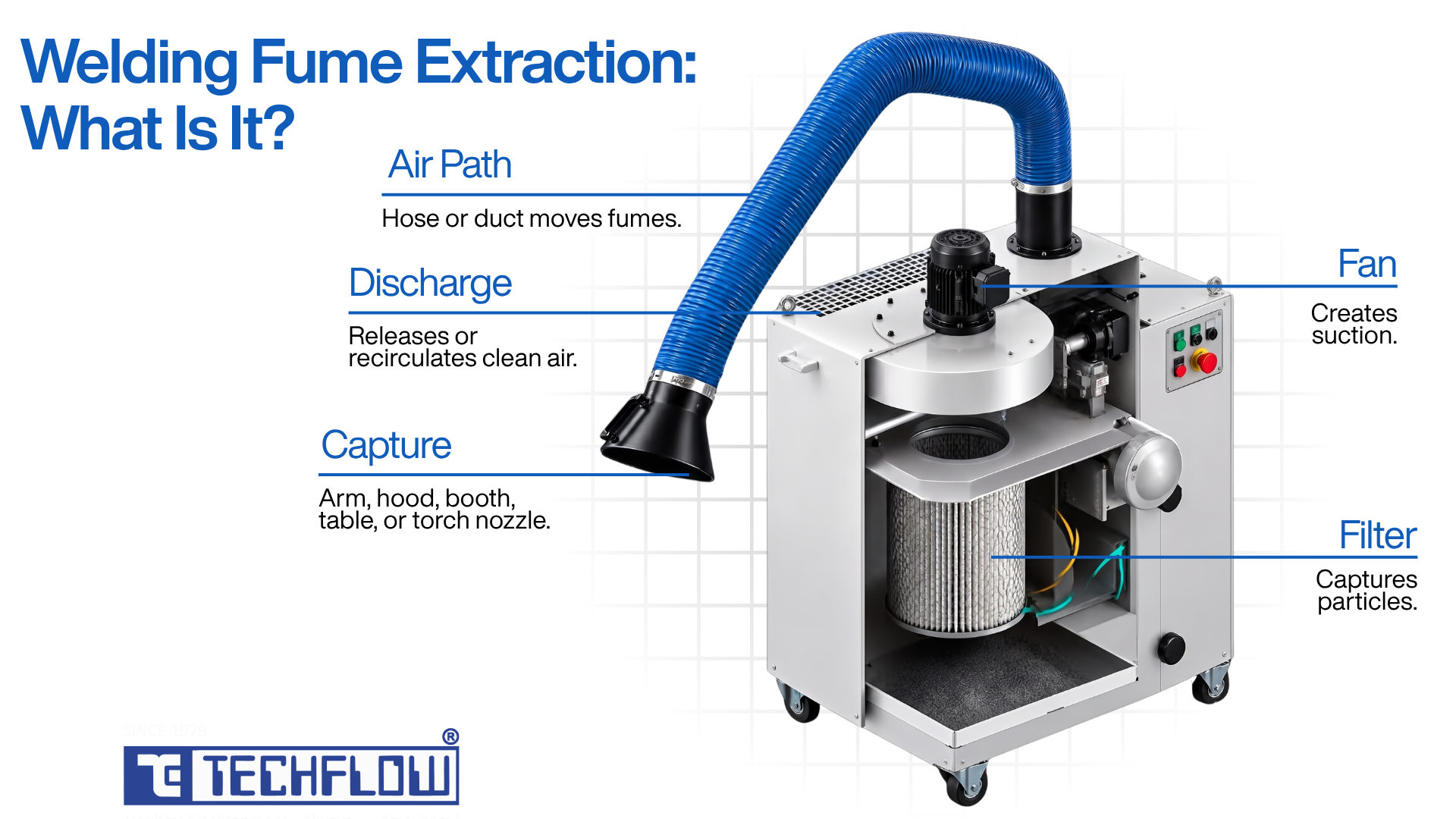
A welding fume extraction system captures the smoke and gases produced at the welding arc, filters out the harmful particles, and discharges clean air.
Think of it as an industrial-duty capture-and-filtration loop built for the welding plume. It acts before the fume reaches the welder, which is why it protects people far better than anything that treats the room air afterwards. You will see the same equipment called a welding fume extractor, a fume exhaust system, or local exhaust ventilation (LEV).
What the System Actually Does
Welding fume forms when metal vaporises at the arc, then oxidises and condenses into extremely fine solid particles suspended among the process gases. Most of that particulate sits below one micron. Studies of arc welding put the bulk of the mass in the roughly 0.1 to 1 µm range, which is exactly the size that penetrates deep into the lungs and the reason ordinary dust equipment is the wrong tool. The system draws the contaminated air through a capture device, carries it to a filter fine enough to hold sub-micron particulate (cartridge media around MERV 15 to 16 is usually needed, especially where air is recirculated or toxic metals are present), and releases the cleaned air outdoors or back into the shop where regulations allow.
The Five Parts Every System Shares
Regardless of size, every system is built from five elements:
- Capture device: an extraction arm, hood, booth, downdraft table, or on-torch nozzle that collects the plume.
- Air path: a flexible hose or rigid duct that carries the air away.
- Fan or blower: the source of suction.
- Filter: usually cartridges that hold the particulate until cleaned or replaced.
- Discharge: a route for cleaned air, outdoors or recirculated.
The real difference between the two approaches is simply how many welding points share those parts. Everything else follows from that.
What Is Local Welding Fume Extraction?
Local extraction gives each welding point its own capture device, usually with a dedicated fan and filter. It is source capture at the level of the individual workstation.
This is the approach most shops meet first. The equipment sits at the work, or moves with it, and serves one operator at a time. That simplicity is its biggest strength, and also the root of its main limitation: performance depends on a person positioning the capture device correctly, over and over, every shift.
Mobile Units and Extraction Arms
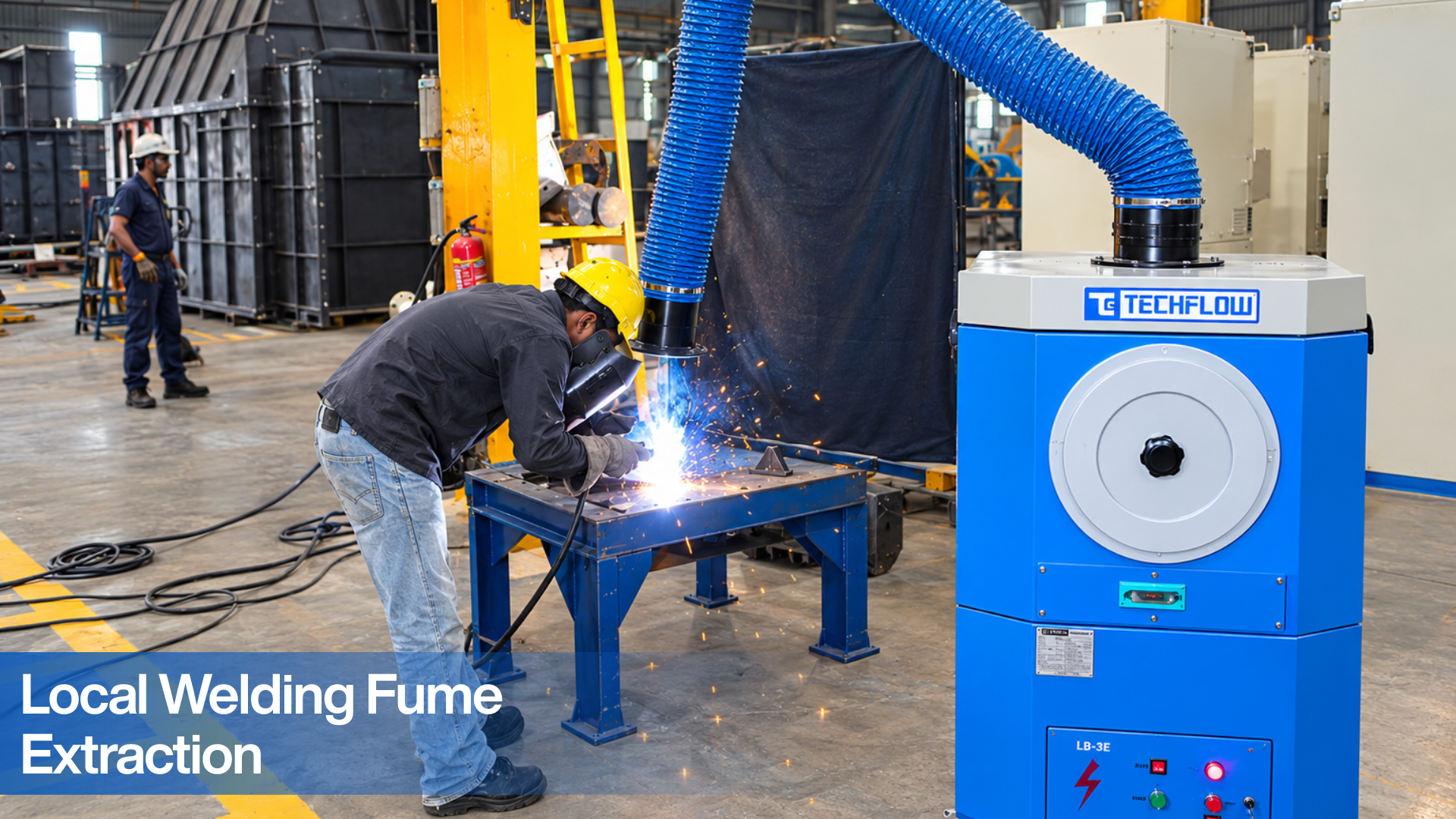
A mobile unit is a wheeled fan-and-filter package with a flexible, self-supporting arm you position over the weld. Point-source units of this type typically move in the order of 1,000 to 2,000 CFM and often run off a standard single-phase supply, so they can be rolled into place and used the same day. Well-designed units, with manual or automatic filter cleaning, suit weld shops, automotive work, and pipe welding.
The practical cautions are worth stating plainly:
- A portable unit normally serves a single operator.
- The units can be noisy.
- Filters need monitoring, because a blocked filter leaves the unit ineffective.
- Trailing power and extraction hoses are a housekeeping and trip hazard.
On-Torch (High-Vacuum) Extraction
Here the capture nozzle sits on the welding gun itself. This is a low-volume, high-velocity design: narrow hoses, typically 30 to 40 mm, with slot or fish-tail nozzles that must sit very close to the arc. Because the capture point travels with the torch, the welder never repositions a separate arm, which makes it well suited to semi-automatic welding with flux-cored wire and to robotic torches.
The trade-offs are specific to the geometry:
- A nozzle set too close can disturb the shielding gas and cause weld defects.
- A nozzle set too far away captures almost nothing, because low-volume systems move so little air.
- The high-vacuum turbines behind these systems cost more to buy and maintain, and they add noise.
Fixed Hoods, Booths, and Downdraft Tables
For repeat work, a fixed hood, welding booth, or downdraft table captures fume without anyone holding a hose. Downdraft tables are common for grinding, tack welding, and small parts. These belong to the local family, since they serve a single work point, even though they do not move.
Why Capture Position Is Everything
The physics is unforgiving. For a portable nozzle on a typical large-diameter hose, the effective capture zone is roughly a hemisphere whose radius equals the nozzle's inlet diameter, and less still if the nozzle is just an open pipe end without a flange. A long weld bead easily runs outside that zone. The best position is just above the midpoint of the weld, where the plume naturally rises.
To put numbers on it, industrial-ventilation guidance (ACGIH) points to a capture velocity in the order of 0.5 to 1.0 m/s at the arc, with the hood kept within roughly 300 to 450 mm of the arc to achieve it. Because a hood's pull falls off steeply with distance, a capture device placed even a little too far back can drop from effective to useless.
This is the heart of source capture: moving contaminated air around the room is not the same as capturing it at the source. Now picture thirty welders, each with a separate unit, a separate filter to service, and a capture nozzle whose effectiveness resets with every repositioning. That maintenance and consistency problem is exactly what centralised systems were built to solve.
What Is Centralised Welding Fume Extraction?
Centralised extraction routes fume from many welding stations through a duct network to one engineered collector.
It uses the same five parts as a local system, arranged differently: the fan and filter are consolidated into one large collector, the capture devices stay distributed at the welding points, and ductwork joins the two. Central collectors are sized far larger than point-source units, commonly in the tens of thousands of CFM, because they serve many simultaneous or intermittent stations.
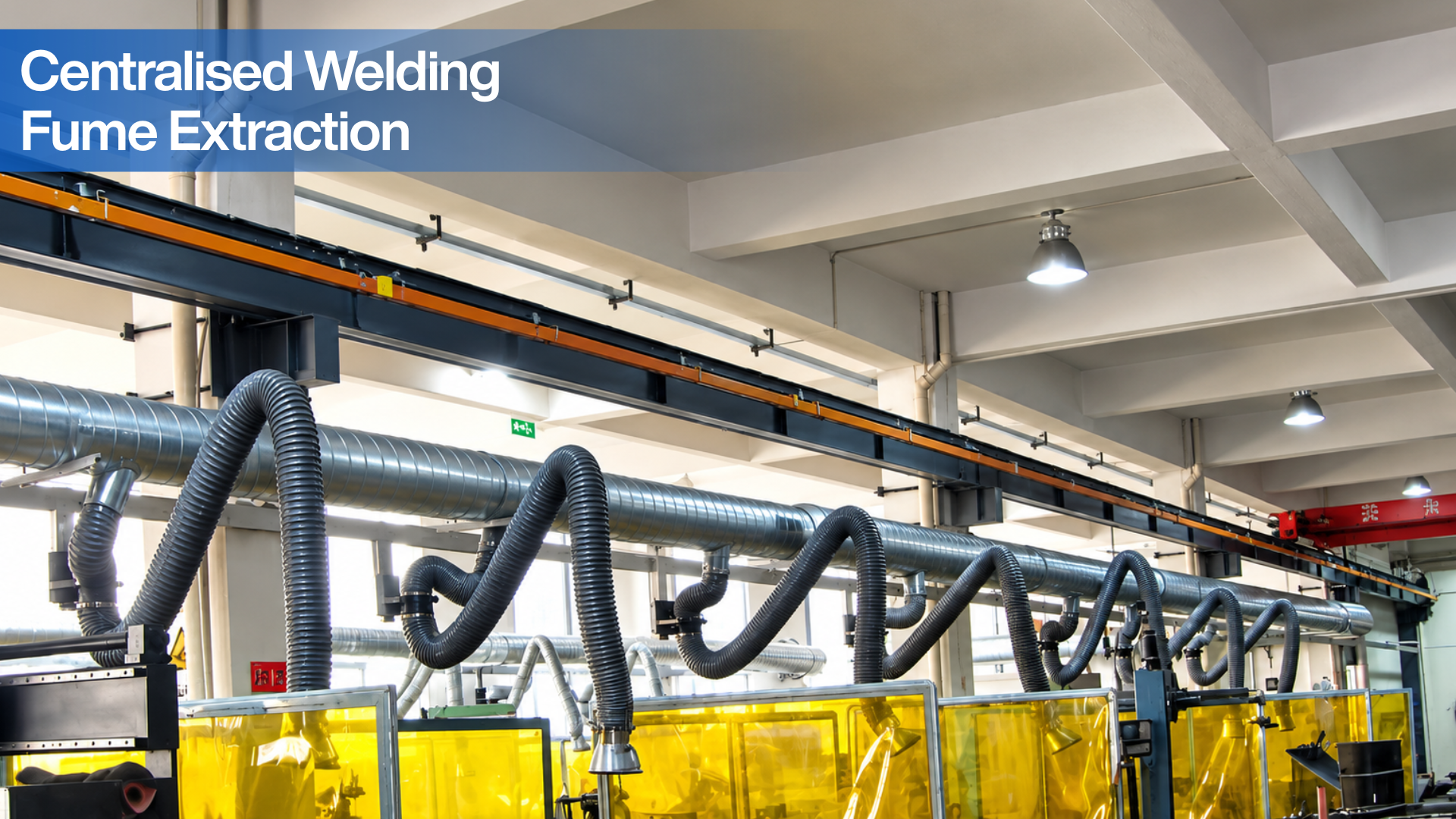
One point the centralised-versus-local framing can obscure: centralised describes the collection and filtration architecture, not the absence of source capture. A well-designed central system still captures fume locally, at each arc, through the same arms, hoods, and on-torch nozzles a standalone unit would use. What is centralised is the fan, the filtration, and the control, not the capture point. So the real choice is rarely "capture at source or not." It is "where does the filtration and air-moving equipment live, and how many points share it."
How the System Is Built
A centralised installation is defined by the network around the collector:
- Trunk and branch ducts leading from the welding area to the collector.
- Extraction arms, hoods, or on-torch guns at each welding point, connected by short flexible hoses to duct inlets.
- A control system, often with variable frequency drives (VFDs) and pressure sensors, for demand-based operation.
- A clean-air discharge or recirculation route, where regulations permit recirculation.
Why Duct Design and Balancing Decide Success
Fixed fans with rigid ducting are the established way to serve many welding positions, with each station reached by a short flexible hose from a duct inlet. But because all branches share one airflow, each branch has to be sized and balanced against the others, and the fan selected against the total system resistance. This is genuine ventilation engineering: the centrifugal blower is chosen against calculated pressure losses, not picked off a shelf.
Two failure modes matter here. Add extra lengths of flexible hose, or close off extraction points the system was balanced around, and you can quietly render the whole installation ineffective. For that reason, duct layout, fan selection, and balancing should be done by competent ventilation engineers rather than improvised on the shop floor.
How Pulse-Jet Filtration Keeps It Running
Fume-laden air passes through filter cartridges that collect dust on their surface. A timed burst of compressed air periodically reverses through each cartridge, knocking the dust into a collection hopper so the collector cleans itself while running. Cleaned air is then exhausted outdoors or, where approved, recirculated. Pulse-jet cartridge collectors are compact, which is part of why they suit space-constrained indoor welding installations.
Where Drive Control Saves Energy
VFDs and pressure sensors let the central fan modulate with demand: when fewer stations are active, the fan slows and draws less power. Individual local units can be switched off one at a time, but they do not coordinate. Demand-based control of one large fan is a real structural advantage of the central approach at scale.
Why Welding Fume Has to Be Captured at the Source
Welding fume is a recognised human carcinogen, and moving the room air does not protect the person standing over the arc. Every design decision in this guide traces back to that fact.
What Is in the Fume?
How much fume forms, and how toxic it is, depends on the base metal, the process and its energy input (more heat generally means more fume), arc-on time, and the air movement around the welder. Mild steel fume is mostly iron oxide but carries manganese. Stainless and high-alloy welding adds hexavalent chromium (Cr VI) and nickel.
What the Science and the Regulators Say
In 2017, the International Agency for Research on Cancer (IARC) reclassified welding fume from "possibly carcinogenic" (Group 2B) to Group 1, carcinogenic to humans, concluding there is sufficient evidence it causes lung cancer, with a positive association for kidney cancer. UV radiation from welding was also placed in Group 1. This applies to all welding fume, including mild steel.
Regulators responded. In February 2019, the UK's Health and Safety Executive issued a welding fume safety alert (STSU1-2019) stating that because general ventilation does not achieve the necessary control, all indoor welding requires local exhaust ventilation, with respiratory protection added only where LEV leaves residual exposure. HSE also noted that extraction controls manganese exposure, which can cause neurological effects similar to Parkinson's disease (manganism).
In the US, OSHA does not set a single limit for "welding fume" as a category, but it regulates the dangerous constituents individually. For stainless and alloy work, the binding driver is the hexavalent chromium limit of 5 µg/m³ (8-hour TWA, under 29 CFR 1910.1026), a figure 1,000 times stricter than the general welding fume limit.
Why General Ventilation Falls Short
Diluting the whole shop's air does nothing for the welder breathing the undiluted plume at the arc, and it wastes conditioned heat. Capture has to happen where the fume forms.
Local vs Centralised Extraction: A Side-by-Side Comparison
Local extraction wins on flexibility, low entry cost, and contained failures. Centralised extraction wins on scale, consolidated maintenance, and standardised documentation. The right column for your shop depends on the factors in the sections that follow.
| Factor | Local Extraction | Centralised Extraction |
|---|---|---|
| Capture arrangement | Dedicated device per point, with its own fan and filter | Distributed capture points ducted to one shared collector |
| Typical capacity | About 1,000 to 2,000 CFM per unit | Tens of thousands of CFM at one collector |
| Best suited for | Few stations, changing work, large or awkward parts | Many fixed stations, high duty cycle |
| Workshop layout | Flexible; adapts to the day | Fixed; built around the installed duct route |
| Mobility | High; roll the unit to the work | Low; ductwork stays where installed |
| Scalability | Add units one at a time | Plan capacity up front; expansion needs duct design |
| Ducting | Minimal or none | Engineered trunk and branch network, balanced |
| Installation | Low complexity, often plug-and-play | High; professional design and commissioning |
| Maintenance | Many small filters across many units | Concentrated on one or a few collectors |
| Energy | Uncoordinated small fans | One fan, with VFD or demand control possible |
| Space requirements | Floor space at each station | Collector footprint plus duct runs; frees station-level space |
| Compliance records | Distributed; relies on consistent habits | Single control point to log and monitor |
| Key limitations | Operator-dependent; units can be overloaded | High upfront cost; shared-failure risk; inflexible once built |
Two points sit behind the table.
- First, downtime cuts both ways: lose a portable unit and one welder is exposed; lose a central fan and a whole bay is exposed, which is why large systems need planned servicing and sometimes redundancy.
- Second, both approaches can meet occupational exposure limits (OSHA, ACGIH) when properly designed and maintained.
The decision is about cost structure, workflow, and how reliably capture holds up over time, not about one system being inherently safer than the other.
When Local Extraction Is the Better Choice
Local extraction fits shops where the welding moves, the work is large, or the future is uncertain. Choose it when your situation looks like one of these:
- Custom fabrication shops: a handful of welders moving around large fabrications that will never fit a fixed booth.
- Maintenance workshops: jobs vary daily, and welding happens wherever the breakdown is.
- Prototype and R&D areas: fixtures and processes change every quarter, so permanent ductwork would be obsolete before it paid off.
- Short-term or rented premises: sites expecting to relocate within a few years.
- Remote sites without engineering support: no one on hand to design and maintain a balanced duct network.
- Crowded overhead space: cranes, conveyors, or tall workpieces make duct and hood placement impractical.
- Low-fume, low-frequency processes: TIG stations produce comparatively little fume, so a small dedicated extractor can be matched to each one.
The limit to respect: a mobile unit has a design capacity. Push it past that, with too much simultaneous fume or hoses extended too far, and capture collapses. When you find yourself fighting that ceiling at point after point, it is the signal to look at the central approach.
When Centralised Extraction Makes More Sense
Centralised extraction pays off when production is stable, stations are numerous, and the fume load is steady and predictable. It usually wins in these scenarios:
- Rows of fixed welding booths feeding steel fabrication lines with similar duty cycles.
- Cutting tables: several CNC plasma or laser tables along one wall generating consistent, heavy fume.
- Robotic welding cells running long shifts, where fume is produced at fixed positions and a repositionable arm would be the wrong tool.
- Training centres: welding schools with dozens of booths on a standardised layout.
- Tight floor space but free roof or mezzanine space, where the collector can sit out of the way.
- Alloy-heavy work: stainless or high-alloy welding, where Cr VI demands robust, well-documented capture.
There is also an audit-readiness argument. When every capture point routes through one collector, standardising capture performance and logging filter status happens at a single control point, which is far easier to manage under a corporate EHS regime than reconciling the maintenance logs of twenty separate units.
Many real plants, though, sit between these two lists. For them the sensible answer is neither one alone.
When a Hybrid Extraction System Makes Sense
A hybrid design gives each area the extraction method that matches how that area actually works. It is a deliberate choice, not a patchwork failure. Common, sensible patterns include:
- Automotive plant: a central collector serves the robotic lines, while portable units cover repair bays where welding moves daily.
- Heavy fabrication: fixed booths connect to the central system, and mobile arms follow welders on structures too large for any booth.
- Growing job shop: it starts with portable units to prove the layout, then adds a central system for the core stations once volumes stabilise, redeploying the portables to speciality cells and as backups.
- Mixed-process manufacturer: small dedicated extractors serve TIG stations, and a high-capacity central collector serves the MIG lines.
The benefit is cost matched to risk, with no single fan carrying the whole shop. The danger is a hybrid that grows by accident rather than design. Decide up front which areas are stable enough to duct and which need to stay mobile. If you expect to centralise later, plan electrical capacity, duct routes, and collector space early so today's portables can be reused as backups rather than stranded.
What to Weigh Before Choosing a System
Before specifying anything, work through the measurable facts of your operation. Each one matters for a concrete engineering reason:
- Welding processes (MIG, TIG, SMAW, FCAW): fume generation rate varies widely by process, driving how much airflow each point needs.
- Materials and consumables: stainless, high-alloy, and coated metals raise capture and filtration demands because of Cr VI and nickel, and some flux-cored wires add other hazardous constituents to the collected dust.
- Welding frequency and duty cycle: near-continuous arcs justify fixed, engineered capture; intermittent welding often does not.
- Number of operators and stations, now and in 3 to 7 years: the single biggest driver of the local-versus-central economics.
- Station mobility: does the work come to a fixed point, or does the welder follow the work?
- Workshop layout and available space: overhead obstructions, roof loading, and mezzanine space decide whether ducting and a collector are even practical.
- Simultaneous operation: a central fan must be sized for realistic simultaneity, not the raw station count.
- Duct route and pressure losses: longer, more complex runs mean higher resistance and a bigger fan, and this is where a central system's cost quietly lives.
- Filtration requirements: fume type and recirculation plans dictate filter media and class.
- Maintenance access: many small filters demand distributed, disciplined servicing; one collector concentrates it.
- Energy and make-up air: extraction removes conditioned shop air, which must be replaced, and demand control can cut the energy bill at scale.
- Future expansion: undersizing to save on first cost is the classic mistake.
- Applicable exposure limits: the metals you weld set the target, and a steel shop's general fume limit is far looser than the Cr VI limit a stainless shop must hit.
Common Welding Fume Extraction Design Mistakes
Even good equipment fails when the engineering around it is wrong. The recurring mistakes:
- Capturing too far from the source: capture effectiveness falls off sharply with distance, and a nozzle a little too far from the arc captures almost nothing.
- Assuming general ventilation is enough: it is not, and that is explicitly the regulators' position for indoor welding.
- Poor hood or nozzle positioning: the best hardware fails if the capture device sits outside the plume.
- Undersizing the system: a system sized only for today becomes inadequate within a couple of years as the shop grows.
- Ignoring simultaneous operation: sizing a central fan for the wrong number of concurrently active points starves capture at the far stations.
- Poor duct design and ignored pressure losses: unbalanced branches and over-long hoses silently defeat a correctly specified collector.
- Neglecting filter maintenance: a blocked filter makes a unit ineffective and can discharge contaminated air back into the shop.
- Forgetting make-up air: extract large volumes without planned replacement air, and the system cannot pull its rated flow.
- Failing to plan for expansion: no spare capacity or duct provision means the next growth phase forces a rebuild.
- Specifying without understanding the process: equipment chosen on price alone, without matching process, metal, and duty cycle, rarely delivers the capture it promises.
Centralised vs. Local Extraction: Which Works Best for Your Facility?
Neither system is universally better. The right choice depends on the number and location of your welding stations, their mobility, your workshop layout, the metals and processes involved, your duty cycle, and your growth plans. Here is a practical way to reach a defensible decision:
- Confirm extraction is required: For indoor welding, assume it is. As a rough screen, sustained steel welding, with the arc on well beyond a couple of minutes in every ten at higher currents, clearly needs engineering control. When in doubt, air sampling against the applicable exposure limit settles it.
- Map stations and duty cycle: Count today's welding points and those planned over three to seven years, and note whether arcs run intermittently or almost continuously. Few, intermittent, mobile points lean local; many, steady, fixed points lean central.
- Identify the metals and consumables: Stainless, high-alloy, and coated metals raise the capture and filtration bar and bring documented-capture obligations for Cr VI. If that is your work, weight the decision toward robust, monitorable capture.
- Check the building: Cranes, columns, roof loading, and available mezzanine space decide whether a ducted central collector is even feasible. Confined spaces carry stricter ventilation requirements.
- Size for the farthest point and the real simultaneity: Verify that duct sizing holds capture velocity at the most distant inlet, and confirm capture at the arc, not just at the hood face. Size the fan for how many points genuinely run at once.
- Interrogate every quote: Ask each supplier: How many extraction points versus what you need? What air volume and inlet velocity at each point? What power draw, and can unused sections be isolated? What noise levels, and where does the fan sit? What filter life, cost, and cleaning method? What hose type, reach, and spatter resistance? Will nozzles or arms obstruct welder access or crane movement?
If this process points cleanly to one approach, follow it. If it splits, with some areas stable and dense and others mobile and sparse, a hybrid is the honest answer. Whichever route you choose, the system still has to be designed, balanced, commissioned, and maintained to deliver the protection on the datasheet.
How TECHFLOW Approaches Industrial Fume Extraction
Once the system choice is made, it has to be designed, built, and commissioned. TECHFLOW Enterprises Pvt. Ltd. is an Ahmedabad-based air pollution control manufacturer, in operation since the 1970s, whose published capabilities map onto both routes described in this guide, which is why it is relevant here rather than as a generic endorsement.
Based on TECHFLOW's own documentation, its welding-related offerings include:
- Local capture: mobile welding fume extraction units (branded Tuff Clean Weld), available standalone or configured to serve a central system, for weld shops, automotive work, and SAW pipe welding. TECHFLOW states its solutions handle fume from SMAW, MIG, TIG, brazing, and soldering.
- Centralised collection: central welding fume extraction systems connecting multiple SMAW stations through suction arms and ducting to a shared pulse-jet cartridge filter or dust collector, with a centrifugal fan or blower and automated damper and blower control.
- Filtration: pulse-jet cartridge collectors, the compact, self-cleaning filtration central to its air pollution control systems.
- Air movers: centrifugal blowers and industrial fans, including ID fans, for the ducted networks a central system depends on.
The practical value is single-source responsibility. Because TECHFLOW manufactures the capture hardware, the filtration, and the fans, the components of a ducted system can be engineered against one another's resistance rather than assembled from mismatched parts. Its fume extraction and filtration systems and its guide to choosing an industrial fume extraction system are useful starting points, and for a layout-specific assessment of whether local, centralised, or hybrid fits your shop, its engineering team is the right point of contact.
The Bottom Line
A welding fume extraction system captures the plume at the arc, filters out the particles, and returns clean air. The real decision is not whether to capture, since for indoor welding that is settled, but how: a dedicated device at each point, or one engineered collector for many. Local extraction gives flexibility, a low entry cost, and contained failures. Centralised extraction gives scale, consolidated maintenance, and a single place to monitor and document performance.
Station count, duty cycle, metals, building constraints, and growth plans point toward one or the other, and hybrid designs resolve the cases in between. Whichever route you take, specify the system against measured needs, have it designed and balanced by competent engineers, verify capture at the arc, and test and maintain it on a schedule. A well-chosen system that is poorly maintained protects no one, while a modest system positioned correctly protects a great deal.
Frequently Asked Questions (FAQs)
Local extraction places a separate capture device, such as a mobile arm, hood, or on-torch nozzle, with its own fan and filter at each welding point. Centralised extraction connects many points through ductwork to one large collector. Local is flexible and cheap to start; centralised suits fixed layouts with many stations. Plenty of facilities use both.
There is no universal number. Some guidance puts the per-station economics in favour of a central system past roughly 15 to 20 points; other guidance finds mobile units more economical below about five. Duty cycle, ducting difficulty, and growth plans all move the crossover. The reliable way to decide is a supplier quote for your actual layout.
Yes, for indoor work. IARC concluded that all welding fume, including mild steel fume, can cause lung cancer, and regulators such as the UK HSE state that general ventilation does not control it, so local exhaust ventilation is expected indoors. Respiratory protection supplements extraction only where residual exposure remains.
Neither is better in every case. Local extraction is better for shops with few welding points, changing layouts, large workpieces, or limited capital. Centralised extraction is better for plants with many fixed stations, robotic cells, or high duty cycles, where one collector costs less per station and is easier to monitor.
Sometimes. It depends on the application and regulatory approval. Central systems can exhaust cleaned air outdoors or recirculate it. Stainless and alloy-heavy work involving hexavalent chromium calls for particular care and a filter class suited to welding fume. Confirm local rules before choosing recirculation.
It depends on the number of simultaneous capture points and the capture velocity each needs. Point-source units commonly move around 1,000 to 2,000 CFM; central collectors run much larger. There is also a design distinction between high-volume, large-hose capture and low-volume, high-velocity on-torch capture. The latter uses far less air but must sit very close to the arc.
Yes, and many growing shops do. Plan electrical capacity, duct routes, and space for a future collector so the transition does not force building changes, and the mobile units can then be reused for maintenance areas or as backups. This staged path suits shops whose layout is not yet stable.
Robotic cells produce steady, predictable fume at fixed positions, which suits enclosures, fixed hoods, or on-torch capture connected to a central or self-cleaning system. Mobile arms that need manual repositioning are a poor match for repetitive, automated work.
It can. A nozzle set too close to the arc may disturb the shielding gas and cause weld defects; set too far away, it captures nothing. Each torch-and-consumable combination should be adjusted and tested before production starts.
Under UK COSHH rules, LEV requires thorough examination and testing at intervals not exceeding 14 months. Beyond any legal interval, routinely test equipment against the supplier's performance data. Requirements vary by jurisdiction, so in India, check the Factories Act, 1948, and applicable state rules. Keep a maintenance log wherever you operate.


