


Key Takeaways
- A shot blasting bag filter is a pulse-jet dust collector that traps blasting dust on felt bags and self-cleans with compressed air during production.
- Shot blasting dust mixes broken abrasive, scale, rust, old paint and, on castings, moulding sand that can release respirable crystalline silica.
- OSHA limits respirable crystalline silica to 50 µg/m³ over eight hours, and abrasive blasting can create short, very high exposure spikes.
- Specify a guaranteed outlet in mg/Nm³: at a 10 g/m³ inlet, 99% efficiency still emits 100 mg/m³, while 99.9% emits 10 mg/m³.
- Needle-felt polyester suits most near-ambient blasting dust, and an ePTFE membrane improves fine-dust capture and releases the dust cake more cleanly.
- A conservative air-to-cloth ratio, controlled air velocity and a cyclone or inlet baffle protect bags from abrasive blasting dust.
- Fine aluminium or magnesium dust can explode, so base antistatic media, spark control and explosion protection on a dust hazard analysis.
A shot blasting bag filter is a pulse-jet fabric dust collector that extracts dust from a shot blasting machine's blast chamber, bucket elevator and air-wash separator. Dusty air passes through felt filter bags, and the dust stays on their outer surface. Short bursts of compressed air clean the bags while the machine keeps running.
Every blast cycle strips scale, rust, paint or sand from the workpiece and turns part of it into fine airborne dust. The filter decides whether that dust ends up in a sealed hopper or in the shop air and the stack. High efficiency is non-negotiable for three reasons. Blasting dust can carry respirable crystalline silica and fine metal particles. Stack limits are written in mg/Nm³, not percentages. And some metal dusts can ignite.
What Is a Shot Blasting Bag Filter?
A shot blasting bag filter is the dust collector at the end of a shot blasting machine's ventilation system. A fan pulls air from the machine through ductwork into a housing that holds rows of fabric bags on wire cages. Clean air leaves through the fan and stack, and the collected dust drops into a hopper for disposal.
Most shot blasting installations use the pulse-jet design because it keeps filtering while it cleans. That matters on lines that run across shifts with no planned stops for the dust collector.
Where the bag filter fits in a shot blasting machine
A wheel blast machine (hanger, tumble belt, table or continuous tunnel type) recycles its shot. Spent abrasive travels up a bucket elevator into an air-wash separator. The separator removes fines, broken shot and debris so that only reusable abrasive returns to the hopper.
The dust collector pulls air from three places:
- The blast chamber openings, where airflow must run inward so dust cannot escape into the shop.
- The elevator, where falling abrasive releases dust.
- The air-wash separator, where the air stream lifts fines out of the recycled abrasive.
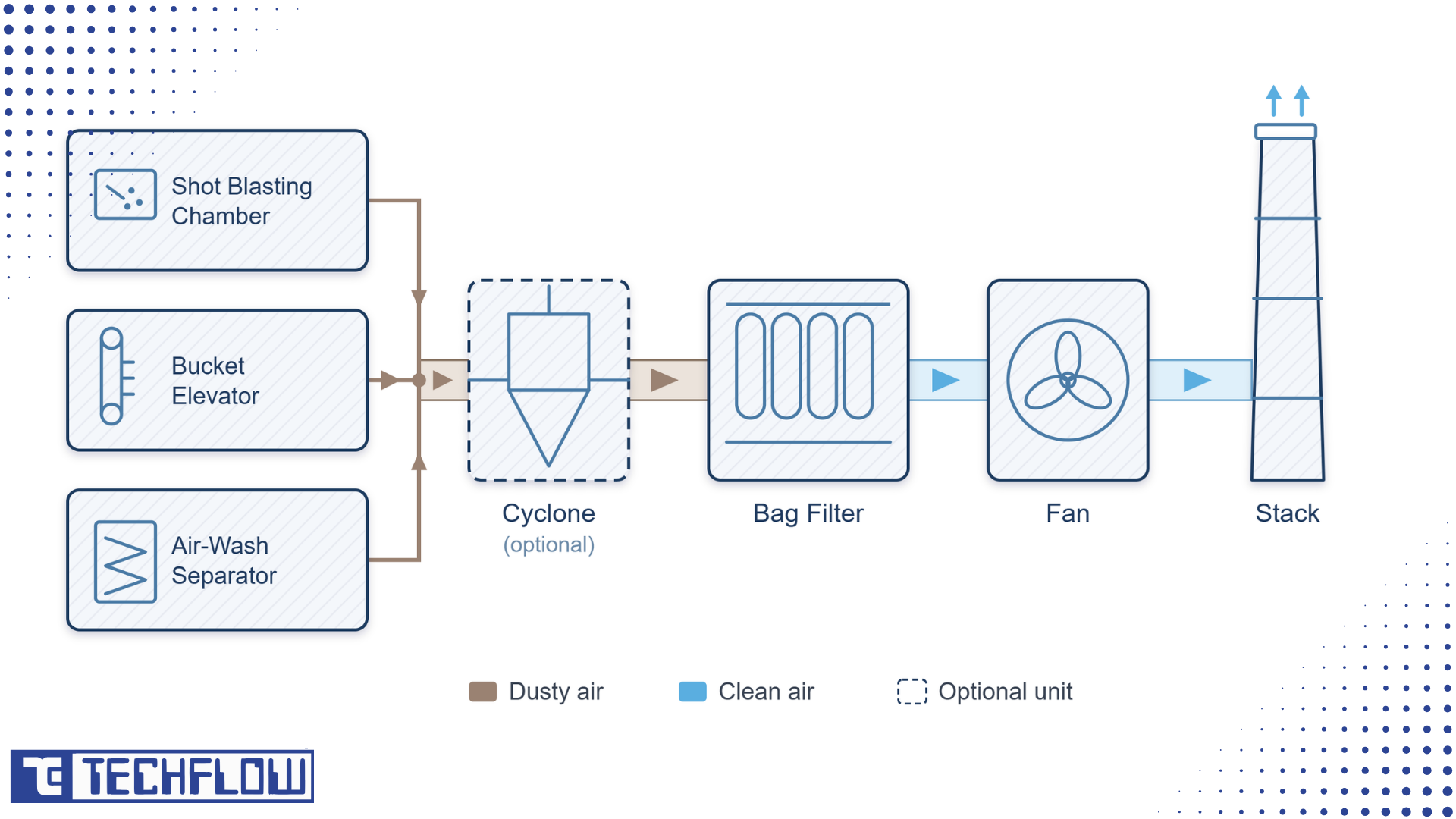
US regulation makes the same split clear. OSHA's ventilation standard for abrasive blasting, 29 CFR 1910.94, requires blast enclosures to be exhausted so air flows inward at every opening. It requires exhausted air to pass through dust-collecting equipment. It also states that the enclosure exhaust cannot replace a separator for removing fines from recirculated abrasive.
Indian plants follow the Factories Act and state factory rules rather than OSHA, but the engineering logic is the same. The separator and the collector work as a pair. A weak link in either one sends extra dust to the other.
Compressed-air blast rooms and cabinets behave differently. An operator directs the abrasive stream by hand, so dust rises in a plume around the workpiece and room concentrations climb quickly. These rooms need enough extraction to clear the air promptly after blasting, not just enough to keep the filter loaded.
How a Shot Blasting Bag Filter Works
- Capture: Hoods and duct connections draw dusty air from the blast chamber, elevator and separator.
- Drop-out: Air slows as it enters the housing, and heavier particles fall into the hopper. An inlet baffle or diffuser protects the bags from direct impact.
- Filtration: Air passes from the outside of each bag to the inside. Dust stays on the outer surface, and the wire cage keeps each bag open.
- Clean exit: Filtered air rises into the clean-air plenum and leaves through the fan and stack.
- Pulse cleaning: A diaphragm valve fires compressed air down a blowpipe and through a venturi into a row of bags. Each pulse lasts 0.03 to 0.1 seconds at 415 to 830 kPa, according to the US EPA. The shock flexes the bag and cracks the dust cake off its surface.
- Discharge: Dislodged dust falls into the hopper and leaves through a rotary airlock or other discharge device.
Online vs offline pulse cleaning
In online cleaning, rows of bags are pulsed one at a time while the rest keep filtering. A sequential timer can fire the pulses at set intervals. Many modern systems instead use differential pressure controllers that clean only when pressure drop reaches a set point. TECHFLOW's explainer on what a pulse jet dust collector is notes that over-cleaning wastes compressed air and shortens bag life, while under-cleaning raises pressure drop and energy use.
In offline cleaning, the collector is split into compartments. A damper or poppet valve isolates one compartment; its bags are pulsed with no air flowing through them, and the compartment returns to service. Released dust settles into the hopper instead of being pulled straight back onto neighbouring bags.
EPA's fact sheet adds that high-velocity designs may need compartments that can be isolated for cleaning. TECHFLOW's guide to pulse jet bag filters recommends offline cleaning for heavy dust loads, sticky dust and tight emission targets.
What Dust Does a Shot Blasting Machine Produce?
Shot blasting dust is a mixture, and each part affects the filter differently. OSHA's fact sheet on abrasive blasting points to two sources of hazardous dust: the abrasive itself and the surface being blasted, including old coatings such as lead paint.
| Dust source | What it contains | What it means for the filter |
|---|---|---|
| Broken abrasive | Steel shot or grit fines | Hard, dense and sharp; erodes bags and cages near the inlet |
| Surface removal | Mill scale, rust, weld spatter | Heavy and abrasive; raises inlet dust loading |
| Casting residue | Moulding and core sand | Can release respirable crystalline silica |
| Old coatings | Paint and primer particles, sometimes lead-bearing | Can be toxic; may be sticky depending on chemistry |
| Light-alloy parts | Aluminium, magnesium or zinc fines | Potentially combustible; changes the safety design |
Three variables set how much dust reaches the collector:
- The abrasive: its type, size and breakdown rate decide how many fines are produced each hour.
- The workpiece: as-cast surfaces with sand, heavy scale or thick paint release far more dust than lightly rusted steel.
- The duty cycle: a machine running three shifts loads the collector very differently from one running occasional batches.
A collector sized only on nameplate airflow ignores all three. Inlet dust loading should be a stated design input in every enquiry. In a foundry, shot blasting is one of several dust sources, alongside furnaces, sand plants and grinding. TECHFLOW's foundry air pollution control page covers these applications together.
Why Shot Blasting Dust Needs High-Efficiency Filtration
Worker health: silica limits leave little margin
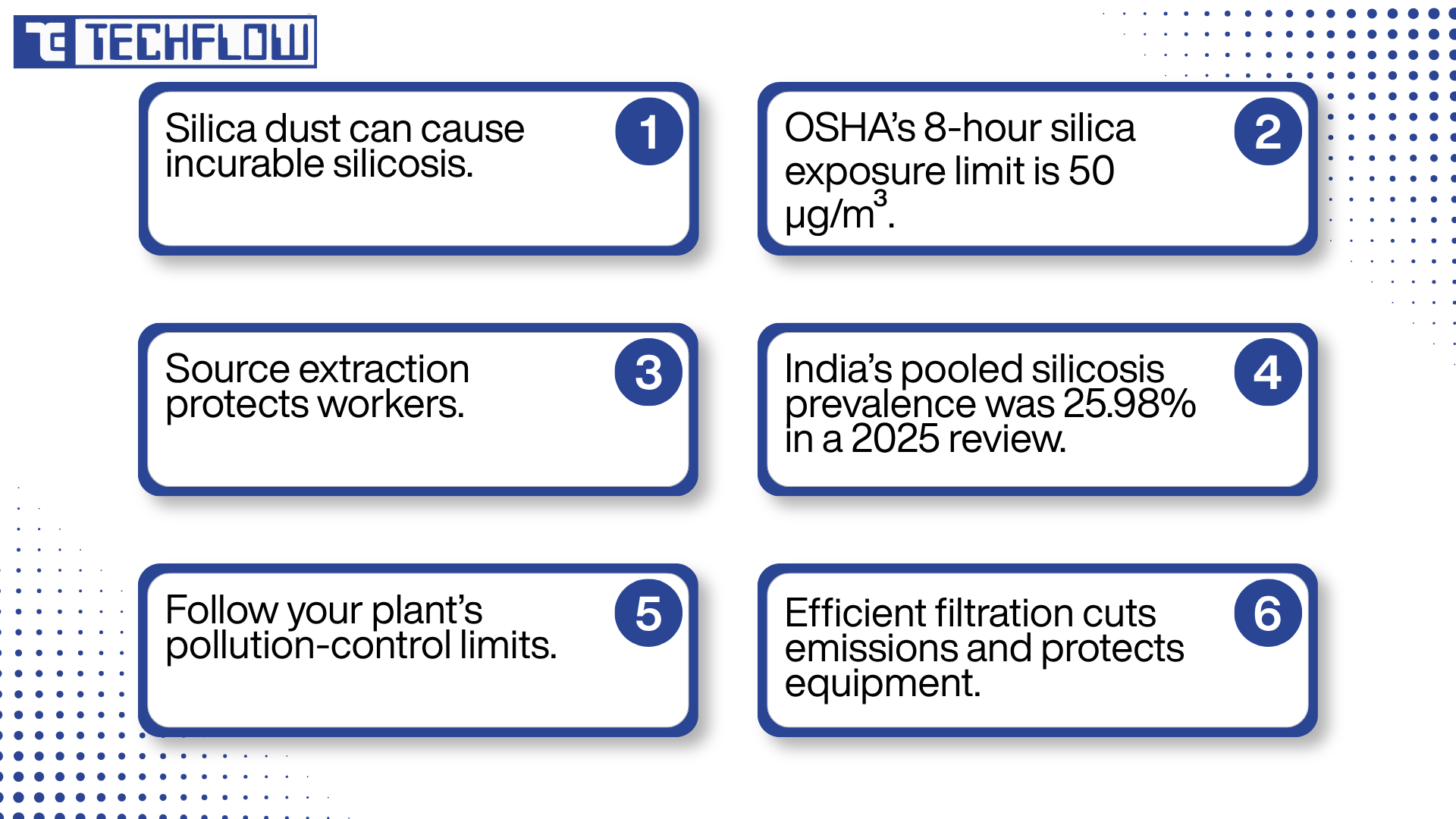
When castings carry moulding sand, or when the abrasive or substrate contains quartz, blasting can release respirable crystalline silica. OSHA's general industry silica standard sets a permissible exposure limit of 50 µg/m³ as an eight-hour average, with an action level of 25 µg/m³.
OSHA shows how little time this allows. For an exposure lasting 15 minutes, the concentration would only need to exceed 800 µg/m³ to reach the action level for the whole shift. OSHA names abrasive blasting as a task that can generate very high short-term exposures.
The same standard puts engineering controls first. Employers must use engineering and work practice controls to keep exposure at or below the limit. Respirators come in only where those controls fall short. A respirator protects the person wearing it. A well-designed extraction and filtration system protects everyone in the bay.
Silica is not the only concern. The World Health Organisation links fine particulate matter to premature deaths from cardiovascular disease, respiratory disease and cancer. In 2013, the International Agency for Research on Cancer classified outdoor air pollution, and particulate matter evaluated separately, as carcinogenic to humans (Group 1). In blasting dust, the coarse fraction carries most of the weight. The fine fraction carries most of the health risk.
Silicosis in India: what the evidence shows
A 2025 scoping review of silicosis in India, published in the Journal of Occupational Medicine and Toxicology, included 49 studies. Its 11 prevalence studies, with a combined sample of 2,072 workers, showed an average silicosis rate of 31.39%. The authors' meta-analysis gave a pooled estimate of 25.98%. These figures span many silica-exposed trades, not shot blasting alone, but they show how common the disease becomes when exposure goes uncontrolled.
In Gujarat, Down To Earth reported in May 2025 that sandblasting has been banned under the Gujarat Factory Rules since 1974 yet remains common in engineering units. The state has more than 3,000 foundries, concentrated around Rajkot and Ahmedabad. Silicosis has no cure, so capture at source, filtered to a high standard, is the control that matters.
Stack compliance: limits are written in mg/Nm³
In India, the stack limit for a shot blasting dust collector is set in the plant's Consent to Operate from the State Pollution Control Board.
The Central Pollution Control Board lists a national emission standard for foundries among its industry-specific standards. Notified under the Environment (Protection) Act as G.S.R. 742(E) in 1990, it sets particulate matter at 150 mg/Nm³ for arc furnaces, induction furnaces and cupolas of 3 tonnes per hour and above. The Institute of Indian Foundrymen reproduces the full standard.
Shot blasting machines are not listed separately, so check the figure in your own consent, which may be stricter. TECHFLOW also keeps a reference list of government emission norms by industry.
Consent conditions are enforced through periodic stack monitoring. A collector that only just passes on commissioning day has no headroom for bag wear, moisture or a surge in abrasive fines. Efficiency margin is what keeps a plant compliant through ordinary operating variation.
Process and equipment protection
Weak extraction also hurts the blasting process. When airflow at the separator falls, fines stay in the recycled abrasive, which can reduce cleaning performance and surface finish. Dust that escapes the enclosure settles on bearings, conveyors and electrical panels, adding wear and maintenance work.
Efficiency Percentage or Outlet Concentration: What Should You Specify?
The US EPA's fact sheet on pulse-jet fabric filters gives the benchmarks most buyers need:
- New pulse-jet designs typically reach 99 to 99.9% efficiency, while older units operate at 95 to 99.9%.
- Well-designed units achieve outlet concentrations below 0.05 g/m³ (50 mg/m³), and in some cases as low as 0.002 to 0.011 g/m³ (2 to 11 mg/m³).
- Typical baghouse inlet concentrations range from 1 to 23 g/m³.
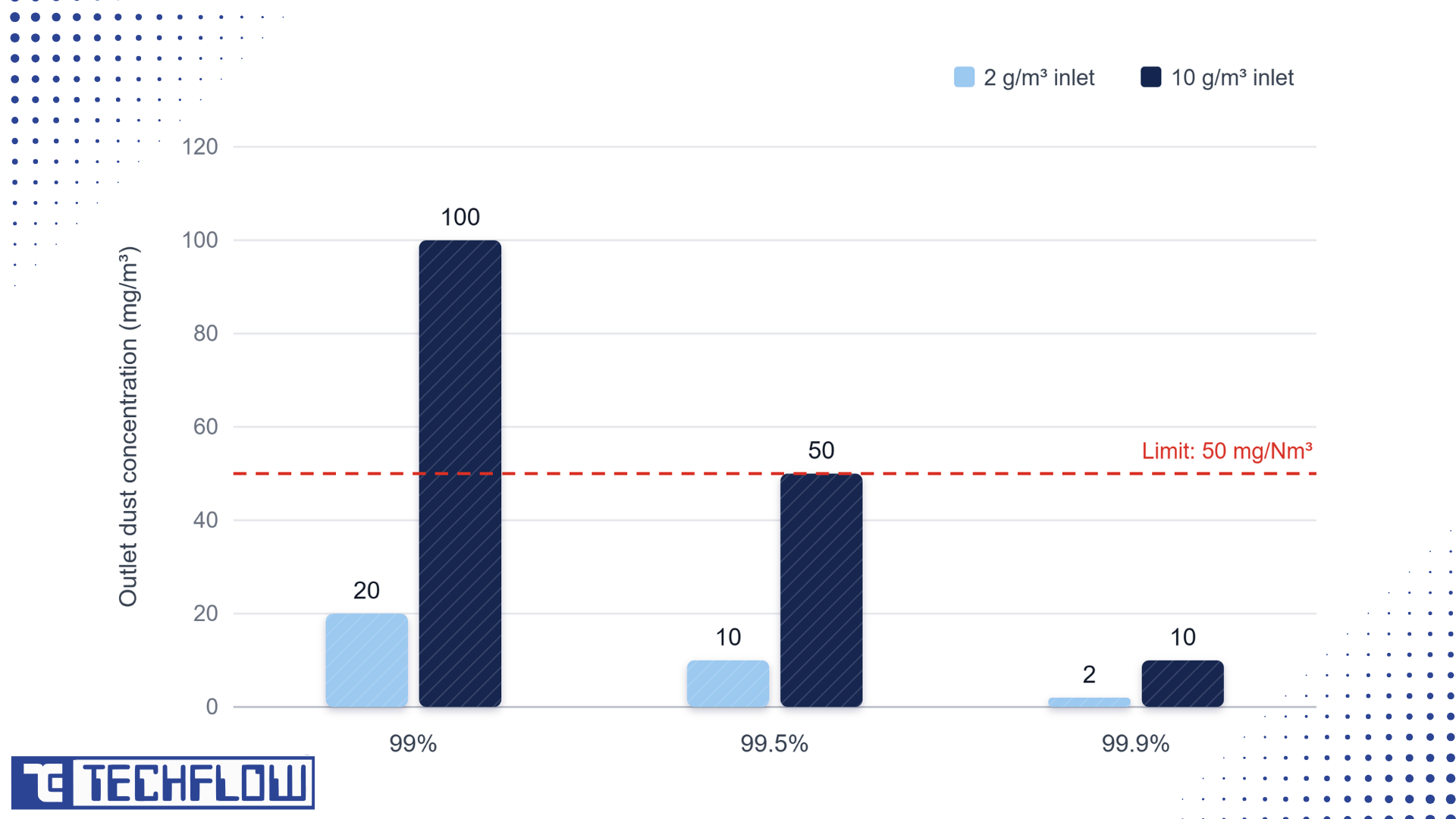
That wide inlet range is why a percentage on its own can mislead. The outlet concentration depends on how much dust goes in. The illustrative example below uses simple arithmetic (outlet = inlet × (1 − efficiency)). It ignores correction to normal conditions, which is small for near-ambient blasting air.
| Inlet dust loading | Outlet at 99% | Outlet at 99.5% | Outlet at 99.9% |
|---|---|---|---|
| Example A: 2 g/m³ (lighter load) | 20 mg/m³ | 10 mg/m³ | 2 mg/m³ |
| Example B: 10 g/m³ (heavier load) | 100 mg/m³ | 50 mg/m³ | 10 mg/m³ |
At 99% efficiency, Example A emits about 20 mg/m³. The same 99% on Example B emits about 100 mg/m³, which would fail a 50 mg/Nm³ consent condition. Both collectors carry the same "99% efficient" label. The outlet figure is what the regulator measures.
Ask suppliers for these numbers in writing:
| Metric | What to ask for | Why it matters |
|---|---|---|
| Outlet concentration | A guaranteed value in mg/Nm³ at your stated inlet loading and airflow | This is the number your consent and stack test use |
| Design inlet loading | The g/m³ figure the design assumes | Shows whether the supplier sized for your real dust |
| Pressure drop | Expected operating range across the cleaning cycle | Sets fan power and signals cleaning health |
| Media and finish | Fibre, weight, surface treatment, antistatic if needed | Decides fine-particle capture and bag life |
| Air-to-cloth ratio and can velocity | The design values and the margin behind them | Undersizing is a common cause of early blinding |
Choosing Filter Bags for Shot Blasting Dust
Why pulse-jet filters use felt, not woven fabric
Pulse-jet filters use felted fabric because felt reaches high collection efficiency without first building a dust cake. Woven fabric in pulse-jet service leaks a great deal of dust after each cleaning, according to EPA.
Most shot blasting runs close to ambient temperature, so needle-felt polyester is the usual starting point. Polyester and acrylic sit in EPA's low-temperature group, usable up to roughly 95 to 150 °C, which covers normal blasting conditions.
Surface finishes and ePTFE membranes
- Singed, calendered, or glazed finishes smooth the surface so the dust cake releases more cleanly.
- An ePTFE membrane laminated to the felt turns the bag into a surface filter. Fine particles stay on the membrane instead of embedding in the felt, which improves fine-dust capture and cake release.
- Antistatic or conductive media dissipate static charge. It is essential where the dust can burn.
- Water- and oil-repellent finishes help where humid air or oily parts risk caking the bags.
Speciality media costs more. The same EPA fact sheet puts the capital cost increase for special materials or complex gas streams at up to 75%. Judge that premium against bag life, compressed air use and compliance risk, not purchase price alone. TECHFLOW's practical guide on how to choose filter bag media walks through the trade-offs by temperature, chemistry and dust behaviour.
| Media option | Strength | Consideration |
|---|---|---|
| Needle-felt polyester | Economical and tough for dry, near-ambient dust | Very fine dust can embed in the felt over time |
| Polyester with singed or glazed finish | Better cake release | Small cost increase |
| Polyester with ePTFE membrane | Best fine-particle capture, cleaner cake release | Higher price; handle carefully during installation |
| Antistatic (conductive) felt | Dissipates static charge | Required where dust is combustible |
| Aramid or PTFE felt | Higher temperature tolerance | Rarely needed for blasting unless heat sources are nearby |
Protecting bags from abrasive dust
Steel fines are hard and sharp, so bag life depends as much on how dust arrives as on the fabric. Inlet diffusers stop oversized particles from damaging bags, and a cyclone can reduce the load where particles are large or inlet concentrations are high. EPA lists both as standard options. A sound inlet design also keeps the dusty stream from striking the lower ends of the bags directly.
How to Size a Shot Blasting Dust Collector
Air-to-cloth ratio
The air-to-cloth ratio is the volume of air filtered per unit area of fabric, usually expressed in m³/min per m². There is no single correct figure. EPA ties it to dust loading, dust characteristics and cleaning method, and notes that high loadings need a larger baghouse to avoid an overly thick dust layer and excessive pressure drop.
Push too much air through too little cloth and dust is driven into the media. Bags blind early, pulses become more frequent, and emissions creep up. For heavy, abrasive blasting dust, a conservative ratio is the safer choice.
Can velocity
Can velocity is the upward speed of air in the spaces between the bags. When it is too high, dust knocked off by a pulse never reaches the hopper. The rising air catches it and carries it back onto the bags. The result can be a pressure drop that keeps rising however often the bags are pulsed. Inlet position and housing geometry both influence air velocity, so it belongs in the design basis alongside the air-to-cloth ratio.
Pressure drop and fan energy
Pulse-jet baghouses typically operate at a pressure drop of 100 to 250 mm of water column, according to EPA. Every extra millimetre is paid for in fan power. A good design holds pressure drop stable across the cleaning cycle. The centrifugal fan should be selected for the full system resistance, including hoods, ducts and any pre-separator.
Extraction points and airflow balance
Filtration efficiency means little if dust never reaches the filter. Extraction points belong where dust is released: the chamber openings, the elevator boot and head, and the separator. Balance the duct branches at commissioning so each point gets its design airflow. Then confirm that air flows inward at every chamber opening.
When to add a cyclone
A cyclone ahead of the bag filter removes coarse abrasive before it reaches the bags. It cuts abrasion and dust loading on the fabric and can act as a spark trap. It does not replace the bag filter, because a cyclone is not built to capture the fine, health-relevant fraction. TECHFLOW's cyclone dust collectors list shot blasting, primary separation ahead of a fabric filter and spark trapping among their applications.
Combustible Metal Dust: Fire and Explosion Protection
Efficiency describes what a filter captures. Safety describes what happens to the dust it holds. EPA warns that dust concentrations of about 50 g/m³ inside a collector may present a fire or explosion hazard.
OSHA lists metals such as aluminium, magnesium, zinc, iron and chromium among materials that can be explosive as dust, even though they do not burn in larger pieces. Shops that blast aluminium castings, magnesium alloys or mixed metals should treat the dust collector as part of their explosion protection design.
NFPA 660, the consolidated Standard for Combustible Dusts and Particulate Solids released in 2025, brings together earlier combustible dust standards, including NFPA 484 for combustible metals. It sets out a process for testing materials and carrying out a dust hazard analysis (DHA). Measures that commonly follow from a DHA include:
- Antistatic filter media, with the housing, ducts and cages grounded and bonded
- Spark detection or a spark trap upstream of the filter
- Explosion venting or suppression on the collector, sized to the tested dust
- Isolation devices that stop a flame front travelling back through the ducts
- Housekeeping that prevents dust building up on ledges, beams and duct tops
That last point is easy to overlook. OSHA's combustible dust guidance explains that a first explosion can shake loose settled dust. The cloud it raises can fuel secondary explosions that are more damaging than the first. Empty hoppers promptly and inspect ducts for build-up. If one collector serves both steel and light-alloy blasting, make sure the DHA assesses that combination.
Bag Filter, Cartridge Collector or Cyclone: Which Fits Your Machine?
Bag and cartridge collectors use the same pulse-jet cleaning principle. The choice depends on dust behaviour, airflow and space.
| Factor | Pulse jet bag filter | Pulse jet cartridge collector | Cyclone |
|---|---|---|---|
| Best fit | Large airflows, heavy abrasive loading, warmer air | Fine, free-flowing dust at ambient temperature; tight spaces | Coarse particles ahead of a filter |
| Footprint | Larger for the same airflow | Compact; pleated media packs more area per element | Small |
| Fine-particle capture | High; highest with membrane media | High | Low on its own |
| Maintenance access | Long bags and cages; top or bottom removal | Low-height, front-loading designs available | No filter media to change |
| Typical role in shot blasting | Main collector for large or continuous lines | Main collector for smaller machines and cabinets | Pre-separator and spark trap |
As a practical rule, a bag filter with a cyclone or well-designed inlet ahead of it is usually the sturdier choice where abrasive loading is heavy and continuous. Where space is tight, and the dust is fine and dry, a cartridge collector is usually the better fit.
How to Maintain a Shot Blasting Bag Filter
Reading differential pressure
Differential pressure across the bags is the most useful single reading on the collector:
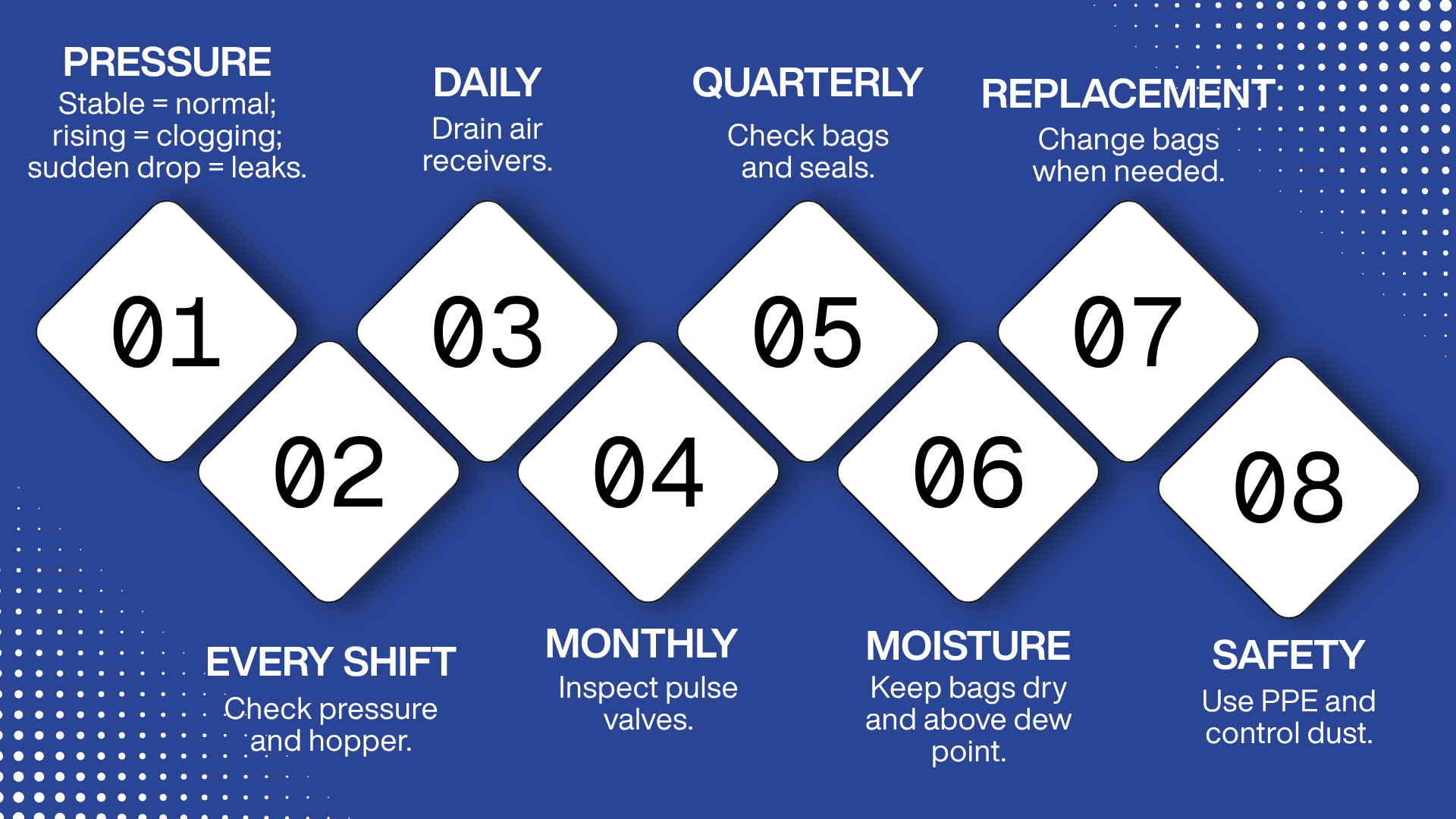
- Steady within the design range: cleaning is working.
- Slow, continuous climb: bags are blinding, pulses are weak, or moisture is caking the dust.
- Sudden drop: a bag has torn, or a seal has failed.
Plants that want earlier warning of failures can add bag leak detection, covered in EPA's fabric filter bag leak detection guidance.
Maintenance schedule
The frequencies below are a reasonable starting point. The equipment manual and your own operating data should set the final schedule.
| Task | Suggested frequency | What it prevents |
|---|---|---|
| Log differential pressure | Every shift | Unnoticed blinding and energy waste |
| Drain compressed-air receivers and check the dryer | Daily | Wet pulses that cake the bags |
| Empty the hopper and check the discharge device | Every shift, or as dust volume requires | Bridging and dust re-entrainment |
| Inspect pulse valves and diaphragms | Monthly | Weak or missing pulses |
| Inspect bags, cages and tube-sheet seals | Quarterly | Leaks and emission spikes |
| Stack monitoring | As your consent requires | Compliance surprises |
Moisture and start-up
EPA is explicit that fabric filters cannot run in moist environments and that the gas must stay above its dew point. Avoid drawing cold, humid air through the bags at start-up, and keep pulse air dry and oil-free. When bags reach the end of their life, replace the full set so airflow stays even across the bags.
Safe bag changes
Spent bags hold the same dust the collector was built to capture. Use a written bag-change procedure with suitable respiratory protection. Empty and remove collected dust in a way that does not contaminate other work areas, as OSHA 1910.94 requires for blasting dust collectors.
Signs Your Existing Collector Needs an Upgrade
Many plants run collectors sized for lighter work or older limits. Watch for:
- Stack monitoring results creeping upward from one round to the next
- A film of dust on roofs, ducts or the area around the machine
- Bag life getting shorter while pulse frequency rises
- Weaker suction at the blast chamber openings
- Fan current climbing compared with commissioning records
Upgrade options, in rough order of cost:
| Upgrade | What it addresses | Typical result |
|---|---|---|
| Repair hoods, ducts, doors and seals | Lost capture and air leakage | Restores suction at the source |
| Switch to finished or membrane bags | Emissions and blinding | Lower outlet concentration, cleaner cake release |
| Add a cyclone or inlet baffle | Abrasive wear on bags | Longer bag life |
| Move from fixed timer to differential-pressure cleaning | Wasted compressed air and bag fatigue | Lower air use, fewer failures |
| Add filter area or replace the collector | Air-to-cloth ratio set too high | Fixes the root cause when nothing else can |
Before spending, measure airflow at each extraction point, differential pressure and compressed air pressure at the header, and get a fresh stack result. The numbers show which upgrade the plant actually needs.
Shot Blasting Dust Collector Specification Checklist
Share these details with any supplier. A supplier who does not ask for them is guessing.
- Machine type (wheel blast or air blast) and every extraction point
- Design airflow at each point, and the static pressure required
- Abrasive type, size and expected breakdown rate
- Workpiece material and surface condition, including sand, paint and light alloys
- Inlet dust loading and particle size distribution, measured where possible
- Air temperature and humidity at the collector
- The outlet limit in your Consent to Operate, in mg/Nm³
- Combustibility test results, or the need for a dust hazard analysis
- Compressed air pressure and quality available at the collector
- Space, access and dust disposal arrangements
For a wider view of supplier selection, TECHFLOW's guide on how to choose a dust collection system manufacturer covers engineering depth, technology range and customisation.
Why Plants Choose TECHFLOW for Shot Blasting Dust Collection
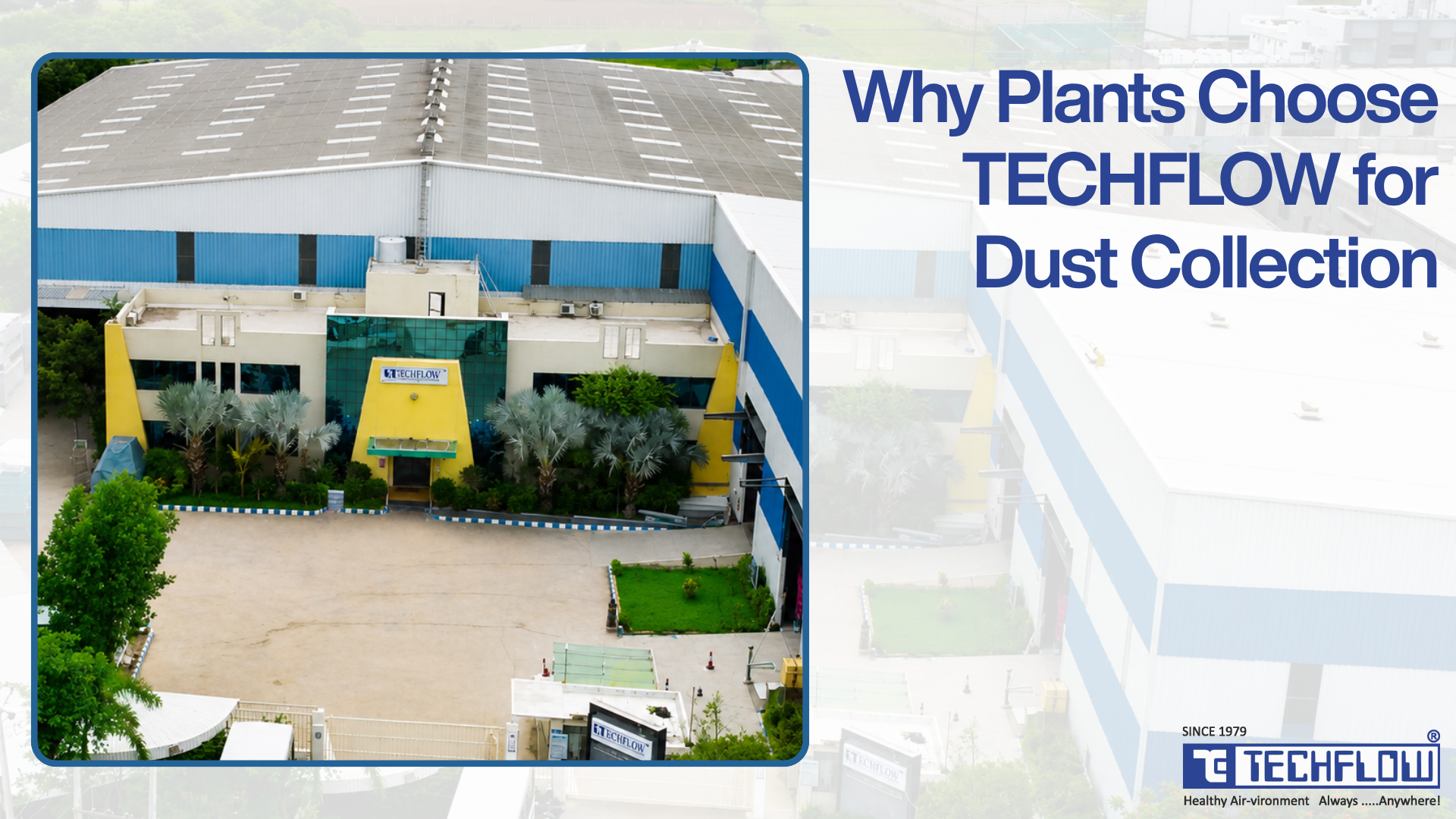
TECHFLOW (Techflow Enterprises Pvt. Ltd.) is an Ahmedabad-based manufacturer that has engineered dust collection and air pollution control systems since 1979. Every recommendation in this guide, from sizing on real dust loading to guaranteeing an outlet figure, depends on the engineering behind the collector. That is where TECHFLOW’s more than 4 decades of application experience shows. The company has supplied 3,169 dust collection systems and 15,589 centrifugal blowers, with installations listed across 28 countries, including India.
Engineered around the dust, not a catalogue table
A shot blasting collector often struggles when it is sized to a standard model rather than to the dust it actually handles. TECHFLOW designs each bag filter around dust loading, air-to-cloth ratio, can velocity, air temperature, dust type and the emission limit the plant must meet. Its engineers draw on an application database covering 127 types of dust. Selection and design run on specialised software under ERP control, supported by aerodynamic simulation studies, and a 17-member in-house design team carries out the work. The full background is on the TECHFLOW company profile.
Manufactured under one roof
TECHFLOW builds its equipment at a greenfield plant in Kubadthal, Ahmedabad, in operation since 2011. The 35,000 m² site includes a 12,000 m² workshop with CNC laser and plasma cutting, plate bending and impeller balancing. Filter housings, hoppers, tube sheets and blowpipe assemblies are made in-house. Diaphragm valves and filter bags come from suppliers TECHFLOW has qualified over many projects, and its quality management system follows ISO 9001:2015.
One engineering team for the whole extraction system
The bag filter, pre-separator, fan and discharge device only perform well when they are matched to one another. TECHFLOW designs and supplies all of them, so one team is accountable for how they work together, and the plant deals with one supplier instead of several.
For heavy, continuous blasting lines, the Pulse Jet Bag Filter (B-TPJF) offers row-by-row online or offline cleaning and tool-less bag and cage replacement. Spark arrestors and surface filtration media are available as options. TECHFLOW designs these units for outlet emissions as low as 2 mg/Nm³ where the dust and operating conditions allow. For smaller machines and blast cabinets, the Pulse Jet Cartridge Filter (C-TPJF) gives a compact, low-height alternative for ambient, free-flowing dust. TECHFLOW has built this cartridge line since the 1980s. Cyclones, centrifugal fans and rotary airlocks complete the system.
Commissioned properly, then supported
A collector that leaves the factory correct can still underperform if it is started up carelessly. TECHFLOW treats commissioning as part of the scope: cleaning cycle settings, inlet velocity distribution and differential pressure set points are tuned at start-up. A dedicated after-sales team supports plants after handover. For complete lines, TECHFLOW’s turnkey project services take shot and sandblasting installations from design through procurement, construction and commissioning.
A record number of customers come back to
TECHFLOW executes more than 450 dust control systems a year and reports that about 96% of its customers stay with it. It received the SME Chamber of India Manufacturing Excellence Award in 2012. Metso Minerals India is one of the clients whose testimonials appear on TECHFLOW’s website. It credits the company with bag filters of various capacities that were commissioned on schedule and run with minimal maintenance. Related surface-treatment applications are covered on TECHFLOW’s powder coating and shot blasting page.
Next Steps for Plant and EHS Teams
Shot blasting will always produce dust. Whether a shop stays healthy and compliant is usually decided when its shot blasting bag filter is specified. Three steps make the biggest difference:
- Measure before you buy or upgrade. Airflow at each point, inlet dust loading and your consent limit turn guesswork into a design basis.
- Specify the outlet, not just the percentage. Ask for a guaranteed mg/Nm³ figure at your stated inlet loading.
- Plan monitoring with the equipment. A logged differential pressure trend and a written bag-change procedure keep a 99.9% design performing years after commissioning.
Planning a new shot blasting line, or fighting rising pressure drop on an existing collector?
Send TECHFLOW's application engineers your machine type, airflow at each extraction point, abrasive, workpiece material and the outlet limit in your Consent to Operate. With that data, they can recommend a pulse jet bag filter, cartridge collector or cyclone-plus-filter arrangement sized to your measured dust load rather than a catalogue average.
Discuss your shot blasting dust collector · sales@techflow.net · +91 78747 19999 · Monday to Saturday, 9:00 am to 6:00 pm IST
Frequently Asked Questions (FAQs)
A shot blasting bag filter is a pulse-jet dust collector connected to a shot blasting machine. It draws dusty air from the blast chamber, elevator and separator through fabric filter bags, holds the dust on the bag surface, and cleans the bags with short compressed-air pulses while the machine keeps running.
New pulse-jet fabric filters are typically designed for 99 to 99.9% efficiency. Because outlet emissions depend on how much dust enters, ask for a guaranteed outlet concentration in mg/Nm³ that meets your Consent to Operate with margin.
Moulding sand on castings, and quartz in some abrasives or substrates, can release respirable crystalline silica, which causes silicosis. Even short blasting tasks can produce exposures high enough to breach OSHA's eight-hour limit.
Needle-felt polyester is the usual starting point for dry, near-ambient blasting dust. A singed finish or ePTFE membrane improves cake release and fine-dust capture, and antistatic media is needed when the dust is combustible.
EPA gives a typical range of 100 to 250 mm of water column. Stability matters more than the exact figure: a steady reading shows effective cleaning, while a slow climb points to blinding and a sudden drop suggests a leak.
There is no fixed interval. TECHFLOW's guidance puts typical industrial bag life at about 1.5 to 4 years, depending on dust, temperature, air-to-cloth ratio and maintenance. Replace the full set when pressure drop stays high after cleaning, emissions rise, or inspection shows wear.
Not always. A cyclone helps when the dust stream carries heavy, coarse abrasive or when spark trapping is needed. It reduces bag wear and dust loading, but it cannot replace the bag filter for fine particles.
Yes, when the dust is combustible and an ignition source is present. Fine aluminium, magnesium and other metal dusts are the main concern. NFPA 660 sets out a dust hazard analysis process, and typical measures include antistatic media, grounding, spark control and explosion venting or suppression.
Online cleaning pulses rows of bags while the collector keeps filtering. Offline cleaning isolates one compartment at a time so released dust settles into the hopper instead of returning to neighbouring bags, which suits heavy dust loads and tight emission limits.
Choose a bag filter for large airflows, heavy abrasive loading or warmer air. Choose a cartridge collector when space is limited, and the dust is fine, dry and at ambient temperature.
TECHFLOW, based in Ahmedabad, Gujarat, has designed and manufactured dust collection systems since 1979. Its range for shot blasting includes pulse jet bag filters, pulse jet cartridge filters, cyclones and centrifugal blowers.


