
Key Takeaways
- Filter bag media is chosen by matching the fabric to six factors: gas temperature, gas chemistry, moisture and dew point, dust behaviour, emission limit and cleaning method.
- Gas temperature sets the shortlist of viable fabrics; chemistry, moisture and dust behaviour determine the final choice.
- Felted (needle-punched) media suits pulse-jet dust collectors; woven media suits reverse-air and mechanical-shaker collectors.
- A PTFE (polytetrafluoroethylene) membrane converts a bag to surface filtration and captures fine particulate from start-up, making it a common choice for stringent emission limits.
- Properly specified fabric filters achieve particulate collection efficiencies of 99% or higher, even on very fine particles.
- Industrial filter bag life typically ranges from about 1.5 to 4 years, depending on dust, temperature, air-to-cloth ratio and maintenance.
- The most reliable cost measure for filter bags is cost per tonne of product, not purchase price.
Filter bag media is selected by matching the fabric to six gas-stream conditions: temperature, chemistry, moisture, dust behaviour, emission limit and cleaning method, with continuous and peak temperature setting the shortlist, and chemistry plus dust behaviour deciding the final choice. Get that match right and a baghouse becomes a long-term compliance asset; get it wrong and the bags blind early, emissions creep upward, and the maintenance budget quietly bleeds.
That single decision which fabric, which construction, which surface finish is the focus of this guide.
A baghouse is only ever as good as the fabric working inside it. You can size the airflow correctly, pick the right cleaning system, and engineer a sound structure, but if the filter media doesn't suit the gas it has to handle, the bags blind early, stack emissions creep upward, and replacement costs quietly drain the maintenance budget.
Media selection is one of the highest-stakes decisions in any dust collection project and one of the most frequently rushed. Two plants can run what looks like the same process and still need entirely different fabrics, because a few degrees of gas temperature or a slightly lower dew point changes everything. This guide explains how that decision is actually made on the ground: the fabrics available, what each one does well, where each one fails, and the framework engineers use to match media to a real application.
At TECHFLOW, media selection sits at the centre of every system we design. It is the single factor that most directly governs how long a fabric filter stays compliant and what it costs to run over its working life.
Quick Answer: How Do You Choose Filter Bag Media?
To choose the right filter bag media, match the fabric to six conditions in your gas stream:
- Continuous and peak gas temperature: these rules fabrics in or out first.
- Gas chemistry: acids, alkalis, solvents and oxygen content.
- Moisture and dew point: the risk of condensation inside the bag.
- Dust behaviour: particle size, abrasiveness, stickiness and combustibility.
- Required emission limit: tighter limits push you toward membrane media.
- Cleaning method and air-to-cloth ratio: pulse-jet systems need felted, not woven, fabric.
Temperature usually decides the shortlist. Chemistry and dust behaviour decide the final choice.
What Does Filter Bag Media Actually Do?
Filter bag media is the engineered fabric that captures particulates as process gas passes through it. In a fabric filter, dust-laden air enters the housing, the fibres trap particles, and clean gas exits to the stack. Properly specified, fabric filters routinely achieve particulate collection efficiencies of 99% or higher, even on very fine particles, the consistency that makes them the backbone of industrial air pollution control.
But the fabric isn't really the filter. Within minutes of start-up, a thin layer of collected dust, the filter cake, forms on the surface and becomes the true filtering medium, trapping particles far smaller than the pores of the cloth itself. The job of good media is to hold enough cake to filter efficiently, then release that cake cleanly when the bag is pulsed.
Media that releases poorly drives pressure drop up and airflow down. Media that bleeds fine dust pushes emissions up. Everything that follows in this guide is, at heart, about getting that balance right for your specific conditions.
Woven or Felted? The First Decision
Before you choose a fibre, you choose a construction, and the two behave very differently.
Felted (needle-punched) media packs entangled fibres into a dense mat and rely on surface filtration. Dust collects on top, cake release is clean, and the structure tolerates the sharp cleaning energy of a pulse jet. This is the standard for most modern pulse-jet bag filters.
Woven media has a defined weave and leans more on depth filtration. It is gentler to clean and is generally paired with reverse-air or mechanical-shaker collectors.
If you are running a pulse-jet dust collector, the most common configuration across Indian industry, you will almost always be specifying felted media, often carrying a surface treatment.
Filter Bag Media Compared by Temperature, Strength and Application
The table below summarises the workhorse fabrics used in industrial baghouses. The figures are approximate continuous operating limits; short surges are tolerated differently by each fabric, which is precisely why peak temperature has to be specified on its own.
|
Media |
Continuous Temp (approx.) |
Key Strengths |
Typical Applications |
|
Polyester (PE) |
~130–150 °C |
Low cost, tough, versatile |
Shot blasting, woodworking, cement packing, general dust |
|
Acrylic (homopolymer) |
~125 °C |
Handles moist, mildly acidic gas |
Dryers, fertiliser, moderate-temperature flue gas |
|
PPS (polyphenylene sulfide) |
~190 °C |
Excellent acid and chemical resistance |
Coal-fired boilers, low-oxygen flue gas |
|
Aramid (e.g. Nomex®) |
~190–200 °C |
High strength, abrasion resistance |
Foundries, steel, asphalt, electric arc furnaces |
|
P84 (polyimide) |
~240–260 °C |
Multi-lobal fibre captures fine dust |
Incinerators, kilns, calciners, smelters |
|
PTFE (felted) |
~260 °C |
Chemically inert, superb cake release |
Corrosive, hazardous and fine-particulate duty |
|
Fibreglass |
~260 °C+ |
High heat, broad acid resistance |
Cement kilns, power plants, high-temperature dryers |
Polyester (PE): the default for ambient and warm dust
At a glance: cheapest, toughest all-rounder for dry dust up to roughly 130–150 °C; fails in hot, humid or acidic gas.
Polyester is the most widely used media in general industry for good reason: economical, mechanically tough and comfortable across most dry dust streams from room temperature up to moderate heat. Its Achilles' heel is hydrolysis; sustained heat combined with moisture breaks the fibre down, so it is a poor fit for hot, humid or acidic gas. For the dry, ambient-temperature dust generated in shot blasting, grinding and woodworking, it is usually all you need.
Acrylic: for damp, mildly acidic gas
At a glance: beats polyester in damp, slightly acidic conditions at moderate temperatures.
Acrylic outperforms polyester in damp, slightly acidic conditions at moderate temperatures. It earns its place on certain dryer and flue-gas duties where polyester would degrade, but the temperature doesn't yet justify a high-end fibre.
PPS (polyphenylene sulphide) the acid specialist
At a glance: superb acid resistance for low-oxygen flue gas; oxidizes quickly in oxygen-rich heat.
PPS comes into its own where flue gas is acidic, but oxygen content is low the classic example being coal-fired boilers. Its chemical resistance and non-flammability are excellent. The caveat is real: in oxygen-rich, high-temperature streams it oxidizes and ages prematurely, so the gas analysis has to confirm low oxygen before it is specified.
Aramid: the mechanical workhorse
At a glance: tough, abrasion-resistant fibre for hot, punishing duty; sensitive to moisture and alkalis.
Aramid is the go-to for hot, abrasive, mechanically punishing duty foundry, steel and asphalt work where bags simply take a beating. It offers strong dimensional stability and abrasion resistance at temperatures the polyester can't approach. It does have limits: it is sensitive to hydrolysis and to alkaline dust, so high-moisture streams and alkali-rich applications such as cement kiln tails need careful evaluation before it is chosen.
P84 (polyimide): for fine particulate at high heat
At a glance: irregular multi-lobal fibre captures fine dust at high temperature; carries a price premium.
P84's fibre has an irregular, multi-lobal cross-section that sharply increases surface area, helping it capture fine particulate more efficiently than round-fibre fabrics. It performs well in dry, high-heat, low-acid environments such as incinerators and kilns. It carries a premium, justified where fine-dust capture and high temperature have to be solved together.
PTFE (polytetrafluoroethylene): the near-universal performer
At a glance: chemically inert, handles acids and moist heat, releases cake exceptionally well; the most expensive mainstream option.
PTFE, the same polymer family as Teflon™, is chemically inert, shrugs off acids and moist heat, tolerates high temperatures, and releases dust cake exceptionally well. It is the most expensive mainstream option, which is why it is reserved for the hardest corrosive, hazardous and fine-particulate duties where lesser fabrics simply won't survive.
Fibreglass: high heat, with a structural caveat
At a glance: tolerates very high heat and most acids, but is brittle; best for gentle reverse-air cleaning, or PTFE-coated for pulse-jet duty.
Fibreglass tolerates very high temperatures and resists most acids, hydrofluoric acid being the notable exception. Its weakness is mechanical: glass fibres are brittle and flex poorly, so bare fibreglass suits gentle reverse-air cleaning far better than aggressive pulse-jet cleaning. Where high heat and pulse-jet duty coincide, PTFE-coated fibreglass is the usual answer.
Surface Finishes: Where Real-World Performance Is Won
Two bags cut from the same fibre can perform worlds apart depending on their surface treatment. In practice, the finish is often what separates a bag that comfortably meets a tight emission limit from one that doesn't.
- Singeing, calendering and glazing use heat and pressure to smooth the surface, improving cake release and lowering the residual pressure drop left after each pulse.
- PTFE membrane lamination bonds a microporous film pores typically in the sub-micron to low-micron range, onto the fabric face. This converts the bag to pure surface filtration and delivers the highest efficiency on fine particulate. When emission limits are stringent, this is frequently the deciding feature.
- Anti-static (conductive) treatment dissipates static charge and is essential for combustible or explosive dusts, where a single spark cannot be tolerated.
- Water- and oil-repellent (W+O) finishes guard against condensation and help with hygroscopic dusts that would otherwise blind the cloth.
- Acid- and alkali-resistant treatments extend life where the chemistry is aggressive.
A well-chosen membrane on a moderately priced base fabric will often outperform a bare premium fabric on both emissions and lifetime cost.
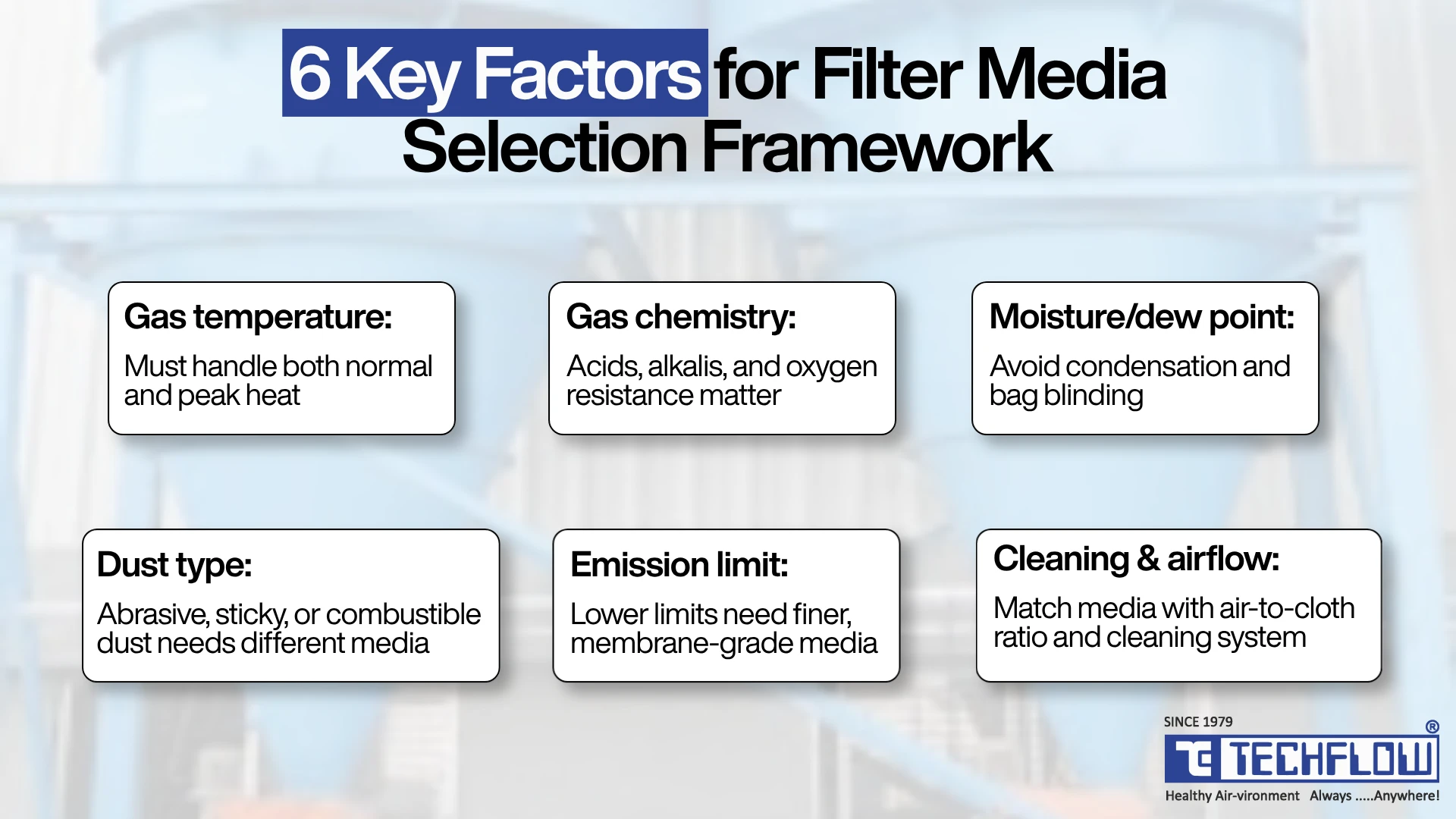
The Selection Framework: Six Factors That Decide the Media
1. Gas temperature: continuous and peak
Temperature is the first cut. A fabric rated for 150 °C continuous will fail fast at 200 °C, and the surge temperatures that occur during process upsets matter as much as the steady-state figure.
Always specify both steady-state and peak. The media has to survive your worst hour, not just your average one. The wrong media at the wrong moment turns a single upset into a full bag change.
2. Gas chemistry
Acids, alkalis, solvents and oxygen can attack fibres even at modest temperatures. PPS resists acid but dislikes oxygen-rich heat; aramid dislikes alkalis; PTFE resists almost everything. A representative gas analysis should precede any firm recommendation, not follow it.
3. Moisture and dew point
If gas cools below its dew point inside the housing, moisture condenses, dust turns to paste and bags blind. Insulation, gas pre-heating and moisture-resistant fibres or finishes all manage this risk, but it has to be designed for, not discovered after commissioning. We have lost more bags to a missed dew point than to almost any fabric defect.
4. Dust behaviour
Particle size, abrasiveness, stickiness, hygroscopicity and combustibility each steer the choice:
- Abrasive dust favours tough fibres such as aramid.
- Sticky or hygroscopic dust favours a membrane surface.
- Combustible dust makes anti-static media non-negotiable.
5. Required emission limit
Indian sponge iron and steel operations are generally required to hold particulate emissions below 100 mg/Nm³, and many newer environmental consents set tighter figures still. The lower the permitted limit, the stronger the case for membrane-finished media that capture fine particulate from the very first minute of operation.
For newer facilities or plant expansions, the Ministry of Environment, Forest and Climate Change (MoEFCC) and State Pollution Control Boards (SPCBs) routinely mandate tighter limits of 50 mg/Nm³ or even 30 mg/Nm³ We explore this further in our look at air pollution control in sponge iron production.
6. Cleaning method and air-to-cloth ratio
The air-to-cloth ratio is the volume of gas filtered per unit area of fabric; in plain terms, how hard each square metre of cloth is being worked. As a rough industry benchmark, pulse-jet systems typically run around 0.9–1.2 m/min, while gentler reverse-air and shaker systems sit lower, often nearer 0.5–1.0 m/min. Push the ratio too high and even good media blinds and wears out early.
Pulse-jet cleaning also applies the most mechanical stress of any cleaning method, which is one more reason it calls for felted or membrane-laminated fabric rather than fragile woven cloth. Sound media choice and disciplined filter bag cleaning work hand in hand to protect both compliance and bag life.
A Quick Decision Logic: Which Fabric, in What Order
When we shortlist a fabric on site, the reasoning tends to run like this:
- Measure continuous and peak temperature. Below ~130 °C and dry → polyester is likely enough. Above it, climb the table.
- Check chemistry. Acidic and low-oxygen (e.g. coal-fired boiler) → PPS. Hot and abrasive (foundry, steel) → aramid. Aggressively corrosive → PTFE.
- Check the dust. Very fine particulate at high heat → P84, or a PTFE membrane on a suitable base.
- Check the emission limit. Tight limit → add a PTFE membrane regardless of base fibre.
- Confirm the cleaning system. Pulse-jet → felted/membrane. Reverse-air or shaker → woven (or coated fibreglass for high heat).
It is a shortlist, not a verdict. The measured numbers always have the final say.
A Worked Example: Sponge Iron Kiln Exhaust
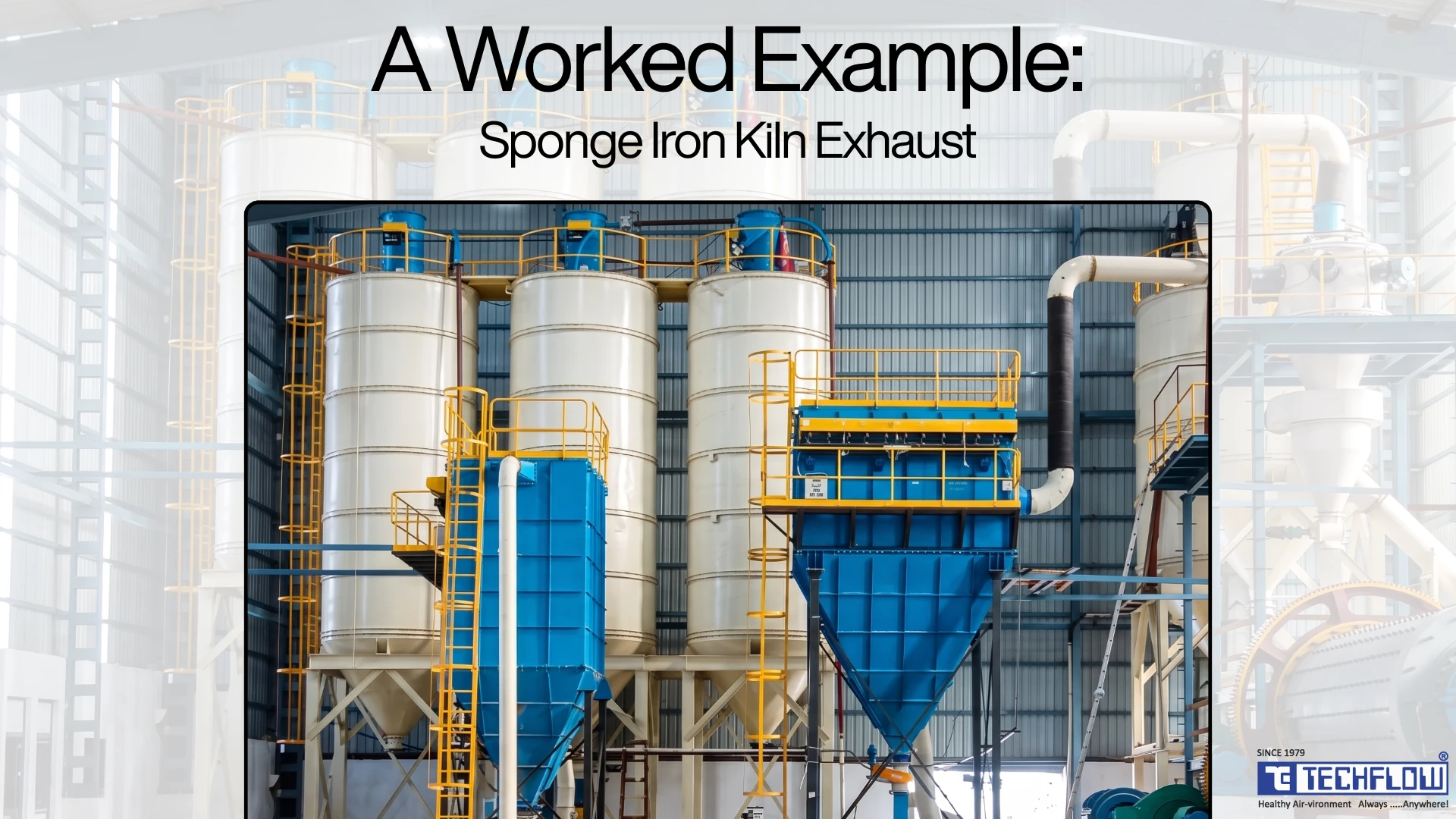
Picture a sponge iron plant cleaning gas from the kiln and after-burning chamber. The stream is hot, carries abrasive char and iron-bearing dust, and has to clear a strict particulate limit.
- Polyester is out immediately on temperature.
- Aramid handles both the heat and the abrasion well.
- Where the plant needs to comfortably beat a tight emission limit on fine dust, an aramid or PPS base fabric carrying a PTFE membrane is a common, well-balanced specification.
The honest answer, though, still depends on the measured gas temperature, oxygen content and moisture at that specific plant, which is exactly why a sound media recommendation follows a site assessment rather than preceding it. The same logic underpins why pulse-jet bag filters matter so much for Indian steel plants: the right fabric, correctly matched, is what turns a filter into a compliance asset.
Cost Versus Service Life: Why the Cheapest Bag Rarely Wins
It is tempting to compare filter bags on purchase price. The number that actually matters is cost per tonne of product over the working life of the bag.
A premium fabric can cost several times more than polyester yet last several times longer in demanding service, while also cutting unplanned shutdowns, trimming compressed-air consumption and reducing the risk of an emission exceedance. Bag life varies widely with dust, temperature, air-to-cloth ratio and maintenance; anywhere from roughly 1.5 to 4 years is typical, and the right media, correctly sized and well looked after, sits at the top of that range.
And here is the part that gets understated in most fabric-selection debates: in the failures we are called in to investigate, the fibre itself is usually fine. More often it is an air-to-cloth ratio that was pushed too high to save on collector size, or a dew point nobody designed for. A cheap bag that fails early is almost always the most expensive choice you can make, but so is a premium bag working in a badly sized system.
Conclusion: The Fabric Decides Everything
A dust collector is only as effective as the media working inside it. Choosing filter bag media isn't about finding the "best" fabric in the abstract; it's about matching the right fabric, construction and finish to the precise conditions of your gas stream. Temperature draws up the shortlist; chemistry, moisture, dust behaviour, emission limits and cleaning method decide the winner.
The plants that get this right treat media selection as an engineering decision grounded in measured data: gas temperature, oxygen content, dew point and dust analysis, rather than a purchasing decision driven by sticker price. They understand that a premium fabric or a well-chosen PTFE membrane often pays for itself many times over through longer bag life, lower compressed-air consumption, fewer unplanned shutdowns and consistent compliance.
If there's one principle to carry away, it's this: specify for your worst hour, not your average one, and measure cost per tonne of product rather than cost per bag. Get the fabric right, and the baghouse becomes a long-term compliance asset. Get it wrong, and it becomes a recurring drain on the maintenance budget.
When you're ready to match media to your specific application, a proper site assessment, not a catalogue, is where the right answer begins. Talk to the TECHFLOW team about a gas-stream assessment for your plant.
Frequently Asked Questions (FAQs) :
The filter media is the engineered fabric that captures dust. The filter bag is a media fabricated into the tube or envelope shape that fits inside the baghouse. The media governs performance; the bag dimensions govern fit.
For continuous temperatures up to roughly 190–200 °C, PPS and aramid are common. From there up to around 260 °C, P84, PTFE and fibreglass take over. The right choice within that band depends on gas chemistry and dust behaviour, not temperature alone.
A PTFE membrane is a microporous film bonded to the bag surface that forces pure surface filtration. It captures very fine particulate from start-up, improves cake release and helps plants meet stringent emission limits.
Service life commonly runs from about 1.5 to 4 years, depending on dust type, gas temperature, air-to-cloth ratio and maintenance discipline. Correct media selection and regular cleaning push life toward the upper end of that range.
It is the volume of gas filtered per unit area of fabric, usually expressed in m/min. Pulse-jet systems typically run around 0.9–1.2 m/min and reverse-air systems lower. Too high a ratio overworks the cloth, raising pressure drop, accelerating wear and shortening bag life. Correct sizing keeps the system efficient and compliant.
No. Felted media suits pulse-jet systems, while woven media suits reverse-air and shaker systems. Beyond construction, the fibre and finish must match the specific gas and dust, so media should always be selected per application.
The wrong media blinds early, raises pressure drop, increases compressed-air and energy use, and risks emission exceedances and unplanned shutdowns. Premium media that lasts longer usually wins on cost per tonne of product produced.