


Key Takeaways
- An air pollution control system for a waste-to-energy plant is a multi-stage flue gas train, not one device, with particulate, acid gas, dioxin, and NOx control handled separately.
- Bag filters and ESPs both capture particulate matter and compete for that job; FGD removes acid gases (SO₂, HCl, HF) and works alongside either, not instead of them.
- Bag filters capture fine, sub-micron particulate more reliably than ESPs and shrug off ash-chemistry swings, which is why new MSW-fired plants tend to favour them.
- ESPs run at low pressure drop and low cost on high-volume streams but lose efficiency when fly ash resistivity drifts outside their optimal window.
- FGD comes in wet, semi-dry and dry forms, each trading capital cost, water use, footprint and SO₂ removal against the others.
- India's Solid Waste Management Rules 2016 set the binding stack limits, including 50 mg/Nm³ particulate and 0.1 ng TEQ/Nm³ dioxins, all corrected to 11% oxygen on a dry basis.
- Staying compliant day to day comes down to sequencing, maintenance, and continuous emission monitoring, not just the equipment picked at the design stage.
Municipal solid waste is one of the hardest fuels an engineer can design around. Its composition changes from one truckload to the next, and when it burns, it releases a flue gas that no coal or gas boiler quite produces: fly ash, acid gases, nitrogen oxides, heavy metals, and trace dioxins and furans. Cleaning that gas stream is not a bolt-on to a waste-to-energy (WtE) plant. It is a core part of the plant's engineering, and it decides whether the facility can hold an operating consent year after year.
This guide walks through how a WtE air pollution control (APC) system is put together, and where the three technologies people most often confuse sit: bag filters, electrostatic precipitators (ESPs), and flue gas desulphurisation (FGD). The thing to grasp first is that these are not three answers to the same question. A bag filter and an ESP both capture particulate matter, so they compete for that role. FGD does something else entirely: it neutralises acid gases that would otherwise pass straight through any particulate device untouched. A real WtE plant usually runs a particulate device and FGD and more, in a deliberate sequence.
What an Air Pollution Control System Does in a WtE Plant
An air pollution control system in a WtE plant is the sequence of flue gas cleaning stages that strips regulated pollutants out of combustion exhaust before it reaches the stack. It is not a single machine but a train of devices, each designed to remove different pollutant classes: particulate collection, acid gas removal, dioxin and mercury control, and NOx reduction.
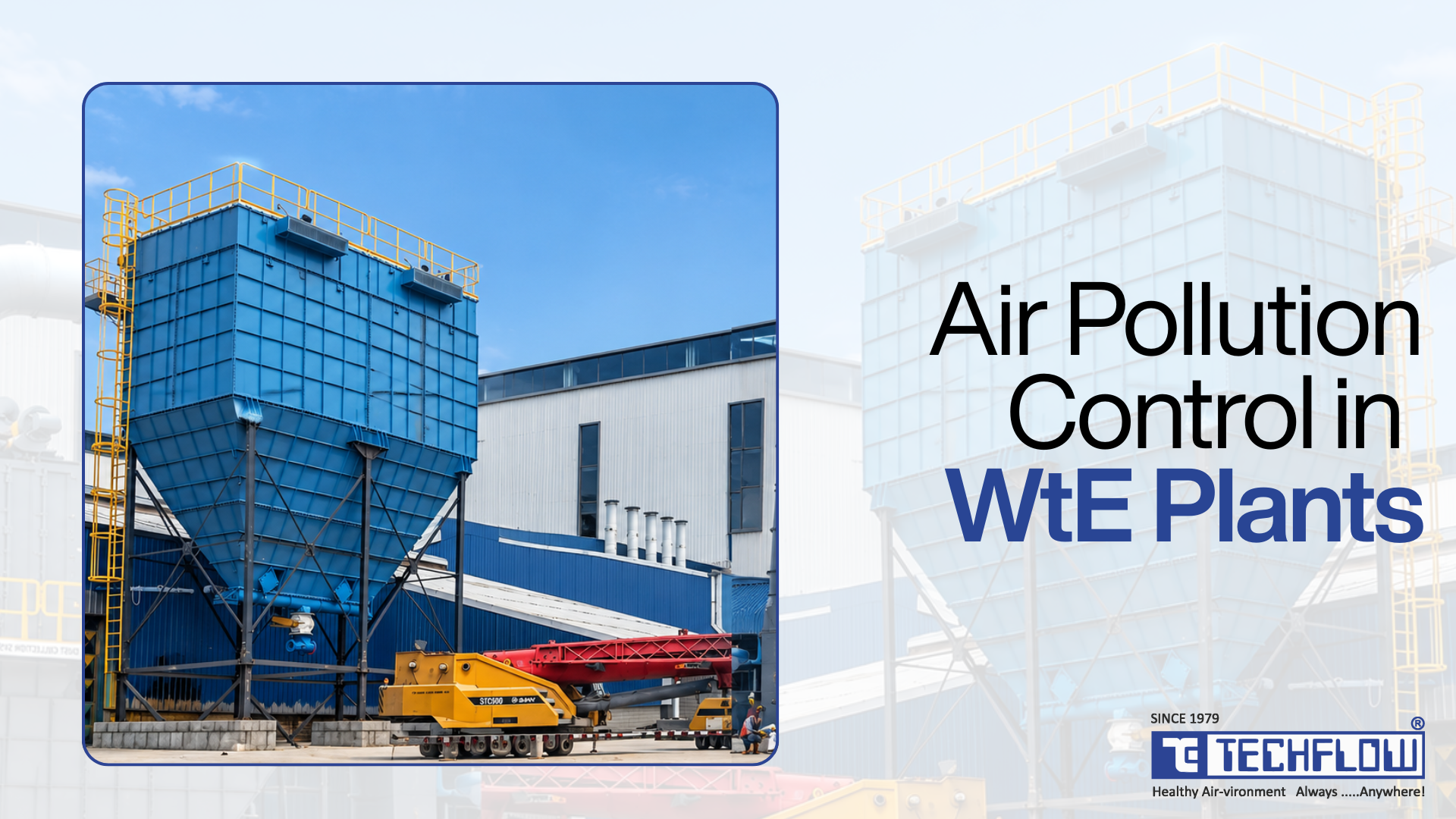
A WtE plant recovers energy by burning municipal solid waste (MSW) or refuse-derived fuel (RDF), usually on a moving grate, to raise steam and drive a turbine. Combustion is only half the plant. The other half is the APC train, and its job is to take raw combustion gas, which would breach ambient air quality standards within minutes of an uncontrolled release and corrode downstream ducting within months, and bring every regulated pollutant below its permitted limit, continuously, while the waste feed and boiler load keep shifting. No single device does that. Take out or undersize one stage and the next one is overloaded.
How Emissions Are Controlled in Waste-to-Energy Plants
Emissions are controlled by assigning a dedicated technology to each pollutant class and arranging those technologies in sequence. Good combustion destroys organics at source; a particulate collector (bag filter or ESP) removes fly ash and particle-bound metals; FGD neutralises acid gases; activated carbon adsorbs mercury and residual dioxins; and SNCR or SCR reduces NOx.
The pollutants do not all respond to the same equipment, which is exactly why several stages are needed:
- Particulate matter and fly ash: The fine, non-combustible ash carried in the gas. Heavy metals and condensed dioxins cling preferentially to the finest particles, so a device that captures fine particulate also removes a good share of those pollutants indirectly.
- Acid gases: SO₂, HCl and HF: Vapours that pass through particulate collectors untouched and need their own acid gas stage. HCl matters especially in waste combustion, because chlorine-bearing plastics push it well above coal-boiler levels.
- Nitrogen oxides (NOx) and carbon monoxide (CO): NOx forms at combustion temperatures; CO flags incomplete combustion. NOx is handled thermally or catalytically, not by particulate or acid gas devices. CO is handled through good combustion.
- Dioxins and furans (PCDD/F): Trace organics that form during combustion and can re-form downstream through de novo synthesis, in a window of roughly 200 to 450 °C. Controlled by good combustion, rapid cooling through that window, and activated carbon adsorption on a downstream filter.
- Heavy metals: mercury, cadmium, lead, and others. Mercury is the hardest to catch because part of it stays in the vapour phase, so it needs activated carbon injection ahead of a filter. The others are mostly particle-bound and leave with the fly ash.
Where Air Pollution Control Fits in the Flue Gas Treatment Train
Flue gas leaves the combustion chamber hot and dirty, and the APC train handles it in a set order. A representative modern sequence runs like this:
- Boiler and heat recovery: Energy comes off as steam and the gas cools.
- Gas conditioning and cooling: An evaporative quench drops the temperature into the window where downstream capture works and where dioxin re-formation is kept down.
- Acid gas treatment (FGD): In dry and semi-dry setups, hydrated lime is injected here.
- Activated carbon injection: Adsorbs mercury and residual dioxins.
- Particulate collector (bag filter or ESP): Captures fly ash along with spent lime and loaded carbon in one pass.
- NOx control (SNCR, sometimes SCR): SNCR acts back in the furnace; SCR, where fitted, sits further downstream.
The exact order shifts with the FGD type, which is the heart of the design. The point worth holding onto: in a dry or semi-dry plant, the particulate collector does double duty, acting as both the fly ash filter and the final trap for reacted reagent and carbon. That is why a bag filter so often sits at the very end of the train.
What a Bag Filter Removes, and How It Works
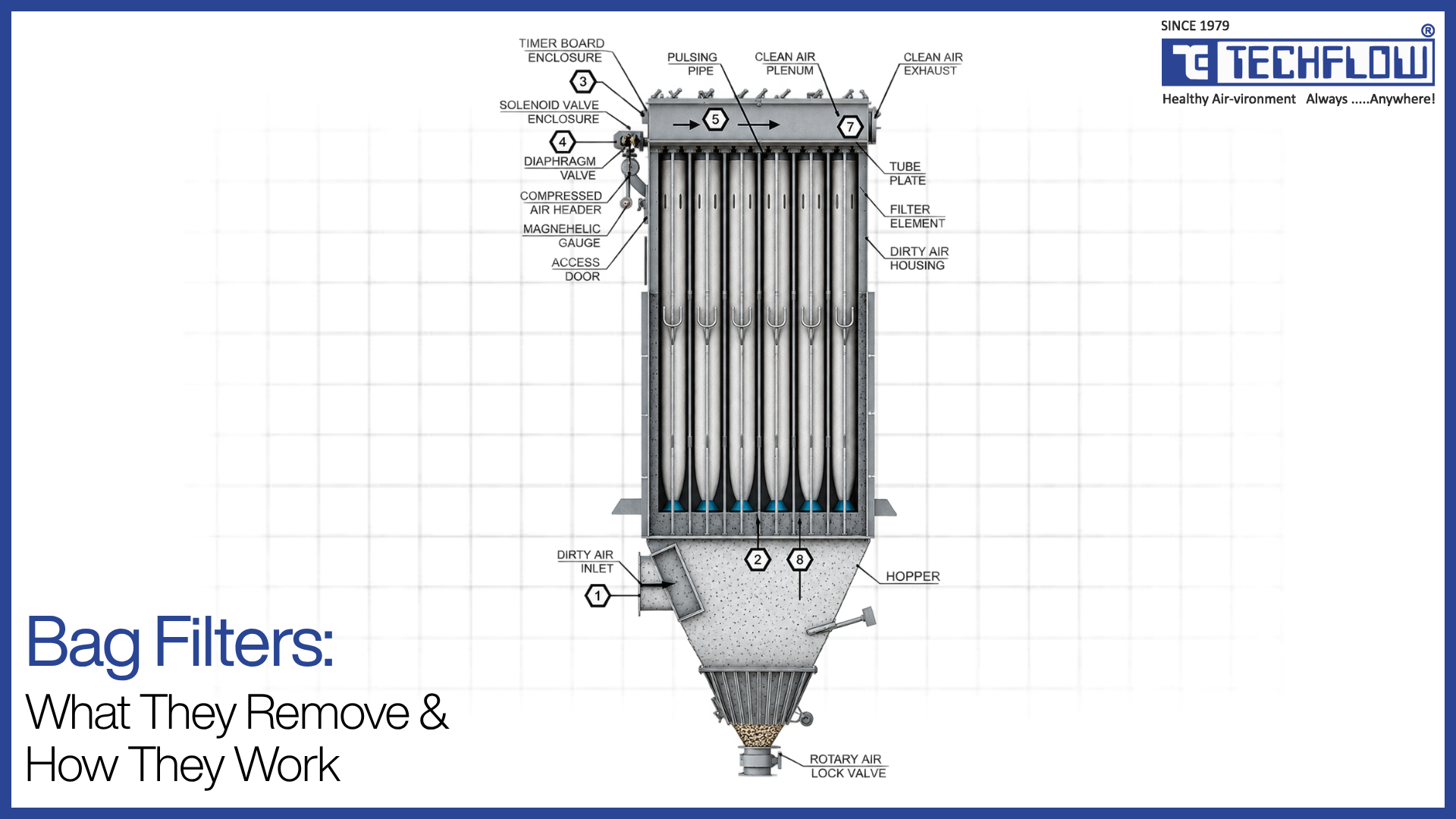
A bag filter removes particulate matter, including the fine sub-micron fraction, by physical filtration, and in doing so helps capture the heavy metals and dioxins riding on that fine dust. Also called a baghouse or fabric filter, it pushes dust-laden gas through fabric bags. A dust layer, the filter cake, builds on the fabric surface, and it is this cake, more than the weave itself, that does the fine filtration. Clean gas passes through; the cake is periodically knocked off into hoppers below.
In pulse-jet designs, which dominate WtE applications, a short burst of compressed air is fired down each bag to shed the cake, so the baghouse keeps running without taking compartments offline.
Pollutants controlled: Mainly particulate matter. Because dioxins, furans, and heavy metals concentrate on fine particles, and because the dust cake gives injected lime and activated carbon longer contact with the gas, a fabric filter placed after dry sorbent and carbon injection also pulls out a meaningful share of acid gases and dioxins. Pilot data on MSW incinerators put fabric-filter PCDD/F removal in the region of 95 to 97%.
Advantages: Collection efficiency is high and barely depends on the fly ash's electrical resistivity, so it stays steady even as waste composition swings. Fabric filters are considerably better than ESPs at catching particles below 2 microns, and the filter cake makes them a strong partner for dry acid gas control.
Limitations: Fabric filters run a higher pressure drop than ESPs because of the media and cake, which pushes up fan power. They are temperature-limited: the gas usually has to be cooled below about 150 °C before the bags, since standard media degrade above their rated limit, and acidic condensation can blind or rot the fabric if the gas falls below its dew point. They also cope less well with sudden upsets and load swings than ESPs. Bag material (PTFE-membrane, fibreglass, aramid and others) has to be matched to the actual gas temperature, moisture and acid content, and the wrong choice fails fast.
How an Electrostatic Precipitator (ESP) Works
An ESP removes particulate without a physical barrier by charging dust particles in a high-voltage field and collecting them on grounded plates. The gas flows between discharge electrodes and collecting plates; a corona discharge charges the particles, which then drift to the plates and stick. Collected dust is knocked loose by mechanical rapping and falls into hoppers. Because the energy goes into the particles rather than the whole gas stream, an ESP results in a low pressure drop, and so a low fan-power cost, which is its defining advantage.
Multi-field ESPs put several charging-and-collection zones in series, so each field grabs what the one before it missed. That is how higher efficiencies are reached.
Pollutants controlled: Particulate matter, including particle-bound heavy metals and dioxins. Just like a bag filter, an ESP does nothing for vapour-phase acid gases.
Advantages: Low pressure drop and low running cost on large, hot, high-volume gas streams. ESPs tolerate higher temperatures than fabric filters and handle continuous heavy dust loads without the media wear of bags, which has made them a long-standing choice for high-throughput, fairly consistent streams such as biomass and coal-assisted boilers.
Limitations: ESP performance hangs on fly ash resistivity, which depends on fuel chemistry, and MSW ash chemistry changes day to day, so efficiency can drift with the waste mix. At the fine end, the physics works against it too: as particles approach the sub-micron range, collection efficiency drops off. That combination, resistivity sensitivity plus weaker sub-micron capture, is the main reason new MSW-fired units lean toward fabric filters for the final particulate stage, often keeping an ESP for bulk pre-collection.
What FGD Is Used For, and What Pollutants Need It
Flue gas desulphurisation controls acid gases: chiefly SO₂, and in waste plants HCl and HF as well. These gases are vapours, so they pass straight through any particulate collector, which means they need FGD no matter which particulate device is installed. FGD reacts the acid gases with an alkaline reagent, usually lime or limestone, to form solid or dissolved salts. Three approaches dominate, and they differ mainly in how the reagent meets the gas and how much water is involved:
Wet FGD:
A limestone or lime slurry is sprayed into an absorber tower; the acid gases react in the liquid phase to form calcium sulphite and sulphate, recovered in some plants as saleable gypsum. Wet limestone scrubbing removes roughly 95% of the SO₂, the highest of the three, but it needs the most water, usually calls for reheating the saturated gas leaving the absorber, and has the most involved wastewater and byproduct handling.
Semi-dry FGD (spray dry absorption):
A concentrated lime slurry is atomised into the gas; the water evaporates, and the acid gases react to a dry powder, caught downstream, usually on a fabric filter. This folds acid gas removal and particulate polishing into one step and uses far less water. It is a common pick for small and mid-sized WtE plants.
Dry sorbent injection (DSI):
Powdered hydrated lime or sodium bicarbonate is injected straight into the ductwork, with the reacted solids caught on the downstream filter. Lowest capital cost and simplest footprint, at the price of higher reagent use and generally lower peak removal.
Sequencing follows from the chemistry. In wet systems, the gas goes through a particulate device first and then into the SO₂ absorber; in dry and semi-dry systems, the SO₂ is reacted with lime first, and the gas then passes through the particulate device. That is the whole reason a bag filter so often sits last in a dry or semi-dry WtE train: it has to capture the reacted lime and spent carbon, not just fly ash.
Bag Filter vs ESP vs FGD: An Honest Technical Comparison
The usual "bag filter vs ESP vs FGD" framing is misleading, because it throws two competing particulate technologies in with a third that does a different job. The table below keeps those roles straight.
| Parameter | Bag Filter (Fabric Filter) | Electrostatic Precipitator (ESP) | Flue Gas Desulphurisation (FGD) |
|---|---|---|---|
| Primary pollutant | Particulate matter | Particulate matter | Acid gases (SO₂, HCl, HF) |
| Working principle | Physical filtration through fabric and dust cake | Electrostatic charging and collection on plates | Reaction with alkaline reagent (lime/limestone) |
| Competes with | ESP | Bag filter | Neither; it complements both |
| Typical performance | 95 to 99%+ PM, strong on sub-micron | ~99% bulk PM, weaker on sub-micron | ~95% SO₂ (wet); semi-dry/dry need a downstream filter |
| Sensitivity to ash variability | Low (mechanical capture) | Higher (resistivity-dependent) | Reagent dosing adjusts to acid load |
| Pressure drop/fan power | Moderate to high | Low | Varies by type (wet highest) |
| Temperature tolerance | Limited by media (~150 °C typical) | Higher | Wet cools/saturates; dry/semi-dry run warmer |
| Position in train | After the acid gas stage in dry/semi-dry plants | Before FGD, or hybrid pre-collection | After or before the PM device, by type |
| Maintenance focus | Bag replacement, pulse-jet cleaning, dew-point control | Electrode alignment, rapping, HV components | Reagent dosing, scaling, slurry/byproduct handling |
Can an ESP and a Bag Filter Be Used Together?
Yes. Since a bag filter and an ESP do the same job, some plants run them in sequence rather than choosing one. An ESP takes out the bulk of the fly ash cheaply, and a downstream fabric filter, sitting after FGD, polishes the fine fraction and captures reacted reagent. In these hybrids, the ESP usually collects most of the ash, and the bags do the final capture, pairing the ESP's low running cost with the fabric filter's fine-particle certainty.
How the Full APC System Works Together
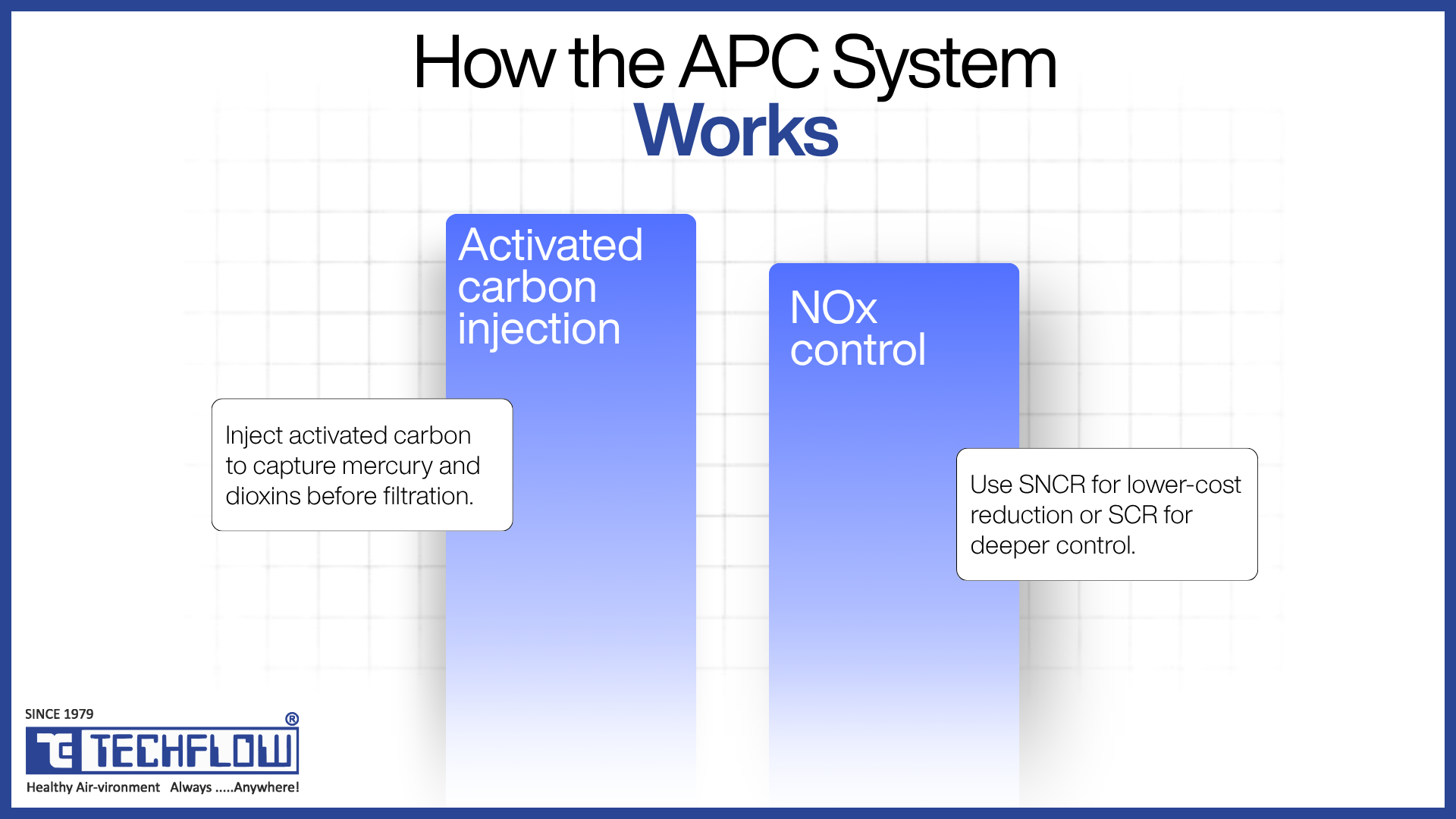
The three headline technologies are only part of a compliant train. Two more stages finish the picture:
- Activated carbon injection (ACI). Dosed just ahead of the final filter to adsorb vapour-phase mercury and residual dioxins; the loaded carbon is then caught with the dust. Studies of uncontrolled incinerators show that adding carbon injection ahead of a baghouse is what brings PCDD/F emissions down to the 0.1 ng I-TEQ/Nm³ standard.
- NOx control. Thermal or catalytic. SNCR injects urea or ammonia into the high-temperature furnace zone without a catalyst, which is the common, lower-cost retrofit. SCR uses a catalyst bed for deeper reduction and is usually kept for new builds chasing the strictest limits, since retrofitting it is costly.
Combustion itself is the first line of control. Holding the secondary combustion chamber above its regulated minimum temperature with enough residence time destroys organics before they reach the APC train, which is why standards tie compliance to combustion conditions, not just end-of-pipe equipment. Under India's Solid Waste Management Rules, 2016, MSW incineration facilities have to maintain a minimum secondary combustion chamber temperature of 950 °C with a gas residence time of at least two seconds.
How to Select an APC Configuration for a WtE Plant
You select an APC configuration by matching the technologies to the plant's specific pollutants, waste composition, combustion process, required emission performance, and overall design. There is no universally correct configuration, and any vendor offering one should be treated with caution. The main drivers:
- Waste characteristics: High, variable chlorine content (from plastics) raises HCl and argues for robust acid gas control and fabric filtration. Highly variable ash chemistry undermines ESP resistivity assumptions and favours bag filters.
- Target emission limits: A 50 mg/Nm³ particulate limit is tough to hold with an ESP alone once resistivity drifts; one reason fabric filters have become the reference particulate technology for new MSW-fired builds.
- Gas volume and temperature: Very large, hot, consistent streams reward the ESP's low pressure drop; smaller or more variable streams favour the fabric filter's stability.
- Water and byproduct economics: Plenty of water and a gypsum market argue for wet FGD; tight water or budget argues for semi-dry or dry.
- Footprint and capital budget: Dry sorbent injection is the most compact and cheapest to install; wet FGD is the largest and most capital-intensive.
Many new MSW WtE plants land on a semi-dry or dry acid gas stage with activated carbon injection, followed by a pulse-jet fabric filter, an integrated, water-efficient train that handles particulate, acid gas, mercury and dioxins. That is a common answer, though, not a default. The right train is the one matched to the specific waste, limits, and site.
What Factors Shape Flue Gas Treatment Design
A handful of engineering factors cut across every configuration:
- Temperature and dew point: The gas has to be cool enough for the fabric filter media yet above its acid dew point, or condensation blinds bags and corrodes steel. The window is narrow and has to hold across load swings.
- Corrosion: HCl and SO₂ make WtE flue gas aggressively corrosive, so material selection for ducting, absorber, and filter housing is a first-order decision. Superheater and ducting corrosion is a well-documented failure mode in waste incineration.
- Pressure drop and energy cost: Fabric filters cost more in fan power than ESPs over the plant's life, which has to be weighed against their stronger fine-particle and dioxin capture.
- Reagent chemistry and dosing: FGD performance depends on correct slurry concentration and good gas contact; misdosing cuts SO₂ capture and causes scaling.
- Byproduct and ash handling: MSW fly ash concentrates heavy metals and adsorbed dioxins and is handled as hazardous waste; Indian rules require ash over toxic-metal thresholds to go to a hazardous waste facility. Hoppers not cleared on schedule re-entrain captured dust.
Common Mistakes When Selecting an APC System
- Treating particulate and acid gas control as interchangeable: Specifying "an ESP" and assuming it covers acid gases is the most common conceptual error. An ESP or bag filter does nothing for SO₂, HCl, or HF; FGD is a separate, mandatory stage.
- Sizing for average waste, not worst case: MSW composition swings, so a train sized for the average breaches limits on the dirtiest days. Size for the range.
- Underestimating fine-particle and dioxin capture: A device that hits a bulk particulate number can still miss the sub-micron fraction that carries the metals and dioxins, the very pollutants the limits care most about.
- Ignoring the dew-point and corrosion window: Fabric filters chosen without regard to media temperature limits and acid dew point fail within months.
- Buying the three stages as separate boxes: The stages interact; sizing them as a single train is what separates a plant that passes commissioning from one that stays compliant.
The Regulatory Backdrop in India
India's binding WtE emission limits come from the Solid Waste Management Rules, 2016 (Schedule II), notified by the Ministry of Environment, Forest and Climate Change. The stack standards include 50 mg/Nm³ for particulates, 50 mg/Nm³ for HCl, 200 mg/Nm³ for SO₂, 100 mg/Nm³ for CO, 20 mg/Nm³ for Total Organic Carbon, 4 mg/Nm³ for HF, 400 mg/Nm³ for NOx (as NO₂), and 0.1 ng TEQ/Nm³ for total dioxins and furans. One detail is easy to miss: every value is corrected to 11% oxygen on a dry basis, a correction that stops operators from meeting limits just by diluting the gas with excess air.
The framework is also moving. In August 2025, the Central Pollution Control Board issued guidelines for MSW incineration-based WtE plants, classifying them under a 'Blue Category' recognised as an essential environmental service; Rule 21 of the SWM Rules requires non-recyclable MSW with a calorific value of 1,500 kcal/kg or more to be diverted to energy recovery rather than landfilled. The reclassification has drawn scrutiny from analysts who point out that existing plants have struggled to comply, a reminder that meeting a design specification and holding compliance in daily operation are two different things.
These are Indian requirements. Other jurisdictions set their own. The EU's Industrial Emissions Directive and the US EPA's municipal waste combustor standards, for example, and a plant has to be designed to whichever framework applies at its site. The 0.1 ng TEQ/Nm³ dioxin limit is a notable point of convergence across the EU, India, and other frameworks, working as a de facto international benchmark, but most other numeric limits vary by jurisdiction.
That gap between design and daily operation is why Online Continuous Emission Monitoring Systems (OCEMS) are now mandatory. They track pollutants at the stack in real time and send the data straight to CPCB and state boards, so a ruptured bag or a failed rapping motor shows up in hours, not at the next scheduled stack test. For operators, APC maintenance becomes a continuous discipline, because a breach is visible to the regulator almost as soon as it happens.
Why Engineering Partner Experience Matters
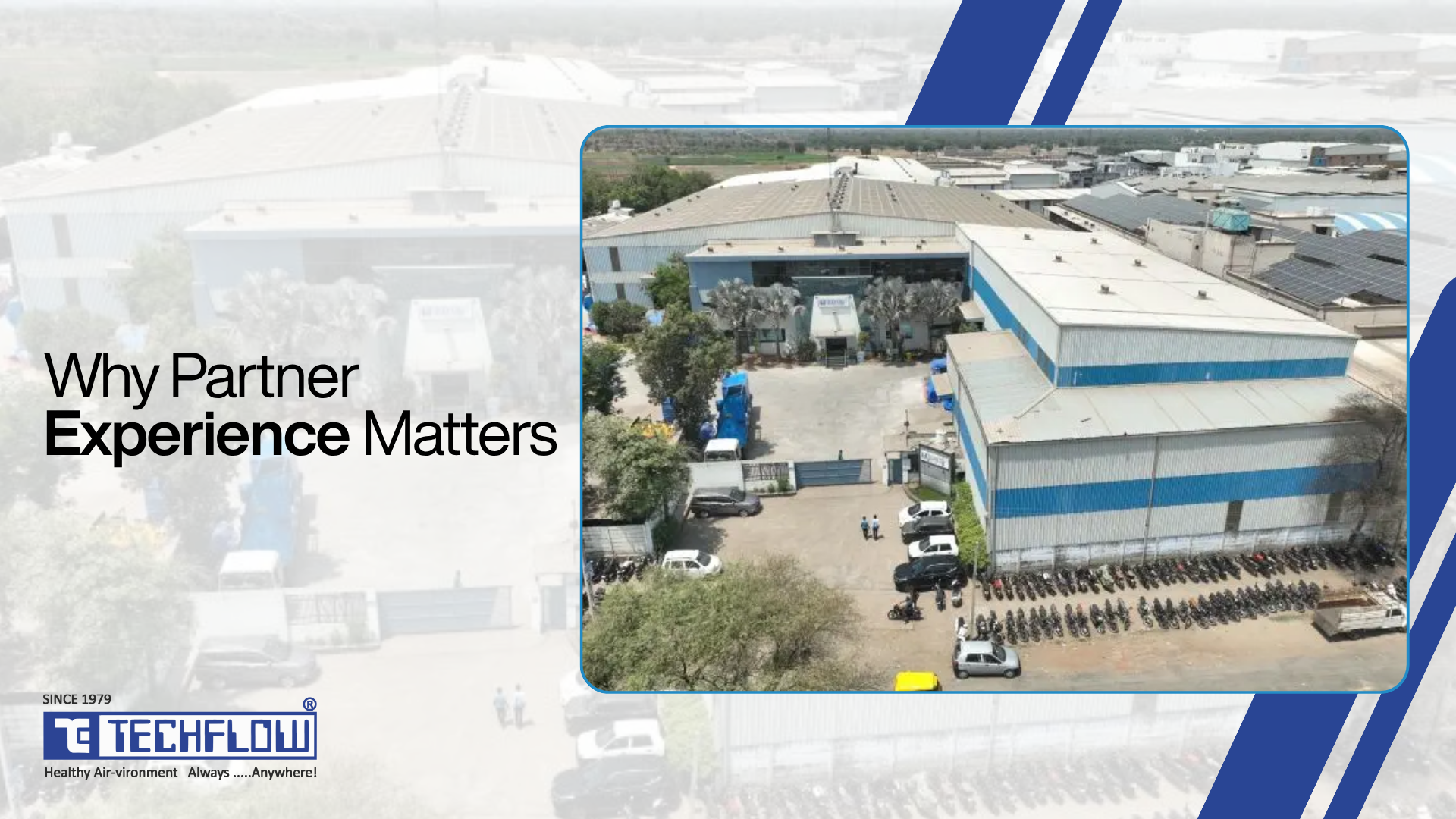
Designing a WtE APC train is not a catalogue purchase. It means matching ESP field configuration or fabric filter media, reagent chemistry, dosing, gas conditioning and sequencing to one specific waste stream, boiler and emission target, then making those stages work as a single system.
TECHFLOW Enterprises Pvt. Ltd. has built its practice around this kind of air pollution control engineering. Founded in 1979 and working out of a dedicated manufacturing facility at Kubadthal, Ahmedabad, the company designs and manufactures electrostatic precipitators, pulse-jet bag filters and fabric filters, flue gas cleaning and flue gas desulphurisation systems, plus the centrifugal fans, ID fans and pneumatic conveying equipment that round out a boiler and WtE gas-handling package. Its listed scope specifically covers Flue Gas Cleaning Systems (FGCS) for waste-to-energy applications, and it serves boiler flue gas and solid-fuel-fired boiler markets in India and abroad. You can read more about its background on the TECHFLOW company page.
For an operator trying to hold emission limits over a twenty-year plant life, a manufacturer that treats particulate control, acid gas control and the fan and conveying system as one coordinated train, rather than three separately sourced boxes, is the difference between a plant that passes its commissioning test and one that stays compliant through every shift in the waste feed.
Frequently Asked Questions (FAQs)
It is the sequence of flue gas cleaning stages that removes regulated pollutants from combustion exhaust before it reaches the stack. It combines particulate collection (bag filter or ESP), acid gas removal (FGD), dioxin and mercury control (activated carbon injection) and NOx reduction (SNCR or SCR), each targeting a different pollutant class.
Both capture particulate matter, but by different means. A bag filter physically strains dust through fabric and a built-up cake; an ESP charges particles electrically and collects them on plates. Bag filters give more consistent fine, sub-micron capture regardless of ash chemistry; ESPs offer lower pressure drop and running cost on large, consistent, hot streams. They compete for the same role.
Mainly particulate matter, including the fine sub-micron fraction and the heavy metals and dioxins that ride on it. Placed after lime and activated carbon injection, a bag filter also helps with acid gas and dioxin capture, because its dust cake keeps reagent in contact with the gas for longer.
It charges dust particles in a high-voltage corona field and collects them on grounded plates, then raps the plates to drop the dust into hoppers. Because it applies energy to the particles rather than the whole gas stream, it runs at low pressure drop, but efficiency depends on fly ash resistivity and weakens for sub-micron particles.
FGD removes acid gases: sulphur dioxide and, in waste plants, hydrogen chloride and hydrogen fluoride. These are vapours that pass through any particulate collector, so they need a dedicated FGD stage regardless of the particulate device installed. FGD reacts the acid gases with lime or limestone to form solid or dissolved salts.
Yes. An ESP can handle bulk fly ash cheaply, with a downstream fabric filter polishing the fine fraction and capturing reacted reagent after FGD. The hybrid pairs the ESP's low running cost with the fabric filter's fine-particle certainty.
It depends on the site. Wet FGD gives the highest SO₂ removal (around 95%) and can produce saleable gypsum, but it needs the most water, space, and capital. Semi-dry and dry systems use far less water and cost less, which makes them common for small and mid-sized plants where water or budget is tight.
By matching the technologies to the plant's pollutants, waste composition, combustion process, required limits, gas volume and temperature, water availability, and budget. There is no universal configuration; variable waste chemistry and tight particulate limits tend to favour fabric filters, while water and byproduct economics drive the FGD choice.
Through three measures that work together: high-temperature combustion to destroy them at source, rapid cooling of the flue gas through the 200 to 450 °C window where they reform, and activated carbon injection to adsorb residual dioxins, caught on the downstream filter.


