


Key Takeaways
- Dry and wet ESPs charge particles in the same way. They differ in one thing only: how the collected material leaves the collecting electrode. That single design choice cascades into every other difference.
- A wet ESP is not simply the higher-performing option. Its practical ceiling is a gas temperature of roughly 80 to 90 degrees Celsius, which rules it out for most boiler and kiln applications outright.
- Dust resistivity is the single most common reason a dry ESP underperforms in the field. Dry ESPs work best in a resistivity window of roughly 5 x 10³ to 2 x 10¹⁰ ohm-centimetre. Wet ESPs sidestep the problem because the humid atmosphere lowers resistivity.
- Capital cost is not comparable. Published United States Environmental Protection Agency cost ranges put wet wire-pipe ESPs at roughly four times the capital cost per unit of gas flow compared with dry wire-plate ESPs, before you price the effluent treatment plant.
- Field count, not the wet-versus-dry label, is usually the biggest lever on both cost and compliance. Emission targets below 20 mg/Nm³ push a dry ESP into more collecting fields, and cost scales with them.
- Series arrangements are common and often correct: a dry ESP handles the bulk coarse load economically, and a wet stage downstream polishes the fine and condensable fraction.
- TECHFLOW designs and manufactures dry horizontal plate-type ESPs with one, two, three, four or more fields, and wet ESPs for tar and acid mist duty on coke oven gas, producer gas and non-ferrous smelters.
If your plant is facing a stack emission limit, an Electrostatic Precipitator is almost certainly on your evaluation list. The complication is that "ESP" describes two genuinely different machines that happen to share the same charging physics. Specify the wrong one, and you inherit a problem you did not budget for: back corona on a high-resistivity ash, cake buildup on a plate that should never have been dry, or an effluent stream with nowhere to go. Specify the right one and the stack quietly stays compliant for twenty years.
This guide sets out how the two technologies actually behave, where each one wins, what the published engineering data supports, and how TECHFLOW approaches the selection. Every performance figure below is traceable to a named source, and the sources are listed at the end.
What Is an Electrostatic Precipitator (ESP)? Dry vs Wet Explained
An electrostatic precipitator is a particulate control device that uses electrostatic forces to remove particles from a gas stream and onto a collecting surface. Because it acts only on the particles and does not put a porous medium in the gas path, it barely restricts flow.
The sequence is the same in every ESP ever built:
- Ionisation: Flue gas enters and passes a zone where high-voltage discharge electrodes emit a corona. Industrial alternating current at 220 to 480 volts is converted to pulsating direct current in the range of 20,000 to 100,000 volts. The applied voltage breaks the gas down electrically around the electrode, and that breakdown is the corona.
- Charging: Ions generated in the corona follow the electric field lines from the electrode to the grounded collecting surface. Every particle passing through must cross at least one charging zone. Electrodes are normally given negative polarity, because a negative corona sustains a higher voltage before sparking than a positive one.
- Migration: Charged particles drift under the electric field towards the earthed collecting electrode. Larger particles above 10 micrometres absorb many times more ions than particles near 1 micrometre, so the electrical force acting on coarse dust is far stronger.
- Collection and release: Particles reach the collecting surface, give up their charge, and build a layer. What happens next is where the two families separate.
The Core Difference Between Dry and Wet ESPs: How Dust Is Removed
In a dry ESP, that accumulated layer is a dust cake, and it is knocked loose mechanically by a rapping or vibration system so it falls into hoppers below.
In a wet ESP, the collecting surface is washed by a film of liquid, usually water, either continuously or at timed intervals. The wash system replaces the rapping mechanism entirely, and the hoppers of the dry design are replaced by a drainage system.
Everything else follows from that. The cleaning method determines what particle sizes you can economically capture, what gas conditions the unit tolerates, what your maintenance calendar looks like, what materials the internals must be built from, and what waste stream ends up on your site.
ESP History: The Wet Branch Isn't a Modern Add-On (Cottrell's Founding Patent)
It is worth knowing that the wet branch is not a modern refinement bolted onto an older dry design. The concept of precipitating smoke particles electrically was first proposed by the German mathematics teacher M. Hohlfeld in 1824, and it took almost a century to become commercially viable. Frederick Gardner Cottrell, then a chemistry professor at the University of California, Berkeley, applied for the founding patent in 1907; patent number 895,729 was granted on 11 August 1908. His first application was the collection of sulphuric acid mist and lead oxide fumes from acid-making and smelting operations, with lead emissions damaging vineyards in northern California. The theoretical basis for how the field actually worked came later, through the work of Walter Deutsch in Germany.
In other words, the first commercially successful precipitator was solving an acid mist problem, which is textbook wet ESP duty today. Both branches are more than a century old.
How Does a Dry ESP Work?
Dry ESP Charging and Collection Cycle in a Horizontal Plate-Type Unit
In the horizontal plate-type configuration that dominates industrial emission control, flue gas flows horizontally and parallel to vertical sheet-metal collecting plates. The high-voltage discharge electrodes hang between them. Plate spacing is typically between 19 and 38 centimetres, and duct heights, meaning the flow areas between plates, typically run 6 to 14 metres to give particles enough residence time to charge and migrate before the gas exits.
Charged particles migrate to the plates and build a dry dust layer. A rapping system periodically shears that cake off so it drops into hoppers, from where it is removed as dry ash by screw conveyor or pneumatic conveying system.
Dry ESP Components: Electrodes, Plates, Rapping, Gas Distribution and Power Supply
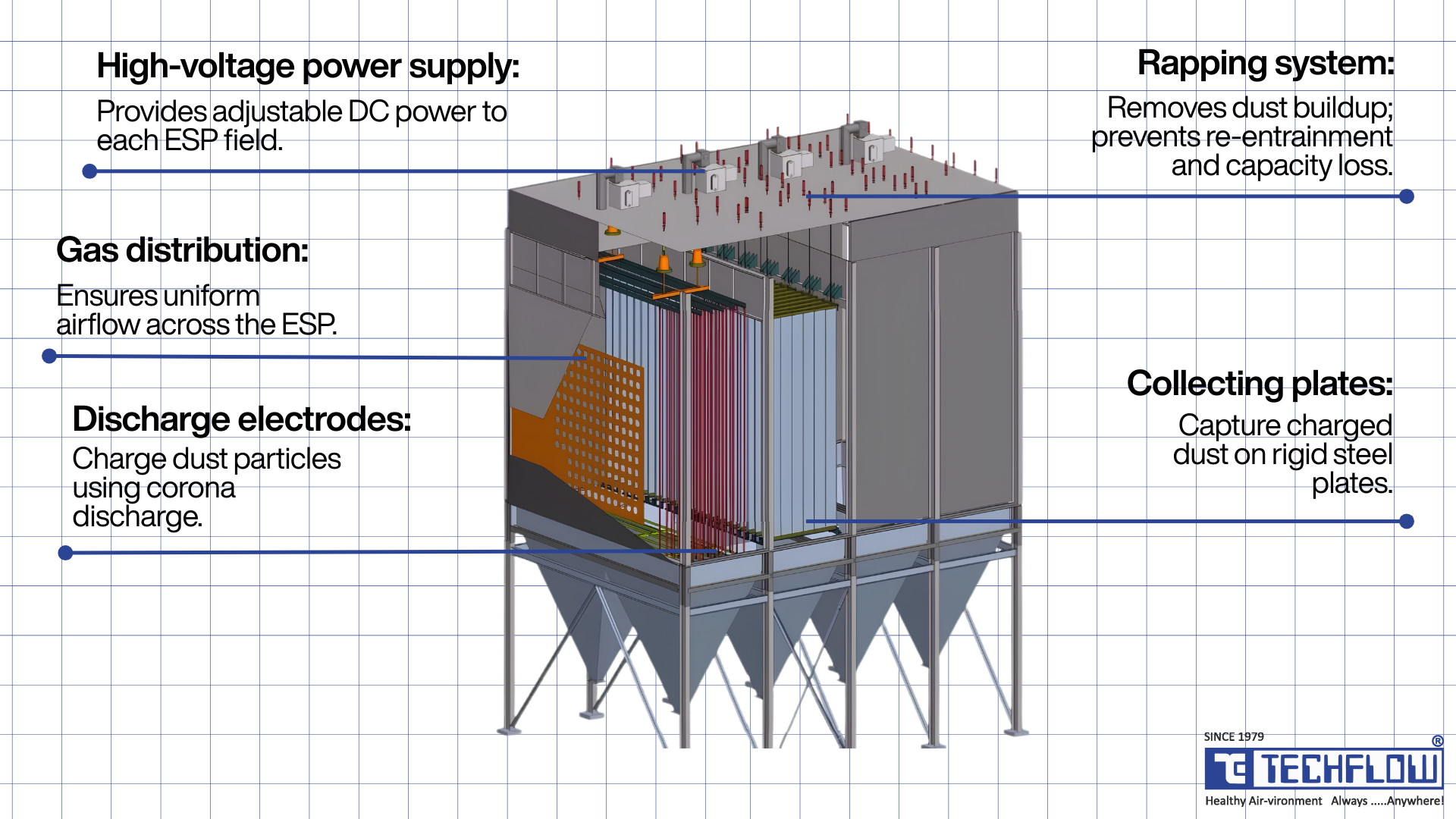
An ESP is only as good as its internals. TECHFLOW specifies each of the following as a distinct engineering decision rather than a catalogue item:
- Discharge electrodes: These emit the corona that charges the dust. They are made from corrosion-resistant materials such as stainless steel or high-chromium carbon steel, and can be spiralised wires at several levels over the electrode height, rigid mast type, or rigid pipe and spike hung from the emitting frame at more than one level where required.
- Collecting plates: Typically cold rolled close annealed carbon steel to IS 513 Grade D, in thicknesses of 1.2 to 1.5 millimetres, fabricated in one piece from top to bottom for rigidity.
- Rapping system: This shears the dust cake off the collecting plates and also clears dust from the spikes of the discharge electrodes, at predetermined and adjustable frequencies. The two common types are Magnetic Impulse Gravity Impact (MIGI) rappers, which deliver short strong impulses, and tumbling hammer rappers, which use rotating shafts and gravity-assisted impacts. Over-rapping causes re-entrainment; under-rapping causes buildup and lost capacity.
- Gas distribution system: This holds gas velocity uniform across the ESP cross-section, generally between 0.4 and 1.2 metres per second. Screens are typically 2.5 to 3.0 millimetre carbon steel plates with punched holes of 8 inch diameter, with the hole pattern determined by Computational Fluid Dynamics analysis. A typical arrangement uses two screens at the inlet and one at the outlet, with the inlet screens themselves wrapped.
- High-voltage power supply: Transformer-rectifier (T/R) sets deliver stable, adjustable direct current voltage and current to each field. TECHFLOW specifies hermetically sealed T/R units without conservator or breather, using a full-wave bridge rectifier, with a microprocessor-based semi-pulse controller on each set. The primary supply is single-phase alternating current under normal conditions, with three-phase T/R sets used where dust is very fine.
Why Dry ESPs Excel at Coarse, Free-Flowing Dust Collection
Because the electrical force on a particle scales with the charge it can hold, and larger particles absorb many times more ions, dry ESPs are extremely effective on coarse, free-flowing dust. Over 99% removal efficiency is achievable on particles below 10 micrometres, and the technology has a very low pressure drop, which keeps induced draft fan power down for the life of the plant.
Two other structural advantages matter. Dry wire-plate ESPs can be designed for very high gas temperatures, up to around 700 degrees Celsius. And the collected material comes off dry, which means it can be conveyed, stored, sold or reused without a dewatering step.
4 Causes of Dry ESP Efficiency Loss: Resistivity, Rapping, Sneakage, Cake Buildup
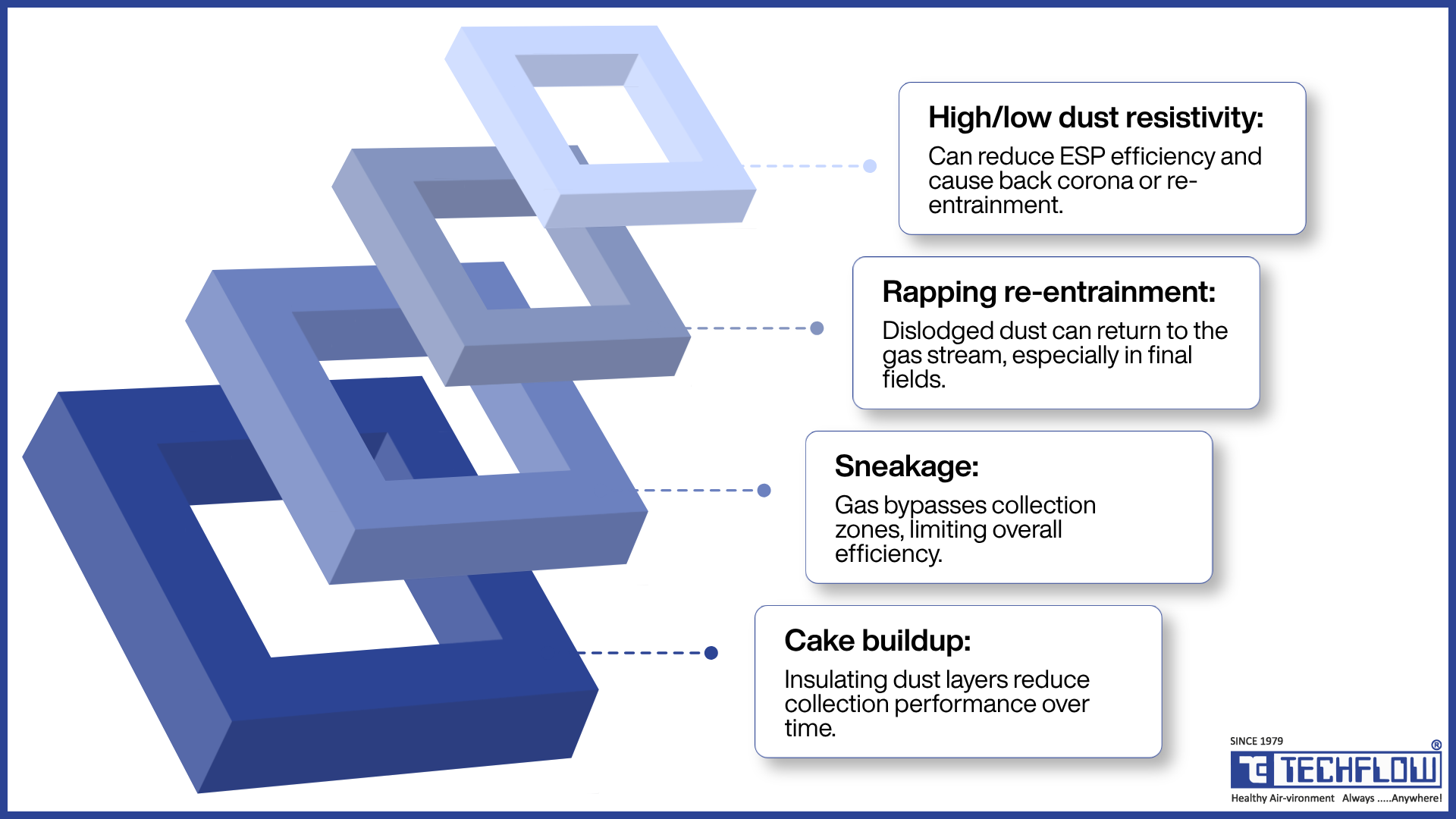
Every one of these traces back to the dry cake.
1. Dust resistivity outside the working window: Because the dust forms a continuous layer on the plates, all the ion current has to pass through that layer to reach earth. In general, dry ESPs operate most efficiently with dust resistivities between 5 x 10³ and 2 x 10¹⁰ ohm-centimetre. Stray outside it in either direction and performance falls:
- Too high: Above roughly 2 x 10¹¹ ohm-centimetre, the current creates an electric field inside the dust layer strong enough to cause local electrical breakdown. Ions of the wrong polarity are injected back into the gap, reducing the charge on incoming particles and causing sparking. This is back corona, and it degrades collection considerably. Fly ash from low-sulphur coal is the classic offender. Some laboratory work places the onset threshold considerably lower, from around 5 x 10⁸ ohm-centimetre, so the safe assumption is that resistivity must be measured or estimated for your actual fuel rather than assumed.
- Too low: Below about 10⁸ ohm-centimetre, particles are held on the plates so loosely that both rapping and non-rapping re-entrainment become much more severe.
Resistivity is not a fixed property either. It is strongly affected by temperature, moisture, gas composition, particle composition and surface characteristics, which is why an ESP sized on the wrong fuel assumption underperforms from day one.
2. Rapping re-entrainment: The same rapping that dislodges the cake also throws some of it back into the gas stream. For coal fly ash, this is typically around 12% of the dislodged material. Particles re-entrained in earlier sections get another chance downstream, but anything re-entrained in the final field escapes the unit entirely.
3. Sneakage: Clearances needed for non-electrified internal components at the top of the ESP let part of the gas flow around the charging zones altogether. This places a hard upper limit on collection efficiency. Anti-sneakage baffles force that bypass flow back into the main gas stream so it can be collected in later sections.
4. Progressive cake buildup between rapping cycles: Controlled laboratory work on high-resistivity particles shows how quickly this bites. In one study using polymethyl methacrylate particles with resistivity above 2 x 10¹⁵ ohm-centimetre, a dry ESP with conductive glass collecting plates drifted from roughly 98.5% to 95.6% efficiency over a single hour of continuous loading as the insulating cake formed. Switching the same unit to wet operation restored it to around 98.0%.
Dry ESP Limitations: What It Can't Remove or Handle
A dry ESP cannot remove gases and vapours that remain in the vapour state at operating temperature, and it is not recommended for sticky or moist particulates that would cling to the collecting surface rather than shearing off cleanly. There is also an explosion hazard where combustible gases or combustible dusts are involved. Like all corona devices, ozone is generated at the negatively charged electrode during gas ionisation.
How Does a Wet ESP Work?
A wet ESP charges particles using the same corona discharge principle. The difference is that the collecting surface is washed with liquid, either continuously or at timed intervals, injected or sprayed near the top of the collecting pipes or plates. The water carries collected particles into a sump, from which the fluid is pumped or drained. A portion is recycled to reduce total water demand, and the remainder goes to a settling pond or a dewatering stage before sludge disposal.
Two geometries are common. The wire-pipe or tubular type sends gas vertically through conductive tubes, generally many in parallel, formed as circular, square, or hexagonal honeycomb. Pipes are typically 7 to 30 centimetres in diameter and 1 to 4 metres long, with wire or rigid mast electrodes running through the axis of each tube. The wire-plate type keeps the plate geometry of a dry unit and irrigates the plates instead.
TECHFLOW's wet ESPs are cylindrical single-field units, designed specifically for tar and acid mist removal from coke oven gas and producer gas in steel plants, and from copper, aluminium and zinc smelters.
How Wet ESPs Eliminate the Resistivity Problem
This single change eliminates the two biggest structural weaknesses of the dry design at once.
Dust resistivity is not a factor for wet ESPs, because the high-humidity atmosphere lowers the resistivity of most materials. That removes the back corona condition. Particle size is also much less of a limiting factor: much smaller particles can be collected efficiently, precisely because there are no resistivity concerns and because re-entrainment is reduced. The continuous washing also limits particle buildup on the collectors, so the unit does not drift downward between cleaning cycles the way a dry unit does.
There is a secondary electrical benefit that is easy to miss. Controlled testing found that a wet ESP started corona discharge at roughly minus 7.5 kilovolts against minus 8.9 kilovolts for the equivalent dry unit, and drew higher current at the same voltage. Water is far more conductive than air, which accelerates ion movement. In practice, that means a wet unit can produce useful corona at lower applied voltage.
Wire-pipe wet ESPs carry one further structural advantage: they provide no sneakage paths around the collecting region, because the entire gas stream is forced through the collection field.
Wet ESP Fine-Particle Removal Efficiency: Up to 99.4% (Peer-Reviewed Data)
The fine-particle case for wet ESPs is well supported.
A single-stage wet ESP using a sand-blasted, titanium dioxide-coated collecting plate held electrostatic precipitation efficiency between 99.4% and 97.2% across a particle range from 16.8 to 615 nanometres at 4.3 kilovolts applied voltage. More importantly for real operation, after heavy loading with roughly 1.2 grams of titanium dioxide nanopowder per plate, collection efficiency across that same size range fell only to 94.7% to 99.0%. A dry unit under equivalent loading would have degraded far further.
A separate comparative study on collecting plate materials makes the wet advantage visible in a single number. Testing penetration at the Most Penetrating Particle Size, an ordinary glass collecting plate allowed over 40% penetration under dry conditions. Operated wet, penetration on the same plate dropped below 20%. The same work found that stainless steel and conductive glass plates already achieved penetration below 6% even dry, which is a useful reminder that collecting electrode material and conductivity matter almost as much as the wet-versus-dry decision.
The Constraint that Decides Most Wet ESP Enquiries
Here is the fact that removes wet ESPs from consideration in most boiler and kiln applications, and it is the single most under-reported point in comparisons of the two technologies.
Wet wire-pipe ESPs are limited to operating at gas temperatures below approximately 80 to 90 degrees Celsius. A dry wire-plate ESP can be designed up to around 700 degrees Celsius.
That is not a marginal difference. A coal or biomass-fired boiler delivering flue gas at 176 or 180 degrees Celsius cannot feed a wet ESP without a quench or upstream scrubbing stage to bring the gas into range, and that stage is a capital line item of its own. This is why wet ESPs in power and process plants almost always appear downstream of a wet flue gas desulphurisation system, where the gas has already been cooled and saturated, rather than as a standalone boiler outlet device.
Wet ESP Trade-Offs: Effluent Treatment, Corrosion and Loading Sensitivity
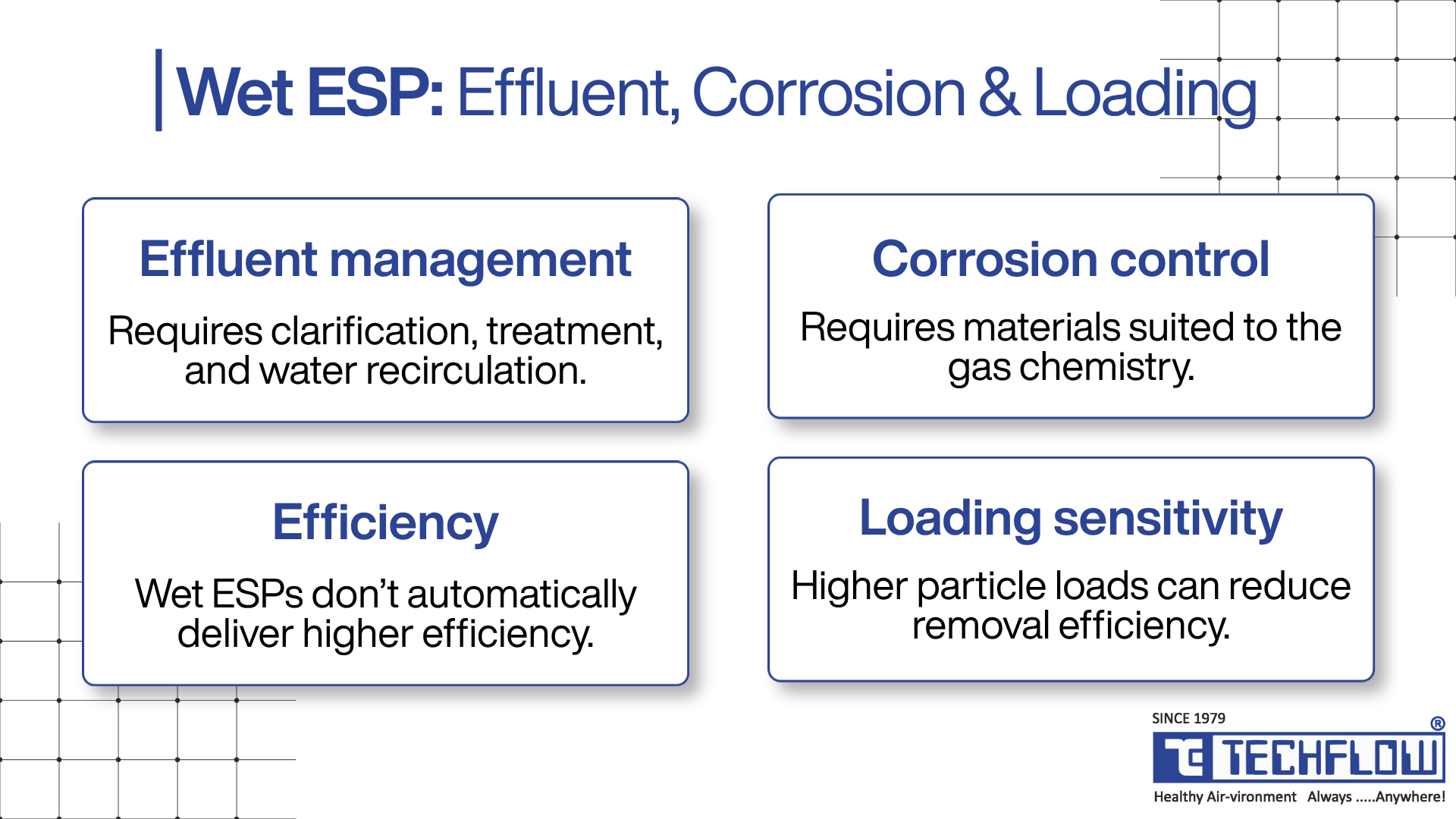
Effluent: The water has to come from somewhere and go somewhere. For simple systems with innocuous dust, ESP water can go to a solids-removing clarifier and then to disposal. More complicated streams require skimming and sludge removal, clarification in dedicated equipment, pH adjustment, and treatment to remove dissolved solids. Where preconditioner spray water is treated separately from plate wash water, recirculation of treated water back to the ESP can approach 100%, which is worth designing for from the start.
Materials and corrosion: Wet ESPs generally must be constructed of non-corrosive materials. This is not theoretical. In controlled long-term testing, stainless steel collecting plates in a wet ESP developed rust under sustained high-humidity exposure, attributed to electrochemical corrosion where particle layers containing water sat against the plate. Chromium oxide passivation does not survive every wet ESP environment, which is why material selection against your actual gas chemistry matters more here than in a dry unit.
Efficiency is not automatic: TECHFLOW is direct about this on its own equipment: cylindrical single-field wet ESP designs typically achieve efficiency below 98%. Wet does not automatically mean higher efficiency. Field count and design quality decide that.
Loading sensitivity: Wet ESP particle removal efficiency declines as inlet particle concentration rises, which is one reason wet units are so often used as a polishing stage rather than a bulk collector.
Dry ESP vs Wet ESP: Full Engineering Comparison Table
The table below compares the two technologies on the parameters that actually change a specification decision. Figures are drawn from United States Environmental Protection Agency control technology fact sheets for wire-plate and wire-pipe designs, from peer-reviewed aerosol research, and from TECHFLOW's own design and commissioning data.
| Parameter | Dry ESP (horizontal plate type) | Wet ESP |
|---|---|---|
| Cleaning mechanism | Mechanical rapping or vibration of collecting plates and discharge electrodes | Continuous or intermittent water film washing the collecting surface |
| Design efficiency, new equipment | 99 to 99.9% | 99 to 99.9% |
| Actual efficiency, older equipment | 90 to 99.9% | 90 to 99.9% |
| Maximum gas temperature | Up to approximately 700°C for wire-plate designs; TECHFLOW offers hot ESP above 250°C with somewhat reduced efficiency | Approximately 80 to 90°C for wire-pipe designs |
| Dust resistivity sensitivity | Critical. Optimum window roughly 5 x 10³ to 2 x 10¹⁰ ohm-cm; back corona prevalent above about 2 x 10¹¹ ohm-cm | Not a significant factor. High humidity lowers resistivity of most materials |
| Sub-micron and PM2.5 performance | Weaker. Hardest sizes are 0.1 to 1.0 µm, with maximum penetration typically at 0.2 to 0.4 µm | Much less limited by particle size due to absence of resistivity concerns and reduced re-entrainment |
| Re-entrainment | Rapping projects roughly 12% of dislodged coal fly ash back into the gas stream | Eliminated by continuous or intermittent washing |
| Sneakage | Present. Anti-sneakage baffles required to force bypass flow back into the gas stream | No sneakage paths in wire-pipe designs; entire gas stream passes through the collection field |
| Typical gas flow range | 100 to 500 sm³/sec for wire-plate designs | 0.5 to 50 sm³/sec for wire-pipe designs |
| Typical inlet dust loading | 2 to 110 g/m³ | 1 to 10 g/m³ |
| Capital cost (2002 USD, indicative of relative magnitude) | 21,000 to 70,000 USD per sm³/sec | 85,000 to 424,000 USD per sm³/sec |
| Annual operating and maintenance cost (2002 USD) | 6,400 to 74,000 USD per sm³/sec | 12,000 to 21,000 USD per sm³/sec |
| Waste stream | Dry ash or dust, removed by screw conveyor or pneumatic conveying | Wet slurry or effluent requiring settling, clarification and often pH or dissolved-solids treatment |
| Materials of construction | Carbon steel collecting plates, typically CRCA to IS 513 Grade D | Non-corrosive materials required; stainless steel can still corrode under sustained wet exposure |
| Handles sticky, wet or explosive dust | Not recommended | Yes, this is the primary application |
| Handles acid mist and condensables | No | Yes, including sulphuric acid aerosol at around 0.1 µm |
A note on how to read the cost rows: these are published United States figures expressed in 2002 dollars, and they are not a quotation. They are included because the ratio is stable and informative. Per unit of gas flow, a wet wire-pipe ESP sits roughly four times higher on capital cost than a dry wire-plate unit, driven by non-corrosive material requirements, water usage, and treatment and disposal of wet effluent. Any real budget must be built from a site-specific design.
How to Choose Between Dry and Wet ESP: 4 Key Questions
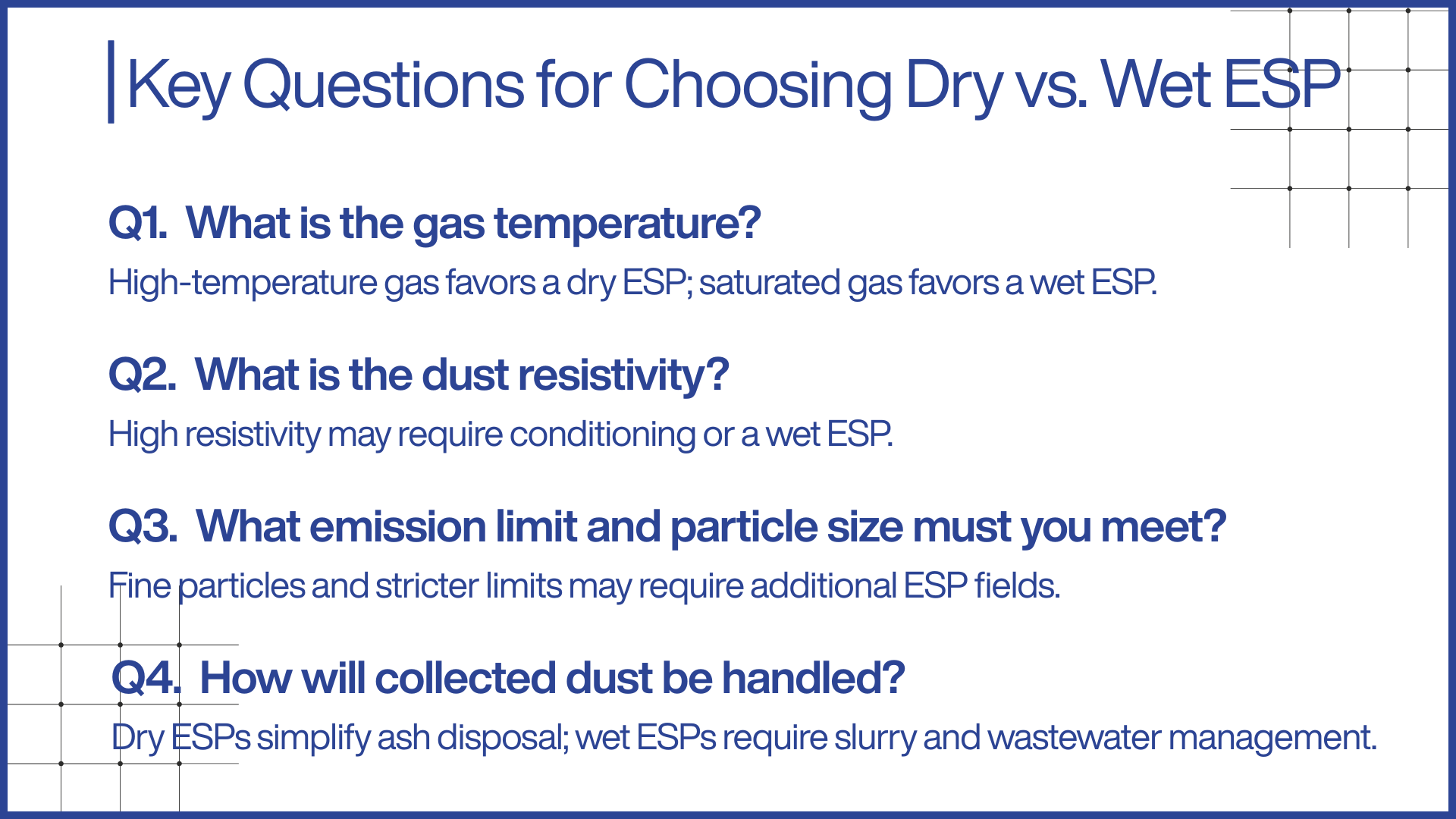
Comparison tables are useful, but selection in practice comes down to four sequential questions. Answer them in order, and the technology usually chooses itself.
Question 1: What is the gas temperature at the ESP inlet?
This is first because it is the hardest constraint and it eliminates options fastest.
If your gas arrives above roughly 90 degrees Celsius and you are not already installing a quench or wet scrubbing stage, a wet ESP is not a candidate as a standalone device. Boiler and thermic fluid heater outlets typically sit at 150 to 200 degrees Celsius. Kiln and sinter plant gases run hotter still. In these cases, the real decision is not dry versus wet; it is how many fields your dry ESP needs and whether you require a hot ESP configuration.
If your gas is already saturated because it has passed through wet flue gas desulphurisation, a venturi scrubber or a quench, then a wet ESP becomes not just viable but frequently the correct answer.
Question 2: What's the Resistivity of Your Fuel's Dust?
Different fuels produce dust with very different resistivity and particle size behaviour. Rice husk ash tends to demand a higher Specific Collection Area. Certain grades of Indian coal fly ash retain charge long enough to risk back corona and often need conditioning. High-ash Indonesian coal demands robust rapping and careful voltage control.
Because dust resistivity plays such a large role in ESP sizing, ESP sizing depends on the fuel type in addition to gas volume, dust burden, and operating temperature. A bag filter's efficiency does not depend on fuel type in the same way, which is a genuine and often decisive difference when comparing control options.
If resistivity is high and conditioning is impractical, a wet stage is the structural fix rather than a workaround. If resistivity sits comfortably inside the dry working window, a dry ESP will do the job at lower capital and operating cost.
Question 3: What emission number do you have to hit, and on what particle size distribution?
On coarse dust, both technologies can look nearly identical on paper. The separation appears at the tail of the particle size distribution.
Dry ESPs struggle most between 0.1 and 1.0 micrometres, with maximum penetration usually at 0.2 to 0.4 micrometres. This is a consequence of the transition region between field charging and diffusion charging, not a design defect. If a meaningful fraction of your emission target sits in that band, or if you are dealing with condensable material such as sulphuric acid aerosol at around 0.1 micrometres, a dry ESP alone will find it hard.
Also be realistic about what tightening the number costs. Achieving emission levels below 20 mg/Nm³ requires more collecting fields, and cost rises accordingly.
Question 4: What do you want to happen to the collected material?
If the collected ash has value, or if your site has no wastewater infrastructure, dry discharge is a substantial advantage. Dust disposal from a dry ESP is a dry discharge via screw conveyor or pneumatic conveying system, which is straightforward to integrate.
Slurry handling is a genuine operational challenge by comparison. If you choose wet, price the clarifier, thickener, or wastewater treatment tie-in as a separate capital line before you compare quotations, because the two quotations are not measuring the same scope.
Dry ESP vs Wet ESP: Best Applications and Use Cases
When to Use a Dry ESP: Best Applications
Dry horizontal plate-type ESPs are the standard configuration where the gas is hot, comparatively dry, and the dust is free-flowing:
- Coal-fired, biomass-fired and agro-waste-fired boilers, including Atmospheric Fluidised Bed Combustion units
- Thermic fluid heaters
- Cement kilns and mineral processing
- Steel sinter plants, foundries and Direct Reduced Iron plants
- Waste-to-energy and material recycling plants where the gas remains dry
TECHFLOW's current ESP focus is exactly here: the design and manufacture of dry horizontal plate-type ESPs with one, two, three, four and more collecting fields for emission control.
When to Use a Wet ESP: Best Applications
Wet ESPs earn their cost premium in three situations:
- Saturated or corrosive gas. Where the stream has already been cooled and saturated, typically downstream of wet flue gas desulphurisation or a wet scrubber. Wet ESPs are commonly installed there specifically to remove fine dust and sulphuric acid aerosol.
- Tar and acid mist. TECHFLOW's wet ESPs are designed for tar and acid mist removal from coke oven gas and producer gas in steel plants, and from copper, aluminium and zinc smelters.
- Sticky, flammable, explosive or very high resistivity material that would cake, blind or create a hazard on a dry plate.
Wet ESPs are also used across textile, pulp and paper, metallurgical, hazardous waste incineration and sulphuric acid manufacturing applications.
Dry and Wet ESP in Series: When to Combine Both
Hybrid arrangements are increasingly common where a gas stream carries both a heavy coarse load and a stubborn fine fraction. The logic is simple: let the dry unit do the economical bulk work, and let the wet unit polish.
Research on oxygen-pulverised coal combustion with carbon capture and storage evaluated exactly this pairing at pilot scale, using a 1,200 m³/hr dry ESP and a 400 m³/hr wet ESP, and concluded that combining the two is promising for efficient gas cleaning in that duty.
That same study produced a finding worth carrying into any dry ESP operation. Oxy-firing reduced the corona current of the dry ESP compared with air firing at the same applied voltage, which reduced collection performance. The fix was not mechanical: simply raising the applied voltage to restore the same corona power consumption recovered the performance, because collection performance behaved as an exponential function of power consumption divided by gas flow rate regardless of combustion conditions. Dry ESP performance is more tunable in the field than most operators assume, provided the power supply and control system can hold voltage close to the spark threshold.
How to Improve an Underperforming Dry ESP (Without Replacing It)
If an ageing dry ESP is missing its target, replacement is rarely the first option to evaluate. Several established interventions restore performance at a fraction of the cost:
Gas conditioning to correct resistivity: Conditioning equipment injects an agent upstream of the ESP that alters dust resistivity and promotes higher migration velocity. Agents in use include sulphur trioxide, sulphuric acid, sodium compounds, ammonia and water, with sulphur trioxide the most widely used. In SO₃ conditioning, an SO₃-air mixture is injected into the duct ahead of the ESP, where it reacts with moisture to form sulphuric acid on the dust surface and lowers resistivity. Ammonia injection works differently, promoting particle agglomeration to improve charging and collection. Which one suits depends on dust characteristics, fuel type, and process conditions.
Adding collecting fields: Where space allows, additional fields directly buy outlet performance, at proportional cost.
Power supply and control upgrades: Voltage should sit as close to the spark threshold as it can without frequent breakdowns. Modern transformer-rectifier sets paired with a Programmable Logic Controller or Supervisory Control and Data Acquisition-based control adjust voltage and current automatically against real-time dust behaviour, load changes and ambient conditions, which keeps corona discharge consistent even when boiler load swings.
Rapping optimisation: Rapping frequency and intensity are adjustable, and getting them wrong in either direction costs efficiency. Over-rapping drives re-entrainment; under-rapping allows the cake to insulate the plate.
Gas distribution correction: Uneven velocity distribution leaves parts of the collection field underused. Deflectors, perforated plates and turning vanes, sized against Computational Fluid Dynamics analysis, restore uniformity without adding significant pressure drop.
Continuous monitoring: An opacity meter in the stack for continuous emission monitoring, in-house and by the pollution control board, plus an ESP management system, turns performance drift into something visible before it becomes a notice.
TECHFLOW ESP Case Studies: Real-World Performance Results
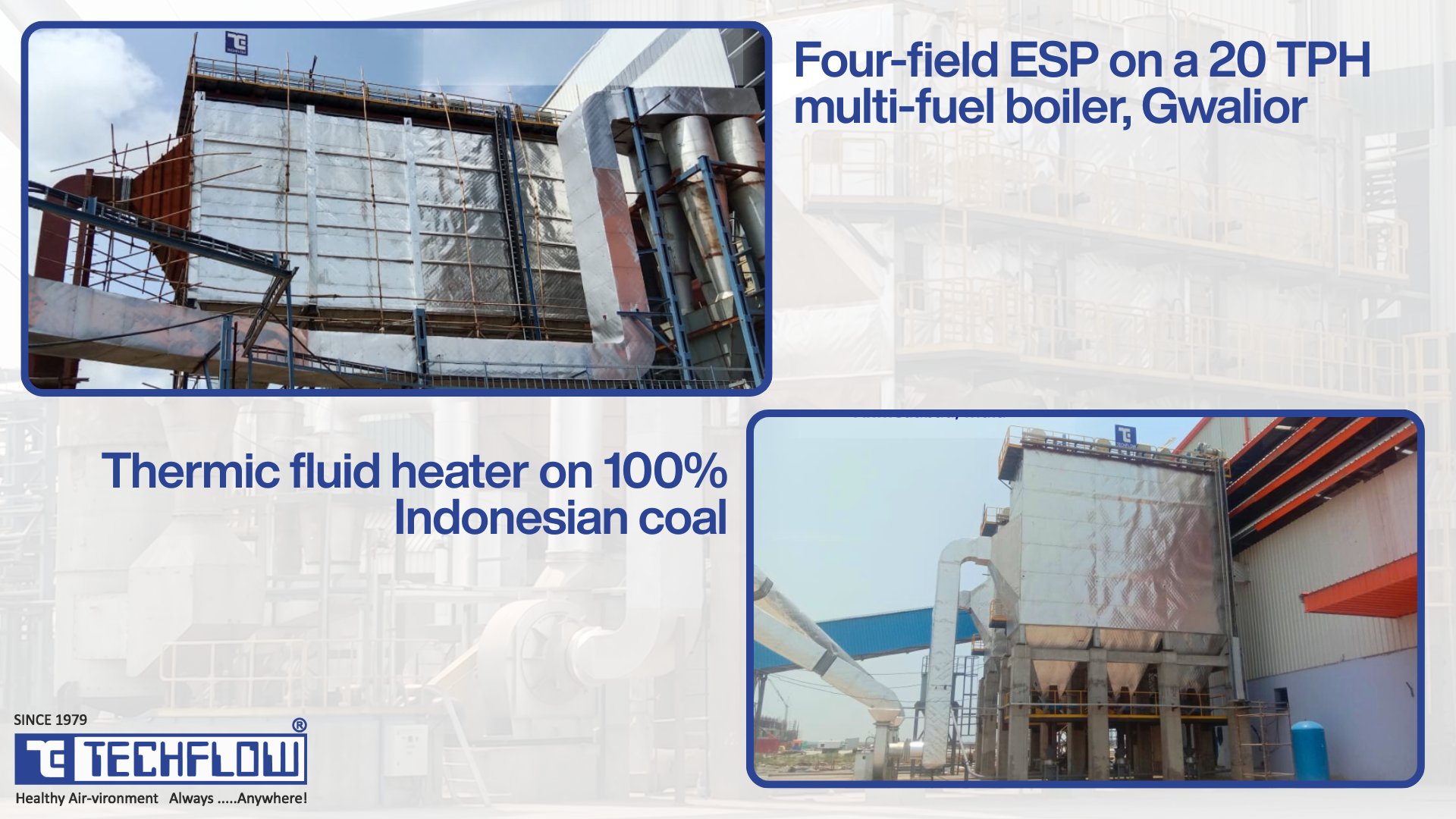
TECHFLOW has been designing and manufacturing industrial air pollution control systems since 1979, from its plant in Ahmedabad, Gujarat. Alongside electrostatic precipitators, the range covers bag filters, wet scrubbers, fume extraction and filtration systems, centrifugal blowers and fans, and pneumatic conveying systems, which means an ESP is specified as part of a complete gas handling train rather than in isolation.
Two commissioned results illustrate how the design parameters above translate into stack numbers.
Thermic fluid heater on 100% Indonesian coal
- Flue gas volume: 15,100 m³/hr
- Operating temperature: up to 176°C
- Design inlet dust load: 6,000 mg/Nm³
- Achieved outlet emission: 33.7 mg/Nm³
- Applicable Gujarat Pollution Control Board limit: 100 and 50 mg/Nm³
- Collection efficiency: 99.44%
High-ash Indonesian coal is a demanding fuel for a dry ESP precisely because of its resistivity and rapping behaviour, which makes the achieved margin against the statutory limit the more useful number here.
Four-field ESP on a 20 TPH multi-fuel boiler, Gwalior
- Boiler type and capacity: Atmospheric Fluidised Bed Combustion, 20 tonnes per hour
- Flow: 51,000 m³/hr
- Fuel: imported coal, rice husk and other biomass
- Moisture content in flue gas: 25% by volume
- Operating temperature: 180°C
- Inlet dust burden: 28 g/Nm³
- Outlet emission: 50 mg/Nm³
- Collection efficiency: 99.82%
The design behind that result: four fields, 3.5 metre field length, 7.0 metre field height, 10,400 millimetre gas passage width, 308 collecting electrodes at 500 millimetre width in an inverted C profile, 280 pipe-and-spike discharge electrodes, tumbling hammer rapping, and four transformer-rectifier sets rated 110 kV peak and 200 mA mean.
Arpit Kantia, Head of Marketing and Business Development at Techflow Enterprises Pvt Ltd, frames the reason results like these hold up in service: performance "comes from how well it's understood, engineered, and integrated."
That integration point is not marketing. TECHFLOW manufactures its own induced draft fans and supplies custom-designed ducting, erection and commissioning under one scope, which removes the interface risk that causes many ESP installations to underperform their design on paper.
ESP Selection Checklist: 12 Questions to Answer Before You Buy
Work through this before you issue an enquiry. The answers determine whether you are specifying a dry ESP, a wet ESP, or a staged arrangement.
- Gas volume at the ESP inlet, in m³/hr or Nm³/hr, with the basis stated
- Operating temperature range, including minimum, normal and maximum
- Moisture content of the flue gas, by volume
- Fuel type and variability, including whether the plant switches fuels seasonally
- Inlet dust burden, in g/Nm³ or mg/Nm³
- Dust resistivity, measured or estimated for the actual fuel, not assumed
- Particle size distribution, especially the fraction below 1 micrometre
- Presence of condensables, tar, acid mist or sticky organics
- Target outlet emission, and the specific notification or State Pollution Control Board consent condition that sets it
- Available plot area and height, since ESPs need low gas velocity and therefore physical volume
- Ash handling route, dry conveying or effluent treatment, and whether the collected material has value
- Continuous Emission Monitoring System requirement based on plant capacity
The Bottom Line: Dry ESP vs Wet ESP
There is no universal winner between dry and wet electrostatic precipitators, only a correct answer for a specific gas stream, dust characteristic, and compliance target.
If your gas is hot and your dust is dry and free-flowing, a dry ESP is almost certainly right, and the real engineering work is in field count, Specific Collection Area, resistivity management and rapping control. If your gas is already saturated, or carries tar, acid mist or sticky sub-micron material, a wet ESP is not a premium option; it is the only option that will hold its number. And if you have both a heavy coarse load and a stubborn fine fraction, a staged arrangement will usually beat either technology on its own.
What decides the outcome is rarely the technology label. It is whether the design was built around your actual fuel, your actual gas conditions, and your actual consent limit. Getting that right before procurement saves years of retrofit spend and unplanned shutdowns.
Get Your ESP Sized and Specified by TECHFLOW's Engineers
TECHFLOW has been engineering industrial air pollution control systems since 1979, and designs and manufactures both dry horizontal plate-type ESPs with one to four and more collecting fields, and wet ESPs for tar and acid mist duty. Field count, plate spacing, rapping selection and gas distribution are sized around your dust load, fuel resistivity and consent limit, not a standard model number.
Send us your gas volume, operating temperature, fuel type, inlet dust burden and target emission, and our engineering team will come back with a technology recommendation and an indicative configuration.
Talk to a TECHFLOW ESP engineer | Explore the TECHFLOW ESP range
Frequently Asked Questions (FAQs)
Both charge particles the same way, using a corona discharge from high-voltage electrodes to drive charged particles onto a grounded collecting surface. The difference is entirely in how the collected material is removed. A dry ESP mechanically raps or vibrates the plates so the dust cake falls into hoppers. A wet ESP washes the collecting surface with a continuous or intermittent water film and drains the resulting slurry. That single choice determines temperature limits, resistivity sensitivity, materials of construction, capital cost and the type of waste stream your plant has to manage.
No. Published design efficiencies for new equipment are 99 to 99.9% for both technologies, and on coarse dry dust the two perform comparably. Wet ESPs pull clearly ahead only on sub-micron particulate, acid mist, condensables and sticky or high-resistivity material. Design quality matters more than the label: TECHFLOW notes that cylindrical single-field wet ESP designs typically achieve efficiency below 98%, while a properly sized four-field dry ESP has delivered 99.82% collection efficiency in commissioned service.
Generally no, and this is the constraint that removes wet ESPs from most boiler applications. Wet wire-pipe ESPs are limited to gas temperatures below approximately 80 to 90 degrees Celsius. Boiler and thermic fluid heater outlets typically run 150 to 200 degrees Celsius. A dry wire-plate ESP, by contrast, can be designed for temperatures up to around 700 degrees Celsius, and TECHFLOW offers hot ESP configurations above 250 degrees Celsius with somewhat reduced efficiency. To use a wet ESP on hot gas, you must first quench or scrub the stream, which is a separate capital item.
Back corona occurs when the collected dust layer on a dry ESP plate has resistivity high enough that the ion current passing through it creates an internal electric field strong enough to break down locally. That breakdown injects ions of the wrong polarity back into the gap, stripping charge from incoming particles and causing sparking. It becomes prevalent above roughly 2 x 10¹¹ ohm-centimetre, with some laboratory work indicating onset from around 5 x 10⁸ ohm-centimetre. Fly ash from low-sulphur coal is the classic case. Wet ESPs do not suffer from it because the high-humidity atmosphere lowers the resistivity of most materials, eliminating the condition entirely.
Dry ESPs operate most efficiently with dust resistivities between about 5 x 10³ and 2 x 10¹⁰ ohm-centimetre. Above that window, back corona degrades charging and collection. Below roughly 10⁸ ohm-centimetre, the opposite problem appears: particles are held so loosely on the plates that both rapping and non-rapping re-entrainment become severe. Resistivity is strongly affected by temperature, moisture, gas composition and particle composition, so it should be measured or estimated for the actual fuel rather than assumed from a coal specification sheet.
For coal fly ash, rapping typically projects around 12% of the dislodged material back into the gas stream. Particles re-entrained in earlier fields get another opportunity to be collected downstream, but anything re-entrained in the final field escapes the unit. This is one reason multi-field designs outperform single long fields, and one reason rapping frequency and intensity are tuned rather than fixed. A wet ESP eliminates this loss mechanism entirely, because there is no rapping event.
It becomes slurry or effluent that must be settled, clarified or treated before discharge or reuse. For simple systems handling innocuous dust, the water can go to a solids-removing clarifier and then to final disposal. More complex streams need skimming, sludge removal, dedicated clarification, pH adjustment and treatment for dissolved solids. Where preconditioner water is treated separately from plate wash water, recirculation of treated water back to the ESP can approach 100%. Sites without existing wastewater infrastructure should budget this as a separate capital item, not as part of the ESP package.
The most difficult particles for a dry ESP have aerodynamic diameters between 0.1 and 1.0 micrometres, with maximum penetration usually occurring between 0.2 and 0.4 micrometres. This sits in the transition region between field charging, which dominates for larger particles, and diffusion charging, which dominates for very small ones. Wet ESPs are much less constrained here. Laboratory testing of a single-stage wet ESP recorded 94.7 to 99.0% collection efficiency across 16.8 to 615 nanometres even after heavy plate loading.
Yes, and staged arrangements are increasingly common. The dry stage handles the coarse bulk load economically, and the wet stage removes the fine and condensable fraction the dry unit cannot. Pilot-scale research on oxygen-pulverised coal combustion with carbon capture evaluated a 1,200 m³/hr dry ESP paired with a 400 m³/hr wet ESP and concluded the combination is promising for efficient gas cleaning. In power plant practice, wet ESPs are typically installed downstream of wet flue gas desulphurisation, where the gas is already cooled and saturated, to remove residual fine dust and sulphuric acid aerosol.
In principle, the charging section works identically, so a water wash stage can be added to an existing shell rather than building a new unit. In practice, the conversion needs new collecting plate materials able to withstand continuous moisture, a water circulation and treatment system, revised structural support for the added weight, and a means of bringing gas temperature down below the wet ESP operating ceiling. Corrosion is a real risk: controlled testing found stainless steel collecting plates rusting under sustained wet exposure. Before pursuing a conversion, it is usually more productive to evaluate whether gas conditioning, additional fields, rapping optimisation or a power supply upgrade will reach the target on the existing dry unit.
An ESP achieves over 99% removal efficiency on particles below 10 micrometres, with a pressure drop of roughly 25 mm water gauge against around 150 mm for a bag filter, so induced draft fan power is substantially lower for the life of the plant. ESP maintenance cost is also much lower, since a bag filter requires 100% of bags to be replaced roughly every two years. The trade-offs run the other way on two points: to reach below 20 mg/Nm³, an ESP needs more collecting fields, which raises capital cost above a bag filter, and ESP sizing depends on fuel type through dust resistivity, whereas bag filter efficiency does not. The general pattern is high capital and low maintenance for an ESP, against lower capital and higher running maintenance for a bag filter.
Yes, for both types, but through different mechanisms. Dry ESPs are affected by electrode wear and corrosion, by resistivity drift as fuel supply changes, and by progressive cake formation between rapping cycles. Published data shows that while typical new equipment design efficiencies fall between 99 and 99.9%, older operating equipment ranges from 90 to 99.9%, so an ageing unit may not meet a current stack limit regardless of type. Wet ESPs avoid the resistivity-driven decline but face corrosion risk from continuous moisture exposure, which is why non-corrosive materials are standard in wet construction.
Independent energisation. Separate fields let engineers energise sections independently, which improves particle capture and cuts wasted power compared with running one long field at maximum voltage regardless of need. It also gives re-entrained material from an upstream field a chance to be recaptured downstream. Hitting emission levels below 20 mg/Nm³ typically requires more collecting fields, which is why field count, rather than the wet-versus-dry choice, is often the biggest single lever on both cost and compliance.
Yes. Ozone is generated at the negatively charged electrode during gas ionisation in both dry and wet designs, because it is a by-product of corona discharge rather than of the cleaning method. Generation scales with corona current: in controlled testing at minus 10 kilovolts, ozone concentration measured 1,521 parts per billion with stainless steel collecting plates, 1,275 ppb with conductive glass and 222 ppb with ordinary glass, tracking the current each material drew. Collecting electrode material therefore influences ozone output alongside collection performance.
For standard coal, biomass or agro-waste fired boilers producing dry ash, a dry horizontal plate-type ESP is the appropriate technology, and this is TECHFLOW's current focus in ESP design and manufacture. Wet ESPs become relevant in coal applications mainly where the gas stream has already been saturated, typically downstream of wet flue gas desulphurisation or carbon capture. At a boiler outlet at 150 to 200 degrees Celsius, a wet ESP simply cannot operate without an upstream cooling stage.
Standards are notified sector by sector under the Environment (Protection) Rules, 1986, so the applicable limit depends on your industry and plant vintage. For thermal power plants, particulate matter limits are 100 mg/Nm³ for units installed before 31 December 2003, 50 mg/Nm³ for units installed up to 31 December 2016, and 30 mg/Nm³ for units installed from 1 January 2017. For industrial boilers below two tonnes per hour, the Central Pollution Control Board tightened the particulate standard to 500 mg/Nm³ in June 2022, down from 1,200 mg/Nm³. State Pollution Control Board consent conditions can be tighter than central standards, so always verify the specific limit in your consent to operate.


