

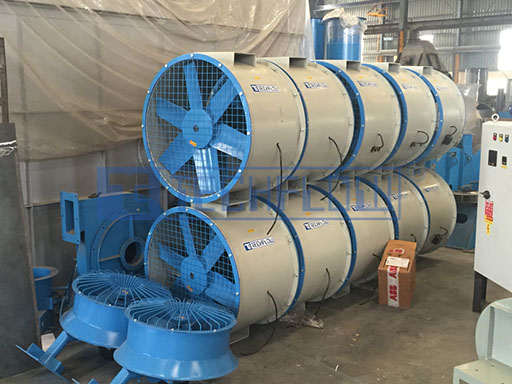
The basic principle of operation of the axial fan is that the direction of air flow is parallel to the rotor shaft. The blades of the fans force air linearly to the shaft. Axial flow fan are known to create a high flow rate, and they are able to achieve a bigger volume of air flow. In their operation, the air movements they create is of lower pressure and generally require lower power input for operation.
Axial Fan Working Principles
The working principle of a mechanical airflow system is largely dependent on the fan's capacity. The amount of fluid moved by a fan is expressed as its capacity in m3/h, m3/min, or m3/sec. Axial fans are typically mounted in short radius diaphragm holes to achieve high volume flow with minimal system pressure.
The axial impeller of an axial fan is the most important part of the system. An axis-shaped impeller has two to twenty blades, which are connected to an incredibly powerful drive motor. The entire unit is then assembled in a housing to create a parallel flow of air. The axial fan is a high-efficiency device, producing greater volume movement for less energy than centrifugal fans. As a result, they are typically more energy-efficient than their centrifugal cousins.
Axial fans are often used in industrial settings, where the airflow is high and the air resistance is low. This makes them a good choice for environments where airflow must be efficient and quiet. There are many different types of axial fans available, and each has its own set of benefits.


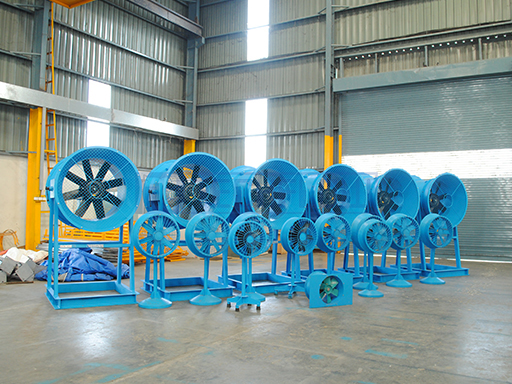


How do they Operate?
These fans are best suited for low air resistance and high flow usage conditions. There is a wide variation of axial fans in industry depending on the final usage. The blades can be forward curved, straight or backward curved. In usage, there is greater efficiency when the blades are curved backwards than the forward curved blades, but it has also been recorded that the forward oriented blades are better at self-cleaning that the backward oriented.
Features of Axial Fans
The main distinguishing component of the axial fan is the axial impeller with the number of blades ranging from 2 to 20 depending on the design and performance requirements. This is connected to powerful drive motor, and these are assembled in a housing designed for parallel flow of air through the fan.
These fans are highly energy efficient with the ability to generate greater air movement using considerably less energy, and therefore high cost savings to users. When compared to other types of fans or axial blower, they are able to offer up to 40% savings on power usage.
Fan Selection Criteria
There are several technical criteria’s used in selections of the fans to use in your premises. These include;
Operating points must never be close to “stall” condition. This is an allowance created through leaving a 2 degree pitch safety angle, so that the drive motor cannot get overloaded.
One must be sure that the motor horsepower is enough to handle the air movements, environmental stress and power losses.
You must ensure that the horsepower per blade, mechanical limit is never exceeded; otherwise it is important to select a fan with additional blades.
One must also check the resulting noise level against any noise limit specifications. It is normally quoted as the sound pressure levels at determined distance from the tower. Vibration frequency considerations
Factors Affecting Axial Fans Performance
There are several design factors affecting the performance of the axial fans and these include;
Density or the weight of air per unit volume
Number of blades in the unit; this is the ratio of the sum of blade widths to the fan’s circumference.
Shape of the blade. Straight, curved, forward or backward orientation. This blade shape affects the air flow on and across the surface of the fan. The shape twists the air and affects the velocity and air profile.
Industrial applications
The design and model of these industrial fans is essentially to create an air pressure alteration in the fan. They are manufactured from aluminum alloys and special plastic and even wood.