

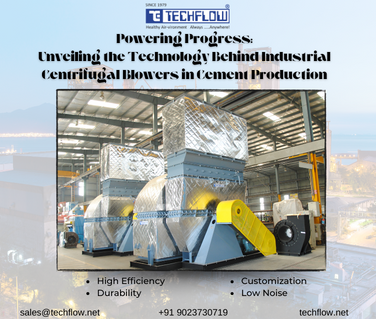
Centrifugal blowers quietly power the cement industry, working behind the scenes to ensure operations run seamlessly. They're like the dependable support system, making sure everything in the cement-making process stays on track and efficient. These fans are essential for keeping things running smoothly and are an integral part of how the cement industry gets things done.
Understanding the Centrifugal Industrial Blower in the Cement Industry
Before we explore the broader applications, let's briefly touch on the crucial role of centrifugal industrial blowers in the cement manufacturing process. In this context, these blowers are pivotal for ensuring proper air circulation and ventilation in kilns, thereby regulating temperature and aiding in the clinker production process. In the cement industry, the demand for high-performance centrifugal fans is paramount to optimize energy efficiency and minimize operational costs.Centrifugal industrial blowers are used in the cement manufacturing process to ensure proper air circulation and ventilation in kilns. This regulates temperature and aids in the clinker production process. Clinker is a hard, calcined material that is the main ingredient in cement. The clinker is produced by heating limestone and clay at high temperatures in a kiln. The hot air from the kiln is then used to drive the centrifugal blower, which in turn provides the necessary air circulation and ventilation. High-performance centrifugal fans are essential for optimizing energy efficiency and minimizing operational costs in the cement industry. They can help to reduce energy consumption by up to 20%, which can lead to significant cost savings.
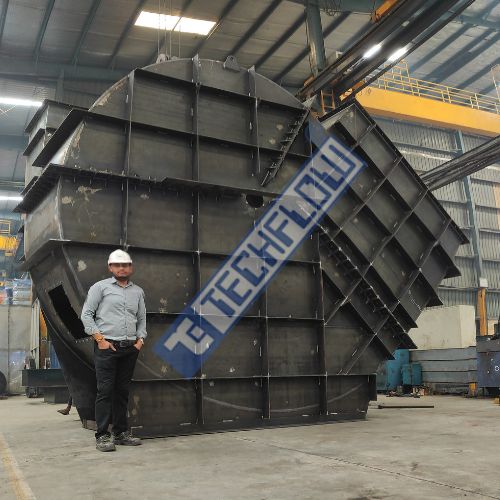
In addition, high-performance centrifugal fans can help to improve the quality of the cement produced. By providing the necessary air circulation and ventilation, they can help to ensure that the clinker is produced at a consistent quality. This can lead to improved product performance and customer satisfaction.
Overall, high-performance centrifugal fans are a valuable asset for the cement manufacturing industry. They can help to improve energy efficiency, reduce operational costs, and improve the quality of the cement produced.
Techflow’s design range
- Airflow: up to 12,00,000 m3/hr
- Pressure: up to 1500 mmWC
- Motor Capacity : up to 1200 kW
- Drive type: Direct/Couple/V-belt drive
In the cement industry, centrifugal fans play a crucial role in various processes by providing the necessary air flow for combustion, material transport, and cooling. Different types of centrifugal fans are employed based on their specific applications. Here are some common types of process fans used in the cement industry:
Types Of Industrial Fans & Their Uses In Cement Industry
Raw Mill Fan (Preheater Fan):
Raw mill fan (preheater fan) is a kind of large fan used in a raw mill. It is mainly used to transport hot air from the preheater to the raw mill. The raw mill fan is a key equipment in the raw mill system. The performance of the raw mill fan directly affects the production efficiency and product quality of the raw mill.
The raw mill fan is usually a centrifugal fan. The impeller is usually made of cast iron or steel. The blades of the impeller are usually backward curved. The raw mill fan is usually driven by a motor. The motor is usually a squirrel cage induction motor. The raw mill fan is usually mounted on the roof of the raw mill. The raw mill fan is usually connected to the preheater by a duct.
The raw mill fan is a high-speed rotating machine. It is important to ensure the safety of the raw mill fan. The raw mill fan should be regularly inspected and maintained. The raw mill fan should be operated in accordance with the instructions.
- Function: Provides the necessary air flow for the raw milling process.
- Application: Used in the preheater and raw mill system to transport raw materials and assist in the grinding process.
Kiln ID Fan (Induced Draft Fan):
Kiln ID fans are used to draw hot gases out of the kiln and into the stack. They are typically large, powerful fans that can move a lot of air. The fan is located at the top of the kiln, and it draws air up through the kiln and out the stack. The fan is typically powered by an electric motor, but it can also be powered by a gas engine.
Kiln ID fans are important for maintaining the temperature in the kiln. The hot gases that are drawn out of the kiln help to keep the temperature inside the kiln high. If the fan were not there, the hot gases would build up inside the kiln and the temperature would drop. This could damage the kiln and the products being fired.
Kiln ID fans also help to prevent pollution. The hot gases that are drawn out of the kiln contain pollutants, such as dust and ash. The fan helps to disperse these pollutants into the atmosphere, where they can be diluted and dispersed.
- Function: Creates a negative pressure in the kiln, drawing the combustion gases through the system.
- Application: Essential for maintaining the proper conditions in the cement kiln, ensuring efficient fuel combustion and clinker production.
Cooler Exhaust Fan:
Cooling fans and clinker cooler exhaust fans are used to circulate fresh air to the clinker to cool down the material. The cooler exhaust fans move 1.8 tons of exhaust air per 1 ton of clinker production. This process is a part of the air blown into the cooler by cooling fans that is not useful for fuel combustion.
The cooling fans are used to move air through the cooler, which helps to cool the clinker. The exhaust fans are used to remove the hot air from the cooler, which helps to prevent the clinker from overheating. The air that is blown into the cooler by the cooling fans is not useful for fuel combustion, as it is too hot and contains too much moisture. The exhaust fans remove this air from the cooler, allowing the cooling fans to continue to circulate fresh air through the cooler.
- Function: Cools the clinker and transports it from the rotary kiln to subsequent processes.
- Application: Used in the clinker cooling process to reduce the temperature of the clinker before it is ground into cement.
Coal Mill Fan (Coal Pulverizer Fan):
Coal mill fan (coal pulverizer fan) is a kind of fan used in coal mill to blow coal powder into the furnace. It is usually a centrifugal fan with a large air volume and low pressure. The coal mill fan is an important part of the coal mill system, and its performance directly affects the pulverization quality of the coal mill.
The coal mill fan is usually installed on the top of the coal mill, and its inlet is connected to the coal mill discharge port, and its outlet is connected to the furnace. The coal mill fan is driven by a motor, and the motor drives the fan impeller to rotate, which generates centrifugal force to suck in air from the inlet and blow it out from the outlet. The air flow generated by the coal mill fan blows the coal powder from the coal mill discharge port into the furnace.
There are many types of coal mill fans, and the most common types are the axial flow fan and the centrifugal fan. The axial flow fan is a type of fan in which the air flows parallel to the axis of the fan. The centrifugal fan is a type of fan in which the air flows radially from the center of the fan to the outside.
- Function: Provides air to the coal mill for drying and carrying the pulverized coal to the burners.
- Application: Used in coal-fired kiln systems for the combustion of pulverized coal.
Filter Fan (Baghouse Fan):
Filter fan (baghouse fan) is a kind of fan used in baghouses. It is used to create negative pressure in the baghouse, so that the dust can be sucked into the baghouse and trapped by the filter bags.
Filter fans are typically centrifugal fans, with a wide range of sizes and capacities. They are typically powered by electric motors, but can also be powered by diesel engines or gas turbines.
Filter fans are an important part of the baghouse system, and they must be properly sized and installed to ensure that the baghouse operates efficiently. If the filter fan is too small, it will not be able to create enough negative pressure in the baghouse, and the dust will not be effectively trapped by the filter bags. If the filter fan is too large, it will waste energy and may cause the baghouse to vibrate excessively.
- Function: Creates the necessary suction for the baghouse or dust collector system.
- Application: Ensures efficient dust collection and air filtration in various stages of the cement manufacturing process.
Recirculation Fan (Raw Mill Circulation Fan):
The recirculation fan is a key component of the raw mill. It is responsible for circulating the raw material in the mill, ensuring that it is evenly ground and that no hot spots develop. The fan is typically located at the top of the mill and draws air from the mill through the grates and into the fan housing. The air is then forced through the fan blades and out the discharge port, creating a strong airflow that circulates the raw material.
The recirculation fan is typically powered by an electric motor, which is controlled by a variable frequency drive (VFD). The VFD allows the operator to adjust the speed of the fan, which in turn controls the airflow through the mill. The airflow is critical to the grinding process, as it helps to break down the raw material and ensure that it is evenly ground.
- Function: Facilitates the recirculation of hot gases and ensures uniform temperature distribution.
- Application: Used in the raw mill system to control the temperature and optimize the drying process.
Finish Mill Fan:
Finish mill fans are used to cool and ventilate the finish mill. They are typically located at the top of the mill and are designed to draw air through the mill and exhaust it out the top. The fans are typically powered by electric motors, and the speed of the fans can be controlled to vary the amount of air that is drawn through the mill. Finish mill fans are an important part of the finish mill process, as they help to ensure that the mill is operating at a safe temperature and that the air quality in the mill is good.
- Function: Provides air flow for the final grinding of clinker and additives.
- Application: Used in the finish milling process to achieve the desired fineness of the cement.
Separator Fan:
Separator fans are used in a variety of industrial applications to separate solids from liquids. The fan creates a vortex that draws the liquid up through the center of the fan and out the discharge, while the solids are centrifugally thrown to the outside of the fan and discharged through the vortex finder.
Separator fans are typically made of cast aluminum or stainless steel and have a variety of impeller designs to suit different applications. The impeller is typically mounted on a motor shaft that is supported by bearings. The motor is typically located at the bottom of the fan housing and drives the impeller through a belt or direct drive.
- Function: Separates fine and coarse particles in the milling process.
- Application: Used in conjunction with the separator to control the particle size distribution in the finished cement.
ESP (Electrostatic Precipitator) Fan:
ESP (Electrostatic Precipitator) Fan is a device that is used to remove particulate matter from the exhaust gas of industrial boilers and furnaces. The fan creates a strong electrostatic field that attracts the particles to the collector plates, where they are collected and then removed. ESP fans are typically centrifugal fans, and they are available in a variety of sizes and configurations to meet the specific needs of each application.
ESP fans are an important part of the air pollution control system for industrial boilers and furnaces. They help to reduce the amount of particulate matter that is emitted into the atmosphere, which can improve air quality and protect human health.
ESP fans are a valuable tool for improving air quality and protecting human health. They are an important part of the air pollution control system for industrial boilers and furnaces.
- Function: Assists in the collection of particulate matter from the flue gases.
- Application: Used in the cement industry's environmental control systems to reduce air emissions.
Cooler Vent Fan:
Cement manufacturers use a large number of cooling fans to cool the clinker from 1500 degrees Celsius to 100 degrees Celsius. The number of cooling fans used in each clinker line depends on the plant’s kiln capacity, typically ranging from 5 to 15 fans. Cooling kilns protect equipment and facilitate quenching the clinker, ensuring that important forms of minerals like C3S, C2S, C3A, and C4AF stay in the clinker. Appropriate design of cooling fans is essential for:
 Maintaining the quality of clinker and conveying system
- Curtailing power consumption in a cement manufacturing plant
It is recommended that cooling fans be equipped with variable speed drives to reduce the amount of cooling air required.
- Function: Assists in the cooling of the clinker in the cooler.
- Application: Supports the cooling process and helps maintain the desired clinker temperature.
The type of centrifugal fan used in a particular application will depend on the specific requirements of the process. For example, a combustion fan will need to be able to move large volumes of air at high speeds, while a material transport fan will need to be able to move materials at high speeds without damaging them.
Centrifugal fans are an essential part of the cement industry, and they play a vital role in ensuring the safe and efficient operation of cement plants.
These types of centrifugal fans are essential components in the cement manufacturing process, contributing to the efficiency and productivity of various stages, from raw material preparation to clinker production and cement milling.
Moreover, in dust control applications and indoor air quality maintenance, these fans stand out for their reliability, adaptability, and minimal noise levels. Their versatility and dependable performance make them indispensable assets in the cement industry's quest for efficient and sustainable production.
Best Industrial Centrifugal Fans: What Sets Techflow Apart
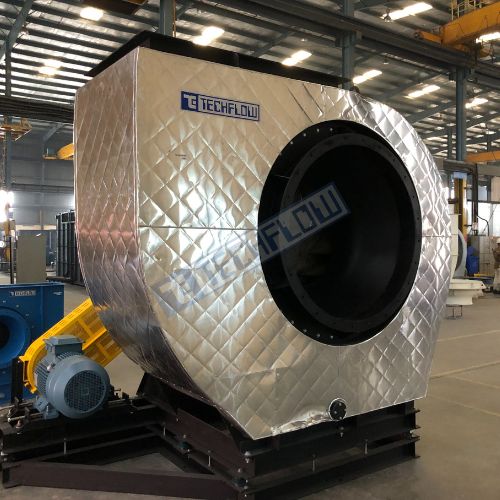
When it comes to selecting the best industrial centrifugal fans for various applications, a few key factors make them stand out:
- High Efficiency: Industrial centrifugal fans are designed to operate with high efficiency, ensuring that they provide robust air movement while consuming minimal energy. This factor is critical for cost-effective operations in any industry.
- Durability: These fans are built to withstand the rigors of industrial environments, making them reliable for extended periods. This resilience is especially important in sectors where equipment uptime is crucial.
- Customization: Manufacturers offer a range of options in terms of size, capacity, and materials to suit the specific needs of different industries. Customization ensures that the centrifugal fan can be tailored to the requirements of each application.
- Low Noise: In many applications, noise levels need to be minimized for the comfort of workers and to adhere to industry regulations. The best industrial centrifugal fans are designed to operate quietly.
Techflow ensures the optimum design and performance guarantee for blowers and fans. Each Fan are designed to achieve higher efficiency over 70% so that the operating cost of the plant lowers without compromising the productivity. Check out the range our low, medium and high pressure centrifugal fan for cement industry
FAQs:
Centrifugal fans are crucial in cement manufacturing for various purposes, including ventilation, material transport, cooling, and dust control. They help maintain proper conditions, contributing to efficient and sustainable production.
These fans ensure proper air circulation and ventilation in kilns, regulating temperatures vital for clinker production. They aid in improving energy efficiency, reducing operational costs, and enhancing cement quality.
Several types serve different functions:
- Raw Mill Fan: Assists in the raw material grinding process.
- Kiln ID Fan: Maintains proper temperature inside the kiln for efficient combustion.
- Cooler Exhaust Fan: Cools clinker before the grinding process.
- Coal Mill Fan: Transports coal powder into the furnace for combustion.
- Filter Fan: Ensures efficient dust collection and air filtration.
- Recirculation Fan: Controls temperature in the raw mill system.
- Finish Mill Fan: Provides airflow for final cement grinding.
- Separator Fan: Controls particle size distribution in the finished cement.
- ESP Fan: Helps in removing particulate matter from exhaust gases.
- Cooler Vent Fan: Assists in cooling the clinker.
Techflow's fans are designed for high efficiency, durability, and customization. They ensure robust air movement with minimal energy consumption, reliability in industrial environments, and low noise operation. These factors contribute to cost-effective and efficient operations in various industrial applications.
Techflow prioritizes efficiency in their fan designs, achieving over 70% efficiency to lower operating costs without compromising productivity. Their range of low, medium, and high-pressure centrifugal fans caters specifically to the needs of the cement industry.