

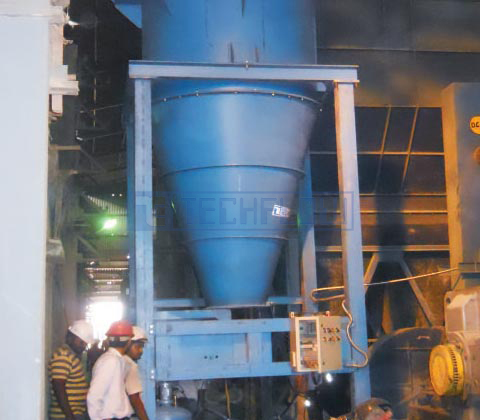
Industrial cyclones can be useful where the process has a separable coarse or abrasive dust fraction. This article focuses on operation and limitations; use our selection checklist when preparing an enquiry.
Low-maintenance
The collector body has relatively simple construction and generally has no moving internal separation parts.
This does not make the complete installation maintenance-free: fans, discharge equipment, ducts and seals still require attention.
Inspect for wear, build-up and leakage at intervals appropriate to the material and operating duty.
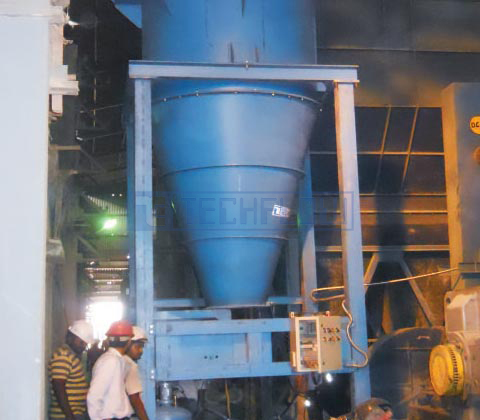
Low-cost
Compare the installed system, including fan, ductwork, supports and material discharge, rather than the collector price alone.
The expected pressure loss forms part of fan selection and operating-energy assessment.
Potential savings must be established for the particular process; no universal percentage reduction is assumed.
Build-up and material behaviour
Material that adheres to walls or accumulates at the outlet can interfere with operation.
Identify moisture, condensation and sticky-dust behaviour before selecting the arrangement.
Access for inspection and cleaning should be considered during layout planning.
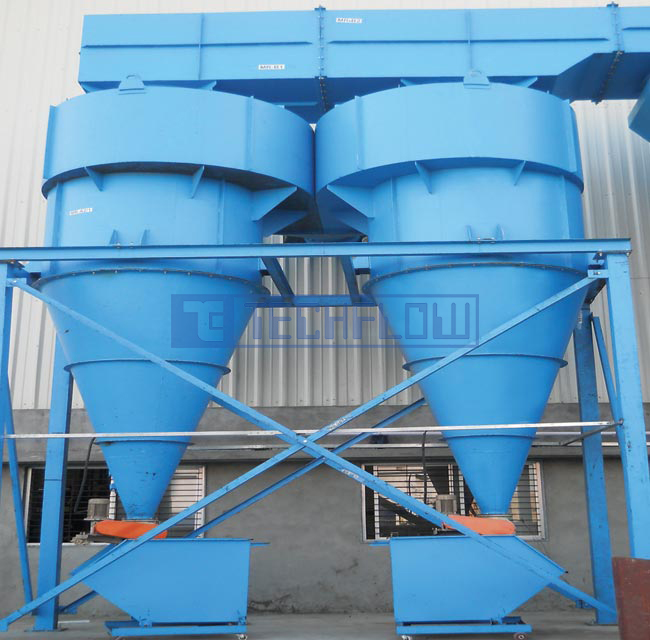
Fine-particle limitations
A cyclone must not be assumed to provide complete sub-micron particulate removal.
Fine-particle duties may need a different collector or a downstream stage selected for the application.
Use particle-size data and the required outlet condition when comparing proposed systems.
Size Ratio
Body dimensions and inlet geometry are engineering choices linked to the required flow and separation duty.
Do not apply a generic diameter ratio without considering the rest of the design.
Dust discharge must avoid unwanted air ingress and allow material to leave the collector.
Efficacy
Assess performance against agreed operating conditions and the characteristics of the actual dust.
The US EPA monitoring guidance explains why particle size and pressure drop matter.
Discuss your duty with TECHFLOW through the CyclaX product page. Do not use an unsupported efficiency, cost-saving or maintenance claim as a substitute for a project specification.


