
Bag Filter versus ESP for Industrial Boilers
Neither a Bag Filter nor an electrostatic precipitator is the universal choice for every industrial boiler. Selection depends on the fuel and ash, flue-gas flow and temperature, moisture and chemistry, inlet particulate loading, load variation, required outlet basis, available footprint, system resistance, utilities, maintenance capability and lifecycle objectives. A fair comparison gives both technologies the same design basis before commercial evaluation.
Establish the design basis first
The comparison should start with confirmed or clearly identified data:
- boiler or heater type, firing system and capacity;
- primary, alternate and blended fuels;
- gas flow at minimum, normal and maximum load;
- normal, peak and upset temperature;
- moisture, oxygen and relevant gas composition;
- inlet particulate concentration, size distribution and ash properties;
- sparks, char, stickiness, abrasion and corrosive constituents;
- required outlet concentration and measurement basis;
- plot space, height, duct and stack interfaces;
- operating hours, turndown, start-up and shutdown conditions;
- power, compressed air and other utilities; and
- maintenance resources, redundancy and lifecycle expectations.
Boiler tonnage or fuel name alone is not enough. Rice husk, bagasse, wood waste, coal, lignite and mixed fuels can behave differently, while firing technology changes particulate carryover and load response.
Boiler Bag Filter option
A Bag Filter captures particulate on filter media and periodically removes the dust through a cleaning system. It can offer effective fine-particle collection across many industrial solid-fuel duties when the gas is compatible with the selected media and operating philosophy.
Important considerations include temperature, dew-point margin, sparks, unburnt carbon, sticky dust, chemistry, filtration velocity, pressure drop, cleaning method, bag and cage access, compressed-air needs where applicable, hopper interface and shutdown practices. Air ingress or a temperature excursion can materially change operating conditions.
Evaluate the Boiler Bag Filter option through its product-specific page.
Dry ESP option
A dry ESP electrically charges particulate and collects it on plates or other collecting surfaces. Rapping transfers accumulated dust into hoppers. It may be attractive where the dust resistivity, gas conditions, operating profile and available footprint support electrostatic collection, particularly where low gas-side pressure loss is important.
Key considerations include resistivity, gas distribution, loading, particle size, temperature, moisture, fuel chemistry, number and arrangement of fields, electrical controls, rapping, hopper evacuation and load variation. A change in fuel or ash chemistry can affect electrical collection behaviour.
Evaluate the dry ESP option for industrial boilers and the ESP product.
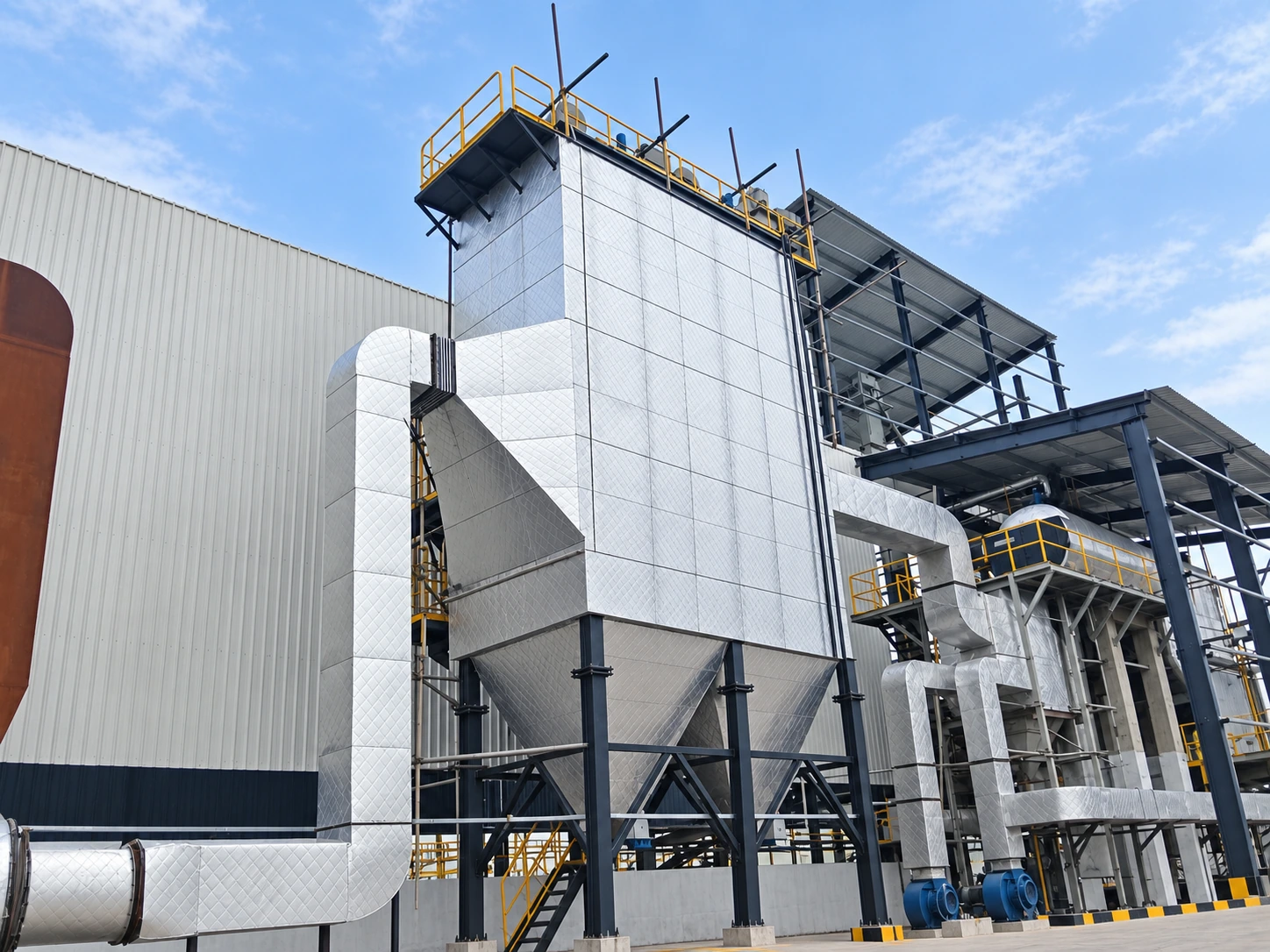
Balanced comparison

| Decision factor | Boiler Bag Filter | Dry ESP |
|---|---|---|
| Collection principle | Filtration through selected media | Electrical charging and collection |
| Fuel and dust sensitivity | Media, temperature, sparks, moisture and chemistry are critical | Resistivity, chemistry, particle behaviour and gas distribution are critical |
| Pressure loss | Typically higher and varies with dust cake and cleaning | Typically lower on the gas side |
| Utilities | Cleaning air may be required depending on configuration | High-voltage electrical system required |
| Temperature constraints | Governed by media and protection philosophy | Governed by mechanical/electrical design and gas conditions |
| Load and fuel variation | Requires review of flow, loading, temperature and condensation | Requires review of flow, resistivity and electrical conditions |
| Footprint | Configuration-dependent | Required fields and collection area can demand more plot length |
| Maintenance focus | Bags, cages, cleaning system, seals and hoppers | Electrodes, rapping, high-voltage equipment, gas distribution and hoppers |
| Fan implication | Higher collector resistance must be included | Lower collector resistance still requires complete gas-path calculation |
| Selection outcome | Appropriate where the full filtration envelope is controlled | Appropriate where electrostatic behaviour and project conditions support it |
The table is a screening framework, not a substitute for application engineering.
When a Bag Filter may be preferred
A Bag Filter may deserve preference when the fuel and gas conditions are compatible with filtration, fine-particle capture is required, the plant can manage the cleaning and maintenance needs, and the higher pressure-drop implication is acceptable. It should not be selected without addressing sparks, condensation, peak temperature and dust chemistry.
When a dry ESP may be preferred
A dry ESP may deserve preference when ash resistivity and gas conditions support electrostatic collection, low gas-side pressure loss is valuable, continuous-duty characteristics suit the plant and sufficient footprint is available. It should not be selected without evaluating fuel variability, gas distribution, electrical operating range and particulate behaviour.
When either technology may work
Many industrial-boiler projects can support more than one technically feasible route. The better decision then depends on total installed arrangement, energy, utilities, footprint, operating skill, planned maintenance, spare strategy, availability and lifecycle cost. Commercial comparison should occur only after both proposals use the same inlet and outlet basis.
Pre-separation and ID-fan implications
A cyclone or multiclone may reduce coarse loading before the final collector in suitable applications. Its value should be assessed against dust distribution, erosion, pressure loss, space and the final target. It is not automatically required for either technology.
The ID fan must be reviewed for the complete boiler, duct, pre-separator, collector and stack resistance. Bag Filter pressure drop and ESP gas-path resistance create different fan duties, but neither removes the need for accurate flow, temperature and density data. See industrial boiler fan selection and the centrifugal fans category.
Emission target and measurement basis
For a suitable application, either technology may be engineered toward an outlet particulate target below 10 mg/Nm³. The statement is incomplete unless it identifies the fuel and inlet loading, gas conditions, operating range, reference oxygen, dry or wet basis, normalization, averaging and contractual test method.
A value measured on one project—including a result below 5 mg/Nm³—must not be converted into a universal guarantee. Country-specific legal limits should be checked from current authoritative sources for the project location.
Common selection mistakes
- comparing proposals with different gas flows or inlet loadings;
- treating all biomass or coal sources as equivalent;
- ignoring alternate fuel and fuel-switching conditions;
- omitting peak temperature, moisture or dew-point risk;
- comparing outlet numbers with different oxygen or moisture bases;
- forgetting dirty-condition pressure drop and ID-fan capability;
- assuming a cyclone alone will meet a stringent final target;
- overlooking footprint, maintenance access and hopper interfaces;
- confusing a new APCD package with minor modification of existing equipment; and
- selecting on initial price before defining lifecycle and responsibility boundaries.
Technology-neutral RFQ checklist
Ask both suppliers to use the same boiler, fuel, firing, gas-flow, temperature, moisture, inlet dust, ash-property, load-range and outlet-test basis. Define the plot, ducts, stack, fan, utilities, controls, civil and structural interfaces, hopper battery limit, erection and commissioning responsibility, documentation and performance-test conditions.
TECHFLOW does not supply downstream ash conveying, storage or recycling. Any hopper connection must therefore be coordinated with the plant or its selected ash-system supplier.
Frequently asked questions
Which has higher collection efficiency: a Bag Filter or ESP?
Both can provide high particulate collection when correctly applied. The meaningful question is whether the selected configuration can meet the agreed outlet basis across the stated fuel, gas and operating envelope.
Which uses less fan power?
A dry ESP normally has lower gas-side pressure loss than a Bag Filter, but total fan power depends on the complete system resistance, gas flow, density, efficiency and control method.
Which is better for biomass?
Biomass is too broad for a single answer. Rice husk, bagasse, wood residues, pellets and blends can have different ash, moisture, chemistry and spark conditions. Compare both options using the specific fuel envelope.
Can either system achieve below 10 mg/Nm³?
For suitable applications, either may be engineered toward that target. The guarantee must be project-specific and tied to the complete design and measurement basis.
Does the comparison include ash handling?
No. It covers the collector and relevant interfaces. Downstream ash handling and conveying are outside TECHFLOW's present scope.
Request a technology-neutral review
Share one common data set for both alternatives. TECHFLOW can assess whether a Boiler Bag Filter, dry ESP or a more qualified next step is appropriate without assuming a winner before the fuel, gas, dust, fan and plant conditions are understood.