

When you're considering the purchase of an Industrial Cyclone Dust Collector, there are several factors to consider. Aside from price, this machine should also have features such as Low-maintenance, low-adhesion, and the ability to capture particulates that are sub-micron in size. Read on to learn more about industrial cyclones. You'll be glad you did! These machines can be installed in many industrial settings and offer a wide range of benefits.
Low-maintenance
Industrial cyclone dust collectors are the most common type of equipment used to collect dust in the industrial sector. They are very effective at separating fine from bulky dust, making them easier to empty and maintain. This article will explain the advantages and disadvantages of using cyclone dust collectors in industrial settings. Also, learn about the different types and sizes of cyclones and the maintenance requirements that each type requires
Industrial workplaces often require periodic maintenance, including cleaning the filter and bag houses. Often, this requires hiring third-party companies to perform these maintenance tasks. However, this can negatively impact the company's budget. If you want to avoid these issues, consider installing a cyclone dust collector. You'll love the low-maintenance, high-capacity, and efficient operation of a cyclone.
Cyclones come in many designs, sizes, and prices. Imperial Systems offers models with varying collection efficiencies and materials. Its cyclones are also designed for high temperatures and abrasion resistance. The manufacturer of a cyclone will help you determine which features are essential to your particular requirements and budget. Typically, a single unit is less expensive than a series of smaller ones.

Low-cost
A low-cost industrial cyclone dust collector is an excellent option for companies with high-volume, high-particle-count processes. Its design takes into account the type and size of particles in the process environment, and its performance is correlated to these three technical performance indicators. Cyclones are efficient at collecting large-sized particulate matter, and stand-alone models can handle as large as 200 mesh particles. Cyclones can also be used as pre-cleaners for baghouses, reducing the overall dust load and minimizing maintenance costs.
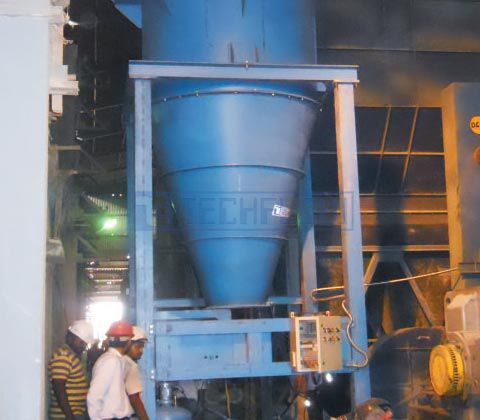
Cyclone dust collectors operate by pulling dust particles from the airflow using centrifugal force. As the airflow passes through the cyclone, a spiral vortex forms between the inner wall of the housing and the exhaust pipe. The spiral vortex rotates downwards under centrifugal force, and the collected particulate drops into a collection hopper. The cleaned air is then discharged through the side outlet transition. The side outlet transition contains a spark-resistant aluminum fan to protect the fan wheel from abrasion.
When choosing a low-cost industrial cyclone dust collector, manufacturers consider your business requirements and application. Large facilities commonly incorporate baghouses, jet dust collectors, and inertial separators into the design of their systems. They may also integrate capture arms and overhead ductwork to allow access to the interior. Some manufacturers also enhance fabric filters with chemically inert limestone. Other optional features include custom paint jobs, tailpipe adapters, and interior duct connectors.
Low-adhesion
Cyclone dust collectors are an excellent choice for capturing fine particles in various industrial settings. These units capture a majority of the saleable product, preventing the need to clean baghouse filters. They are also comparatively easy to maintain, as their construction has no moving parts. The basic unit has six sections: the inlet scroll section, conical housing, inner vortex tube, surge hopper, and scroll clean gas outlet.
The size and distribution of airborne particles are important factors for dust collection efficiency. It is important to choose the right dust collector according to the size and distribution of particulates present in your factory or plant. Low-adhesion industrial cyclone dust collectors are efficient in capturing even large particulates. Some models are able to handle up to 200 mesh particles. Others serve as pre-cleaners for baghouses. They reduce the amount of fine dust in the exhaust stream by pre-filtering coarser material.
Cyclone dust collectors have a helix-shaped baffle to divert air. As the air enters the cyclone, it forms a cyclonic flow. The smaller dust particles fall to the bottom of the cyclone, while the heavier ones are carried away in the centrifugal force. The size of the cyclone's outlet tube also determines its efficiency.

Capable of removing sub-micron-sized particulates
There are several ways to collect samples of sub-micron-sized airborne particles. They may be used for pollution detection or as an experimental tool for particle analysis. Some methods are used for scientific measurements of the atmosphere, such as determining the size and type of particles found in jet and rocket exhaust. A sample of sub-micron-sized particles may also be used for air pollution control or as a test of air quality standards.
One common particulate control technology involves the use of electrostatic precipitators. These filters work by directing liquid onto collecting plates to remove particles. Their design minimizes the possibility of re-entrainment and provides a consistent collection efficiency. Another way to remove particulates is to cool the gas stream before it enters the scrubber. Because the gas is highly moist and has a high moisture content, the gas stream must be cooled significantly before it enters the system. This system is also expensive to operate, and requires substantial cooling.
In addition to using a filter system capable of removing sub-micron-sized particles, this technology may be applied in various other industrial applications. A sample containing five-millimeter-sized microspheres is an example of a filter that can remove this size range. In this case, the filter is capable of removing up to 42% of the particles. The rejection rate is around 0.2.
Size Ratio
The size ratio of industrial cyclone dust collectors varies. In general, the smaller the cyclone, the more efficient it is. However, this relationship only applies to the same family of cyclones. For example, the Cyclone 3 has a smaller capacity than the Cyclone 2, but is nearly 50 percent larger. In general, a smaller cyclone is better for removing fine dust.
The size ratio of an industrial cyclone is a key consideration when selecting a cyclone. This ratio is related to the gas inlet velocity. Standard cyclone dimensions assume air velocities of 20 to 100 fps, and most industrial applications fall between these two ranges. However, some laboratory tests have shown inlet velocities as low as 10 fps and as high as 150 fps. The cutoff diameter is also an important consideration because it may prevent particles from blocking the cyclone's inlet. In addition, special linings prevent dust from damaging the cyclone when operating in high-velocity air, and replaceable wear plates are also recommended to ensure a long cyclone's life.
The size ratio of an industrial cyclone dust collector is an important consideration for both efficiency and cost. Many cyclones are not efficient at all. To get the most efficiency out of a cyclone, it is important to measure the amount of air that the machine needs to remove. In order to do this, you should look for a cyclone that is based on its CFM to water pressure drop.
Efficacy
When it comes to separating particles, the Efficacy of Industrial Cyclone Dust Collector is important. This device removes dust and particles smaller than 1.0 micron. The size of the cyclone also has an impact on its efficiency. A cyclone with a diameter of 6.5 feet has a 30.6 percent efficiency in capturing dust particles of 1.0 micron. The pressure drop of a cyclone can be as high as 11.6 inches.
The efficiency of an industrial cyclone dust collector depends on the size and distribution of airborne particles. You need to know the size and density of the particulate matter in your factory or plant before you buy the cyclone. Cyclones can handle both small and large particles. For example, standalone cyclones can handle up to 200 mesh particles, while smaller units may be better suited to handle larger particles. Additionally, you can use cyclones as pre-filters for baghouses, reducing the overall dust load.
Cyclone dust collectors work by diverting air through a helix-shaped baffle. The resulting cyclonic air flow separates dust particles and gases. As air enters the cyclone, the dirtier air is thrown to the bottom by the centrifugal force. The clean air then travels through the inner cylinder and is expelled through a gas outlet.