

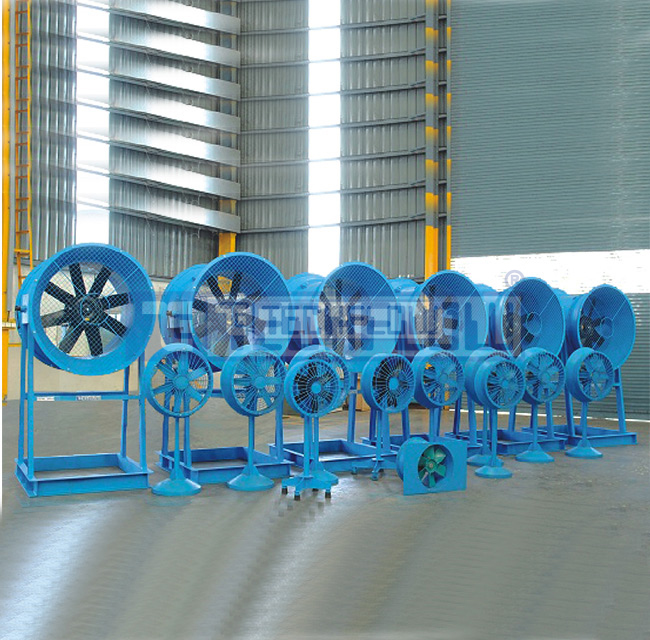
In order to get the most out of centrifugal fans, it's vital to understand their working principle. There are several factors that affect how these fan units operate, and you'll want to ensure that you're not making any mistakes that could harm your unit.
Axial vs Centrifugal Fans
Axial vs centrifugal fans are used in various industrial applications. While they may seem similar at first, they differ considerably in terms of their working principle. The primary difference between these two types of fans is the amount of pressure they create and the volume of air that they can move.
In a centrifugal fan, air is pushed out of the fan at high speed and is thrown in a radial direction. It is this type of fan that works well in air conditioning systems, drying systems, and dust control. The fan can also be found in air conveyor devices.
Axial fans have a much lower power input and can produce a higher flow rate than centrifugal fans. However, they can be noisy. Axial fans are generally suited for low-pressure applications, such as ventilation systems, cooling systems, and industrial heating systems. They are also suitable for non-ducted applications.
Axial fans are typically manufactured with pitched blades, which help to create a pressure differential as the air moves through the fan. Axial fans are usually smaller and less expensive than their centrifugal counterparts. Besides, they are often quieter.
The construction of an axial fan is fairly simple. The fan assembly consists of an electric motor, a shaft, and the fan blades. The fan is then placed in a protective casing.
Both axial and centrifugal fans utilize motors. The main difference is that the axial fan is powered externally, while the centrifugal fan's motor is located within the fan's casing. Axial fans can be multistage, which can increase the pressure drop and air volume.
Both types of fans are commonly used in air conveyor devices, but the differences in their operating principles make them ideal for different applications. Axial fans are best suited for applications with low pressure drops, while centrifugal fans are better for high-pressure applications.
An impeller is the key component of a centrifugal fan. The working principle of an impeller is that the impeller is rotated to generate a flow field that propels a gas stream into an outlet duct. The flow field is a result of the interaction of the blades with the casing. When the flow field is steady, the impeller's efficiency remains constant. However, when the impeller becomes overpowered, the flow field changes and the fan loses efficiency.
In order to reduce the power consumption of a fan, a redesign of the impeller is required. A number of design constraints must be considered when redesigning the impeller. The impeller needs to match the existing volute and achieve the specified output pressure at the lift-side volute exit. In addition, it is imperative to account for aerodynamic losses.
To accomplish this, a high-fidelity CFD-based computational approach is used. This approach is capable of accounting for all aerodynamic losses. As part of the design calculation, all casing surfaces are treated as no-slip walls.
The baseline lift-fan impeller is a double-width, double-inlet centrifugal type with two non-staggered blade rows. It is fitted with a double-discharge volute.
A new impeller was designed to meet the same specifications, but with a lower specific speed. It was optimized using a two-dimensional blade profile to minimize the loss of radii. It is also optimized to prevent flow separation at the leading edge of the impeller. This improves efficiency by 1.2 percentage points.
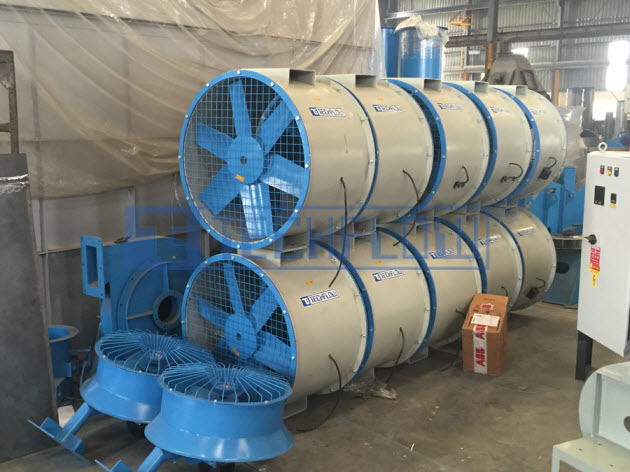
Compare Radial vs Centrifugal Fans Performance
Radial fans and centrifugal fans are the two most popular types of fans used in industrial applications. They both utilize motors to move air, and their applications are varied. However, while both types are effective, one type may be more suitable for your specific application.
There are a number of factors to consider when deciding between the two. In general, a radial fan is a more durable and reliable solution that can handle large particulate air streams.
A centrifugal fan, on the other hand, uses the force of a rotor to create a high-pressure stream of air. While it can be used to cool systems, it's most commonly used in heating or material handling applications. It also works in a variety of spaces, including difficult-to-reach areas.
It's not as noisy as an axial fan, and it uses less energy. It can also produce higher-pressures than a radial fan. In a centrifugal fan, the air is forced out perpendicular to the rotor's central axis. This makes the motor more efficient and helps to reduce overloading.
Radial fans are generally more affordable than centrifugal options. In addition, they are available in a range of sizes, including ones that can fit in tight spaces. They can also be custom-made to meet your needs. In addition, they have self-cleaning features that make them easier to maintain.
Depending on the end use, noise may or may not be a factor. It's a good idea to have an acoustical designer evaluate the noise level of the system. It's also a good idea to take into account the EMI effects of either type of fan.
Both radial and centrifugal fans are capable of providing cooler air to critical components in a system. They can also help to dry out damp areas in a building.
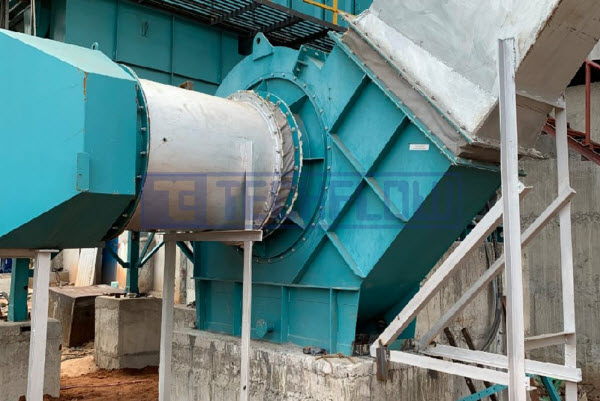
How does Centrifugal and Axial Fans Work?
Mixed flow fans combine the principles of axial and centrifugal fans to create a high-performance system. They are also more efficient at moving air inline, as opposed to axial fans. They can be found in a variety of applications, such as industrial furnaces and ovens. They are often suited for use in small and tight spaces.
Centrifugal fans produce less pressure than axial fans, but they can achieve the same efficiency and speeds. The difference comes from the shape of the fan blades. The more curved the blades, the lower their efficiency.
The air that enters the fan is pushed to the impeller by centrifugal forces. It then passes through the impeller and is drawn inward and outward from the axis of the fan. The kinetic energy of the gas is then guided into the outlet ducts. It is this process that helps increase the efficiency of mixed flow fans.
Unlike centrifugal fans, axial fans have parallel nozzles. Their impellers are usually cantilevered blades, which make them subject to centrifugal forces. They also require less power for operation, so they are ideal for a wide variety of applications. They can be easy to insert into a plant and provide efficiencies close to those of radial fans.
Axial fans are best for applications that demand a large amount of pressure gain. They can deliver efficiencies of up to 85%. They can be belt driven by an external motor, or they can be direct driven.
They can be used in low pressure systems, such as rotary filters or return air trenches. They are especially useful in heating and cooling systems. They can be easily cleaned. They are available in a variety of models and sizes. They are also suitable for large flows.
The Bottom Line
Centrifugal fans can work in a wider variety of conditions, and are designed to accommodate gas and dust. They are typically used in air handling units, process heating, building ventilation systems, and furnace forced draft services. They are durable and reliable. They can be purchased in AC and DC versions. Axial fans, on the other hand, can operate at higher speeds and lower static pressures. This gives them a higher maximum flow rate than a radial fan.