
Key Takeaways
- A furnace FES works in five stages: capture, transport, filtration, draft, and discharge.
- Source capture, pulling fume in at the furnace before it spreads, is the industry standard. General roof ventilation only dilutes the hazard; it doesn't remove worker exposure.
- The hood is the most important component. If fume isn't captured at the source, no downstream filter can fix it.
- Hood type depends on the furnace: motorised swivel hoods for induction furnaces, third-hole extraction for electric arc furnaces, plus canopy and side-draft hoods for fugitive capture.
- The pulse-jet baghouse is the global workhorse for dry foundry fume; a cyclone often sits ahead of it as a pre-separator.
- A correctly designed system keeps stack emissions well within CPCB/SPCB limits, with a 50 mg/Nm³ particulate ceiling for metal furnaces in stricter airsheds.
Ask most operators where their fume control happens, and they will point at the baghouse or the big fan on the roof. That instinct is exactly why so many systems underperform. A furnace fume extraction system (FES) is not one component; it is a chain that starts at the furnace mouth and ends at the stack, and its performance is decided by the weakest link, not the most robust one.
The fume itself is unforgiving. The most hazardous fraction, condensed metal oxides and respirable silica, is finer than anything the eye can register, which means a system can look like it is "working" while the particles that actually damage lungs sail straight past a poorly specified hood or an undersized filter. Add tightening CPCB emission limits to the health stakes, and getting the full chain right stops being good practice and becomes a condition of operating at all.
This guide walks through that chain end to end: capture, transport, filtration, draft, and discharge, and explains how each stage shapes the one after it, why the hood matters more than the fan, and how the design changes depending on the furnace you run.
What Is a Furnace Fume Extraction System?
A furnace fume extraction system is an engineered air-management system that captures, cools, filters, and safely discharges the fume, vapour, and fine particulate generated when metal is melted in a furnace. It is built specifically around the furnace it serves; the metal type, the melt cycle, the fume volume, and the local emission rules all shape the design.
In plain terms, it catches the bad air where it is made, cleans it, and sends clean air out, keeping it out of the operator's breathing zone and out of the atmosphere.
Why Furnace Fume Is More Dangerous Than It Looks
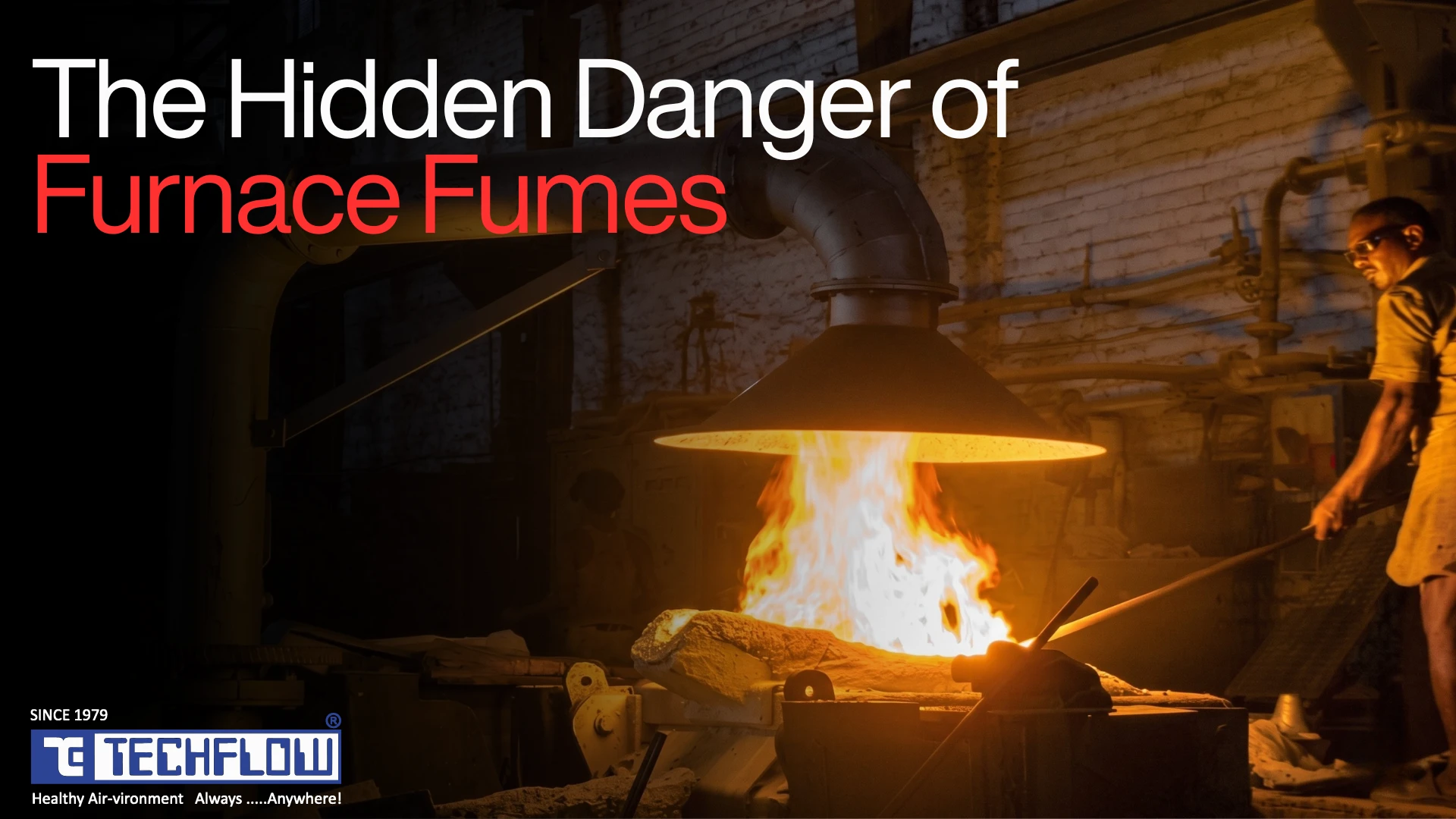
Calling furnace emissions "smoke" badly understates the risk. Foundry fume is a reactive mix of ultrafine particles, metallic vapours, and gases formed when molten metal meets air, charge material, and furnace linings.
Respirable metal fume forms when metallic vapour condenses into particles roughly 0.1 to 1 micron across. Because they are so small, they slip past the body's upper-respiratory defences and lodge deep in the lungs. Common toxic oxides include zinc, lead, copper, cadmium, manganese, and iron.
Respirable crystalline silica (RCS) is generated from sand moulds, cores, fettling, and refractory linings. When silica-rich material dries and goes airborne, it becomes a serious long-term inhalation hazard.
The health stakes, briefly
|
Type |
Condition |
What happens |
|
Acute |
Metal fume fever |
Flu-like chills, fever, metallic taste, throat irritation. Onsets within hours, usually clears in 24-48 hours. |
|
Chronic |
Silicosis |
Incurable, progressive lung scarring from long-term RCS exposure. Permanent and potentially fatal. |
|
Chronic |
Systemic disease |
Heavy-metal and silica exposure raises the risk of lung cancer, COPD, and kidney disease. |
These aren't abstract risks. A 2023 peer-reviewed study published in Heliyon assessed a foundry furnace operator's exposure and found that levels of iron, nickel, chromium, and manganese all exceeded occupational exposure limits. In the United States, OSHA estimates that about 2.3 million workers are exposed to crystalline silica on the job, including workers in foundries. The conclusion is hard to argue with: a well-designed, well-maintained FES is a life-safety system, not a facility upgrade.
The Core Principle: Capture at the Source
Every effective extraction strategy rests on one idea: catch the fume as close to where it is generated as possible, before it reaches the worker.
Older facilities sometimes relied on roof vents or high ceiling exhausts. That approach fails modern standards for two reasons.
- First, by the time fume reaches the roof, it has already passed through the operator's breathing zone.
- Second, ceiling ventilation only dilutes fume across the building volume; it never removes the source of exposure.
That is why source capture is the accepted standard for furnace applications.
How a Furnace Fume Extraction System Works: The Five Stages
A furnace FES moves contaminated air through five sequential stages. Weaken any one of them and the whole chain underperforms.
Stage 1 Capture: The Hood System
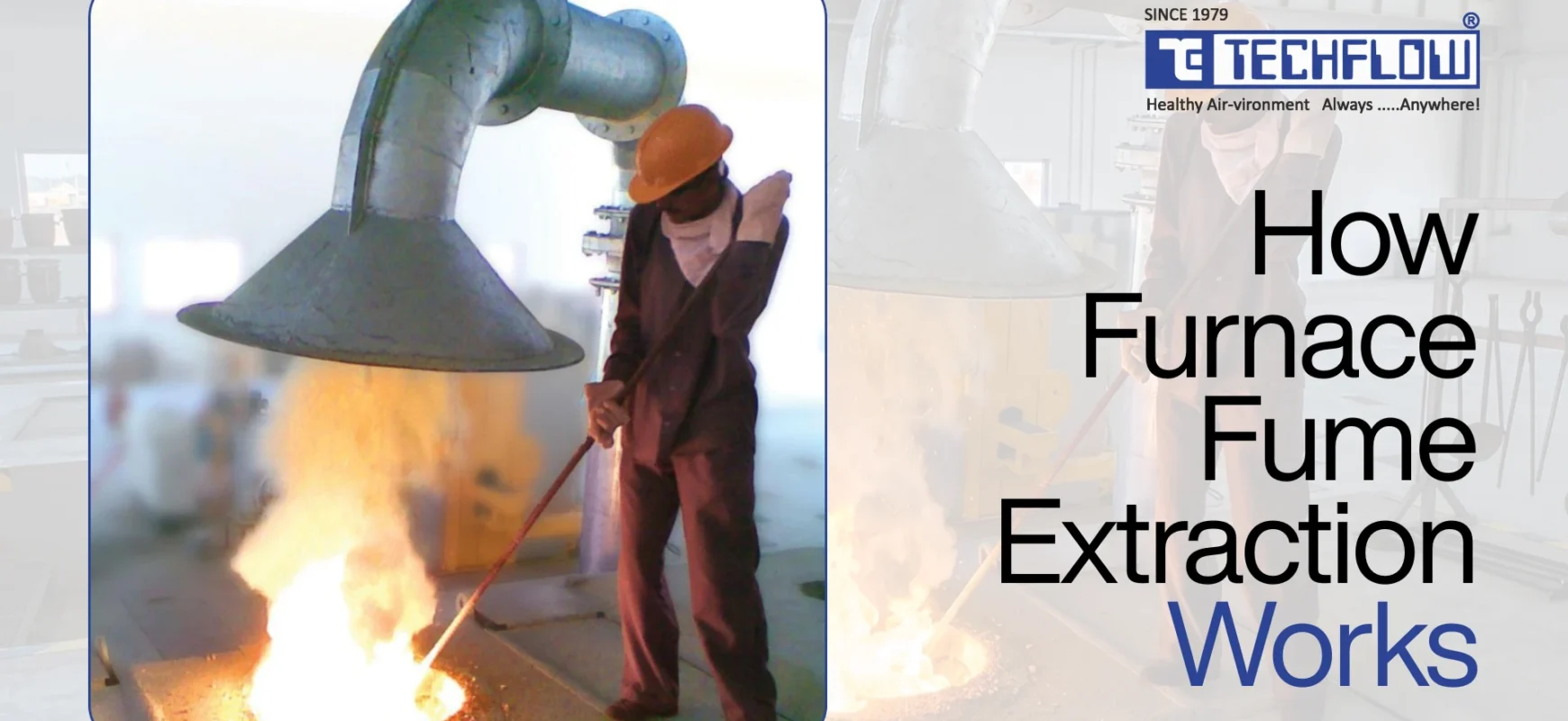
The hood is the single most critical part of the system. By generating targeted negative pressure, it pulls fume off the furnace and funnels it into the ductwork. Get this wrong, and the best filter in the world is a waste; it never receives the fume in the first place.
Because furnaces and melt cycles vary, there is no universal hood. The right choice depends on the furnace type, the operating cycle, and the fume volume:
- Motorised swivel hood (primary hood): The standard choice for induction furnaces. It pivots directly over the furnace mouth and retracts on demand, so operators can charge and tap while keeping close-proximity extraction running. Water-cooled versions handle the radiant heat right above the bath.
- Canopy hood: Mounted high above the furnace, it captures the rising thermal plume. Because it catches fume only after it has begun to rise and spread, it needs much higher airflow and careful air management. It is most useful as a secondary or fugitive-capture layer.
- Side-draft hood: Positioned to the side, it draws fume horizontally across the furnace opening. This is the problem-solver where overhead crane travel or low clearance rules out a canopy.
- Third-hole extraction: A dedicated port engineered into the roof of an electric arc furnace. It evacuates hot gases and heavy fumes from inside the furnace shell before they can escape into the shop.
Stage 2 Transport: Ductwork, Cooling, and Dampers
Once captured, fume has to travel from intense furnace heat to the filter without losing momentum or destroying components along the way. The ductwork is engineered, not passive pipe.
|
Requirement |
The challenge |
The engineered solution |
|
Transport velocity |
Heavy particulate settles inside ducts if airflow is too slow, causing blockages and fire risk. |
Ducts are sized to hold a continuous conveying velocity (commonly around 4,000 fpm for heavy foundry dust). |
|
Heat resistance |
Furnace exhaust routinely runs 200–400 °C; uninsulated mild steel warps and corrodes. |
High-temperature or insulated steel, sometimes with refractory lining. |
|
Pre-filter cooling |
Hot gas scorches fabric filter bags on contact. |
A cooling section air dilution or water-cooled heat exchanger drops gas to a filter-safe temperature before the baghouse. |
In multi-furnace shops, butterfly dampers at branch points let operators direct suction to the furnace that is actually melting, rather than spreading it thinly across idle lines.
Stage 3 Filtration: The Heart of the System
This is where fume is physically separated from the air. Three technologies dominate furnace work:
Pulse-jet baghouse. The global standard for foundry fume. Dirty air passes through fabric filter bags or pleated cartridges; fine metal oxides collect on the outer surface and build a "dust cake" that counterintuitively sharpens filtration. As the cake thickens and resistance rises, a short reverse pulse of compressed air snaps it off the bag so it drops into the collection hopper.
Cyclone separator. Often fitted upstream of the baghouse as a pre-separator. It spins the airstream and flings heavier, coarser particles into a hopper by centrifugal force. By stripping out the bulk grit first, it extends bag life dramatically and provides useful first-stage cooling for very hot gas.
Wet scrubber. Used where the process generates gases or vapours that dry filters cannot hold. Scrubbing liquid is sprayed into the airstream to absorb the contaminant. It is effective for specific chemistries but produces a wastewater stream that must be treated before disposal, which adds operational complexity.
Stage 4 Draft: The Induced Draft (ID) Fan
The induced draft fan is the engine of the system. It creates the negative pressure that pulls fume from the hood, drags it through the ductwork and cooler, forces it through the filter media, and pushes clean air out the stack.
Crucially, the ID fan sits after the baghouse, on the clean-air side. Place it on the dirty side, and the abrasive, hot, particle-laden gas sandblasts the impeller and leads to early failure.
The fan also has to overcome static pressure, the cumulative resistance from duct friction, hood losses, bends, and the loaded dust cake in the baghouse. This is why catalogue airflow can be misleading: a fan rated for 2,000 CFM in open air might deliver far less once it is pulling through a loaded baghouse and a long duct run. The fan curve has to be matched to the system's real operating resistance.
Modern installations pair the fan with a variable frequency drive (VFD). Instead of running flat out continuously, fan speed tracks furnace activity, ramping up for the peak melt surge and easing back during standby. That keeps the floor safe while cutting a large share of the energy bill.
Stage 5 Discharge: The Stack
The final stage releases cleaned air safely. The stack is engineered, not a plain chimney: its height and exit velocity are calculated so any residual trace emission disperses high into the atmosphere and avoids "downwash" gas getting caught in wind eddies and pulled back into the building.
The stack is also where compliance is measured. In India, foundry and furnace emissions are governed by the Central Pollution Control Board (CPCB) and enforced by State Pollution Control Boards. Limits have tightened over time, and in stricter airsheds such as Delhi-NCR, a 50 mg/Nm³ particulate ceiling now applies to metal furnaces. A properly engineered high-efficiency baghouse is designed to keep outlet emissions comfortably within these limits, with well-maintained systems achieving substantially lower readings.
Matching the System to the Furnace
Different furnaces generate fume in different ways, so the front end of the system changes even though the filtration and draft logic stays similar.
Induction Furnaces
The workhorse of the modern foundry. Because melting is electromagnetic rather than flame-based, fume is relatively steady through the main cycle, but it spikes hard during charging and tapping. Recycled scrap coated in sand, oil, or casting residue adds unexpected dust loads. The typical induction furnace setup pairs a motorised swivel hood at the furnace mouth with a canopy to catch fugitive fume, feeding a cyclone, cooler, and pulse-jet baghouse.
Electric Arc Furnaces (EAF)
Among the most demanding applications. Charging releases a violent, sudden surge of fume that can overwhelm an undersized system. EAFs usually need a dual approach: third-hole extraction during the melt, plus a large canopy when the roof swings open to charge. EAF off-gas also contains combustible carbon monoxide, so a properly engineered duct system includes a combustion or burn-out zone to eliminate CO safely before it reaches the baghouse.
AOD Converters (Argon Oxygen Decarburisation)
Used in stainless-steel refining of high-chromium alloys. The fume is especially hazardous because it is rich in chromium compounds, including hexavalent chromium, a known carcinogen. Extraction here is highly specialised and engineered with tight tolerances to capture toxic particulate and meet closely monitored emission limits.
Key Design Parameters That Decide Performance
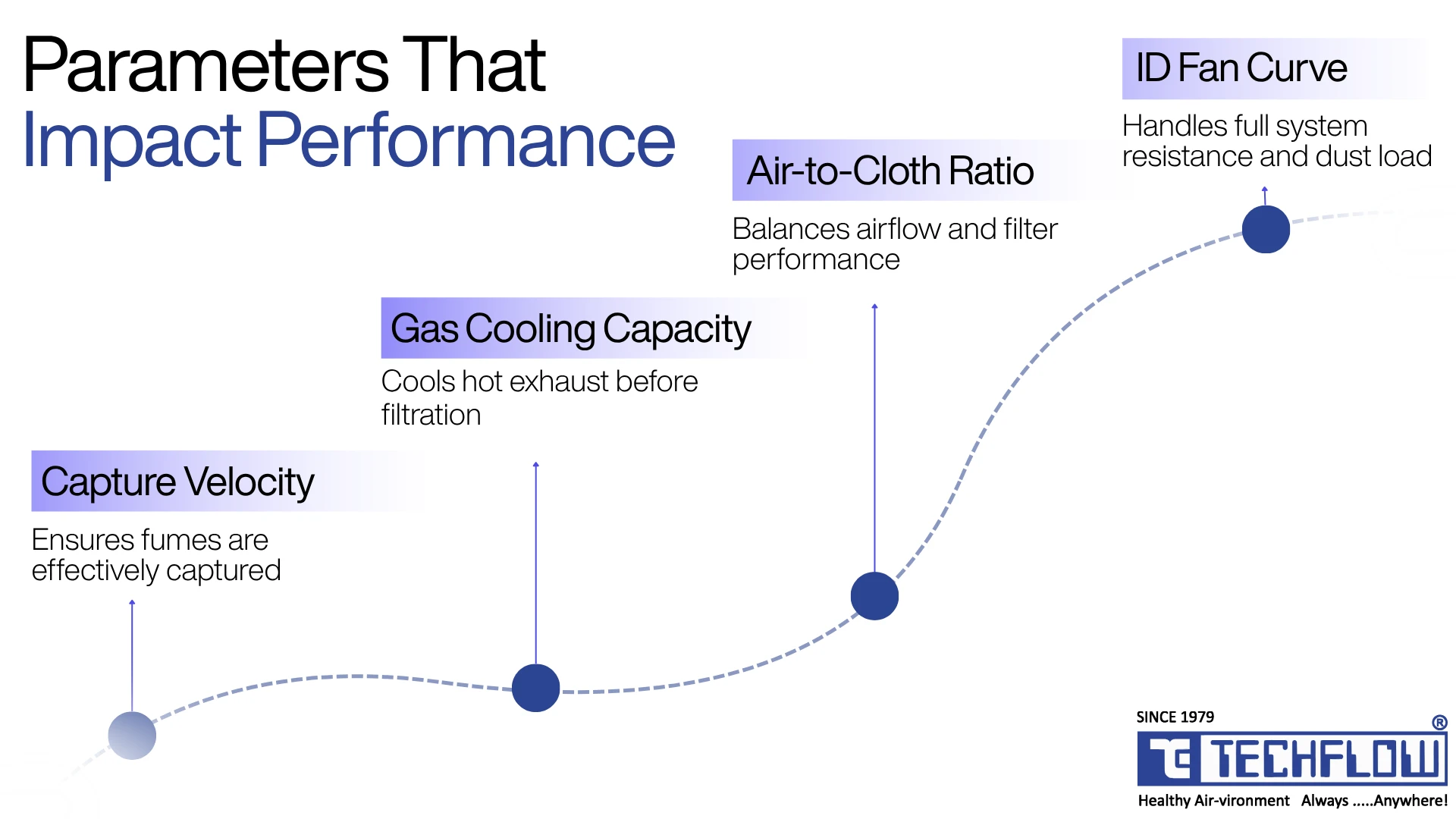
For anyone evaluating or upgrading a system, performance comes down to a few numbers:
- Capture velocity: the air speed at the hood face. It has to beat the upward buoyancy of hot fume and any cross-drafts from floor fans. Complex hoods are often modelled with computational fluid dynamics (CFD) to get this right.
- Gas cooling capacity: raw exhaust can hit 300-400 °C, while common fabric bags operate well below that. A cooling section that performs under worst-case conditions is mandatory, not optional.
- Air-to-cloth ratio: the filter area scaled to gas volume. Undersizing the baghouse and you force too much air through too little fabric, spiking pressure drop, killing airflow, and shortening bag life.
- ID fan performance curve: the fan must overcome the total system resistance, including a fully dust-loaded filter, not just the duct.
Keeping the System Running: Common Failure Points
Even a well-designed FES degrades without maintenance. The recurring trouble spots:
- Filter bags: abrasion, "blinding" from condensation, and heat damage from a failed cooler. Watch differential pressure across the baghouse; a rising, sustained pressure drop is the early warning.
- Dampers seize over time. A stuck damper bleeds suction away from the active furnace. Inspect and lubricate routinely.
- Hoppers: if allowed to overfill, dust bridges or re-entrains into the airstream. Discharge on a fixed schedule.
- ID fan: even trace fines erode the impeller over time. Monitor bearing temperature and vibration.
- Ductwork: settled dust in horizontal runs is a fire risk, and leaking joints quietly kill suction. Inspect internally and keep joints sealed.
The Techflow Approach to Furnace Fume Extraction
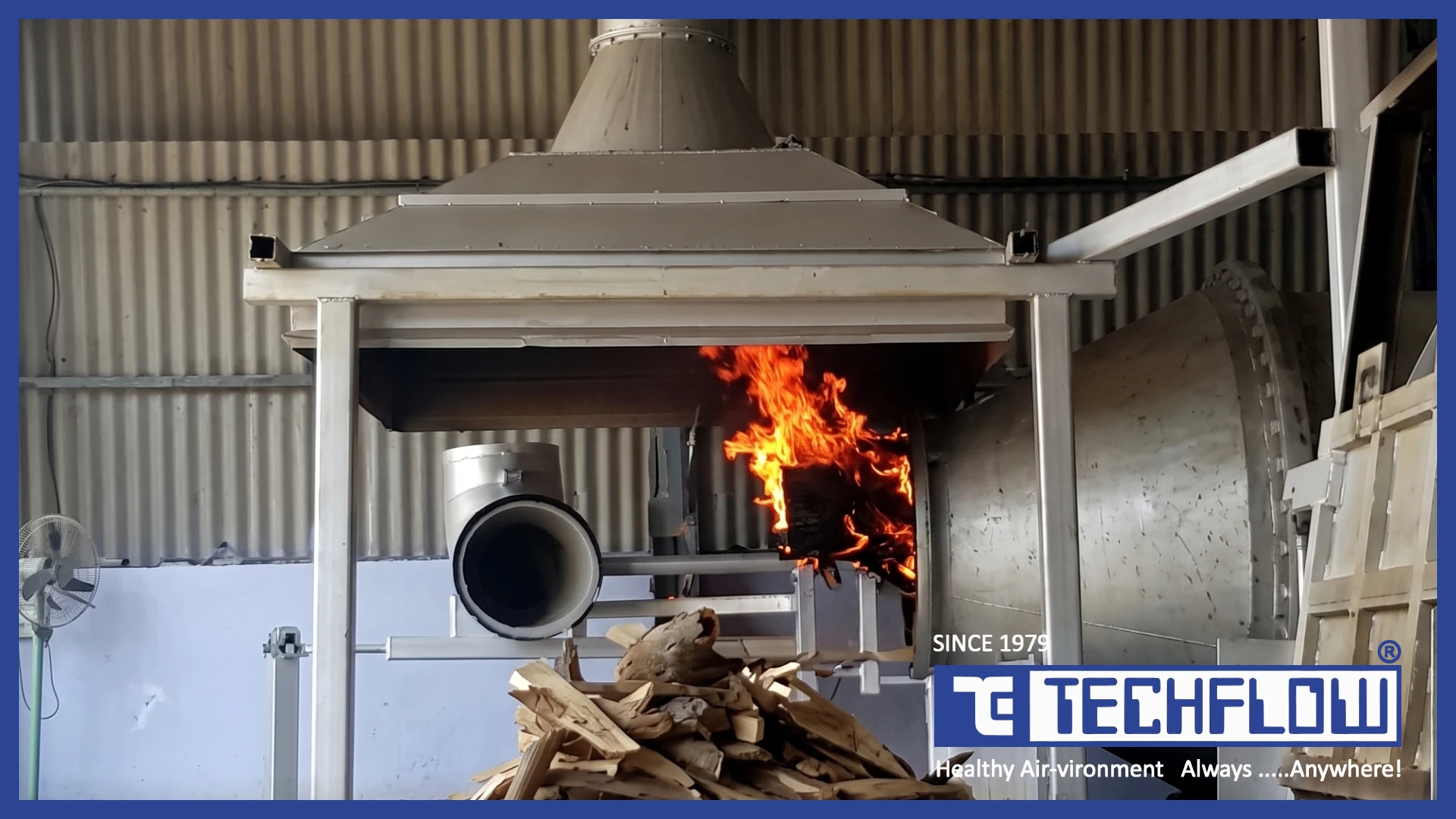
Founded in 1979 by Mr D. K. Parikh in Ahmedabad, Gujarat, Techflow Enterprises Pvt. Ltd. brings more than four decades of specialised experience in industrial air handling, pollution control, and dust collection. Techflow engineers furnace pollution-control solutions built to meet CPCB and State Pollution Control Board requirements.
Rather than supplying isolated parts, Techflow engineers a complete hood-to-stack package tailored to the furnace, the metal, and the local rules:
- Capture hoods: motorised and manual swivel hoods, side-draft hoods, and canopy configurations.
- Engineered ductwork: high-temperature, correctly sized, with heavy-duty butterfly dampers.
- Thermal management: gas coolers that protect the downstream filter.
- Multi-stage filtration: primary cyclone pre-separators feeding pulse-jet or reverse-air baghouses.
- Draft generation: high-pressure centrifugal ID fans with VFD control.
- System intelligence centralised control panels for monitoring and automated operation.
Techflow supplies both primary FES (close capture at the furnace) and secondary FES (fugitive capture) across induction, electric arc, and AOD furnace applications.
Conclusion
A furnace fume extraction system is never one piece of equipment; it is a tightly matched chain that captures, transports, cools, filters, and discharges, in sequence. Undersize one stage, skip maintenance on another, or specify the wrong hood for the furnace, and the whole system underperforms, and it is the people on the shop floor who pay for it.
For foundry managers and furnace operators, understanding that the chain end-to-end is the first step toward a system that actually performs: protecting the workforce, holding compliance with CPCB and SPCB limits, and keeping production running without interruption. Whether it is a single induction furnace or a multi-furnace melt shop, the right fume extraction system is not optional; it is the foundation of a safe, compliant, productive operation.
Ready to specify or upgrade your furnace fume extraction system?
Every furnace and melt shop is different, and the right system is the one engineered around your furnace type, metal, fume volume, and local emission rules. Techflow designs complete hood-to-stack solutions for induction, electric arc, and AOD furnaces, sized to perform on your floor and to stay within CPCB and SPCB limits.
Explore Techflow's furnace fume extraction systems → and talk to our engineers about a system matched to your operation.
Frequently Asked Questions (FAQs) :
A furnace fume extraction system is an engineered system that captures, cools, filters, and safely discharges the fume and fine particulate produced when metal is melted in a furnace. It keeps hazardous metal-oxide and silica particles out of workers' breathing zones and brings stack emissions within legal limits.
The five stages of furnace fume extraction are capture, transport, filtration, draft, and discharge. Capture pulls fume in at the hood, transport carries it through ductwork, filtration removes particulate in a cyclone or baghouse, the ID fan provides draft, and the stack discharges cleaned air.
Source capture is better because it removes fume at the furnace before it spreads into the workspace. General roof or ceiling ventilation only dilutes fume across the building; it never eliminates the source, and the fume still travels through the operator's breathing zone on its way up.
A motorised swivel hood is best for an induction furnace. It sits directly over the furnace mouth for close-proximity capture and retracts on demand for charging and tapping. A canopy hood is often added above it to catch fugitive fume during those high-emission moments.
Fume extraction for an electric arc furnace is more demanding because charging releases violent fume surges and the off-gas contains combustible carbon monoxide. EAFs typically need third-hole extraction during the melt plus a large canopy for charging, and a combustion zone that burns off CO before the baghouse.
The ID fan is placed after the baghouse, on the clean-air side, so it only handles filtered air. On the dirty side, the hot, abrasive, particle-laden gas would erode the impeller like sandblasting and cause early mechanical failure.
Baghouse filter bags handle temperatures set by their fabric, commonly well below raw furnace exhaust, which can reach 300–400 °C. Because of this, a cooling section (air dilution or a water-cooled heat exchanger) must bring the gas down to a filter-safe range before it reaches the bags.
The air-to-cloth ratio is the volume of gas processed per unit area of filter fabric. It matters because too high a ratio forces excessive air through too little fabric, which raises pressure drop, chokes airflow, and shortens bag life. A correctly sized baghouse keeps this ratio in balance.
Foundry and furnace emissions in India are governed by the CPCB and enforced by State Pollution Control Boards. Limits have tightened over time, and stricter airsheds such as Delhi-NCR now apply a 50 mg/Nm³ particulate ceiling to metal furnaces. Well-designed baghouse systems are engineered to stay within the applicable limit.
You maintain a furnace fume extraction system by monitoring differential pressure across the baghouse, inspecting and lubricating dampers, discharging dust hoppers on schedule, tracking ID-fan vibration and bearing temperature, and keeping ductwork clear of settled dust with airtight joints.