

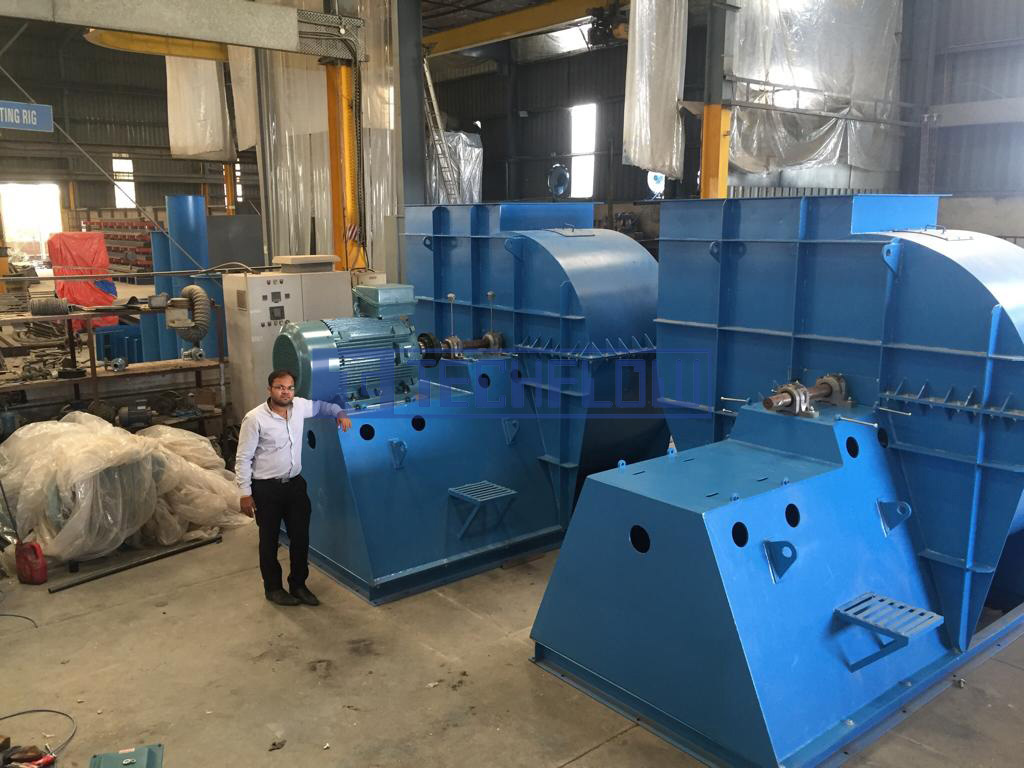
Various industries use centrifugal blowers for a range of processes and operations. Their primary functions include delivering high volumes of air, creating pressure, generating air flow and handling various materials, including vapours and particulate matter.
The industry is experiencing rapid growth due to product innovations that are aimed at increasing efficiency and productivity. Also, manufacturers are working towards reducing power consumption and producing space-saving designs.
Centrifugal Blowers: Enhancing Airflow Efficiency and Industrial Safety
A centrifugal blower is a type of fan that relies on blades to drag air into a circular motion with centrifugal forces, speeding it radially and outward. They can be used to move air through ducts or tubes, and they are commonly found in ventilation systems for buildings and industrial processes.
They are also found in dust control systems as they provide a stronger and more stable air flow than axial fans. In HVAC applications, they are typically found in ventilation systems and in building air conditioning and heating systems.
The process that a blower works is pretty simple: an electric motor spins the fan wheel and diverts air from a source, usually a high-pressure area, and sends it out the outlet at a 90-degree angle to the direction of the intake air. The fan wheel itself can have a variety of blade styles.
Typical users of centrifugal blowers include cement production plants, which use them to move calcium carbonate, iron ore, alumina and silica further in the manufacturing process. They are also used in the wood industry to remove dust particles. Moreover, they are utilized in the chemical industry for exhausting high temperatures and harmful gases.

Centrifugal Blowers: Versatile Solutions for Material Handling and Industrial Applications
Material handling, ranging from sand to sawdust and plastic pellets to wood chips, is an important application for centrifugal blowers. They are a vital part of pneumatic systems and maintain consistent pressure to prevent fallout and clogs.
In cement manufacturing, for example, a centrifugal blower is used to move calcium carbonate, silica, and alumina further in the process. They are also used to exhaust high temperatures and harmful gases from chemical plants.
In the mining industry, centrifugal blowers are used to circulate air through ducts and tunnels, as well as in the ventilation system. They are also useful for generating hot air, which is needed in many industrial processes.
Centrifugal blowers are an integral part of many industrial applications, including HVAC, material handling, and food processing. They operate on the same principles as turbomachines; they transfer energy between a rotating shaft and a fluid, which is usually air or another gas.
They are characterized by the high-pressure ratio they achieve when compared to fans and blowers. This property makes them ideal for moving large volumes of air at low RPMs while producing minimal energy.
The market for centrifugal blowers is growing rapidly due to increased demand across the construction industry. The market is also driven by the expansion of oil and gas infrastructure, especially in the developing countries.
The main function of centrifugal blowers is to move and recycle air within a processing plant. They must meet the same Food and Drug Administration (FDA) regulations as any other form of equipment used in food processing. These blowers are also used as part of the drying process for cheeses and dairy by-products.
Centrifugal Blowers for Air Movement and Versatility in Industrial Applications
Whenever an industrial process requires the movement of air or other gas, centrifugal blowers can help. They belong to a class of machines called turbomachines, which transfer energy between a rotating shaft and a fluid, typically air or steam.
In the mining industry, high-pressure centrifugal blowers are employed in ventilation, cooling, and exhaust gas systems to circulate air through ducts, tunnels, and underground passageways. This is an efficient way to distribute and circulate heat.
Additionally, these fans can be used to move fine particles such as sand, sawdust, paper trim, and wood chips in a confined space. This is due to their strong centrifugal force.