

Centrifugal blowers and fans play a pivotal role in various industrial applications, ensuring efficient ventilation, cooling, and circulation of air or gases. These devices are composed of several critical components that collectively contribute to their performance. In this article, we delve into the key elements of centrifugal blowers and fans, examining their advantages and disadvantages.
Impeller Design:

The impeller is one of the most crucial components of centrifugal blowers and fans. Its design significantly impacts airflow and pressure generation. Forward-curved, backward-curved, and radial impellers each have distinct characteristics.The impeller is the central component of a centrifugal blower or fan. Its design determines how much air it moves and how much pressure it creates. Forward-curved, backward-curved, and radial impellers each have their own advantages and disadvantages.
Forward-curved impellers are the most common type of impeller. They are relatively inexpensive to manufacture and have a high efficiency at low speeds. However, they are not as efficient at high speeds and can create a lot of noise.
Backward-curved impellers are more efficient than forward-curved impellers at high speeds. They are also less noisy. However, they are more expensive to manufacture and have a lower efficiency at low speeds.

Radial impellers are the most efficient type of impeller. They are also the most expensive to manufacture. They are not as noisy as forward-curved or backward-curved impellers. However, they are not as efficient at low speeds.
The type of impeller that is best for a particular application depends on the specific requirements of the application.
Advantages:
Forward-Curved Impellers: These are highly efficient for low-pressure systems and offer stable performance. They are also quieter in operation. They have higher RPM than the others.
Backward-Curved Impellers: Ideal for high-pressure systems, these impellers are energy-efficient and well-suited for harsh operating conditions.
Radial Impellers: They strike a balance between pressure and airflow, making them suitable for various applications.
Disadvantages:
Forward-Curved Impellers: It has lower efficiency and face vibration issue often than their counterparts
Backward-Curved Impellers: They can be sensitive to particulate-laden gases, potentially leading to erosion and reduced efficiency, which can be optimised by adding a protecting layer.
Radial Impellers: While versatile, they might not excel in extreme pressure or flow requirements.
Housing and Scroll:
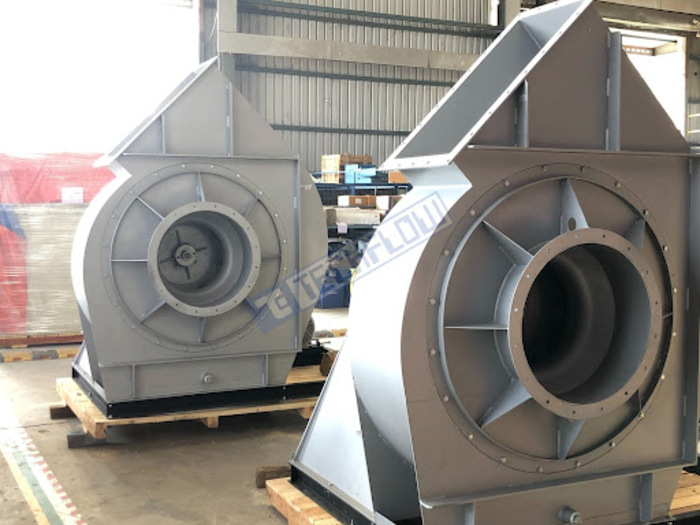
The housing or scroll of a centrifugal fan helps direct and control the airflow generated by the impeller.The housing or scroll of a centrifugal fan is a component that directs and controls the airflow generated by the impeller. It is typically made of metal or plastic and has a spiral shape that helps to accelerate the airflow. The scroll is an important part of the fan's design, as it helps to ensure that the airflow is directed in the desired way and that the fan operates efficiently.

Advantages:
Well-designed housings improve overall fan efficiency by minimizing air turbulence.
Carefully engineered scroll shapes can enhance pressure development and airflow uniformity.
Strong casing will give fan robustness and rigidity.
Split housing gves ease of installation
Disadvantages:
Poorly designed housing can lead to airflow losses and decreased efficiency.
Complex scroll designs might increase manufacturing costs.
Drive Systems:
Centrifugal blowers can be powered by various drive systems, including direct drive and belt drive. Centrifugal blowers can be driven by various drive systems, including direct drive and belt drive. Direct drive is a type of drive system in which the motor is directly connected to the blower. Belt drive is a type of drive system in which the motor is connected to the blower by a belt.

Advantages:
Direct Drive: This system eliminates the need for belts, reducing maintenance and improving efficiency.
Belt Drive: Offers flexibility in adjusting fan speed by changing pulley sizes, allowing for better system control.
Disadvantages:
Direct Drive: Initial costs might be higher, and the fan speed cannot be easily adjusted after installation.
Belt Drive: Belts require regular inspection and replacement, adding to maintenance requirements.
Materials of Construction:
The choice of materials for fan components greatly influences their performance and durability.The materials used to make fan components have a significant impact on their performance and lifespan. Techflow manufactures blowers using Mild Steel, Stainless Steel and special grade steel depending on application and nature of media to be handled. Usually the contact parts and non contact parts designed seperately.
Advantages:
High-quality materials increase the fan's lifespan and resistance to corrosion.
Robust construction ensures stable operation even in demanding environments.
Special grade MS or SS can provide durability to the fan.
Disadvantages:
Premium materials can escalate manufacturing costs.
Incompatibility between materials and the transported gases can lead to chemical reactions or material degradation.
Balancing and Vibration Isolation:
Balancing the rotating components and isolating vibrations are critical for maintaining smooth operation.The balancing of rotating components and the isolation of vibrations are essential for ensuring smooth operation. Improper balancing can lead to excessive vibration, which can cause premature wear and tear on components, as well as noise and discomfort for operators. Vibration isolation can help to reduce the transmission of vibration from one machine to another, or from a machine to its surroundings. This can help to improve the reliability and longevity of equipment, as well as the comfort of operators.
Advantages:
Proper balancing minimizes noise, extends the fan's life, and reduces the risk of catastrophic failures.
Vibration isolation prevents the transfer of vibrations to the surrounding equipment and structures.
Disadvantages:
Balancing and vibration isolation mechanisms add complexity to the manufacturing process.
Inadequate balancing can lead to excessive wear, noise, and decreased efficiency.
In conclusion, understanding the advantages and disadvantages of critical components in centrifugal blowers and fans is essential for making informed decisions regarding their selection and usage in various industrial applications. The interplay between impeller design, housing, drive systems, materials, and balancing mechanisms ultimately determines the fan's efficiency, durability, and performance in diverse operating conditions.
At Techflow, a reputable centrifugal ID fan manufacturer in India, we prioritize the meticulous design and construction of centrifugal blowers and fans. Our expertise in this field ensures that our products excel in efficiency, reliability, and innovation, meeting the demands of industries across the spectrum. Whether you require industrial centrifugal blowers or fans, Techflow has the solution tailored to your needs.
Learn about 5 critical parts of centrifugal blowers by clicking here – Understanding the 5 Critical Parts of Centrifugal Blowers
FAQs:
Centrifugal blowers and fans consist of several critical components that work together to create airflow and provide ventilation in various industrial applications.
These components include:
Impeller or Wheel, Housing or Casing, Inlet and Outlet Flange, Motor, Bearings, Drive Mechanism, Noise Control Features, Base or Mounting Frame.
The impeller is the rotating component responsible for generating airflow and creating pressure within the fan.
Here are the key roles and aspects of impeller design in centrifugal fans:
 Airflow Generation
- Pressure Development
- Efficiency
- Flow Control
- Noise Reduction
- Material Selection
- Balancing
- Maintenance Considerations
- Application-Specific Design
Effective impeller design contributes to the overall effectiveness and reliability of the centrifugal fan.
Housing or casing is the protective body for fan and important to create pressure inside, it also affects performance by,
- Aerodynamics: Casing design impacts airflow efficiency by minimizing turbulence, ensuring maximum air delivery.
- Efficiency: A well-designed casing reduces energy losses, improving the blower's overall efficiency.
- Noise Reduction: Proper casing design dampens noise levels, making the blower quieter, crucial in many applications.
- Material Selection: Choosing the right casing material ensures durability and resistance to corrosion or wear in harsh environments.
- Pressure and Flow Control: Customizable casing shapes and sizes allow tailoring the blower's performance to specific requirements.
Centrifugal blowers can be powered by various drive systems, depending on the specific application and operational requirements.
Here are some common drive systems used in centrifugal blowers:
Direct Drive, Belt Drive, Variable Frequency Drive (VFD), Couple Drive
The choice of drive system depends on factors such as the required airflow and pressure, energy efficiency, control flexibility, available power sources, and environmental conditions. Each drive system has its advantages and limitations, and the selection should align with the specific needs of the centrifugal blower's application.
Durability of fans depends on the media to be handled, materials like Mild Steel is used for normal dust, flue gas, ambient air or hot gases. On the other side the moisture, air with vapor, chemical fumes need corrosion protection and hence stainless steel is used. Sometimes to keep the procurement cost in check some normal grade mild steel is enhanced with protective layers like PP, FRP etc.
Vibration isolation is crucial for the smooth and efficient operation of centrifugal fans because,
- Reducing Noise: Vibration isolation minimizes vibrations transmitted to structures, reducing fan noise.
- Enhancing Equipment Lifespan: It protects fan components from wear and tear, extending the fan's life.
- Maintaining Fan Performance: Vibration isolation ensures the fan operates at its designed efficiency and performance levels.
- Preventing Structural Damage: It safeguards the surrounding structure from potential damage caused by excessive vibrations.
- Enhancing Comfort and Safety: Vibration isolation creates a more comfortable and safer environment by reducing discomfort and safety hazards associated with fan vibrations.