

Industrial boilers play a vital role in many factories, but they also produce large volumes of unburnt fly ash as dust and fine particles. If not managed properly, this fly ash dust can affect air quality, reduce equipment life, and lead to legal trouble due to environmental regulations.
That’s where an ESP system for boiler dust comes into the picture.
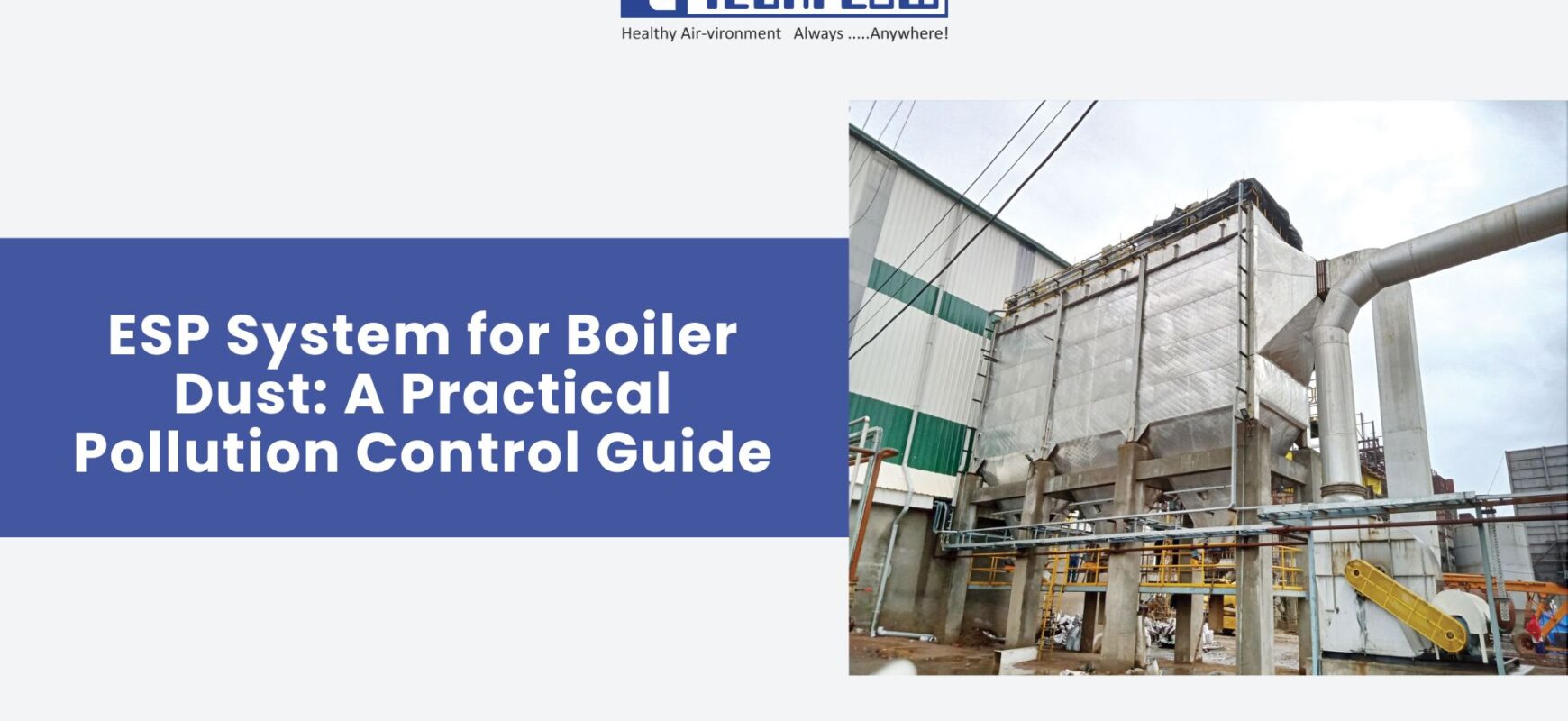
This blog will cover how ESP (Electrostatic Precipitator) systems help keep boiler operations cleaner, safer, and within pollution control norms. It will also discuss how TECHFLOW, as a trusted Dry ESP manufacturer in India, supports industries with reliable solutions.

What Is an ESP System and How Does It Work?
An ESP (Electrostatic Precipitator) is an air pollution control device. It captures fine dust particles from flue gases before they’re released into the atmosphere.
Here’s how it works:
- Dust-laden gas enters the ESP.
- Inside, high-voltage discharge electrodes create an electric field.
- Dust particles pick up a negative charge.
- These particles move toward grounded collecting plates and stick there.
- Clean gas exits the system, and dust is removed from the plates via mechanical rapping or vibration.
This process happens quickly and without affecting the flow of gases. It’s ideal for high-temperature and large-volume exhausts, especially from industrial boilers.
Common Boiler Dust Challenges
Boiler systems generate dust during fuel combustion. This dust isn’t just regular ash – it includes fine particles, some even smaller than 1 micron. These can be tough to handle.
Common issues include:
- Sticky or abrasive dust causing damage to ducting and filters
- High dust loading from continuous combustion
- Very low bulk density dust creating a problem of high differential pressure
- Clogged stacks reducing boiler efficiency
- Health risks for workers
- Regulatory pressure to control emissions
Factories with older or poorly designed systems like wet scrubbers or poorly designed bag filters often struggle to stay within limits.
How an ESP System Helps
An ESP system handles all the above issues by removing dust before it even reaches the chimney.
Here’s what it does well:
- Works well with both fine and sticky particles
- Operates under high-temperature conditions
- Needs less frequent maintenance compared to bag filters
- Keeps emission levels within legal limits
With a proper setup, ESP can achieve over 99% collection efficiency, which is more than enough to meet pollution control norms.

Types of ESP Systems for Boilers
There are different types of ESP available. The two most common are:
1. Dry ESP
This is the most used type for boiler applications. It's suitable for dry dust and high flue gas temperatures. TECHFLOW offers custom dry ESP based on plant needs.
2. Wet ESP
Used where sticky or moist particles are involved. Less common for boiler dust but may be required in special cases.
Depending on your plant’s flue gas volume and particle characteristics, TECHFLOW suggests the right configuration—be it a single-stage or two-stage setup.
Why TECHFLOW’s ESP System Is a Trusted Choice
TECHFLOW has years of experience in designing ESP systems for different industrial needs. Our team focuses on practical solutions that are easy to install and maintain.
Key features include:
- High efficiency, even for fine dust
- Strong mechanical design for heavy-duty industrial use
- Easy-to-clean collecting plates
- Reliable performance over long durations
- Low pressure drop across the system
TECHFLOW is a known Dry ESP manufacturer in India, with installations across power plants, textile units, and chemical industries.
Industries That Use ESP for Boiler Dust
While boilers are used in many sectors, some industries rely heavily on ESP systems due to the type and amount of dust generated.
These include:
- Thermal power plants
- Paper and pulp factories
- Textile and garment manufacturing
- Food and beverage processing
- Steel and alloy plants
In each of these, maintaining low emission levels is important—not just for the environment, but also for plant safety and smooth functioning.
Choosing the Right ESP for Your Boiler
Selecting an ESP is not just about size. Other factors matter too:
- Type of fuel used (coal, biomass, oil)
- Flue gas volume
- Dust loading per hour
- Operating temperature
- Available installation space
TECHFLOW takes a site-based approach. We inspect your plant layout, collect basic data, and suggest an ESP system that fits your needs.
A good ESP system for boiler dust can make a big difference in how your plant runs. It cuts down maintenance issues, helps meet emission norms, and improves the air inside and around your facility.
TECHFLOW’s solutions are built to work with real-world conditions. If you’re looking for a reliable Dry ESP manufacturer in India, our team is ready to help you make the right choice.
Want to know more about how TECHFLOW can support your boiler dust control needs?
Get in touch with us for a free consultation or technical discussion. We’re happy to help.