

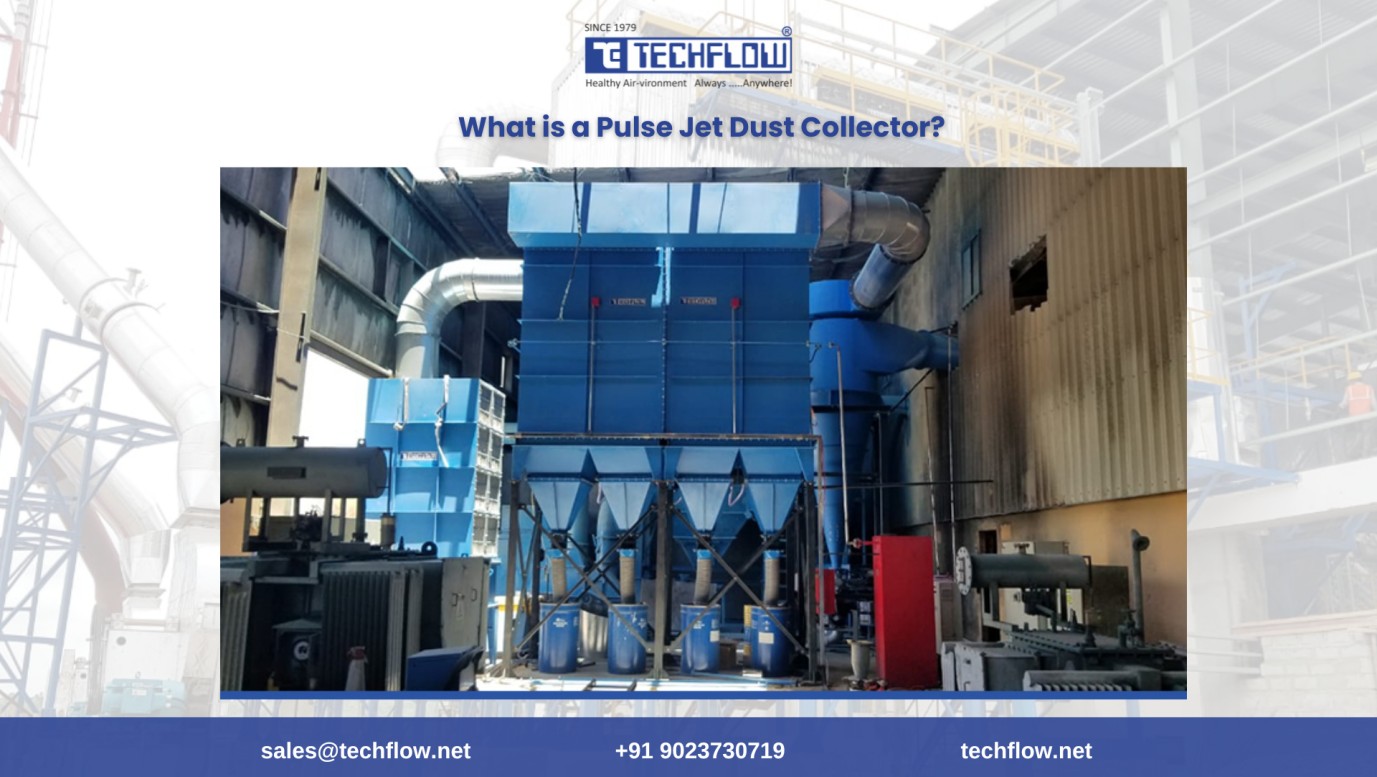
A pulse jet dust collector is an industrial air pollution control system that removes particulate matter from process air using compressed air pulses to clean filter media.
It is widely used in industries where:
• Continuous operation is required
• High dust loads are present
• Fine particulate filtration is critical
• Energy efficiency is important
It is considered one of the most advanced forms of baghouse dust collection systems.
Modern engineered systems — such as those designed and manufactured by TECHFLOW — are customized based on airflow capacity, dust characteristics, and industry-specific compliance requirements.
How Does a Pulse Jet Dust Collector Work?
Step-by-Step Working Principle
- Dust-laden air enters the collector housing.
- Particles are trapped on the outer surface of filter bags.
- Clean air exits through the top of the bag into the clean air plenum.
- At preset intervals, compressed air is injected in reverse direction.
- The pulse dislodges accumulated dust cake.
- Dust falls into the hopper for disposal.
Unlike shaker or reverse air systems, pulse jet collectors clean filters without shutting down airflow, making them ideal for continuous industrial operations.
What Are Filter Bags in a Pulse Jet Dust Collector?
Filter bags are the core filtration component.
They are designed to:
• Capture micron-level particles
• Withstand high temperatures
• Resist chemical exposure
• Maintain low pressure drop
|
Common Filter Media Types |
|||||||||||||||
|
Correct filter media selection directly affects:
• Bag life
• Differential pressure
• Energy consumption
• Maintenance frequency
Engineered manufacturers like TECHFLOW optimize media selection to ensure longer filter life and reduced lifecycle cost in demanding industrial environments.
What is a Compressed Air Cleaning System?
The compressed air cleaning system is the heart of the pulse jet mechanism.
It consists of:
• Air header tank
• Solenoid valves
• Diaphragm valves
• Blow pipes
• Nozzles
When triggered (time-based or differential pressure-based), the diaphragm valve releases a high-pressure air pulse into the filter bag.
Important Note:
Overcleaning wastes compressed air and reduces bag life.
Undercleaning increases pressure drop and energy usage.
Modern systems use differential pressure controllers to optimize cleaning cycles — a key design factor in high-efficiency pulse jet dust collection systems.
Reverse Pulse Jet Dust Collector – What Makes It Efficient?
Reverse pulse jet cleaning:
• Maintains constant airflow
• Reduces dust redeposition
• Ensures uniform cleaning
• Handles high dust loading
• Supports high-temperature operation
This makes it ideal for:
• Cement plants
• Steel plants
• Power plants
• Recycling industries
• Foundries
• Boiler applications
As a pulse jet dust collection system manufacturer in India, TECHFLOW engineers systems for heavy-duty industrial conditions across India and global markets.
FD Type Compressed Air Cleaner Dust Collector
FD type collectors are engineered for:
• Indoor and outdoor installation
• High structural integrity
• Explosion protection compatibility
• Galvanized steel body construction
• Off-line reverse air cleaning
Advanced designs can withstand internal static pressures, improving safety in high-risk environments.
Where Are Pulse Jet Dust Collectors Used?
Heavy Industries
• Steel & Sponge Iron Plants
• Cement Plants
• Power Plants
• Waste-to-Energy Units
Process Industries
• Pharmaceuticals
• Food Processing
• Pigments & Chemicals
• Rubber & Recycling
Equipment Applications
• Boiler Bag Filters
• Kiln Dust Collection
• Shot Blasting Units
• Powder Handling Systems
Industrial plants across these sectors increasingly rely on engineered dust collection systems supplied by experienced manufacturers such as TECHFLOW for performance reliability and regulatory compliance.
Key Benefits of Pulse Jet Dust Collection Systems
- High Collection Efficiency
Captures fine particulate matter effectively. - Continuous Operation
No need to shut down during cleaning. - Reduced Downtime
Improves plant productivity. - Energy Optimization
Optimized cleaning reduces compressed air usage. - Extended Filter Bag Life
Proper maintenance increases lifecycle. - Compact Design
Requires less floor space compared to traditional baghouses.
Selection Criteria: How to Choose the Right Pulse Jet Dust Collector
Choosing the wrong dust collector leads to:
• Excessive energy cost
• High maintenance
• Poor compliance
• Short filter life
Key Engineering Parameters:
• Airflow (CFM / m³/hr)
• Dust loading concentration
• Particle size distribution
• Gas temperature
• Moisture content
• Static pressure requirement
• Explosion risk (ATEX compliance)
• Space constraints
A technically engineered solution — such as those manufactured by TECHFLOW — ensures:
• Emission norms compliance
• Long-term reliability
• Lower lifecycle cost
Why India Is Emerging as a Global Hub for Pulse Jet Systems
India has become a major engineering hub for:
• Air pollution control systems
• Bag filter manufacturing
• Industrial dust extraction systems
If you are searching for a:
• Pulse jet dust collection system supplier in India
• Pulse jet dust collection system supplier
• Top pulse jet dust collection system manufacturer
• Top pulse jet dust collection system manufacturer in India
It is critical to evaluate:
• Manufacturing infrastructure
• In-house engineering capability
• Customization capacity
• Industry experience
• Installation references
• After-sales service support
Companies like TECHFLOW, with established engineering and manufacturing capabilities, contribute significantly to India’s growing global presence in air pollution control systems.
A pulse jet dust collector is not just a filtration device — it is a critical performance system that impacts:
• Compliance
• Productivity
• Equipment life
• Energy efficiency
• Workplace safety
Strategic design, proper filter selection, and optimized compressed air management are the keys to maximizing system performance.
Industrial plants across India and globally are increasingly investing in engineered dust collection solutions — including systems manufactured by TECHFLOW — that deliver performance, efficiency, and regulatory compliance without compromising production capacity.
FAQs:
A bag filter refers to the filtration housing. A pulse jet dust collector refers to the cleaning mechanism using compressed air pulses.
Typically 1.5 to 4 years depending on dust type, temperature, and maintenance practices.
Yes, with appropriate filter media (e.g., polypropylene, PTFE-coated fabrics).
If not optimized, yes. Modern differential pressure-based systems minimize air usage.