

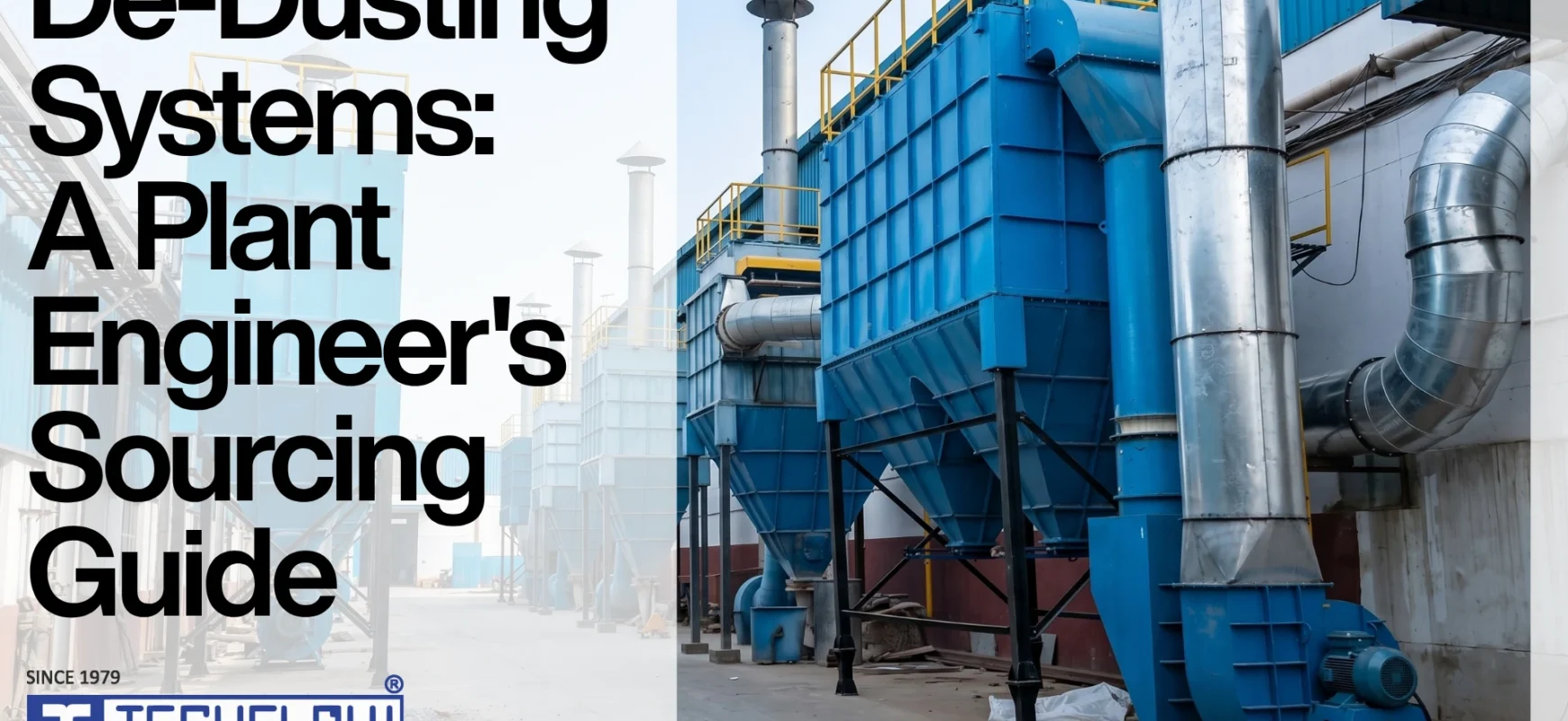
A de-dusting system captures airborne dust at the source, separates the particulate from the gas stream through fabric, mechanical, electrical, or wet means, and discharges clean air back to the workspace or to the atmosphere. In India, the workhorse technologies are pulse-jet bag filters, cyclone separators, electrostatic precipitators (ESPs), and cartridge dust collectors. The right choice depends on your dust characteristics, gas volume and temperature, the CPCB emission limit that applies to your industry, and the total cost of ownership across a 10-15 year operating window, not on the lowest quoted price.
India has a deep, capable manufacturing base for this equipment, anchored by long-established players with pan-India project execution. Among them, TECHFLOW Enterprises is one of the most experienced air pollution control manufacturers in the country, with a track record spanning more than four decades across pharmaceutical, food and beverage, mining, cement-allied, automotive, and general manufacturing sectors.
This guide is written the way an experienced plant engineer actually evaluates a vendor: what to measure before the RFQ goes out, what to verify during a factory visit, and what to lock into the supply contract.
Why Does the Wrong De-Dusting System Cost More Than Its Quoted Price?
A wrong de-dusting system rarely fails on day one. It fails over the next 18 months: stack readings creep up during an SPCB audit, filter bags blind at 9 months instead of 36, the fan motor draws 15% more power than the nameplate, and your Consent to Operate (CTO) renewal suddenly arrives with new conditions attached.
For engineers responsible for compliance, uptime, and shop-floor air quality, this is an operational decision dressed up as a procurement one. The saving you book on the purchase order is repaid, with interest, through higher replacement frequency, energy penalty, and the production risk of a non-compliant stack. Get the engineering right at the specification stage, and the rest of the asset life takes care of itself.
What Is a De-Dusting System and How Does It Work?
A de-dusting system is an engineered chain of five elements:
- Capture: hoods, enclosures, or local exhaust ventilation at each dust-generation point.
- Transport: ductwork sized to maintain transport velocity (typically 18–25 m/s for industrial dust, so particles stay airborne and don't settle out).
- Separation: a bag filter, cyclone, ESP, scrubber, or cartridge unit.
- Air mover: a centrifugal fan or blower.
- Disposal: a rotary airlock valve, screw conveyor, dust bin, or pneumatic conveying line.
The collector is the visible part of the system and the part buyers focus on. In practice, most field problems start upstream at the hood, the ducting, and the fan. A perfectly sized filter cannot fix dust that the hood never captured.

Why Do Indian Industrial Plants Need a De-Dusting System?
Regulatory compliance. The Air (Prevention and Control of Pollution) Act, 1981 places statutory limits on industrial particulate emissions. Sector-specific limits are notified under the Environment (Protection) Act, 1986. The Central Pollution Control Board (CPCB) sets the standards; State Pollution Control Boards (SPCBs) enforce them through Consent to Establish (CTE) and Consent to Operate (CTO).
Worker exposure. Silica, coal, metal fumes, fine API powders, and combustible food dusts all carry documented chronic-exposure risks. Source capture is the first line of defence, far more effective than personal protective equipment alone.
Equipment protection. Fine particulate inside switchgear, bearings, hydraulic systems, and precision instruments shortens mean time between failures and drives up maintenance cost. A correctly sized de-dusting system often pays back as much through avoided downtime as through compliance.
Which Types of De-Dusting Systems Are Used in Indian Industries?
There is no universal solution. Before you approach any manufacturer, you need clarity on which technology suits your process conditions. Each has defined strengths, limits, and applicable dust types.

Bag Filter Systems (Fabric Filters)
Bag filters, also called baghouse dust collectors, are the most widely used de-dusting technology across Indian industry. Dust-laden air enters the housing, passes through fabric bags, and particulate collects on the outer surface of each bag. Clean air passes through and exits. The collected dust cake is periodically dislodged into a hopper below.
Three cleaning configurations are common:
- Pulse-jet bag filters the most common type. A pulse of compressed air is fired through the bags in reverse to dislodge the dust cake, allowing continuous operation during cleaning.
- Reverse-air bag filters are used in high-temperature applications such as cement kilns and steel furnaces. Cleaning is gentler, which suits fragile filter media.
- Shaker (mechanical-shake) bag filters are older technology. Bags are mechanically shaken to release the cake. Simpler and cheaper, but less efficient on very fine particulate, and they need compartmentalisation for continuous duty.
Bag filters suit dry dust with gas temperatures typically below 200–250°C, though high-temperature variants with fibreglass or PTFE-coated media handle higher ranges. They are not suitable for wet, sticky, or hygroscopic dust without special media treatment.
Cyclone Separators
Cyclone separators use centrifugal force to separate dust from the gas stream. Dust-laden air enters the cyclone tangentially, spirals downward along the walls, and the heavier particles are flung outward and collected at the bottom hopper. The cleaner inner vortex exits upward through the central outlet.
Cyclones are mechanically simple, have no moving parts, require minimal maintenance, and can handle high dust concentrations and high temperatures. However, their efficiency drops significantly for particles below 10 microns. In most modern installations, cyclones serve as pre-cleaners to reduce the load on downstream bag filters or electrostatic precipitators rather than as standalone solutions.
Multi-cyclone configurations (twin, quad, or modular cyclones) improve separation efficiency compared to single units, particularly for medium-sized particles. For a fuller view of where cyclones earn their place, see TECHFLOW's notes on the benefits of an industrial cyclone dust collector.
Electrostatic Precipitators (ESPs)
ESPs apply a high-voltage electric field to charge dust particles, which are then attracted to and collected on oppositely charged plates. They are highly effective at capturing fine particulates and handle very high gas volumes with relatively low pressure drop.
ESPs are the preferred choice for large-scale continuous processes, such as thermal power plants, cement kilns, large steel furnaces, and glass manufacturing. Their capital cost is higher than that of bag filters, and they require electrical infrastructure and skilled maintenance. They are not the best choice for sticky, conductive, or electrically resistive dusts without design modifications.
Cartridge Filter
Cartridge filters use pleated filter media wound into cylindrical cartridges. The pleating dramatically increases the effective filter surface area within a compact footprint. These systems are well-suited to fine, dry dust in light-to-moderate concentrations, and are widely used in pharmaceutical, food processing, and precision manufacturing environments.
Cleaning is typically done by pulse-jet reverse air. Cartridge systems offer smaller footprints compared to equivalent bag filter systems, but the filter elements are more expensive and require careful media selection for abrasive or high-moisture dusts.
Which De-Dusting Technology Is Best? Bag Filter vs ESP vs Cyclone vs Scrubber vs Cartridge
|
Technology |
Particle Size (µm) |
Typical Efficiency |
Best Fit |
Limitation |
|
Pulse-jet bag filter |
2–50+ |
99–99.9% |
Fine, dry industrial dust; pharma, cement, foundry, packaging |
Not for sticky, wet, or hygroscopic dust without media treatment |
|
Reverse-air bag filter |
2–50+ |
~99% |
High-temp gases (cement kiln, steel furnace) with fragile media |
Larger footprint; gentler cleaning; lower A/C ratio |
|
Shaker bag filter |
2–50+ |
95–98% |
Low-cost, light-duty applications |
Needs compartmentalisation; older technology |
|
Cyclone separator |
10–50+ |
70–95% (coarse) |
Pre-cleaner upstream of a bag filter or ESP |
Poor capture below ~10 µm |
|
Electrostatic precipitator |
1–10 |
99%+ |
Very large gas volumes; power, large kilns, large furnaces |
High capex; not for sticky or highly resistive dust |
|
Wet scrubber |
1–50+ |
95–99% |
High-temp gases, combustible dust, simultaneous gas + PM removal |
Wastewater handling and disposal |
|
Cartridge filter |
1–50+ |
99–99.9% |
Pharma, food, electronics, light-loading fine dust |
Higher media cost; not for abrasive or wet dust |
Decision shortcut. If your stack limit is below ~30–50 mg/Nm³ and your dust is dry, default to a pulse-jet bag filter unless gas temperature, stickiness, or volume rules it out. Cyclones rarely meet stack norms on their own; use them as pre-cleaners. Wet scrubbers are problem-solvers for combustibility or simultaneous gas treatment, not the first choice for ordinary dry dust.
What Are the CPCB Emission Norms for Industrial Dust in India (2026)?

Plant engineers should verify three things before specifying any system.
Applicable emission standard. Sector-specific particulate limits notified under the Environment (Protection) Act, 1986, govern your stack. For cement plants, the current limit is 30 mg/Nm³ for particulate matter, following the MoEF&CC notification of 9–10 May 2016 (effective 31 March 2017), which superseded the older tiered standards of 50/100/150 mg/Nm³. Limits for steel, foundries, ceramic units, lime kilns, glass plants, reheating furnaces, and industrial boilers were similarly tightened through subsequent gazette notifications. Sector limits and historical norms are documented on the CPCB General Standards page.
OCEMS obligation. Under CPCB's revised OCEMS guidelines of August 2018, all 17 categories of highly polluting industries must install Online Continuous Emission Monitoring Systems on stacks, with real-time data transmitted to CPCB and SPCB servers. Recent directives (CPCB, January 2026) have extended OCEMS plus PTZ camera requirements specifically to air-polluting Red category units in NCR-Delhi and adjacent districts of Haryana, UP, and Rajasthan, with mandatory CSIR-NPL certification for connected analysers.
NCAP exposure. India's National Clean Air Programme, launched in January 2019, identified 131 non-attainment cities across 24 states and UTs and set a target of 40% PM10 reduction by 2025–26 over 2017 baselines (revised from the original 20–30% by 2024). Plants in NCAP cities face stricter inspection cycles, tighter CTO conditions, and the political risk of being identified as point sources during seasonal air quality crises.
When you brief a manufacturer, share your specific consent conditions, not just the industry sector. Generic compliance promises do not translate to your actual stack reading.
How to Read Pulse-Jet Bag Filter Specifications: 3 Numbers That Reveal Honest Sizing
Three numbers tell you whether a bag filter is honestly sized.
1. Air-to-cloth ratio (A/C). Pulse-jet ratios typically fall between 1.0 and 3.0 m/min (about 3:1 to 10:1 in ft/min units). Use the lower end for cohesive, hygroscopic, or sub-10-micron dust (cement, pharma, fly ash). The higher end is acceptable only for free-flowing coarse dust. Anything above 3.0 m/min on fine industrial dust is undersized; the bags will blind early, and the pressure drop will climb.
2. Can velocity. This is the upward gas velocity between the bags inside the housing. For pulse-jet units with 5–6 m long bags, target below 1.5 m/s. High velocity re-entrains dislodged dust onto adjacent bags during cleaning, producing the classic "constantly cleaning, never clean" symptom.
3. Pressure drop. Design clean ΔP is typically 1000–1,700 Pa (100–170 mm WC). If the manufacturer guarantees lower than 1000 Pa at design dust loading, ask how. Usually, it means optimistic assumptions about dust release.
A vendor who cannot defend these three numbers from first principles is selling you a catalogue, not a system.
What Defines a Leading De-Dusting System Manufacturer in India?
A leading de-dusting manufacturer combines in-house process engineering (air balance, A/C ratio, can velocity, and pressure-drop modelling), its own fabrication and quality control, traceable filter media with mill certificates, pan-India installation and after-sales coverage, and a verifiable, multi-industry track record built over a long operating history. Capability, not catalogue depth, is what separates a true manufacturer from a reseller.
What that looks like in practice:
- Engineering done in-house, not outsourced: worked calculations for your A/C ratio, can velocity, hood capture velocity, and system pressure drop.
- Owned fabrication and QC-controlled welding, dimensional checks, and traceable steel and media.
- A broad, proven product range so the recommendation is driven by your process, not by the single product the vendor happens to sell.
- Pan-India service presence spares and engineers within reach of your plant, not a dependency on third-party contractors.
- A long, documented history across sectors with dust similar to yours.
TECHFLOW Enterprises: A Benchmark for De-Dusting Engineering in India

TECHFLOW Enterprises Pvt. Ltd. is one of India's longest-established air pollution control manufacturers. Its engineering lineage dates back to 1979, with the present corporate entity formed in 2008, and the journey traces from an 80 sq. m workshop to a modern manufacturing facility at Kubadthal, Ahmedabad, spread across roughly 35,000 sq. m. Over a 45-year history, that experience has translated into pan-India project execution rather than a single-region footprint.
The product range covers pulse-jet cartridge dust collectors, single/twin/quad/modular cyclones, bag filter systems, centrifugal blowers, and pneumatic conveying systems the full chain from capture to disposal under one roof. TECHFLOW has supplied air pollution control systems for furnace applications, including induction, AOD, and ARC furnaces, and serves pharmaceutical, food and beverage, mining, cement-allied, automotive, foundry, and general manufacturing sectors.
That combination of long history, in-house engineering depth, a complete product range, and nationwide execution is exactly the profile the framework below is designed to test for. Use the seven steps to hold any prospective manufacturer to the same standard.
How Do You Evaluate a De-Dusting System Manufacturer? A 7-Step Framework

Step 1: How Do You Document Process Data Before Issuing an RFQ?
For every dust generation point, document:
- Gas volume (Am³/h at operating temperature, not Nm³/h)
- Gas inlet temperature
- Dust composition, bulk density, particle size distribution (PSD)
- Inlet dust loading (g/Nm³ or kg/h)
- Moisture content
- Dust characteristics: sticky, abrasive, hygroscopic, combustible, conductive
- Target outlet emission limit per your CTO
- Available space, compressed air supply (capacity and quality), electrical supply, and water availability
A vendor who asks for this data before quoting is an engineer. One who quotes without asking is fabricating.
Step 2: How Do You Verify a Manufacturer's Production Capability?
Ask for a factory visit or a detailed video walkthrough. Look for CNC plasma or laser cutting, a controlled welding environment, dimensional QC, in-house or certified fan/blower sourcing, and traceable filter media with mill certificates.
Step 3: How Do You Assess a Manufacturer's Engineering Depth?
A real air pollution control manufacturer performs air-balance calculations, system pressure-drop modelling, hood capture-velocity calculations, and structural drawings in-house. Ask to see the worked numbers for your A/C ratio, can velocity, and inlet velocity. If you get a brochure instead, walk away.
Step 4: How Do You Conduct Reference Checks for a Dust Collector Vendor?
Ask for three reference installations in your industry segment, with similar dust. Call those plant engineers directly. Ask about actual outlet emissions versus the guarantee, bag life versus the claim, breakdown response time, and any costs that appeared after commissioning.
Step 5: How Do You Evaluate After-Sales Service Coverage in India?
Where is the nearest service engineer? What is the contractual response time? Are pulse valves, diaphragms, rotary airlocks, and standard bag sizes ex-stock or made-to-order? Manufacturers without service presence in your region will leave you dependent on third-party contractors who don't know the system.
Step 6: What Compliance Documentation Should the Manufacturer Provide?
For CTO and CTE filings, demand: third-party stack emission test reports from comparable installations, filter media technical data with NABL-accredited test certificates, fan performance curves, and your specific system design calculations as an annexure to the supply contract.
Step 7: How Do You Calculate the Total Cost of Ownership for a De-Dusting System?
Get a 10-year TCO breakdown including filter bag life and replacement cost, compressed air consumption (Nm³/h per 1,000 m³ of treated gas), fan power consumption (kWh per 1,000 m³), expected scheduled maintenance, and spare parts holding cost.
What Should a De-Dusting System RFQ Include? Mandatory Specifications Checklist
Issue a structured RFQ that requires bidders to declare each of these. If a bidder omits any line item, treat the offer as incomplete:
- Guaranteed outlet dust concentration (mg/Nm³) at stated inlet conditions
- Net filtration area (m²) and gross filtration area
- Air-to-cloth ratio (m/min) at design and during cleaning
- Can velocity (m/s)
- Filter bag material, grade, weight (gsm), and expected life
- Cleaning system: pulse pressure (bar), pulse duration (ms), pulse interval (s), compressed air consumption (Nm³/h)
- Fan type, design point (m³/h × Pa), motor rating (kW), and efficiency (%)
- Housing material, plate thickness (mm), and welding standard
- Hopper geometry, slope angle, and discharge arrangement (rotary airlock, screw conveyor, double-flap valve)
- Clean system pressure drop (Pa)
- Insulation and weather-proofing, if applicable
- Warranty terms, equipment, and performance with remedy clauses
- Spare parts list with prices, valid for 2 years post-commissioning
Which De-Dusting System Suits Your Industry? Cement, Steel, Pharma, Food, Chemical, Mining

Different industries generate dust with materially different characteristics. The right system must account for these.
De-Dusting Systems for Cement Plants in India
High dust loadings, elevated temperatures at kiln exit (120–200°C), abrasive particles, and alkali chlorides in the gas. Reverse-air or pulse-jet bag filters with PPS or PTFE-membrane fibreglass bags are standard. ESPs are used for large kilns. Current CPCB stack limit: 30 mg/Nm³, depending on the sector.
De-Dusting Systems for Steel Plants and Foundries
Iron oxide fumes, silica dust, high temperatures, and, in electric arc furnace applications, very fine sub-micron particulates. Bag filters with high-temperature media (PTFE-coated fibreglass) or ESPs are appropriate. Here at TECHFLOW, we supplied air pollution control systems for furnaces, including induction, AOD, and ARC furnaces.
De-Dusting Systems for Pharmaceutical Manufacturing
Fine API powders, strict containment requirements, and potential for product cross-contamination between batches. Cartridge filters with a HEPA secondary stage, or dedicated bag filter systems with high-efficiency media, are typical. Design must accommodate clean-in-place or easy bag changeout without contamination risk. A/C ratios at the conservative end (1.0–1.2 m/min).
De-Dusting Systems for Food Processing Plants
Fine powders (flour, sugar, spice), potential combustibility, and hygienic requirements. Cartridge or bag filter systems with stainless steel contact parts and smooth internal surfaces prevent product build-up. NFPA-style explosion venting or suppression is mandatory for many flour and sugar handling applications.
De-Dusting Systems for Mining and Minerals Processing
High dust loading, abrasive coarse particles, and large gas volumes. Cyclone pre-cleaners followed by bag filters are the standard configuration.
What Are the Most Common Mistakes When Buying a De-Dusting System in India?
Undersizing to hit a budget. The bag area cut to save cost is the most common avoidable failure. The savings disappear in 18 months through higher bag replacement frequency and pressure drop.
Sloppy dust specification. "Cement dust" or "coal dust" is not a specification. PSD, moisture, temperature, and chemistry change media selection, cleaning frequency, and housing design.
Lowest-bidder syndrome. The cheapest bid usually reflects thinner steel gauge, lower-quality media (often unbranded woven polyester instead of needle-felted PPS or PTFE-membrane), an undersized fan, and skeleton instrumentation. Over a 15-year life, the cost difference is multiples of the initial saving.
Ignoring the hood and ductwork design. The collector is only as good as the air it gets. Poorly designed hoods, undersized ducts, and ducts with too many tight 90° elbows are the single most common reason a new system fails to meet design capture efficiency at the source.
Missing explosion risk. Combustible dust (food powders, wood, coal, fine metals, certain pharma intermediates) requires venting, suppression, or isolation engineering at the design stage, not as a retrofit.
How Should Plant Engineers Move Forward With De-Dusting System Procurement?
Selecting the right de-dusting system manufacturer in India is a procurement decision with operational consequences that run for 10 to 20 years. The country has a capable manufacturing base, with manufacturers at different points on the quality and capability spectrum.
The practical discipline that separates successful sourcing from costly mistakes is process-first thinking, defining your exact dust characteristics, compliance obligations, and operational context before approaching any manufacturer. A system designed to your actual process data will consistently outperform a standard catalogue product selected on price alone.
TECHFLOW Enterprises, with over four decades of experience in air pollution control, is one example of a manufacturer that has built a track record across diverse Indian industries. But regardless of which manufacturer you evaluate, the framework in this guide process data first, engineering depth assessment, reference checks, total cost of ownership analysis, and compliance documentation review remains the same.
For plant engineers managing compliance, uptime, and air quality in parallel, structured sourcing is not a luxury. It is standard engineering practice.
Frequently Asked Questions (FAQs) :
An industrial de-dusting system captures airborne dust at its source, filters out particulates using air pollution control equipment, and discharges clean air. It consists of capture hoods, ductwork, a separator unit (such as a baghouse or cyclone), a centrifugal fan, and a dust disposal mechanism.
The pulse-jet bag filter is the most commonly used dust collector in India. It dominates industries like cement, steel, and pharma because it handles fine dust at high efficiency (99%+) while allowing continuous online cleaning without shutting down operations.
The current CPCB particulate matter emission limit for cement plants in India is 30 mg/Nm³. This standard was established by the MoEF&CC 2016 notification, completely superseding the older, relaxed tiered limits of 50 to 150 mg/Nm³.
The 17 categories of highly polluting industries in India must install Online Continuous Emission Monitoring Systems (OCEMS). This includes cement, steel, power, pharma, and chemical plants. In 2026, air-polluting Red category units in the Delhi-NCR region must also add connected PTZ cameras.
The air-to-cloth (A/C) ratio is the volume of gas passing through a filter divided by its net filtration area ($m^3/text{min}/m^2$). It is the primary sizing parameter. For pulse-jet systems, it ranges from 1.0 to 3.0 m/min; an aggressive ratio causes early bag blinding and pressure spikes.
Industrial filter bags typically need to be replaced every 24 to 60 months under normal operating conditions. Harsh environments involving high temperatures, moisture, chemical corrosion, or highly abrasive dust can reduce bag lifespan to 9 to 18 months.
Choose a manufacturer based on in-house engineering capabilities, verifiable project references in your specific sector, and a 10-year total cost of ownership (TCO). Never buy on initial purchase price alone; evaluate air-to-cloth calculations, regional service availability, and NABL-accredited compliance test records.
No, standard dry de-dusting systems only remove particulate matter. To remove gas-phase pollutants, you must use a wet scrubber. For processes requiring strict control of both, plants install a two-stage setup: a dry collector followed by a chemical wet scrubber.
Verify efficiency claims by requesting third-party stack emission test reports issued by an NABL-accredited laboratory for a comparable field installation. Ensure the report details both inlet dust loading and outlet concentrations under real-world operating volumes, not just theoretical baseline values.