

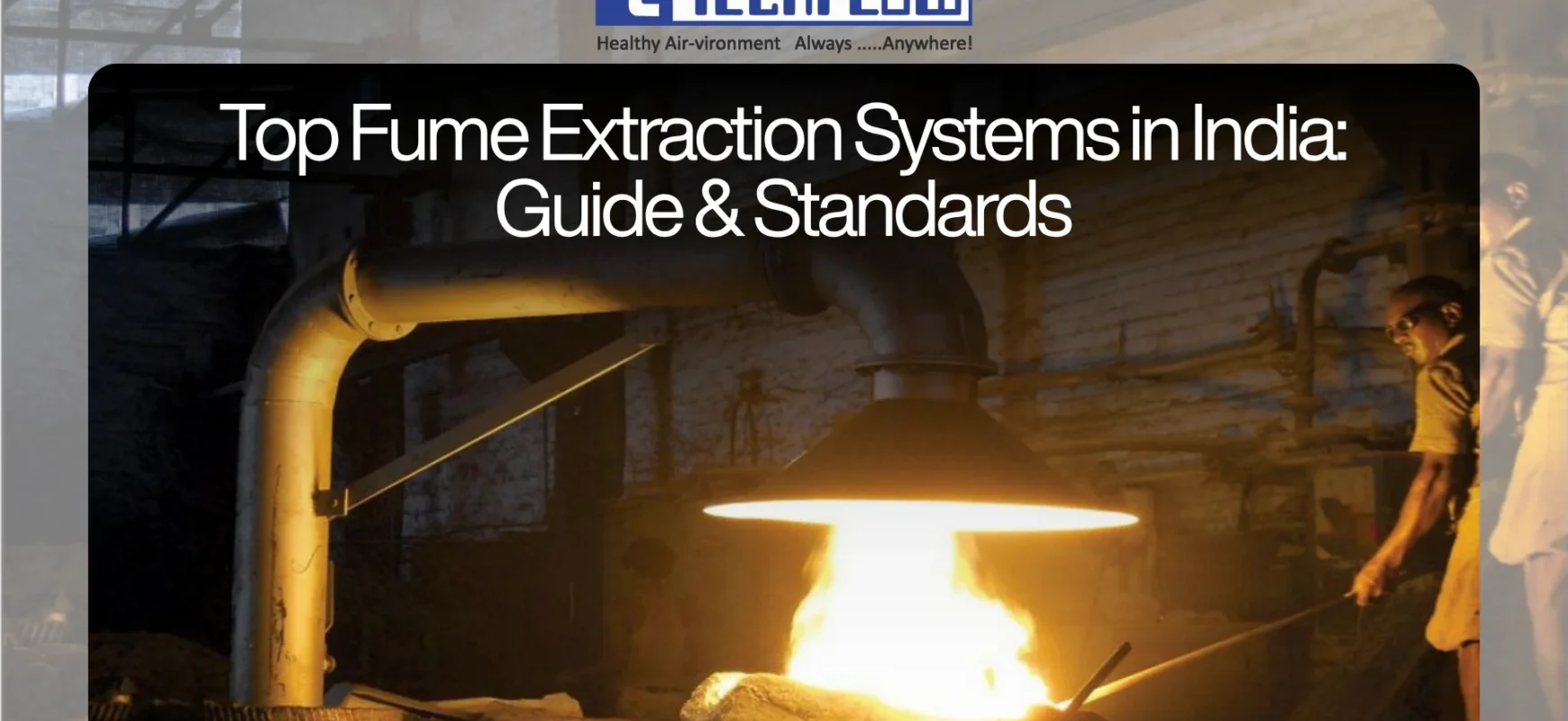
Walk into any Indian melt shop or foundry while a furnace is running, and you'll see it almost at once: a rolling cloud lifting off the furnace mouth at charging, a sheet of flame-laden smoke rolling sideways during tapping, a haze hanging under the shed roof that never quite clears. People who work around it stop noticing it. Their lungs don't. That cloud is a mix of sub-micron metal-oxide fume, combustion gases, and fine dust thrown off whenever metal is melted, refined, tapped, or poured and increasingly, regulators, insurers, and your own buyers refuse to treat it as background noise either.
That makes choosing a furnace fume extraction system (FES) and the company that engineers it far more than a purchase-order line item. It affects your operators' health, your Consent to Operate, your stack-emission compliance, the quality of your castings, and what you spend keeping the plant running for the next decade. This guide is about furnace fume extraction specifically: what these systems are, how they work at furnace temperatures, the furnace types and hood types involved, the standards that apply in India, and how to tell an engineered solution from a fan bolted to a duct.
What Is a Fume Extraction System?
A furnace fume extraction system captures the hot fumes, gases, and fine dust generated during melting and metal-handling operations right at the furnace, cools and cleans that gas stream, and discharges it safely, usually outside through a stack that meets emission limits, and in some recovery applications back into a usable product.
The word "fume" matters here. A fume is not the same as visible dust or smoke. It forms when a solid, almost always a metal, is heated until it vaporises, then cools and condenses in the air into extremely fine solid particles, most of them well under a micron across. A melting furnace is a textbook fume source: the heat boils off metal and any coatings on the scrap charge, and that vapour re-freezes into a fog of metal-oxide particles so small they bypass the nose and throat and lodge deep in the lung.
Because furnace fume is this fine and because the gas stream leaving a furnace can sit anywhere from roughly 200 °C to 400 °C or higher, a roof vent or a wall fan does almost nothing. A working system rests on five things that have to be engineered together: capture at the furnace, high-temperature conveyance, gas cooling, the right filtration, and a correctly placed induced-draft fan. Get any one wrong, and the system underperforms regardless of fan horsepower.
How a Fume Extraction System Works (in 5 Stages)
Occupational hygiene follows a simple ladder called the hierarchy of controls: remove the hazard if you can, substitute a safer process if you can't, and only then reach for engineering controls. For furnace emissions, capturing the fume at or near the source before it reaches the operator's breathing zone or escapes into the shed is the core engineering control. Indian law, in fact, requires the exhaust to be fitted as close as possible to the point of origin (more on that below).
Here is the journey the gas takes inside a well-built furnace FES.
|
Stage |
What happens |
What the engineer must get right |
|
1. Capture |
A hood (canopy, side-draft, swivel, water-cooled, or fourth-hole) collects fume at the furnace |
The hood must capture across charging, melting, holding, skimming, tapping, and pouring not just steady melting |
|
2. High-temperature conveyance |
Insulated or SS ducting carries the hot, often flame-laden gas away |
Ducting must withstand the temperature and keep particles moving without settling |
|
3. Gas cooling |
A spark arrestor, air-dilution cooler, or air-to-water/heat exchanger brings the gas down to a filter-safe temperature |
Fabric filters cannot survive raw furnace gas; the gas is usually cooled to roughly 80–120 °C first |
|
4. Filtration |
A cyclone/multiclone removes coarse sparks and grit, then a pulse-jet or reverse-air baghouse (or an ESP) strips the fine fume |
The media must catch sub-micron metal-oxide fume and survive the dust loading |
|
5. Air handling & discharge |
An induced-draft (ID) fan pulls the whole train and pushes clean gas up the stack |
The ID fan sits on the clean side (after the filter) and must overcome the combined resistance of hood, duct, cooler, and filter |
Two design ideas do most of the work. Capture velocity is the air speed the hood must generate at the source to draw fume in. With a furnace, the fume rides a strong thermal plume; hot gas is buoyant and rises fast, so canopy hood design is as much about catching that rising plume as about pulling against drafts. Transport (duct) velocity is the speed inside the duct that keeps particles suspended; for metallurgical and foundry dust this is kept relatively high (commonly in the region of 18–20 m/s, roughly 3,500–4,000 ft/min, per ACGIH design guidance) so heavier grit doesn't drop out and clog the run.
One furnace-specific point catches people out: hot gas occupies far more volume than cold gas. A given mass of fume leaving a furnace at 350 °C takes up roughly twice the volume it would at room temperature, so the hood, duct, and fan have to be sized for the actual hot gas volume, not a cold-air figure. Undersize on this and capture quietly fails.
Types of Industrial Fumes (and What Each One Demands)

Not every furnace throws off the same fume, and the furnace type drives both the capture method and the filtration. These are the furnaces most commonly fitted with an FES in Indian industry.
|
Furnace type |
What it does / where it's used |
Typical fume & capture approach |
|
Induction furnace |
The workhorse of Indian steel and foundry melting; melts steel, iron, and non-ferrous metals in a coreless crucible |
Iron/metal-oxide fume, scrap-coating fume; captured by a top-draft, side-draft, swivelling, or water-cooled hood at the furnace mouth |
|
Electric Arc Furnace (EAF) / Arc furnace |
Melts steel scrap with a high-current electric arc in steel plants and SMS units |
Heavy, hot, dense fume; captured via a fourth-hole (direct evacuation), water-cooled duct, plus a secondary canopy at the shed roof |
|
AOD furnace (Argon-Oxygen Decarburisation) |
Refines stainless and alloy steel after melting |
Cr(VI)- and nickel-bearing fume during blowing; needs primary capture plus heavy secondary roof capture |
|
Cupola furnace |
Coke-fired vertical furnace for melting cast iron in foundries |
Metal-oxide fume, grit, and combustion gas; gas extracted at the top or above the charging door, cooled, then filtered |
|
Crucible/pit furnace |
Smaller melts of non-ferrous metals (brass, bronze, aluminium) |
Metal fume (including zinc/copper oxide); captured by a canopy or side-draft hood over the crucible |
|
Gas-fired / zinc & galvanizing furnaces |
Melting zinc, galvanizing kettles, zinc-dust recovery |
High zinc-oxide fume; often a recovery application where the captured zinc is itself the product |
|
Heat-treatment / oil-quenching furnaces |
Hardening, tempering, annealing of components |
Oil smoke and combustion fume from quench tanks and furnace doors; captured by side-draft or door hoods |
|
DRI / sponge iron & ferroalloy furnaces |
Direct-reduced iron and ferroalloy production |
Heavy process dust and fume at high temperature; large primary extraction with baghouse or ESP |
|
Ladle, tundish & tapping stations |
Transfer and pouring of molten metal between furnace and mould/caster |
Tapping and pouring fume; captured by swivel hoods, tap-hole hoods, or local canopies |
The takeaway: a system built for an induction-furnace melt shop is not automatically right for a cupola, a galvanizing kettle, or an AOD blowing stainless. Each furnace has its own fume chemistry, temperature, and duty cycle, and the FES has to be matched to it.
Types of Fume Hoods Used on Furnaces
The hood is where the system succeeds or fails. Because a furnace is charged, melted, tapped, and poured each a different fume event in a different place most furnace installations use more than one hood type, and many use a hood that can move with the process. These are the hood types an experienced manufacturer will draw on.
- Top-draft / canopy hood: sits above the furnace mouth and catches the rising thermal plume. Simple and effective for steady melting, but it has to be sized for the hot-gas updraft and can lose capture in cross-drafts.
- Side-draft hood: mounted to the side of the furnace, drawing fume horizontally. Useful where an overhead crane charges the furnace and a canopy would be in the way.
- Swivelling (swivel) hood: pivots in and out over the furnace mouth so the crane can charge the furnace, then swings back to capture during melting and holding. The standard answer where charging access and capture have to coexist, and the usual choice for a standby furnace in a multi-furnace shop.
- Water-cooled hood: built with water-cooled panels to survive the radiant heat and flame close to an arc or large furnace. Common on EAF and high-temperature duties.
- Fourth-hole / direct evacuation (DEC): on an electric arc furnace, gas is drawn straight out of a fourth hole in the furnace roof the most effective primary capture for EAF, usually paired with a water-cooled elbow and combustion gap.
- Doghouse/enclosure hood: a partial or full enclosure around the furnace that contains fume before it can escape, used where capture has to be near-total.
- Tap-hole, spout & pouring hoods: local hoods positioned over the tapping spout or pouring stream to catch the burst of fume during tapping and pouring, which a melting-only hood will miss.
- Charging hood: positioned to capture the heavy fume pulse when contaminated or coated scrap first hits the heat.

The judgment a good engineer makes is to match hoods to the whole cycle, not just to melting. The best capture hood is the one your operators will actually use without being nagged, which usually means it must not block charging, tapping, or the crane.
Primary vs Secondary Furnace Fume Extraction
Furnace fume control is normally talked about in two layers, and serious melt shops use both.
Primary fume extraction captures the fume directly at the furnace at the mouth, through a swivel or water-cooled hood, or through a fourth-hole on an EAF during melting and refining. It catches the largest share of fume at the point of generation, which is exactly what the hierarchy of controls and Indian law both demand.
Secondary fume extraction deals with the fume that still escapes during charging, scrap addition, tapping, and pouring; the fume that forms a cloud under the shed roof. Here, a series of canopy hoods with automatic dampers is installed across the roof of the shed; the dampers open over whichever furnace is active (manually, or automatically on a fume sensor) and pull the escaped cloud to the filtration plant.
A well-designed melt shop typically runs primary capture on each furnace and a shared secondary roof system across the bay. The split between the two how much you rely on tight primary capture versus a large secondary canopy is one of the central design decisions, and it depends on your furnace type, your charge material, and how dirty your scrap is.
Note on scope: this guide deliberately focuses on furnace (process-source) extraction, primary and secondary capture at the furnace and the melt-shop roof. It does not cover portable or general-purpose mobile fume extractors, which are a different class of equipment for a different problem.
Why Fume Extraction Matters: Health, Compliance & Quality

There are three separate reasons serious melt shops and foundries invest in furnace fume control. Any one justifies the spend; together they leave no real choice.
1. Worker health is the central reason
The International Agency for Research on Cancer (IARC), the cancer arm of the World Health Organisation, classifies occupational exposure during iron and steel founding as a Group 1 carcinogen "carcinogenic to humans," a conclusion reaffirmed in IARC Monograph Volume 100F (2012). The evidence is a consistent excess of lung cancer in foundry workers across many countries, with cohort studies typically showing risk elevated by roughly 1.5 to 2.5 times.
Several individual ingredients of furnace fume carry their own well-documented risks:
- Hexavalent chromium [Cr(VI)] and nickel compounds, both Group 1 human carcinogens, appear in the fume when melting or refining stainless and alloy steels (for example during AOD blowing). U.S. OSHA caps Cr(VI) exposure at just 5 micrograms per cubic metre over an 8-hour shift, a very low limit that uncontrolled alloy melting can exceed.
- Cadmium and lead can be released when melting coated, plated, or mixed scrap.
- Manganese, common in steel fume, is linked to long-term overexposure to Parkinson's-like neurological damage.
- Zinc and copper oxide fume from galvanizing kettles and brass/bronze melting cause metal fume fever, a flu-like illness.
OSHA is a U.S. body, but its limits and the IARC classifications are the benchmarks Indian EHS teams, multinationals, and export-focused plants design against anyway.
2. In India, compliance is the law, not a suggestion
Indian law approaches furnace emissions from two directions: what leaves your stack (environmental) and what your people breathe inside the shed (occupational). You cannot legally run a fume-generating furnace in India without managing both. The specific Acts and limits are covered in the standards section below
3. Product quality and uptime
Fume and fine dust settle on castings, machined surfaces, and finished product, driving rejects and rework. In some furnaces, the captured fume is not waste at all but a recoverable product: on zinc and galvanizing furnaces, the FES is often run to recover zinc dust from the baghouse, and a well-engineered system can bring stack emissions down to as low as around 2 mg/Nm³ while collecting saleable zinc. Good furnace extraction can be a yield and quality tool, not only a safety one.
Which Industries Need Fume Extraction Systems in India?
Furnace fume extraction is a core requirement wherever metal is melted, refined, or heat-treated at scale.
|
Industry |
Typical furnace |
Main contaminant |
|
Steel mills, SMS & melt shops |
Induction, EAF, AOD |
Iron/metal-oxide fume, Cr(VI), nickel |
|
Iron & steel foundries |
Induction, cupola |
Metal-oxide fume, foundry dust |
|
TMT & re-rolling |
Induction, reheating furnaces |
Process fume and dust |
|
Aluminium & non-ferrous smelting |
Crucible, induction, reverbatory |
Metal fume, fluxing fume |
|
Zinc, galvanizing & zinc-dust recovery |
Gas-fired, induction kettles |
Zinc-oxide fume (often recovered) |
|
DRI / sponge iron & ferroalloys |
DRI kilns, submerged-arc furnaces |
High-temperature process dust and fume |
|
Heat treatment & forging |
Quench, hardening, tempering furnaces |
Oil smoke, combustion fume |
Filtration for Furnace Fume: Cyclones, Baghouses, ESPs & Coolers
Filtration for furnaces is built around two realities that don't apply to lighter fume sources: the gas is hot, and the dust load is heavy. That's why furnace FES filtration looks different from a small workshop extractor.
- Gas cooling comes first. Raw furnace gas is far too hot for fabric filters, so the train almost always starts with a spark arrestor and a cooling stage, air dilution, a U-tube/air-to-air cooler, or an air-to-water heat exchanger to bring the gas down to roughly 80–120 °C before it reaches the filter media.
- Cyclones and multiclones are used as pre-separators to knock out sparks, embers, and the coarser grit before the fine filter, protecting the bags and reducing their load.
- Pulse-jet or reverse-air baghouses (fabric filters) are the workhorse final stage for furnace fume. The fabric bags catch sub-micron metal-oxide fume, and a periodic pulse of compressed air (or a reverse-air cycle) cleans the collected dust off the bags to keep the gas flowing.
- Electrostatic precipitators (ESPs) are used on very large, high-temperature, high-volume duties (large furnaces, certain process gas streams) where they handle the volume and heat efficiently.
Cartridge filters appear on some compact induction-furnace duties where the gas is cooler and cleaner, but for most furnace work the choice is a baghouse or an ESP. The key engineering call is matching the cooling and filter media to your gas temperature, dust load, and the emission limit you must hit, which is why this stage should be designed around your numbers, not pulled off a shelf.
Furnace Fume Extraction Standards & Compliance in India

Indian compliance runs on two tracks: environmental (what leaves the stack) and occupational (what workers breathe). A defensible furnace project covers both, and furnaces have their own specific emission limits.
Environmental: the Air Act, CPCB & furnace emission limits
The Air (Prevention and Control of Pollution) Act, 1981 is the backbone of industrial air regulation in India. The Central Pollution Control Board (CPCB) sets standards nationally, and the State Pollution Control Boards (SPCBs) enforce them. Two provisions matter for any furnace plant: under Section 21, you cannot operate in an air-pollution-control area without the State Board's prior consent (the Consent to Operate, CTO); under Section 22, you cannot discharge air pollutants above the prescribed standards.
The furnace-specific particulate matter (PM) limits under the Environment (Protection) Rules, 1986 include:
|
Furnace/source |
Particulate matter limit |
|
Cupola (foundry), melting rate < 3 t/hr |
≤ 450 mg/Nm³ (stack to be built over the cupola beyond the charging door, height ≥ 6× cupola diameter) |
|
Cupola (foundry), ≥ 3 t/hr |
≤ 150 mg/Nm³ |
|
Arc furnaces (all sizes) |
≤ 150 mg/Nm³ |
|
Arc & induction furnaces |
Provision must be made to collect the fumes before discharging emissions through the stack |
These are national baselines; your SPCB consent may set tighter figures, and many modern plants and buyers specify well below them. Crucially, the regulation explicitly requires that arc and induction furnaces collect fume before discharge; in other words, an FES is effectively mandatory, not optional.
A current tightening to watch: in 2026 the Commission for Air Quality Management (CAQM) issued Direction No. 98, setting a uniform PM limit of 50 mg/Nm³ for identified polluting industries, including metal industries with furnaces, operating in Delhi-NCR, applicable from 1 August 2026 for large and medium industries and 1 October 2026 for the rest. It is a strong signal of the direction of travel nationally, and plants near or supplying NCR should design to it now.
The CPCB also publishes the National Ambient Air Quality Standards (NAAQS) for pollutants such as PM2.5 and PM10. Your furnace extraction equipment is, in practice, how you prove compliance and protect your consent.
Occupational: the Factories Act, 1948
On the worker side, Section 14 of the Factories Act, 1948 is directly on point: where a process gives off dust or fume likely to harm workers, the Act requires effective steps to prevent its inhalation and accumulation in the workroom and, where needed, an exhaust appliance fitted as close as possible to the point of origin. That phrase is the law restating the source-capture principle every good furnace engineer already follows. These occupational duties are being consolidated under the newer Occupational Safety, Health and Working Conditions Code, 2020.
|
Standard |
Authority |
What it governs |
|
Air Act, 1981 (Sec. 21 & 22) |
CPCB / SPCBs |
Consent to Operate; emission limits |
|
Environment (Protection) Rules, 1986 |
CPCB |
Furnace-specific PM limits (cupola, arc, induction) |
|
CAQM Direction No. 98 (2026) |
CAQM (Delhi-NCR) |
50 mg/Nm³ PM for metal industries with furnaces |
|
Factories Act, 1948 (Sec. 14) |
State factory inspectorates |
In-plant fume capture at source |
|
NAAQS |
CPCB |
Ambient air quality (PM2.5, PM10) |
How to Choose a Furnace Fume Extraction System: A 7-Step Guide

Specifying a furnace FES is a sequence of engineering questions answered in order. Skip a step, and you end up with a system that's loud, costly to run, and still failing its emission test.
- Identify the furnace and the fume. Induction, EAF, AOD, cupola, crucible, galvanizing, DRI? Mild steel, stainless/alloy (Cr(VI), nickel), or non-ferrous (zinc, aluminium)? This drives everything downstream.
- Map the duty cycle. Charging, melting, holding, skimming, tapping, pouring where and when does the fume actually appear? This decides your hood mix and the primary/secondary split.
- Choose the capture method. Canopy, side-draft, swivel, water-cooled, fourth-hole, or enclosure selected for capture efficiency and for not blocking the crane and operators.
- Account for temperature and gas volume. Establish the gas temperature and the actual hot-gas volume, then design the cooling stage (spark arrestor, dilution, or heat exchanger) to protect the filter.
- Size airflow and ducting. Work out the capture volume at each hood and size the duct for a transport velocity that keeps metallurgical dust suspended, at an acceptable pressure drop.
- Select filtration to the emission limit. Cyclone/multiclone pre-separation, then a pulse-jet/reverse-air baghouse or ESP sized to hit your SPCB limit with recovery built in for zinc-type duties.
- Build the compliance case. Make sure the design supports your CTO, your Factories Act duties, and any customer or export specification from the start.
Airflow, Temperature & Ducting: The Engineering That Decides Performance

More furnace systems fail on airflow, temperature, and ducting than on the filter or fan. Three ideas do most of the work.
Hot-gas volume. As noted, furnace gas expands with heat, so hood, duct, and fan must be sized for the actual hot volume. Sizing on a cold-air figure is one of the most common and most expensive errors.
Capture against a thermal plume. Furnace fume rises fast on its own buoyancy. Canopy hoods exploit that plume but must be large and high enough to catch it without being defeated by cross-drafts; tap and pour hoods have to be positioned for the burst of fume at exactly the right moment.
Transport velocity and duct layout. The duct must stay fast enough to keep heavy metallurgical dust suspended (commonly in the region of 18–20 m/s per ACGIH guidance) without being so fast it wastes fan power and wears the duct. A clean run with balanced branches and correctly sized cooling sections delivers the airflow you calculated at the hood; a tangle of bends bleeds it away before it reaches the filter.
The standard engineering reference for these calculations is the ACGIH Industrial Ventilation: A Manual of Recommended Practice for Design.
Furnace FES Buyer's Checklist: 10 Questions to Ask
Use this when comparing furnace fume extraction suppliers. A strong manufacturer answers all of these without flinching.
- Furnace-specific design engineered for your furnace type and charge, not a generic catalogue unit.
- Whole-cycle capture hoods that handle charging, melting, tapping, and pouring, not just steady melting.
- Primary and secondary capture: a clear plan for both furnace-mouth and shed-roof fume.
- Temperature & gas-volume figures: gas temperature and actual hot-gas volume shown, with cooling designed accordingly.
- Velocities stated: capture and transport velocities shared openly, with the airflow maths behind them.
- Filtration to your limit baghouse/ESP and pre-separation sized to your SPCB emission figure in mg/Nm³.
- Compliance support: the design helps you meet CTO, EP-Rules furnace limits, and Factories Act duties.
- Recovery where relevant for zinc/non-ferrous duties; captured material recovered as product where possible.
- Track record in your furnace delivered on your specific furnace and industry, not "industry" in general.
- Local after-sales support is real help for commissioning, bag changes, and breakdowns in India.
Furnace FES Maintenance: Best Practices
A furnace fume extraction system protects only as long as it performs. A clogged or neglected unit can quietly let emissions and in-shed exposure climb while everyone assumes they're covered.
- Watch the filter pressure drop. A rising differential pressure across the baghouse warns you the bags are loading up and airflow is falling. Most systems carry a gauge for exactly this.
- Service and change bags on schedule. Follow the maker's intervals and handle spent media as hazardous waste; furnace dust can contain Cr(VI), lead, and cadmium.
- Check the cooling stage and spark arrestor. If gas reaches the bags too hot, the media degrades fast; confirm coolers and spark arrestors are working before bag life suffers.
- Confirm capture at each furnace. Verify hoods and swivel arms are still in position and the pull hasn't faded; operators move things.
- Inspect ducting for settled dust. A build-up means transport velocity has dropped, raising blockage and, with combustible dust, fire risk.
- Look after the ID fan and cleaning system. Check the fan and confirm the pulse-jet or reverse-air cleaning is firing correctly.
- Keep records. Maintenance logs back up your compliance position and make SPCB audits far less painful.
One budgeting note people forget: account for bag/consumable replacement and energy over the system's life, not just the day-one price. A cheap unit with short-lived bags and a poorly cooled gas stream often costs far more over five years.
Common Furnace Fume Extraction Buying Mistakes to Avoid

- Sizing on cold-air volume. Furnace gas is hot and expands; size for the actual hot-gas volume or capture fails.
- Skipping or undersizing the cooling stage. Send raw furnace gas to a baghouse, and you destroy the bags.
- Capturing melting only, ignoring tapping and pouring. A melting-only hood misses the heavy fume bursts at charge, tap, and pour.
- No secondary capture. Without roof canopies, the escaped cloud just hangs in the shed.
- Sizing on fan power instead of airflow. Horsepower isn't capture; the numbers that matter are hot-gas volume, capture velocity, and duct velocity.
- Filtration that won't meet the limit. Choosing media without designing to your SPCB mg/Nm³ figure invites a failed stack test.
- Treating compliance as an afterthought. Designing without CTO, EP-Rules furnace limits, and Factories Act duties in mind invites rework and penalties.
- Buying generic instead of engineered. Off-the-shelf units rarely fit a real melt-shop layout, furnace type, or charge.
Why Choosing the Right Furnace FES Manufacturer Matters

A furnace fume extraction system is only as good as the engineering behind it. The same hood, cooler, baghouse, and fan can succeed or fail depending on whether someone correctly read the furnace and charge, calculated the hot-gas volume, sized the cooling and ducting, and matched the filtration to both the fume and the emission limit. That is why the company matters as much as the machine.
This is where experience shows. TECHFLOW ENTERPRISES, based in Ahmedabad and founded in 1979 by engineer Mr. D. K. Parikh, is one of the established names in furnace air-pollution-control and fume extraction in India. Its furnace work covers what a real melt shop or foundry needs: furnace fume extraction systems (FES) for induction, EAF, arc, AOD, cupola, and gas-fired/zinc furnaces; both primary and secondary capture; swivelling and water-cooled hoods and fourth-hole/direct evacuation; primary cyclones and multiclones; air-water coolers and spark arrestors; pulse-jet and reverse-air baghouses and electrostatic precipitators; and the centrifugal blowers and ID fans that drive them serving foundries, steel mills, SMS units, TMT plants, aluminium and zinc smelting, DRI/sponge iron, and more.
For a buyer, the value of an experienced furnace manufacturer comes down to a few things: engineering built around your furnace, charge, and duty cycle rather than a generic unit; the ability to customise hoods for awkward crane access and multi-furnace bays; a working grasp of CPCB/SPCB consent norms and Factories Act duties built into the design from the start; and breadth across filtration technologies (baghouse, ESP, cyclone, recovery) so the recommendation isn't quietly steered to one product.
If you're scoping a furnace fume extraction project a single induction furnace, an EAF melt shop, a cupola, or a galvanizing line the right starting point is a conversation about your furnace type, your charge material, your duty cycle, and your emission target, so the system is designed around your process rather than pulled off a shelf.
Frequently Asked Questions (FAQs) :
A furnace fume extraction system (FES) captures the hot fume, gas, and fine dust generated when metal is melted, refined, tapped, or poured in a furnace, cools and filters that gas stream, and discharges clean gas through a stack within emission limits. A typical system is a capture hood, high-temperature ducting, a cooling stage, a baghouse or ESP, and an induced-draft fan.
In effect, yes. The Environment (Protection) Rules, 1986 specifically require arc and induction furnaces to collect fumes before discharging through the stack, and set PM limits for cupolas (450 mg/Nm³ below 3 t/hr, 150 mg/Nm³ at or above) and arc furnaces (150 mg/Nm³). Separately, the Air Act, 1981 requires a Consent to Operate, and Section 14 of the Factories Act, 1948 requires fume capture as close as possible to the source. Together, these make an FES a practical requirement for any fume-generating furnace.
Induction furnaces, electric arc furnaces (EAF) and arc furnaces, AOD furnaces, cupolas, crucible and pit furnaces, gas-fired and zinc/galvanizing furnaces, DRI/sponge iron and ferroalloy furnaces, and heat-treatment and quenching furnaces. Each produces a different fume at a different temperature, so the system design changes with the furnace.
Common furnace hoods include top-draft/canopy hoods, side-draft hoods, swivelling hoods (which pivot aside for crane charging), water-cooled hoods for high-temperature duties, fourth-hole/direct-evacuation systems on EAFs, doghouse enclosures, and dedicated tap-hole, spout, and pouring hoods. Most furnaces use a combination, because charging, melting, tapping, and pouring each release fume in a different place.
Primary extraction captures fume directly at the furnace during melting and refining through a furnace-mouth hood, swivel hood, or EAF fourth-hole. Secondary extraction captures the fume that still escapes during charging, tapping, and pouring, usually via canopy hoods with automatic dampers across the shed roof. A well-designed melt shop uses both.
Gas leaving a furnace can be 200–400 °C or higher, which would damage or destroy fabric filter bags. A spark arrestor and a cooling stage (air dilution, air-to-air, or air-to-water heat exchanger) bring the gas down to roughly 80–120 °C before it reaches the baghouse, protecting the media and removing sparks that could cause a fire.
Yes. IARC classifies occupational exposure during iron and steel founding as a Group 1 (human) carcinogen, with foundry cohorts showing elevated lung-cancer risk. Furnace fume can also contain hexavalent chromium and nickel (carcinogens, from alloy melting), manganese (linked to neurological damage), and zinc or copper oxide (causing metal fume fever). Effective capture at the furnace is the primary control.
It starts with the capture volume needed at each hood, adjusted for the actual hot-gas volume at furnace temperature (hot gas expands and takes up more space). Ducting is then sized for a transport velocity that keeps metallurgical dust suspended, commonly in the region of 18–20 m/s at a manageable pressure drop, and the cooling stage and filter are sized to hit your emission limit. The ACGIH Industrial Ventilation: A Manual of Recommended Practice for Design is the standard reference.
Look for engineering built around your specific furnace and charge rather than a generic unit; hoods designed for your whole duty cycle and crane access; openness about hot-gas volume, capture and duct velocities, and outlet emission in mg/Nm³; a cooling stage and filtration sized to your SPCB limit; a clear grasp of CPCB/SPCB consent and Factories Act compliance; a track record on your furnace type; and reliable local after-sales support for bags and commissioning.