

Key Takeaways
- A pulse jet bag filter is a dry dust collector that captures particulates on the outer surface of fabric bags and cleans them with short bursts of compressed air.
- It cleans online, pulsing one row of bags at a time, so filtration continues without stopping the process, which is why it suits continuous industrial operations.
- Dust is captured as gas flows from the outside of each bag inward, and the dust cake that forms on the surface does much of the fine filtration.
- The air-to-cloth ratio is the most important design parameter; setting it too high shortens bag life and raises pressure drop, while too low oversizes the unit.
- Filter media is selected by operating temperature and chemistry: polyester suits ambient dust (~135 °C), aramid and PPS handle moderate heat (~190 °C), and P84, PTFE, and fibreglass serve high-temperature streams (~240–260 °C).
- TECHFLOW designs, manufactures, and commissions pulse jet bag filters across a capacity range of roughly 1,000 to 100,000 m³/hr in both online and offline cleaning configurations.
Dry industrial processes that crush, grind, dry, or melt produce dust. A steel plant, cement kiln, foundry, or sponge iron unit turns dust into a problem that must be managed. If dust is not managed, it ends up in the stack, in the employees’ lungs, and in the inspectors’ reports.
Bag filters are used to manage the dust at most of these locations. They are self-cleaning and compact, and when designed correctly, the bag filter maintains emissions at single-digit milligrams. All three of these traits are the main reason this system is the most commonly used dust collector in the industry.
This document is meant to be an introductory guide to the inner workings of bag filters and the numerous designs that exist. The concepts presented in this document will enable the user to accurately assess a bag filter’s performance using a single rating and the design’s major operating locations. It is designed for the user who is writing the specifications, the person giving the authority to proceed with the work, and the person purchasing the system.
The points detailed below are based on actual in-field practices for bag filters in the range of 1,000 to 100,000 m³/hr. We design and execute these systems at TECHFLOW.
What Is a Pulse Jet Bag Filter?
A pulse jet bag filter is a dry dust collector that collects dust on the outer surface of fabric bags. Using a short, high-pressure burst of compressed air, the bags are cleaned without interrupting the filtration process. The name gives away the method of the cleaning process: a short pulse of air is jetted down into each bag.
Pulse jet bag filters belong to the family of fabric filters, commonly known as baghouses. What sets this type of filter apart is the ability to effect bag cleaning while the filter maintains functionality. This characteristic is important for the continuous operation of the processes using this type of filter, i.e., kilns, furnaces and mills.
Dirty gas enters the system, dust is collected on the bags, clean gas is discharged through the stack, and compressed air sends dust to the collector. All of this occurs while the production process is active.
How a Pulse Jet Bag Filter Works
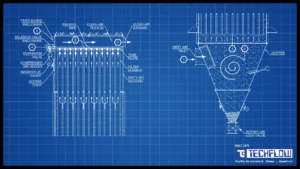
Filters have a few different classifications. Being aware of these distinctions will allow you to configure the filter more precisely, without having to worry about under or over-building.
By Cleaning Configuration: Online vs Offline
In online (continuous) cleaning, the unit filters without interruption while rows of bags are pulsed one at a time. This is the more common of the two configurations and suits steady, continuous operations well.
In offline (sectional) cleaning, dampers isolate a compartment completely before it is pulsed, then return it to service once clean. Because the bags in that compartment are not carrying flow during cleaning, the dust cake releases more completely, which translates to lower residual emissions. This makes offline cleaning the better choice for heavy dust loads, sticky or cohesive dust, and processes with tight emission targets. Larger installations use multi-compartment housings so that one section can be taken offline without reducing the total filtration area in service.
The choice between the two usually comes down to two factors: how heavy and difficult the dust is, and how tight the permitted emission limit is.
By Filter Element: Bag vs Cartridge
Bag filtering (tubular) uses long tubes of fabric, which are stretched over and held by a cage. These filters are especially workhorse-appropriate considering their ability to sustain high loads and higher dust concentrations.
Cartridge filters, on the other hand, use more pleated media. This method allows more surface area for the same volume. This method of filtering excels at applications of finer-birthed dusts, especially of a dry nature, where temperature is not especially high. This can include powder coating, shot-blasting, and some fine chemical applications.
By Layout
Units can have top-bag removal (bags are changed from the clean side, a genuine advantage during maintenance) or bottom-bag removal, and can have insulated or jacketed housings for hot gas streams. For high-temperature service, the housing is designed around gas temperature, the acid dew point, and thermal expansion, all at the same time (not one at a time).
Filter Media: Match the Fabric to the Gas
The bag is where filtration actually happens, so matching the fabric to the gas stream is one of the highest-stakes decisions in the whole specification. Run polyester into a stream that’s too hot, or a non-acid-resistant media into acidic flue gas, and bags fail early, emissions climb, and replacement costs stack up fast.
Two factors drive the choice: the continuous operating temperature and the chemical environment acids, alkalis, moisture, and abrasion.
| Filter Media | Approx. Max Continuous Temp. | Best Suited For |
| Polyester (PE) | ~135 °C | The most common, cost-effective media for ambient and low-temperature dust; strong abrasion and dry-heat resistance. Avoid in moist heat it’s prone to hydrolysis. |
| Acrylic | ~120 °C | Moderate temperatures with some acid and moisture resistance. |
| Aramid (meta-aramid) | ~190 °C | Hotter, abrasive dusts foundries, dryers, certain furnace streams. |
| PPS (polyphenylene sulfide) | ~190 °C | Acidic flue gas, such as sulphur-bearing coal-boiler exhaust. |
| P84 (polyimide) | ~240–260 °C | High temperatures; its multi-lobed fibre boosts surface area and fine-dust capture. |
| PTFE (Teflon) | ~250–260 °C | A premium media for high heat, acids, and moist heat, with excellent cake release. |
| Fiberglass | ~260 °C | The economical high-temperature option (cement kilns, power); resists most acids but not hydrofluoric. |
Surface treatments matter as much as the base fibre. Laminating an ePTFE membrane onto the fabric turns it into a surface filter; dust never embeds, cake release improves, and emissions drop. Singeing, glazing, PTFE coatings, and anti-static finishes each tune the media to a specific dust. And for any dust that can carry a static charge many fine organic and metallic powders, anti-static media is a safety requirement, not an optional upgrade.
Where Pulse Jet Bag Filters Are Used
Bag filters are everywhere that a fine particulates must be managed after an air pollution control device. Whether the issue is regulatory compliance, personnel safety, or product recovery, bag filters are the solution. The major industry segments include:
- Steel, sponge iron, and DRI refining: dust de-collection from dryers and coolers, fume extraction from furnaces, and dusty raw material and product handling. The bag filters are important to meet the emission limits for coal-based sponge iron, which is a very dusty process.
- Cement: coolers and high volume / high temperature dust from milling and packing.
- Power and boiler plants: fly ash and flue-gas particulate from coal and biomass combustion.
- Foundries and metal melting: dust and fume collection from various furnaces and casting/sand processing.
- Mining, minerals, and crushing: dust from crushing, screening, and conveying.
- Wood, laminate, and particleboard: dust from sanding and wood processing, with special explosion protection designs.
- Pharmaceuticals, food, and chemicals: fine powder capture and product recovery, where contamination control matters as much as emissions.
- Dust from powder coating and shot blasting.
- Pigments, rubber, and tyre recycling.
All of these systems have a common focus on air quality beyond the facility, on the safety of personnel within the facility, and on maintaining the facility’s operational permit.
Why Industries Choose Pulse Jet Bag Filters
The advantages are practical rather than theoretical:
- High collection efficiency on fine particulate, including the small fractions that matter most for health and compliance.
- Continuous operation: online cleaning means production never pauses for the dust collector.
- Compact footprint: higher A/C ratios shrink the unit for a given gas flow, which counts when floor space is scarce.
- Lower running cost: pressure-triggered cleaning spends compressed air only when needed, and a stable dust cake keeps the fan efficient.
- Longer bag life when the media, A/C ratio, and cleaning settings are matched to the duty.
- Dependable compliance: sized and maintained properly, these systems meet stringent stack limits with headroom.
How to Specify and Size a Pulse Jet Bag Filter
A sound specification starts with the process, not the equipment. The questions that genuinely shape the design are:
- What’s the gas flow rate?
This sets the broad capacity in m³/hr. - What’s the operating temperature, continuous and peak?
This picks the media and decides whether the housing needs insulation. - What’s the dust like?
Particle size, concentration, stickiness, abrasiveness, moisture, and whether it can hold a charge. - What emission limit must be met?
This drives the A/C ratio, the cleaning configuration, and whether a membrane media is needed. - Is there an explosion or combustibility risk?
Fine organic and metallic dusts may call for anti-static media and explosion protection.
From these answers, the engineer calculates the required filter area, sets an appropriate air-to-cloth ratio, selects the media, and sizes the compressed-air and fan systems. Skipping this groundwork is the single most common reason bag filters underperform after commissioning. A capacity figure on its own tells you almost nothing about whether a unit will do its job.
How to Choose a Pulse Jet Bag Filter Manufacturer
Buying a bag filter is not the same as buying a pump or a valve. The unit is engineered to a specific process, and the performance of the system over its ten- or fifteen-year service life depends almost entirely on how well the manufacturer understood that process at the time of design. A few questions cut through the noise quickly.
- Ask for process-specific references, not just a project list. A long reference list that includes steel, cement, and chemicals tells you the manufacturer has built units. It does not tell you they have built a unit for your dust, your temperature, and your emission limit. Ask for references from plants running a process comparable to yours, and ask what emission figures those systems are currently achieving, not what they were designed to achieve.
- Verify in-house engineering depth. The vendor should be able to walk you through the air-to-cloth ratio selection, the media choice, and the cleaning cycle logic for your specific application without referring you to a catalogue. If the answers are generic, the engineering is generic, and the system will be sized to a standard table rather than to your process.
- Understand what is manufactured in-house and what is bought out. The bag, the diaphragm valve, and the compressed-air system are the components that determine reliability. Know whether the vendor controls their quality or assembles from whoever quotes the lowest that quarter.
- Look at commissioning and post-commissioning support. A bag filter that is put into service without proper commissioning, inlet duct balancing, and initial cleaning cycle tuning will underperform from the first week. The manufacturer should be present at startup and should be reachable when something changes in the process two years later.
- Pressure-test the warranty terms. A five-year bag life guarantee is only as good as the conditions attached to it. Understand what voids it: pulse air quality, differential pressure limits, operating temperature exceedances. These terms reveal how confident the manufacturer actually is in the design.
- Check whether the design has a margin built in. A correctly designed system is not sized to the minimum required filter area. It has a margin in the A/C ratio, in the compressed-air capacity, and in the hopper volume, so that process fluctuations do not immediately translate into emission spikes. Ask the vendor to show you where the margin is.
The right manufacturer is the one who asks more questions about your process than you ask about their product.
Keeping the System Performing
A pulse jet bag filter is low-maintenance (not no-maintenance). The simplicity of a pulse jet bag filter is well worth the investment. Consider the following:
- Monitor differential pressure. Slow, steady pressure drops are a good signal of healthy systems; however, a slow increase will blind bags, and a sudden drop will rupture bags.
- Always keep your pulse cleaning air dry and clean. Pulsing moist or oily air will release the filter cake, causing bags to blind from the inside.
- Always check the schedule for your bags and cages to ensure there is no visual damage.
- Maintain your bag loading hoppers. Ensure the bags do not accumulate dust, or it will re-enter the bags through the collection hoppers.
- At the end of a bag’s life cycle, always change out the entire set and do not wait for bags to fail.
With consistent maintenance and good filter management, bags can reach the end of their service life. Poor management of filters will cause bags to fail far before the end of their service life. (For more information, please refer to TECHFLOW’s guide on how to clean pulse jet bag filters.)Emission Compliance in India
How TECHFLOW Approaches This
The systems described throughout this document are the systems we design and build at TECHFLOW, in the capacity range of roughly 1,000 to 100,000 m³/hr, across steel and sponge iron plants, cement facilities, power plants, foundries, and process industries.
Our starting point is always the process gas stream, not a catalogue selection. The air-to-cloth ratio, the media specification, the cleaning configuration, and the hopper and discharge arrangement are all worked out from the actual dust characteristics, temperature, and emission requirement before a single drawing is issued. When the process has an acid dew point risk, a sticky dust, or an unusually variable load, the design reflects that from the outset rather than as an afterthought.
We manufacture the filter housings, hoppers, tube sheets, and blow pipe assemblies in-house. We source the diaphragm valves and filter bags from suppliers whose quality we have verified over multiple projects and can stand behind.
Commissioning is part of the scope, not an optional add-on. Initial cleaning cycle settings, inlet velocity distribution, and differential pressure set points are tuned at startup, because a unit that leaves the factory correct can still underperform if it is commissioned carelessly.
Plants we have designed continue to operate within their permitted emission limits through routine maintenance and periodic media replacement, which is the outcome that a correctly specified system should deliver. That is the standard we design to.
Emission Compliance in India
For Indian Plants, the framework of regulations is the Central Pollution Control Board (CPCB) and the relevant State Pollution Control Boards, with differing limits depending on the industry and processes. For sponge iron (DRI) de-dusting systems, the limits have generally been around 50 mg/Nm³ for new units and 100 mg/Nm³ for old units, with requirements for stack height and monitoring of fugitive emissions.
As these limits are dynamic and vary by state and sector, the applicable lesson is the same one that is learned by engineers on site: design the system with adequate margin for the limits that are most applicable for the process and the location, rather than for some generalised target. A properly designed pulse jet system will exceed those limits and provide the site with a defensible compliance position for a regulatory inspection.
Frequently Asked Questions (FAQs) :
It removes fine dust and particulates from industrial process gas before that gas is released to the atmosphere. It protects air quality, recovers valuable products in some processes, safeguards worker health, and keeps plants within emission limits.
A short, high-pressure burst of compressed air fires down into each row of bags. The resulting shockwave flexes the bag and cracks off the accumulated dust cake, which falls into a hopper. The rest of the unit keeps filtering, so there's no shutdown.
Online cleaning pulses individual rows while the whole unit stays in service. Offline cleaning isolates a compartment, cleans it fully, then returns it. Offline gives more complete cleaning and lower residual emissions, which suits heavy or sticky dust.
There's no single universal figure; it depends on the dust, the temperature, and the cleaning system. Fine, light, or abrasive dust needs a lower ratio. The correct value is set during engineering; running too high a ratio shortens bag life and raises pressure drop.
Match the media to your gas temperature and chemistry. Polyester suits ambient and low temperatures, aramid and PPS handle moderate heat and acidic gas, and P84, PTFE, or fibreglass cover high-temperature streams. A membrane finish improves cake release and lowers emissions.
Bag filters use tubular fabric bags and handle high temperatures and heavy loads. Cartridge filters use pleated media that fits more area into less space, making them ideal for fine, dry, ambient dust where the footprint is tight.
Bag life depends on the media, the dust, the temperature, and how well the system is run and maintained. With the right media and clean, dry pulse air, bags reach their full intended service life; with mismatched media or poor maintenance, they fail far sooner.
Yes, provided the right high-temperature media (P84, PTFE, or fibreglass) is used, and the housing is engineered for the temperature, acid dew point, and thermal expansion involved.
When correctly sized and maintained, they bring stack particulate well within the limits set by the CPCB and State Pollution Control Boards for the relevant industry, giving plants a reliable and defensible compliance position.