

Key Takeaways
- A fan moves large volumes of air at low pressure. A blower moves moderate volumes at higher pressure against system resistance, such as ducting, filters, and dust loads. The dividing line is pressure ratio: up to about 1.11 for fans, 1.11 to 1.20 for blowers.
- The two numbers that drive every selection are airflow (CFM or m³/hr) and static pressure (mmWG or Pascals). Miscalculate either, and the machine underperforms on day one.
- For continuously running fans, electricity is the single largest cost over the machine's life, far exceeding the purchase price. Energy efficiency is not a luxury; it is where the money is.
- Oversizing "to be safe" backfires. It inflates capital cost, wastes power, and pushes the fan into unstable, vibration-prone operation.
- In India, your fan and its motor are accountable to real standards: IS 4894 (centrifugal fans), IS 3588 (axial fans), IS 12615 (motor efficiency, IE2 mandatory minimum), and emission and noise limits set by CPCB/SPCB and the Model Factories Rules.
Choosing an industrial fan or blower is one of those decisions that looks simple on a purchase order and turns expensive when it goes wrong. Get the airflow, pressure, material, and motor right, and the machine runs quietly in the background for fifteen years. Get them wrong, and you are paying for it every single month in wasted electricity, nuisance trips, and unplanned shutdowns that stall an entire line.
This guide is written for the people who actually make that call: plant heads, project engineers, maintenance managers, and procurement teams across India's process industries. It covers what fans and blowers really are, the types that matter on a factory floor, how to size and specify them correctly, the Indian standards you are accountable to, and how to read lifecycle cost instead of sticker price.
What Are Industrial Fans and Blowers?
Industrial fans and blowers are heavy-duty rotating machines that move air, gas, or material-laden air streams through a system or space. They are the workhorses behind ventilation, cooling, combustion air supply, dust collection, fume extraction, and pneumatic conveying in almost every manufacturing plant.
On the shop floor, the two words get used interchangeably, but they are not the same machine. The difference comes down to how much pressure they generate to push air through resistance.
Under the widely used classification from the American Society of Mechanical Engineers (ASME), the three air-moving categories are separated by pressure ratio, which is discharge pressure divided by inlet pressure:
- Fans: pressure ratio up to about 1.11
- Blowers: pressure ratio from 1.11 to 1.20
- Compressors: pressure ratio above 1.20
In plain terms, a fan is a high-volume air circulator, best for open spaces and cooling. A blower is a high-pressure air pusher, built to force air through restrictive ductwork or to move solid material along a pipeline.
Fan vs Blower: The Core Difference at a Glance
|
Parameter |
Industrial Fan |
Industrial Blower |
|
Pressure ratio |
Up to ~1.11 |
1.11 to 1.20 |
|
Airflow profile |
High volume, low pressure |
Moderate volume, higher pressure |
|
Typical duty |
General ventilation, cooling, localised exhaust |
Pneumatic conveying, combustion air, dust collection |
|
Construction |
Simpler; axial or centrifugal |
Heavier, reinforced housing; centrifugal or positive displacement |
|
Energy use |
Lower power per unit volume |
Higher power per unit volume due to pressure resistance |
A quick test for buyers: if you are circulating air across an open hall or a cooling tower, you almost certainly want a fan. If you are pulling air through a bag filter or pushing cement through a pipe, you need the pressure of a blower.
Types of Industrial Fans

Industrial fans are classified by the direction in which air leaves the impeller. The right type depends on your pressure requirement and the space you have to work with.
Axial Flow Fans
In an axial fan, air moves parallel to the shaft, the same way a ceiling fan or an aircraft propeller works. These are the natural choice for high-volume, low-resistance air movement.
- Best for: cooling towers, condenser cooling, transformer cooling, and general ventilation in large halls and warehouses.
- Strengths: compact, very high airflow for the size, and cost-effective.
- Limitation: performance falls off sharply against high system resistance, so they are a poor fit for heavy ducting or dust collection.
Centrifugal Fans
A centrifugal fan draws air into the centre of the impeller and throws it outward at right angles. This change of direction allows it to generate far more pressure than an axial fan, which is why it dominates industrial process air.
- Best for: industrial HVAC, dust collection, fume extraction, and material conveying.
- Strengths: handles high pressure and can be engineered for hot, abrasive, or contaminated air streams.
- Blade types matter here:
- Forward-curved: clean air, low pressure, compact.
- Backwards-curved (or backwards-inclined): high efficiency, stable, non-overloading power curve. The preferred choice where energy cost matters.
- Radial: rugged, self-cleaning, built for dust-laden and high-pressure duty.
Mixed Flow Fans
Mixed flow fans sit between axial and centrifugal designs. They deliver more pressure than a pure axial fan while keeping a compact, in-line footprint.
- Best for: tunnel and metro ventilation, and commercial exhaust where space is tight but moderate pressure is needed.
Cross Flow (Tangential) Fans
These use a long cylindrical impeller that draws air across its full width and discharges it as a wide, even sheet.
- Best for: air curtains at factory and cold-storage entrances, equipment cooling, and industrial air heaters.
- Strength: very uniform airflow and quiet running.
Types of Industrial Blowers
When a fan cannot overcome the static pressure of a system, a blower takes over.
Centrifugal Blowers
The most widely used blower in Indian manufacturing. It resembles a centrifugal fan but uses a tighter, reinforced housing to generate much higher pressure. Available in single-stage and multi-stage builds.
- Best for: boiler draft systems, industrial furnaces, and chemical process piping.
Positive Displacement (Roots) Blowers
Positive displacement blowers use counter-rotating rotors that trap fixed pockets of air and deliver a constant volume per revolution, regardless of changes in system pressure. That consistency makes them reliable for moving heavy material through pipelines.
- Best for: pneumatic conveying of bulk solids such as cement, fly ash, flour, sugar, and plastic granules.
Regenerative (Side Channel) Blowers
Regenerative blowers spin air in a ring-shaped vortex to build pressure. They are compact, quiet, and oil-free, which suits clean and sensitive processes.
- Best for: aeration in effluent and wastewater treatment plants, and vacuum on packaging lines.
ID Fans vs FD Fans: The Pair That Runs Indian Process Plants
If you operate a boiler, furnace, kiln, or any combustion or pollution-control system, you will deal with two specific fans constantly, so they deserve their own section.
A Forced Draft (FD) fan pushes fresh air into a system. An Induced Draft (ID) fan pulls flue gas, fumes, or dust-laden air out of it. They usually work as a pair to manage the pressure balance across a combustion chamber or a dust collector.
- FD fans handle cleaner, cooler ambient air on the inlet side and operate under positive pressure. They are typically backwards-curved centrifugal fans.
- ID fans handle hot, dirty, abrasive gas on the outlet side, often downstream of a bag filter or scrubber. They face the harshest conditions in the plant, which is why they are built with heavy-duty radial or backward-inclined impellers, wear-resistant liners, and high-temperature bearing arrangements.
Getting the ID and FD fan duty right is the difference between a pollution-control system that holds emission limits and one that leaks, trips, or chokes. This is the category where custom engineering earns its keep, because catalogue fans rarely match real duct resistance, gas temperature, and dust loading.
How to Select the Right Industrial Fan or Blower

Fan selection is an engineering calculation, not a guess from motor size. Work through these seven steps before you raise an enquiry.
Step 1: Fix the Airflow Requirement
Airflow is the volume of air the system must move per unit time, in CFM (cubic feet per minute) or m³/hr. It is driven by:
- Total room or plant volume
- Required Air Changes per Hour (ACH) for safety and ventilation
- Process-specific thermal or material load
Step 2: Calculate the Static Pressure Honestly
Static pressure is the resistance the fan must overcome to push air through the whole system, measured in mmWG (mm water gauge) or Pascals. You must add up friction losses across:
- The full length of ductwork
- Filters, dampers, silencers, and hoods
- Every bend, branch, and transition
Underestimating static pressure is the most common sizing error in the field. The fan gets installed, the real resistance is higher than assumed, and actual airflow collapses. Account for it accurately the first time.
Step 3: Understand the Operating Point
A fan does not have a single airflow; it has a performance curve. Where that curve crosses your system resistance curve is the operating point, and you want that point to sit at or near the fan's Best Efficiency Point (BEP). A fan forced to run far from its BEP wastes energy, runs hot, and vibrates. This is exactly why oversizing is dangerous: a too-large fan throttled by a damper ends up running inefficiently and unstably.
Step 4: Match the Material of Construction (MOC) to the Environment
|
MOC |
Best Use |
|
Mild Steel (MS) |
General-purpose, clean-air duty. Cost-effective default. |
|
Stainless Steel (SS) |
Corrosive gases, high moisture, and sanitary applications in food and pharma. |
|
FRP (Fibre-Reinforced Plastic) |
Aggressive chemical and acid-fume extraction. |
|
Abrasion-resistant / lined steel |
Dust-laden and high-velocity particulate streams, such as ID fans on dust collectors. |
Step 5: Engineer for Temperature
Standard fans suffer warped shafts, bearing failure, and structural fatigue under sustained heat. Kiln, furnace, and boiler-exhaust duty needs specific features: shaft coolers and heat-dissipating discs, water-cooled or water-jacketed bearing housings, high-temperature coatings, and bearings rated for the operating temperature.
Step 6: Specify the Motor Efficiency
The motor, not the impeller, is where most of the lifetime electricity goes. In India, IE2 (High Efficiency) is the mandatory minimum class for line-operated three-phase induction motors under IS 12615:2018. For a fan that runs continuously, step up to IE3 (Premium) or IE4 (Super-Premium), because the energy saving repays the higher motor cost quickly. Also size the motor with a safe margin above the fan's brake horsepower (BHP) to avoid overloading during cold start-up.
Step 7: Plan for Noise Compliance
Sustained high noise is both a worker-health hazard and a compliance risk. Specify low-turbulence fan designs, and ask whether the supplier can add inline silencers or acoustic insulation. Indian workplaces are held to a 90 dB(A) limit over an 8-hour shift under the Model Factories Rules, and plant boundary noise is capped separately by CPCB norms.
Which Indian Industries Rely on Fans and Blowers
Air-movement equipment is rarely generic. Each sector deploys specific machines for specific duties.
|
Industry |
Primary Application |
Equipment Typically Used |
|
Cement |
Kiln draft, raw mill ventilation, material handling, dust collection |
Heavy-duty centrifugal (ID) fans and PD blowers |
|
Steel & Metallurgy |
Furnace combustion air, ladle heating, plant cooling |
High-pressure centrifugal blowers and ID/FD fans |
|
Textiles |
Humidification and localised exhaust ventilation |
Axial flow fans |
|
Power Plants |
Forced and induced draft for boiler combustion and flue gas |
Large centrifugal FD and ID fans |
|
Pharmaceuticals |
Cleanroom ventilation, HVAC, contamination control |
High-efficiency centrifugal fans and air curtains |
|
Chemical & Petrochemical |
Hazardous gas handling, fume extraction, tank venting |
Corrosion-resistant centrifugal blowers (SS/FRP) |
|
Food Processing |
Drying, cooling, ingredient conveying |
Regenerative and positive displacement blowers |
|
Wastewater Treatment |
Continuous tank aeration |
Regenerative and PD blowers |
Energy Efficiency: Where the Real Money Is
Here is the uncomfortable truth that changes how you should buy: for a fan that runs around the clock, the purchase price is a small fraction of what it costs you over its life. The dominant cost is electricity. Industry lifecycle studies consistently put energy at the top of total cost of ownership, and for the driving motor alone, electricity can account for well over 90% of lifetime cost while the purchase price is often just 2 to 5%.
That single fact justifies four moves that pay back fast.
- Install Variable Frequency Drives (VFDs). Throttling airflow with a damper is like driving with the handbrake on; you burn power fighting artificial resistance. A VFD changes the motor speed to match real demand. Because of the fan affinity laws, power demand falls roughly with the cube of speed: drop the speed by 20% and power demand falls to about half. Real-world VFD retrofits on fan systems commonly cut energy bills by 30 to 50%.
- Choose backward-curved impellers. For centrifugal duty, backward-curved (or backward-inclined) impellers reach peak efficiencies in the region of 80% or higher, and their non-overloading power curve protects the motor. Over years of running, that efficiency gap dwarfs the small premium over forward-curved designs.
- Refuse to oversize. Padding the specification "to be safe" inflates capital cost, wastes energy, and risks aerodynamic stall and vibration. Trust the calculation, not a comfort margin.
- Specify efficient, certified motors. Insist on at least IE2, and prefer IE3 or IE4 for continuous duty. Where it applies, check for Bureau of Energy Efficiency (BEE) star ratings, which give a verified, comparable measure of real-world performance.
Indian Standards and Compliance Checklist
Before you sign a purchase order, confirm the equipment is accountable to the right standards. Note that fan performance and motor efficiency are governed by separate standards, and emissions and noise by separate authorities.
|
Standard / Norm |
What It Governs |
|
IS 4894 |
Bureau of Indian Standards specification for centrifugal fans, covering construction, safety, performance, and test methods. |
|
IS 3588 |
Indian Standard for electric axial flow fans. |
|
IS 3141 |
Current BIS specification for centrifugal fans used in HVAC and industrial applications, with emphasis on aerodynamic performance and efficiency. |
|
IS 12615 |
Energy-efficient three-phase induction motors (IE code), harmonised with IEC 60034-30-1. IE2 is the mandatory minimum efficiency class in India. |
|
IS 12065 |
Permissible noise limits for rotating electrical machines (motors). |
|
AMCA Standards |
International certified ratings from the Air Movement and Control Association for verified airflow (AMCA 210) and sound (AMCA 300) performance. |
|
Model Factories Rules (under the Factories Act, 1948) |
Workplace safety, ventilation, and the 90 dB(A) over 8-hour occupational noise exposure limit. |
|
CPCB / SPCB Norms |
Central and State Pollution Control Board limits on stack emissions and boundary noise for dust and fume extraction systems. |
A note on the Factories Act: the Act itself does not state a numeric noise limit. The 90 dB(A) over 8 hours figure comes from the Model Factories Rules framed under it and is the limit recommended by the Directorate General of Factories Advisory Services and Labour Institutes (DGFASLI). Specify your fan's noise accordingly.
One more thing worth asking your supplier about: dynamic balancing. A quality manufacturer balances every impeller to a recognised grade (commonly G6.3 or G2.5 under ISO 1940) before dispatch, and provides the balancing report. An unbalanced impeller is a vibration and failure problem waiting to happen.
Common Selection Mistakes to Avoid
- Sizing from motor power alone. Always start from airflow and static pressure, then derive the motor.
- Ignoring static pressure losses. Forgetting bends, filters, and silencers leaves you with a fan that cannot deliver rated airflow.
- Oversizing for comfort. It costs more to buy, more to run, and invites instability.
- Buying on sticker price. A cheaper fan with a low-efficiency motor is usually the most expensive option over ten years.
- Wrong MOC. Putting mild steel into a corrosive or abrasive stream guarantees early failure.
- Skipping the balancing and test certificate. No performance test against IS 4894 and no balancing report means you are buying on trust alone.
Maintenance Best Practices for Maximum Uptime
A critical process fan that fails mid-production can cost lakhs of rupees per hour. A proactive maintenance routine is the cheapest insurance you can buy.
- Lubricate bearings on schedule. Bearings are the most common failure point. Follow the OEM's grease grade and interval, and avoid both under- and over-lubrication. Never mix incompatible grease bases.
- Inspect belts and drives monthly. Check V-belts for wear, cracking, and glazing. Use a laser tool to verify pulley alignment and a gauge to set correct tension, neither too loose nor too tight.
- Clean the impeller. In cement, textile, and food plants, even a few grams of uneven buildup unbalances the impeller and triggers damaging vibration. Schedule routine cleaning.
- Monitor vibration. Track velocity (mm/s) and displacement with handheld or mounted sensors. A rising trend is an early warning that lets you act during a planned shutdown instead of a breakdown.
- Test motor insulation. Use a Megger periodically to check winding insulation resistance, especially in humid and coastal plants where moisture ingress causes winding failure.
- Hold critical spares. For boiler ID/FD fans and other high-priority duty, keep a balanced spare impeller, a matched bearing set, V-belts, and shaft seals on site. It cuts your Mean Time to Repair from weeks to hours.
How to Choose a Fan and Blower Supplier in India
The equipment matters, but the partner behind it matters just as much. Evaluate suppliers against six benchmarks.
- Manufacturing and quality certification. Look for ISO 9001 quality management and, importantly, in-house dynamic balancing capability so every impeller is balanced before it ships.
- Pan-India after-sales network. A responsive service presence near your industrial corridor, with a clear emergency turnaround commitment, prevents a small fault from becoming a long outage.
- Long-term spares availability. Industrial fans outlive their components. Insist on OEM-standard replacement parts being available for years after installation, not proprietary parts that vanish.
- Custom engineering capability. Catalogue fans rarely fit a real layout. Confirm the supplier can adapt the design to your duct geometry, gas chemistry, temperature, and space constraints.
- Sector-specific track record. A supplier who builds excellent commercial HVAC fans may struggle with an abrasive clinker fan. Ask for case studies and references from your industry.
- Transparent warranty and pre-sales support. A partner who shares General Arrangement (GA) drawings and performance curves at the quotation stage, and offers a clear performance and defect warranty, is far more likely to deliver.
Why TECHFLOW for Industrial Fans and Blowers

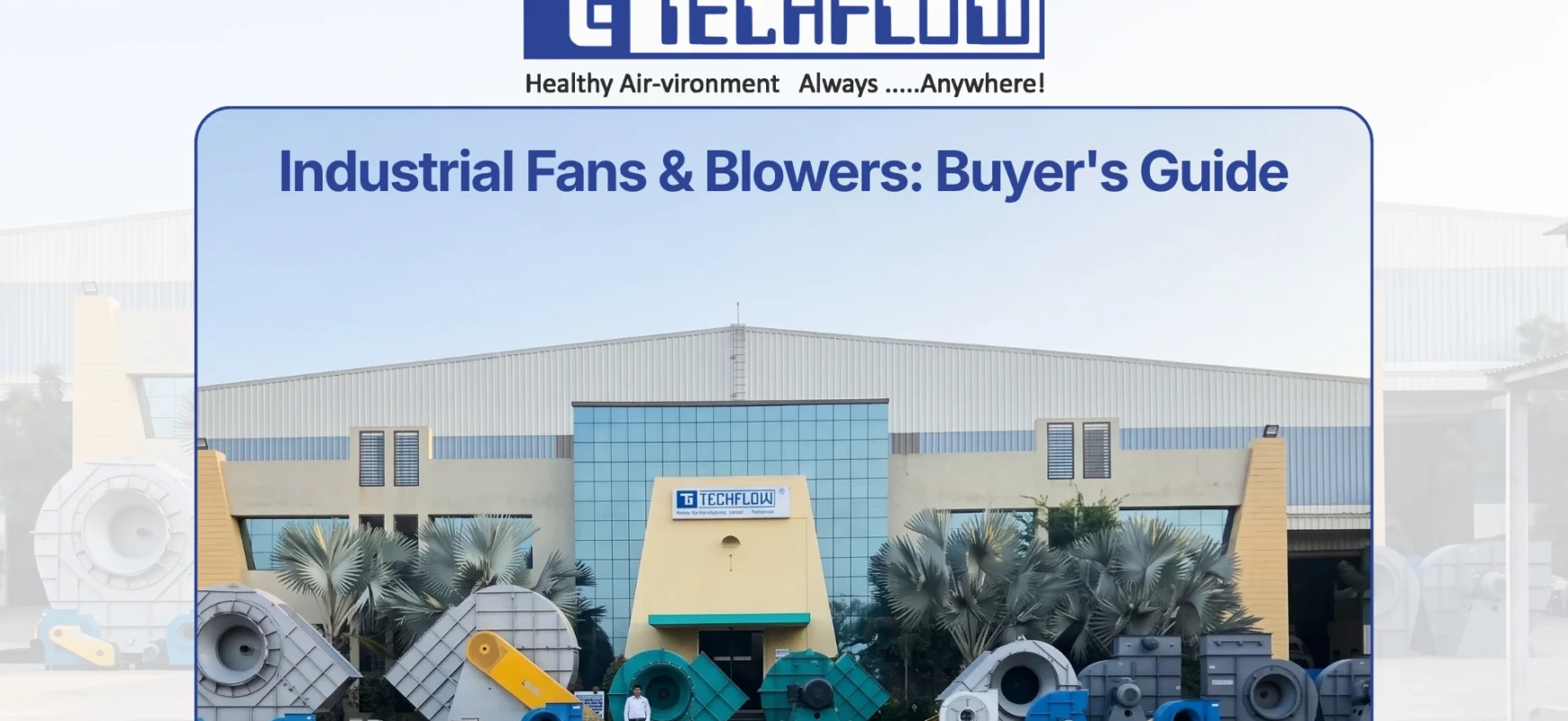
TECHFLOW has engineered air-movement and air pollution control equipment for Indian industry since 1979. From its Ahmedabad facility, the company designs and builds customised centrifugal blowers, Induced Draft (ID) fans, Forced Draft (FD) fans, dust collection systems, and furnace fume extraction systems for some of the most demanding operating conditions in the country.
The difference shows up where standard fans struggle. TECHFLOW engineers fans for high-temperature, high-abrasion, and corrosive duty, matching the impeller design, material, and bearing arrangement to the real temperature, pressure, gas chemistry, and dust load of each application. Every unit is built to perform against Indian engineering standards and backed by in-house quality control and balancing.
For a plant team, that means a fan that is correctly sized, built from the right material, and engineered to hold up under India's toughest industrial environments, not a catalogue compromise. If you are setting up a new line or upgrading legacy ventilation, dust-collection, or material-handling systems, TECHFLOW's engineering team can size the duty, recommend the right configuration, and run an efficiency assessment of your current setup.
Conclusion
Selecting an industrial fan or blower well is a balance of correct aerodynamics, the right material and motor, honest lifecycle costing, and compliance with Indian standards. The buyers who get it right start from airflow and static pressure, refuse to oversize, prioritise energy efficiency because that is where the cost lives, and partner with a manufacturer who can engineer for their exact conditions rather than sell a catalogue fit.
If you are specifying a new system or upgrading an existing one, talk to TECHFLOW's engineering team for accurate duty sizing, the right configuration for your environment, and an efficiency assessment that protects your plant's uptime and your operating budget.
Frequently Asked Questions (FAQs) :
A Forced Draft (FD) fan pushes fresh air into a system and handles cleaner, cooler air under positive pressure. An Induced Draft (ID) fan pulls hot, dust-laden flue gas out of a system, usually downstream of a filter or scrubber, and is built tougher to survive abrasion and heat. They commonly work as a pair to balance pressure across a combustion or pollution-control system.
It depends on system resistance. If you are moving large volumes of air through an open space or a cooling tower, use a fan. If you must force air through ducting, filters, or dust collectors, or convey material through a pipe, you need the higher pressure of a blower.
IE2 is the mandatory minimum efficiency class for line-operated three-phase induction motors sold in India, required under IS 12615:2018 since January 2018. IE3 and IE4 are higher classes that are not mandatory but are strongly recommended for fans that run continuously, because they pay back the price difference through lower electricity use.
An oversized fan costs more upfront, draws more power, and is usually throttled by a damper to bring airflow down, which wastes energy and pushes the fan away from its best efficiency point. That can cause aerodynamic stall, instability, and excess vibration that shortens bearing and shaft life. Correct sizing beats a comfort margin.
Because of the fan affinity laws, power demand falls roughly with the cube of speed, so reducing fan speed by 20% cuts power demand to about half. In practice, VFD retrofits on fan systems commonly reduce energy bills by 30 to 50%, with payback often inside two years for high-runtime fans.
Mild steel suits clean, general-purpose air. For corrosive gases, high moisture, and sanitary food or pharma duty, choose stainless steel. For aggressive chemical and acid fumes, FRP is the right call. For abrasive, dust-laden streams such as ID fans on dust collectors, use abrasion-resistant or lined steel.
Indian workplaces are held to a 90 dB(A) exposure limit over an 8-hour shift under the Model Factories Rules framed under the Factories Act, 1948. Plant boundary noise is regulated separately by CPCB norms, and you can control fan noise with low-turbulence designs, inline silencers, and acoustic insulation.
AMCA certification means the fan's airflow and sound performance have been tested and verified to internationally recognised methods (such as AMCA 210 for airflow and AMCA 300 for sound), rather than relying on the manufacturer's unverified claims. It gives buyers confidence that the published performance is real.
Dynamic balancing corrects the weight distribution of a spinning impeller so it runs without vibration. A quality manufacturer balances every impeller to a recognised grade, commonly G6.3 or G2.5 under ISO 1940, and supplies a balancing report. Poor balancing leads to vibration that damages bearings, shafts, and the housing.
Bearing lubrication follows the OEM's running-hours schedule, belt and drive inspection is best done monthly, and impeller cleaning and vibration checks should be scheduled around your production calendar. Critical process fans, such as boiler ID and FD fans, warrant condition monitoring and an on-site critical-spares inventory.
Watch for a sudden rise in vibration, abnormal noise or whistling, a drop in actual airflow or static pressure, overheating of the motor or bearing housing, and rising energy consumption or frequent breaker trips. Any of these means the fan needs inspection before it fails in service.
Centrifugal fans fall under IS 4894 (and the current IS 3141 specification), axial fans under IS 3588, and motor efficiency under IS 12615. AMCA covers internationally certified performance ratings, the Model Factories Rules cover workplace noise, and CPCB/SPCB norms cover emissions and boundary noise.