


Key Takeaways
- The cleaning mechanism is the core difference. Pulse jet fires short, high-pressure bursts of compressed air down through the bags to crack off the dust cake, while reverse air uses a slow, low-pressure backward airflow to gently collapse and clean the bags one compartment at a time.
- Pulse jet needs a smaller footprint. Because it runs at a much higher air-to-cloth ratio, a pulse jet collector needs far less filter area and floor space than a reverse air unit handling the same airflow.
- Reverse air is gentler on bags. Its low-stress cleaning cycle typically extends individual bag life, which matters where bag changeouts are difficult, or the exhaust is very hot.
- Reverse air needs no compressed-air system. It runs on a fan or blower and dampers alone, avoiding the compressors, blowpipes, venturis, and solenoid valves a pulse jet system depends on.
- Pulse jet dominates new installations. Most new cement, power and mineral processing plants specify pulse jet today for its continuous online filtration and compact footprint.
- Reverse air still fits legacy and extreme-heat plants. Older cement kilns, steel mills and coal-fired boilers often retain reverse air because it protects fragile woven fibreglass bags in sustained high-temperature service.
- In India, both must be engineered to meet a 30 mg/Nm³ particulate limit for cement kilns and new thermal power units set by the Central Pollution Control Board, alongside mandatory continuous emission monitoring.
- Total cost of ownership, not sticker price, should decide the winner. Weigh pulse jet's ongoing compressed-air energy cost against reverse air's larger footprint, higher steel content, and higher bag count over the plant's full life.
Every plant that burns, grinds, crushes, or dries something eventually faces the same question: how do we clean this air before it leaves the stack? For most heavy industries, the answer is a baghouse. But two baghouses handling identical airflow can clean themselves in completely different ways, and that single design choice shapes your footprint, your energy bill, your bag replacement schedule, and how steadily you hold your emission limit.
The two technologies competing for that decision are pulse jet and reverse air. Pulse jet cleans itself with short, forceful bursts of compressed air while the plant keeps running. Reverse air cleans slowly, one isolated compartment at a time, using nothing but a fan and a set of dampers. Neither is universally better. Each was engineered for a different combination of dust, heat, and plant economics, and picking the wrong one is an expensive mistake to discover after commissioning.
This guide breaks down exactly how each mechanism works, where each fits, and how to decide, using the same factors an engineer weighs when specifying a fabric filter.
What Is a Baghouse Dust Collector?
A baghouse, also called a fabric filter, is an air pollution control device that draws dust-laden gas through cloth filter bags, trapping particulate on the fabric while clean air passes through and exits the stack. It is the workhorse of industrial dust control, used across cement plants, power stations, steel mills, foundries, chemical units, pharmaceutical producers, and food manufacturers to keep stack emissions inside legal limits.
Why does a baghouse need to clean itself?
Every baghouse eventually reaches a point where the accumulated dust cake on the bags restricts airflow and raises the pressure drop across the system. At that point, it has to clean itself, or performance collapses. How a baghouse performs that self-cleaning is the single biggest factor an engineer weighs when specifying it, because it drives the size, the fabric, the energy source, and the maintenance load.
What are the main baghouse cleaning methods?
Three cleaning families exist in industry: shaker, reverse air, and pulse jet. Shaker designs are largely legacy technology now, so this comparison focuses on the two systems actively specified for new industrial projects. A useful way to picture the difference is to think of a baghouse as a lung. Air moves in, particulates are filtered out, and periodically the system has to exhale to clear what it has trapped. Pulse jet and reverse air are simply two breathing patterns built for the same job: one takes rapid, forceful breaths without ever pausing, the other takes slow, deliberate breaths one section at a time. Each was designed for a different set of lungs, and the rest of this guide walks through where each breathes best.
How Does a Pulse Jet Bag House Clean Itself?
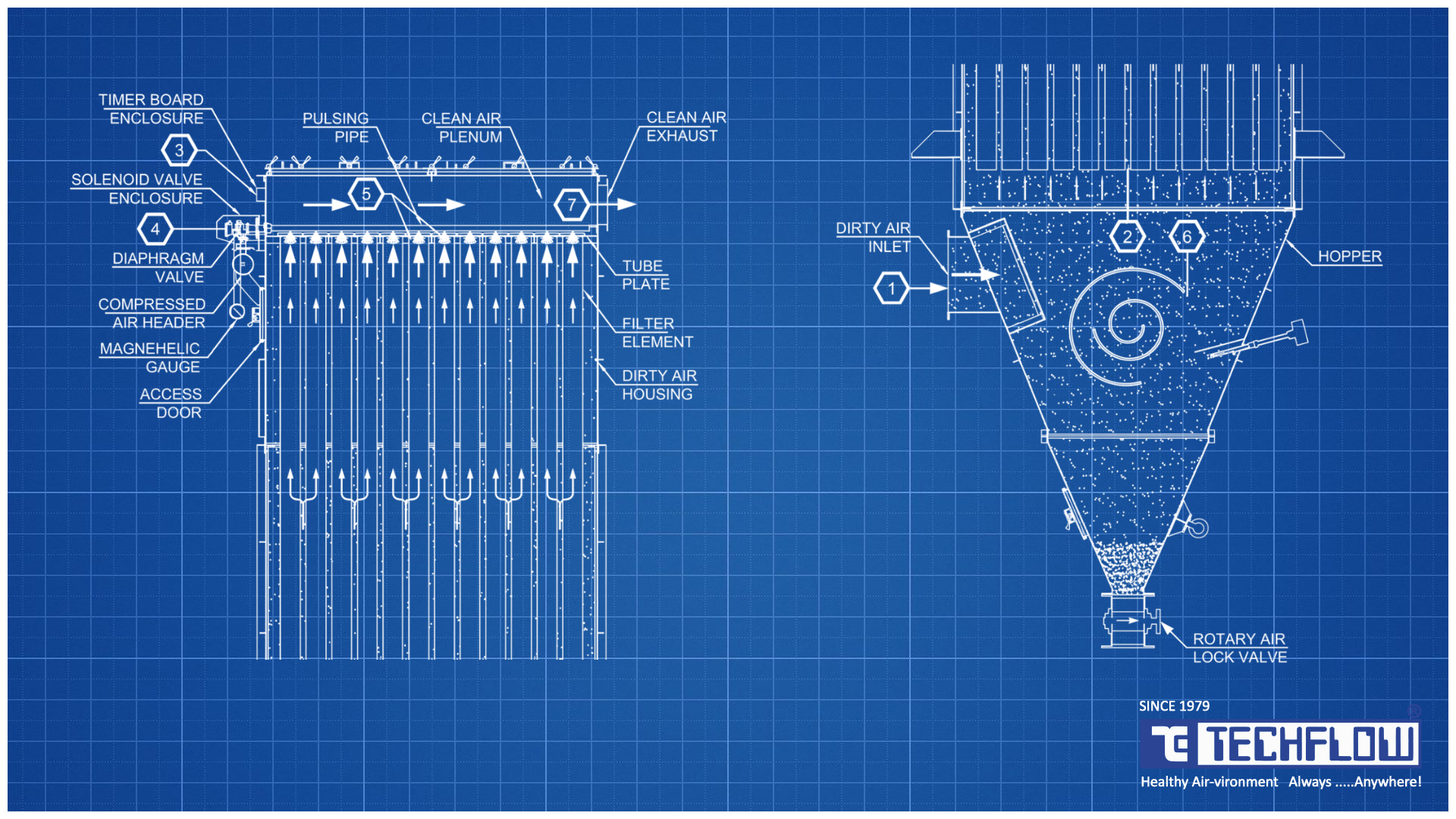
In a pulse jet system, dust-laden air enters the housing and passes from outside to inside the filter bags, so particulate builds up on the outer surface. Above each row of bags sits a blowpipe connected to a compressed air header. At preset intervals, or when the pressure drop crosses a set threshold, a solenoid valve fires a short, high-pressure burst of air, typically lasting around a tenth of a second, down into each bag.
What happens during the pulse?
That burst travels the length of the bag like a fast-moving pressure wave, flexing the fabric outward and cracking the dust cake loose. The dislodged dust falls into a hopper below while filtration continues uninterrupted in every other row. This is what makes pulse jet an online cleaning technology: there is no need to isolate a compartment or stop airflow, because the cleaning pulse is a tiny fraction of the total gas volume moving through the collector.
Why do pulse jet bags need cages and felted media?
A metal cage inside each bag stops it from collapsing during the pulse and holds its cylindrical shape between cleaning cycles. Because the cleaning action is aggressive and instantaneous, pulse jet bags are almost always made from non-woven, felted media built to withstand repeated flexing. TECHFLOW's own pulse jet dust collector guide covers this row-by-row, online-or-offline cleaning sequence in more detail.
How Does a Reverse Air Bag House Clean Itself?
A reverse air bag house takes the opposite approach: gentle, slow, and offline. The bag house is divided into several isolated compartments. During normal operation, dirty gas flows from inside to outside the bags, the reverse of the pulse jet direction, and dust collects on the inner surface.
What happens during a reverse air cleaning cycle?
When a compartment needs cleaning, dampers close it off from the main gas stream. A separate fan, or in some designs a low-pressure blower, then pushes clean air backwards through that compartment, from outside to inside the bags. This reverse flow slightly pressurises and partially collapses the bags, which cracks the dust cake so it falls into the hopper. A full compartment cycle usually runs about 30 to 60 seconds, considerably longer than a pulse jet's fraction-of-a-second burst. Rigid rings sewn into the bags at intervals stop them collapsing fully or chafing against each other during the cycle.
Why does reverse air use woven fibreglass?
Because cleaning happens compartment by compartment, the rest of the baghouse keeps filtering normally while each isolated section is briefly taken offline. This is fundamentally gentler than a compressed-air pulse. There is no shock and no flexing burst, just a soft backward breath. That gentleness is exactly why reverse air bags are usually made of woven fibreglass, a fabric that tolerates high heat very well but cannot survive the aggressive flexing of pulse jet cleaning.
What is a cassette or travelling-carriage variant?
A related variant worth knowing is the cassette or travelling-carriage type. TECHFLOW's reverse air cassette type filter uses horizontally arranged filter envelopes cleaned by a travelling blast nozzle fed from a centrifugal blower, which replaces the compressed-air system economically while keeping the reverse-cleaning principle.
Pulse Jet vs Reverse Air: Complete Comparison Table
The whole comparison comes down to the numbers engineers actually use when specifying a system.
| Comparison point | Pulse jet baghouse | Reverse air baghouse |
|---|---|---|
| Cleaning method | High-pressure compressed-air bursts through blowpipes | Low-pressure backward airflow through isolated compartments |
| Cleaning duration | Around a 0.1-second pulse per row | Roughly 30 to 60 seconds per compartment |
| Operating mode during cleaning | Online, continuous filtration, no shutdown | Offline, one compartment isolated at a time |
| Airflow direction (filtering) | Outside to inside the bag | Inside to outside the bag |
| Cleaning equipment required | Compressor, blowpipes, venturis, solenoid and diaphragm valves | Fan or blower and dampers only, no compressed air |
| Air-to-cloth ratio | Higher, commonly up to about 6:1, engineered systems to ~8 ft/min | Lower, commonly about 1 to 4 ft/min |
| Physical footprint | Compact | Larger, extra area needed to offset the offline compartment |
| Filter bag fabric | Felted, non-woven | Woven fibreglass |
| Mechanical stress on bags | High | Low |
| Individual bag life | Shorter, more frequent replacement | Longer, reduced fatigue extends service life |
| Total bag count | Fewer (higher velocity per bag) | More (lower velocity per bag) |
| Energy source | Compressed air, continuous compressor load | Fan or blower, steadier and generally lower draw |
| Cold-climate reliability | Weaker, compressed air prone to moisture and freezing | Stronger, no pneumatic parts to ice up |
| Peak collection efficiency | Up to about 99.9% with the right media | Comparable, capable of 99%+ with the right media |
| Emission consistency | High, thin uniform cake maintained continuously | Slight variability possible during compartment switchover |
| High-temperature suitability | Improving with advanced media | Traditionally the stronger choice |
| Capital cost | Generally lower | Generally higher |
| New-installation trend | Dominant choice for new plants | Rare in new builds, common in legacy retrofits |
The air-to-cloth ranges above are general design references, not fixed rules. Actual values depend on dust type, particle size, temperature and moisture, which is why they are always confirmed against the specific application rather than lifted from a catalogue. The rest of this guide unpacks the rows that most often decide the choice.
Air-to-Cloth Ratio and Footprint
The air-to-cloth ratio, also called filtration velocity, measures how much gas passes through each unit area of filter media per unit time. It is the single biggest driver of a baghouse's physical size, because a higher ratio means the same gas volume can be filtered through less cloth.
Why can pulse jet run at a higher ratio?
Pulse jet's aggressive online cleaning keeps the dust cake thin and manageable, which lets it run at higher velocities. The US Environmental Protection Agency notes that pulse jet designs reduce baghouse size and capital cost precisely because higher gas-to-cloth ratios need less fabric. Reverse air relies on a gentler cycle and woven fabric that cannot tolerate the same velocity, so it is held to a noticeably lower ratio, generally in the low single digits in feet per minute.
How does this change the footprint?
In practice, this means:
- A pulse jet collector sized for a given exhaust flow will almost always be physically smaller than a reverse air unit handling the same volume.
- A reverse air system needs extra filtration area to compensate for the compartment sitting offline during cleaning at any moment, which further increases the footprint.
- Plants with tight space, especially retrofits inside existing buildings, lean toward pulse jet almost by default.
TECHFLOW positions its pulse jet hose bag type filters around exactly these gains: higher air-to-cloth ratios, lower pressure drop, and lower floor-space requirement for large or hot airflows.
Filter Bag Material and Bag Life
Because the two systems clean so differently, they demand different fabrics, and those fabrics age at different rates.
Why do pulse jet bags wear out faster?
Pulse jet bags absorb thousands of high-force flexing cycles over their working life. That mechanical fatigue, combined with abrasion as the cake breaks loose, is the main reason pulse jet bags need replacing more often than reverse air bags.
Does longer bag life make reverse air cheaper overall?
Not automatically. A responsible total-cost view has to weigh three things together:
- Bag replacement frequency, which favours reverse air.
- The number of bags needed to reach the same filtration area, which favours pulse jet, since fewer higher-velocity bags are required.
- Labour per changeout, which can be higher for reverse air simply because there are more bags in the system, even if each one lasts longer.
Advances in high-temperature, abrasion-resistant media have also narrowed this gap. Some pulse jet installations now approach reverse air bag life even in demanding thermal service.
Energy Consumption and Compressed Air Demand
This is where the two systems diverge sharply in day-to-day operating cost.
Why is pulse jet more energy-hungry to clean?
Pulse jet cleaning depends entirely on compressed air, and generating compressed air is energy-intensive. Compressors have to run more or less continuously to keep header pressure available for the next pulse. Reverse air uses a single fan or blower to move air backwards through an isolated compartment, a comparatively modest and steady electrical load with no compressed-air system at all.
What about cold-climate reliability?
For plants in cold climates, the distinction matters twice over. Compressed-air systems are prone to moisture and freezing in low temperatures, while reverse air has no pneumatic valves or venturis that can ice up. In short, pulse jet trades higher ongoing compressed-air energy cost for a smaller footprint and continuous operation, while reverse air trades a larger footprint for lower, steadier energy draw. TECHFLOW's cassette-type reverse air filter is engineered specifically around this trade-off, using a centrifugal blower to replace compressed air and cut running costs.
Emission Performance and Regulatory Compliance
Both technologies can hit stringent particulate limits when properly engineered. Well-designed fabric filters achieve very high collection efficiencies, and membrane-enhanced media can capture extremely fine particles. The meaningful difference is not peak efficiency but consistency.
Which system holds emissions more steadily?
Because pulse jet cleans continuously and keeps the dust cake thin and uniform across all bags at all times, emission spikes are rare. Reverse air, cleaning one compartment at a time, can show brief variability as a section transitions between online and offline states, though a well-maintained system keeps this inside its compliance band.
What emission limits apply in India?
The Central Pollution Control Board has tightened particulate norms over the past decade, and the current limit for cement kilns and for newer thermal power units is 30 mg/Nm³, a level that leaves little margin for emission excursions. Alongside the limit itself, continuous emission monitoring systems are mandated for major categories such as cement, thermal power and integrated iron and steel, so a collector's steady baseline performance directly affects how many excursions that monitoring records. Internationally, the European Union's Industrial Emissions Directive sets even tighter benchmarks for cement, which is part of why plants chasing export-grade compliance scrutinise emission consistency so closely. Whichever technology a plant selects, it has to be engineered to hold the limit continuously, not just on a good day.
Temperature Tolerance and High-Heat Applications
Reverse air has a long-standing reputation as the safer choice for extreme heat, and it is earned.
Why has reverse air owned the high-heat niche?
Woven fibreglass bags, cleaned gently, withstand the thermal cycling and stiffening of high-temperature exhaust from kilns, smelters and furnaces far more reliably than the felted media traditionally used in pulse jet systems. Its gentle cleaning cycle protects those fragile high-temperature bags from mechanical failure.
Is that gap closing?
Yes. Advanced high-temperature media, including PTFE-treated fabrics and speciality fibreglass laminates, now let many facilities run pulse jet systems successfully in service that once demanded reverse air. The right media choice is application-specific, so gas temperature, moisture and chemistry all need confirming before committing either way.
Best-Fit Industries for Each Technology
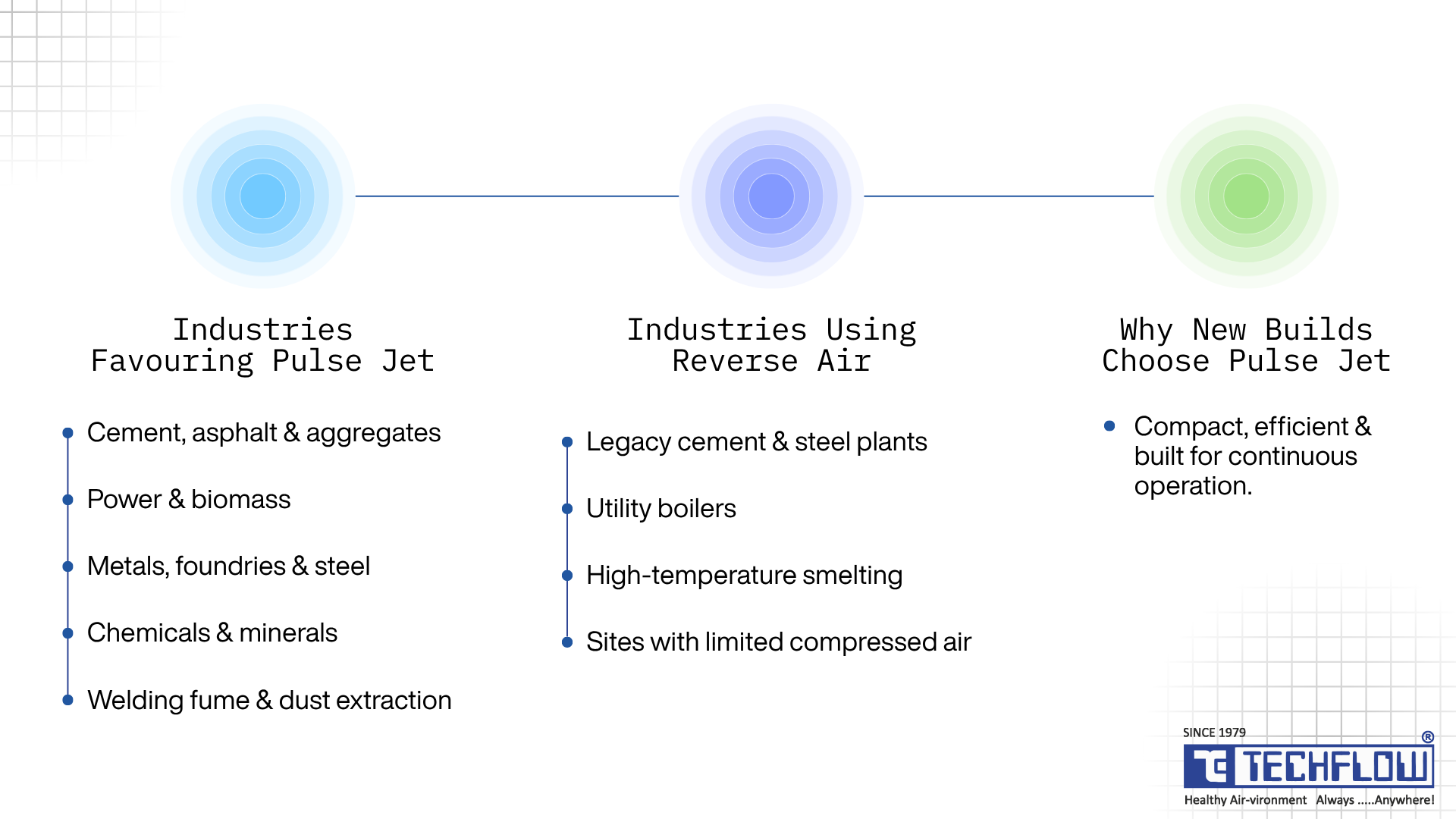
Rather than one system being universally better, each tends to dominate in specific contexts set by dust load, heat and space.
Which industries typically favour pulse jet?
- Cement grinding and clinker cooling
- Asphalt mixing plants and aggregate dryers
- Coal-fired power generation and biomass boilers
- Metals processing, foundries and steel melting
- Chemical processing and mineral handling
- Welding fume and grinding dust extraction
Which industries still rely on reverse air?
- Legacy cement kilns and older steel plants with existing reverse air infrastructure
- Utility coal-fired boilers with established fibreglass bag systems
- Smelting operations handling very high-temperature, abrasive dust
- Sites where compressed air is limited or costly to provide
Why do new builds overwhelmingly pick pulse jet?
New-build projects favour pulse jet largely for the space and continuous-operation advantages above, and the reasons are process-specific. Cement grinding mills and clinker coolers generate a fine, continuous dust load that would overwhelm a reverse air compartment's offline cycle without an oversized footprint, exactly the scenario pulse jet was built for. Foundries and steel melting shops face intermittent high-temperature bursts of fume during pouring and tapping, which favour pulse jet's ability to respond immediately without waiting for a compartment to cycle offline. Utility boilers and legacy smelters, by contrast, often run a steady, predictable gas stream at sustained high temperature, where reverse air's gentle cycle and fibreglass media have decades of proven reliability, and the case for tearing out working infrastructure is genuinely weak.
TECHFLOW builds bag filters for cement, steel, foundry, mining, power and chemical processing, and its overview of types of bag filters and applications sets out where pulse jet, reverse air and cartridge systems each fit within the wider dust-control landscape.
Maintenance Demands Compared
Maintenance load follows directly from mechanical complexity.
Where does maintenance effort go in each system?
Pulse jet maintenance centres on solenoid valve inspection and replacement, compressed-air system upkeep including dryers, filters and moisture traps, blowpipe and venturi alignment, and bag and cage replacement on a more frequent cycle. Reverse air maintenance centres on damper seal inspection, since air leaks sharply reduce cleaning effectiveness, fan and motor upkeep, compartment isolation valve checks, and less frequent but more voluminous bag replacement.
How does predictive monitoring differ?
Pulse jet operators usually track pressure drop across the bag house in real time and use it to trigger cleaning automatically, which doubles as an early warning for failing bags, clogged blowpipes or a struggling compressor. Reverse air operators monitor pressure drop per compartment and lean more on scheduled inspection of damper seals, because a leaking damper can quietly reduce cleaning effectiveness for weeks before a pressure trend makes the problem obvious. Either system paired with a basic SCADA or programmable logic controller monitoring layer catches degrading performance far earlier than one relying on manual gauge checks.
Environmental and Sustainability Considerations
Dust collection equipment is bought to protect air quality, but the equipment itself carries an environmental footprint worth acknowledging.
What is the carbon footprint of a baghouse?
A peer-reviewed lifecycle analysis published in Heliyon estimated that manufacturing and operating baghouse dust collectors worldwide could add more than 70 million tonnes of CO2 by 2030 on top of 2021 levels if current trends hold. That reframes the cleaning-technology choice as partly a sustainability question, not only an operating-cost one.
How do the two systems compare on embodied and operating emissions?
Pulse jet's compressed-air dependency ties its carbon footprint closely to how the plant generates electricity for its compressors, so a cleaner grid or efficient, well-maintained compressors narrows the gap considerably. Reverse air's footprint is weighted more toward manufacturing, since a larger structure, more filtration cloth and more steel all carry embodied energy. A plant chasing sustainability targets should therefore look at both operating-phase and manufacturing-phase emissions rather than assuming one system is automatically greener. Notably, the same study found that consolidating several small collectors into one larger unit can cut manufacturing-stage energy substantially.
Common Mistakes When Specifying a Baghouse
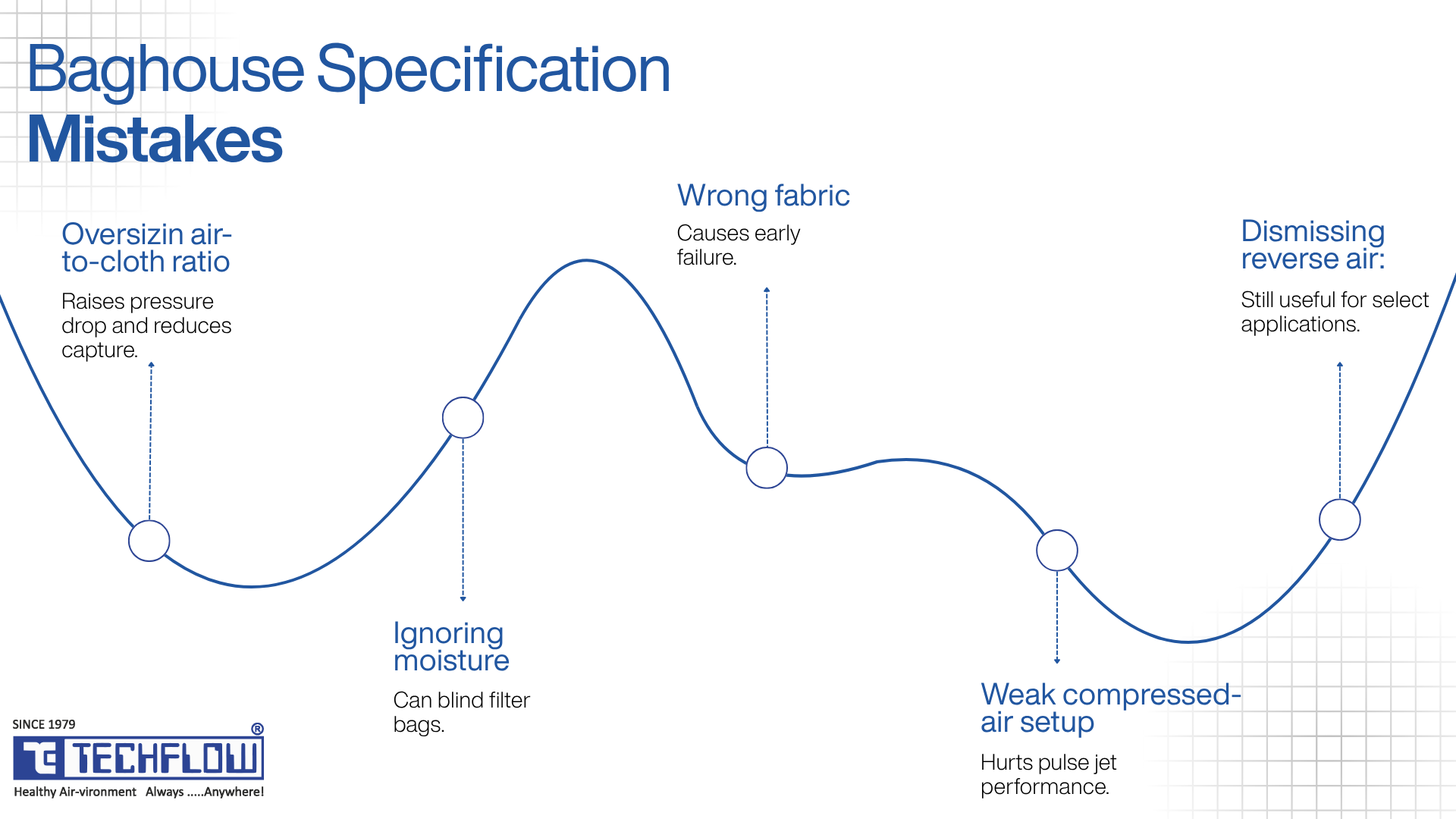
Even experienced plant engineers misjudge baghouse specifications, and the most common errors trace back to the cleaning mechanism.
- Oversizing the air-to-cloth ratio: Pushing either system past its safe filtration velocity leads to high pressure drop, incomplete cleaning and poor capture at the pickup point, problems that compound rather than resolve themselves.
- Ignoring moisture and stickiness in the dust: Sticky or hygroscopic dust can blind either fabric quickly, though it tends to be more forgiving in a well-cleaned pulse jet system where cake build-up is continuously managed.
- Choosing fabric on cost alone: A felted bag in a reverse air system, or a stiff woven fibreglass bag in a pulse jet, will underperform and fail early because the fabric was never designed for that cleaning force.
- Underestimating compressed-air infrastructure for pulse jet: Some plants specify a pulse jet collector without budgeting for the compressor capacity, air dryers and moisture traps needed to run it reliably.
- Assuming reverse air is obsolete: It is rare in new builds, but it remains the technically correct choice in specific high-heat, low-compressed-air scenarios.
Getting the specification right the first time avoids retrofits, warranty disputes and unplanned production losses, which is why working with a manufacturer that engineers to the process rather than to a catalogue part number matters more here than for almost any other piece of plant equipment.
Retrofitting and Conversion Considerations
Plants running an ageing reverse air system sometimes ask whether it makes sense to convert to pulse jet rather than replace the unit. The honest answer is that it depends on what already exists on site.
What does a reverse air to pulse jet conversion involve?
Converting a reverse air bag house to pulse jet is not a simple bag swap. The internal architecture changes: bag orientation reverses, cages must be added to prevent collapse under the pulse, and a compressed-air header, blowpipes and solenoid valve network have to be installed where none existed. For plants with the structural steel and space to support this, conversion can unlock the footprint and energy advantages of pulse jet without a full rebuild. For plants without that flexibility, particularly older facilities built to their exact isolation-compartment footprint, replacement is often more economical than conversion once engineering and downtime are added up.
Is there a lower-risk middle path?
Yes. A partial upgrade keeps the existing reverse air shell and compartments while improving damper sealing, upgrading to more efficient fibreglass media, or adding better monitoring instrumentation. This rarely delivers the footprint gains of a true pulse jet conversion, but it can meaningfully improve emission consistency and cut maintenance costs at a fraction of the capital. Before committing either way, plants should have airflow, dust loading and temperature data reverified against current process conditions, since many reverse air systems installed decades ago now run outside the envelope they were designed for, which skews any convert-versus-replace calculation if left unchecked.
Capital Cost vs Total Cost of Ownership
A lower price on day one does not always mean the lowest cost over a twenty-year plant life.
What should a total cost of ownership model include?
A responsible model combines capital cost, energy consumption, maintenance labour, bag replacement frequency and any production value lost to offline cleaning cycles. Pulse jet systems generally carry a lower initial capital cost thanks to their compact footprint and simpler structural steel, with no multi-compartment isolation network, but their lifetime compressed-air draw and more frequent bag changes add to operating expense. Reverse air systems often cost more upfront because of the larger structure and higher bag count, yet can claw that back over time through lower energy use and longer bag life.
So which is actually cheaper?
There is no single answer. The right one depends on local energy prices, labour rates, dust characteristics and how much floor space is actually available, which is exactly why total-cost modelling rather than brochure comparison should guide the final decision.
From Spec Sheet to Shop Floor: How TECHFLOW Applies This Comparison
Everything above is the engineering comparison: air-to-cloth ratios, bag fabrics, energy draw, emission consistency. Turning that into a working system on a plant floor means matching it against real airflow, dust loading, particle size, gas temperature, moisture, explosion risk and available space. Get one of those wrong and a plant ends up with excess energy cost, unplanned downtime or a compliance failure that could have been designed out.
TECHFLOW Enterprises Pvt. Ltd. engineers air pollution control systems out of Ahmedabad, Gujarat, and manufactures both pulse jet and reverse-air-cleaned bag filter systems, along with cartridge filters, centrifugal fans and blowers, and pneumatic conveying systems, for cement, steel, foundry, mining, power and chemical processing plants in India and export markets. Because it builds both technologies rather than promoting a single design, the recommendation a plant receives is based on its actual process conditions rather than a fixed product line.
For deeper reading, TECHFLOW's breakdown of the pulse jet dust collector covers the online cleaning cycle in detail, its types of bag filters guide maps where each technology fits, and its cartridge type dust collection system page covers the third major fabric-filter family for finer, free-floating dust.
Conclusion
Neither pulse jet nor reverse air is objectively better. They answer different questions. If your priority is a compact footprint, continuous operation and the ability to hold a strict, steady emission limit, pulse jet is almost always the right call, which is why the large majority of new industrial installations choose it.
If your plant already runs on reverse air infrastructure, deals with sustained extreme heat, or needs to avoid the operating cost of a compressed-air system, reverse air remains proven and reliable rather than a relic.
The decision comes down to matching the cleaning mechanism to the dust, the heat and the economics of your specific process, and that match is best made with an engineering partner who builds both systems and has no reason to default to one.
Frequently Asked Questions (FAQs)
The core difference is how each cleans its filter bags. Pulse jet uses short, high-pressure bursts of compressed air to dislodge dust while the system keeps running. Reverse air uses a slow, low-pressure backward airflow to clean one isolated compartment at a time while the rest of the system keeps filtering.
Pulse jet needs a smaller footprint. It runs at a higher air-to-cloth ratio, so it needs less filter area to handle the same gas volume, and it does not lose capacity to an offline compartment during cleaning the way reverse air does.
Reverse air generally gives longer individual bag life because its gentle, low-stress cleaning causes less mechanical fatigue than the aggressive flexing of pulse jet cleaning. Pulse jet systems use fewer total bags, though, which partly offsets the shorter life of each one.
Yes, with the right filter media. Reverse air has traditionally been preferred for extreme heat because it cleans fragile fibreglass bags gently, but advanced high-temperature media such as PTFE-treated fabrics now let many pulse jet systems run successfully in high-heat service once reserved for reverse air.
New plants favour pulse jet mainly for its compact footprint, continuous online cleaning with no production interruption, and ability to hold strict, consistent emission limits under automated controls, all of which matter more in space-constrained, high-throughput modern facilities.
No. Reverse air uses a fan or blower to generate the backward cleaning airflow, so it avoids the compressors, blowpipes and diaphragm valves a pulse jet system depends on. That is a key reason it suits sites where compressed air is limited or costly.
Reverse air generally has lower and steadier energy consumption, since it relies on a single fan rather than the continuously running compressors needed to keep header pressure available for pulse jet cleaning.
Reverse air is usually more reliable in cold climates because it has no compressed-air components prone to moisture and freezing, unlike the pneumatic valves and venturis used in pulse jet systems.
As a general reference, pulse jet systems are often designed up to about a 6:1 air-to-cloth ratio, with some engineered systems reaching roughly 8 ft/min, while reverse air systems are usually kept far lower, around 1 to 4 ft/min, because woven fabric and gentle cleaning cannot tolerate higher filtration velocity. Actual values depend on dust type, temperature and moisture and should be confirmed for the specific application.
A pulse jet fires a burst of about a tenth of a second per row and never stops filtering, whereas a reverse air compartment typically takes about 30 to 60 seconds and is briefly taken offline during that cycle. That difference is why pulse jet is called an online system and reverse air an offline one.
For cement kilns and newer thermal power units, the Central Pollution Control Board sets a particulate limit of 30 mg/Nm³, and major categories must run continuous emission monitoring. Both pulse jet and reverse air can be engineered to meet it, but the collector must hold the limit continuously, which favours steady, well-monitored operation.
Often, yes. Where compressed air is limited, production demand is moderate, or the larger reverse air footprint is not a constraint, the existing shell can frequently be maintained, retrofitted with better sealing and media, or optimised rather than replaced outright. A full pulse jet conversion is more involved, since it changes the internal architecture and adds a compressed-air network.


