


Key Takeaways
- A bag filter for powder coating must be sized around five parameters at once: air-to-cloth ratio, filter media, pulse-jet cleaning, pressure drop, and combustible dust safety.
- Powder coating dust is fine, light, charged, and combustible, so a dust collector spec written for cement or wood dust does not transfer to it safely.
- Air-to-cloth ratio is the master sizing decision. Set it wrong and every other parameter spends its life compensating for that mistake.
- Filter media choice is also a safety decision. Antistatic media removes static discharge as an ignition source inside a housing full of combustible dust.
- Pulse-jet cleaning governs filter life. Over-cleaning fatigues bags and under-cleaning chokes airflow, so the best systems clean on measured pressure drop.
- Pressure drop is the single gauge of filter health. Drifting up or down outside its normal band is usually the first sign of trouble.
- In India, CPCB's 150 mg/Nm³ general particulate limit is the compliance floor every paint booth exhaust must hold, not just pass at commissioning.
Quick Answer: A bag filter built for powder coating paint booth filtration has to be specified around five parameters together. It needs an air-to-cloth ratio suited to fine, light powder dust, sitting toward the lower end of the pulse-jet range. It needs filter media that captures particles in roughly the 20 to 45 micron band without an excessive pressure penalty.
It needs a pulse-jet cleaning cycle tuned to shed the dust cake without over-stressing the bags. It needs a pressure drop held inside a defined operating band. And it needs full compliance with combustible dust safety standards, because powder coating overspray is a combustible particulate. Get those five right as a system, rather than as five separate checkboxes, and the filter runs for years instead of clogging, under-recovering powder, or turning into a hazard.
Why Powder Coating Exhaust Needs Purpose-Built Filtration
Every powder coating booth has to manage one stubborn fact: not every particle sprayed at a workpiece lands on it. The overspray that misses the part, or bounces off it, goes airborne inside the booth, and that air has to go somewhere.
Left unfiltered, it does one of two things. It drifts into the workshop as a breathable hazard, or it vents to the atmosphere as a compliance breach. The filtration system between the booth and clean air is not an accessory bolted on at the end. It is the component that decides whether the whole operation is efficient, compliant, and safe.
What sets this apart from ordinary industrial dust collection is the material itself. Powder coating dust is fine, light, and combustible because most powders are epoxy, polyester, or hybrid resin systems. A bag filter designed for cement dust or wood shavings will not perform correctly if it is simply repurposed here, and it may not perform safely. Every parameter in this guide exists because powder coating dust has specific physical and chemical properties that the filter has to be designed around from the start, not adapted to after commissioning.
What Powder Coating Dust Is, and Why It Filters Differently
Powder coating formulations are engineered to spray in a fine range. Both filtration design guidance and equipment literature point to roughly 20 to 45 microns as typical for dry powder overspray. That is fine enough to slip through a loosely woven fabric as though it were not there, which is exactly why media selection carries so much weight here.
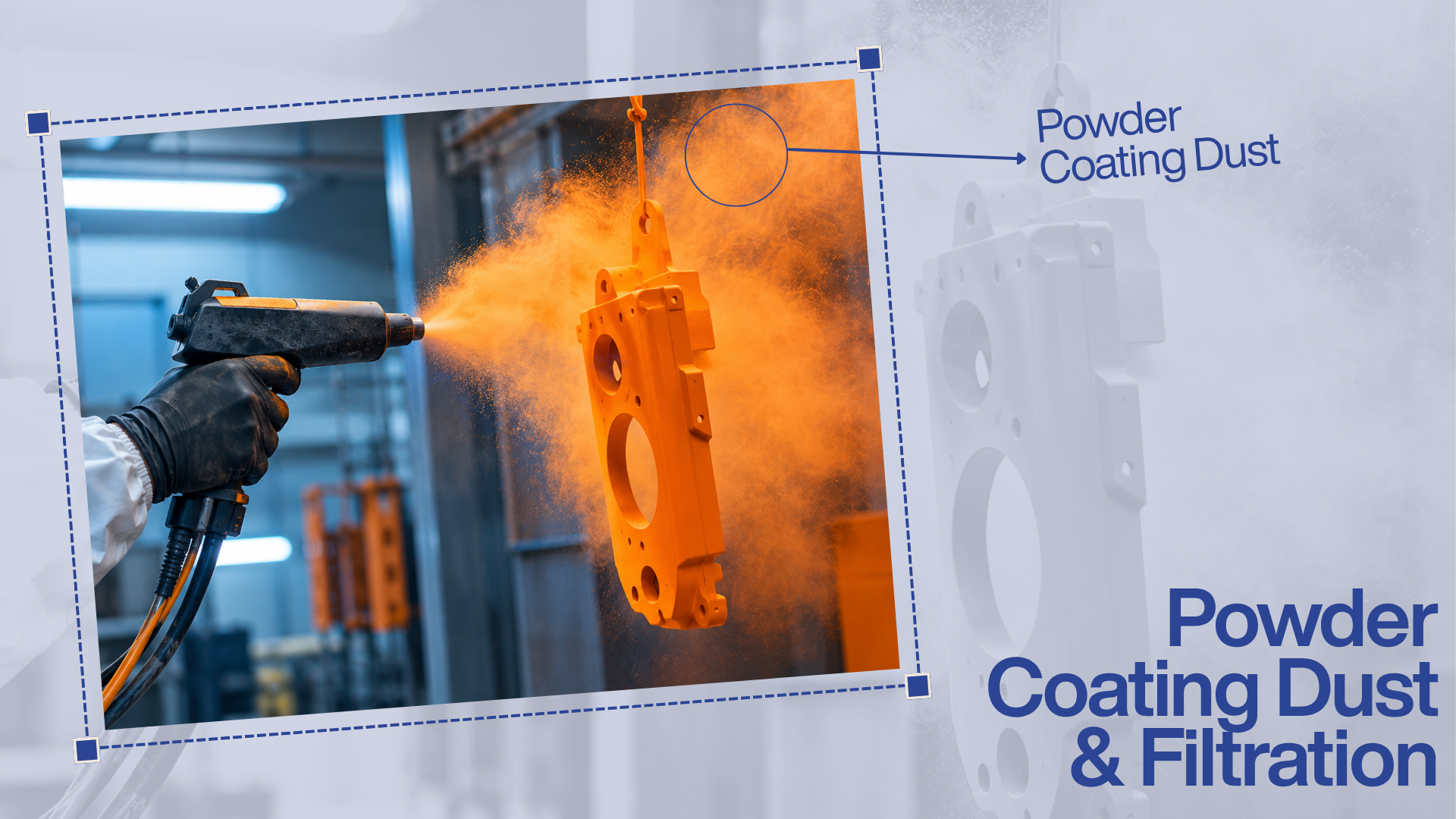
One caveat is worth stating plainly. This range reflects commonly cited equipment-design figures, not a single fixed industry standard. Actual particle-size distribution varies by powder formulation and manufacturer, and where precise sizing matters, it should be confirmed against the specific powder in use.
That particle band sits in an awkward middle zone. It is too fine for coarse mesh to capture reliably, but not so fine that it behaves like a true nanoparticle needing HEPA-grade media. The practical result: paint booth filters need media engineered for this exact band. Oversize it "for safety," and pressure drop and cost climb needlessly. Undersize it and fines pass through, powder-recovery efficiency drops, and material cost per coated part rises.
Three further properties shape the design beyond particle size:
- Low bulk density: The powder is light and stays airborne longer than heavier industrial dusts, which lengthens its residence time inside the filter housing.
- Combustibility: Most powder resins are organic and combustible when suspended at sufficient concentration, a factor that governs safety design far more than it would for inert mineral dust.
- Retained electrostatic charge: Because powder coating relies on electrostatic spray in the first place, overspray often carries residual charge, which changes how it behaves inside the housing and how it interacts with the media.
Air-to-Cloth Ratio: The Most Important Sizing Number
If one number decides whether a powder coating bag filter performs well for years or poorly from week one, it is the air-to-cloth ratio.
What Air-to-Cloth Ratio Actually Measures
The air-to-cloth (A/C) ratio, also called air-to-media ratio or filtration velocity, is the relationship between the airflow entering the housing and the total surface area of media available to process it. It is usually expressed as cubic feet of air per minute per square foot of media (ft/min), and filtration engineering literature treats it as the most common single design criterion for fabric filters.
Set it too high and air is forced through the media faster than the dust cake can properly form and release during cleaning. Pressure drops, fines are driven deeper into the fabric, and bag life and capture efficiency fall together. Set it too low, and you have bought an oversized, needlessly expensive housing for the airflow you are actually moving.
Recommended Air-to-Cloth Ranges for Powder Coating
Different cleaning mechanisms support different A/C ranges. Seeing where pulse-jet systems, which are near-universal for powder coating, sit against the alternatives helps set realistic expectations:
| Cleaning Mechanism | Typical A/C Ratio Range |
|---|---|
| Reverse-air collectors | 1:1 to 4:1 |
| Mechanical shaker collectors | 2:1 to 6:1 |
| Pulse-jet baghouses | 2:1 to 10:1 |
For powder coating specifically, given the fine particle size and light bulk density, designers usually target the lower-to-middle portion of the pulse-jet range rather than pushing toward the ceiling. That trades a little housing compactness for lower pressure drop and longer media life.
One detail is easy to overlook. The airflow between and immediately below the filter elements needs its own attention. If this interstitial velocity runs too high, it can re-entrain dislodged powder before it settles into the hopper, effectively cancelling the cleaning pulse that just fired.
Filter Media Selection: Matching Fabric to Powder Chemistry
Once airflow and A/C ratio are set, media selection determines how effectively that airflow is actually cleaned, and how long the system runs before maintenance.
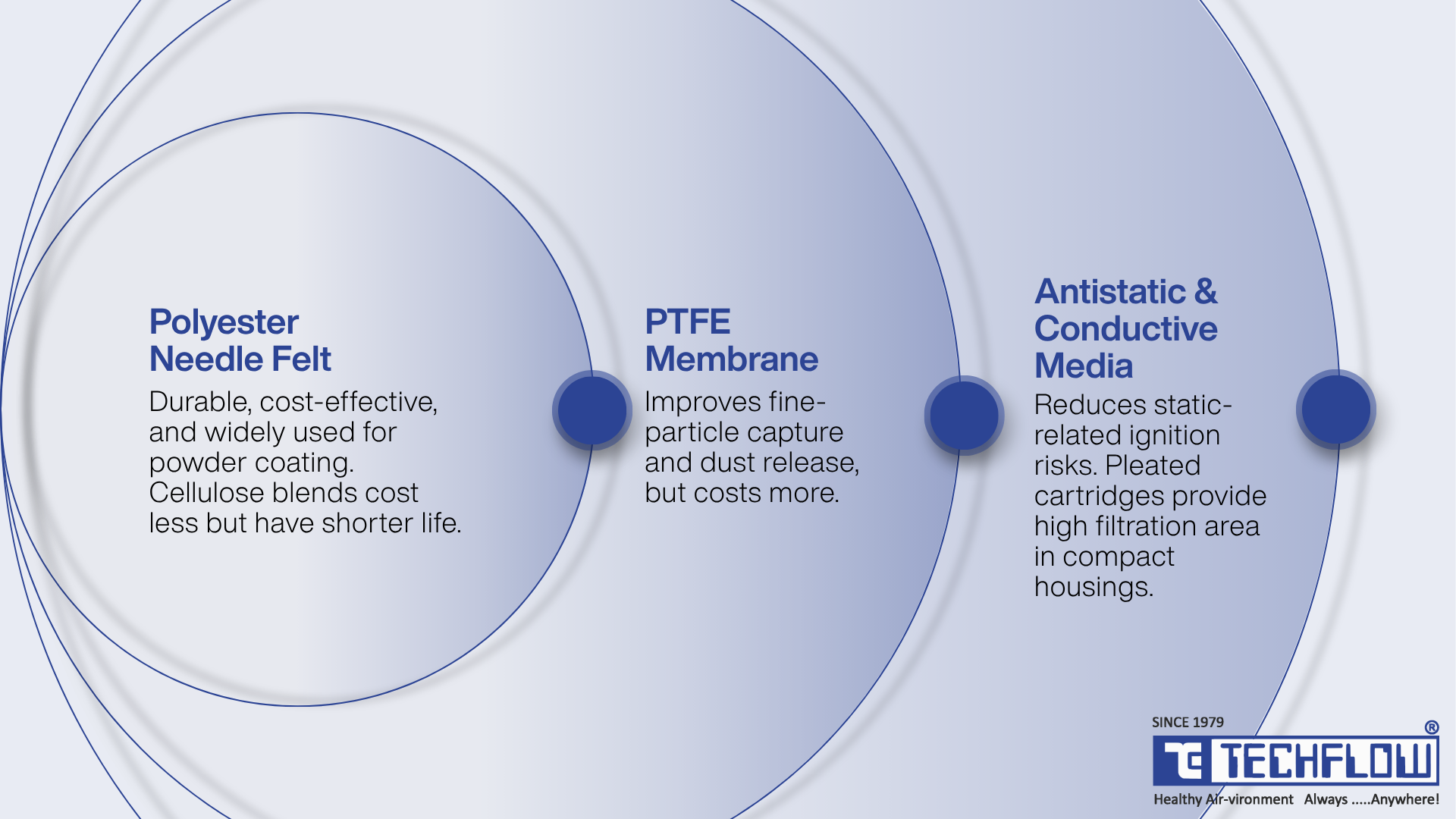
Polyester Needle Felt
Spun polyester is the most widely used media for powder coating filtration, a meaningful step up from basic cellulose at moderate cost.
Cellulose-based cartridges, essentially paper often blended with polyester in ratios from 80/20 up to a heavy-duty 60/40, remain the cheapest option. They generally deliver shorter service life and weaker dust release during cleaning than pure spun polyester.
PTFE Membrane
Where an application demands higher capture efficiency and better cake release, a PTFE membrane laminated onto a polyester needle-felt substrate forms a continuous, extremely fine surface layer.
It stops even small particles from penetrating into the underlying fabric. That improves efficiency and cleanability at the same time, because the dust cake sits on the membrane surface rather than embedding in the fibres, which makes it far easier to pulse off. The trade-off is cost.
Antistatic and Conductive Media
Given the combustible, charged nature of powder coating dust, antistatic or conductive media crosses from pure performance into safety. Static discharge inside a housing loaded with combustible dust is a recognised ignition source, which is why conductive-thread or carbon-impregnated media is standard practice for this application rather than an optional upgrade.
Housing geometry and cartridge dimensions matter here too. A common configuration referenced in filtration literature is cylindrical, generally 24 to 48 inches long, built around a wire or expanded-metal support with pleated media to maximise surface area in a compact footprint. Booths run anywhere from 2 to 24 cartridges depending on size and required airflow. Actual dimensions vary by manufacturer and booth design, so treat this as a general pattern rather than a fixed spec. TECHFLOW's pulse-jet cartridge and bag filters use this pleated, compact-footprint construction to pack maximum filter area into a small housing.
Filtration Efficiency and Micron Rating
With powder particles commonly cited in the 20 to 45 micron range, media pore size has to sit well below that threshold to capture meaningfully. Filtration trade literature for powder booth applications typically references a 2 to 6 micron media pore size as common practice, fine enough to capture the great majority of overspray while still passing adequate airflow.
This is a genuine trade-off, not a free upgrade. Finer pores generally mean higher initial pressure drop and potentially faster loading. That is exactly why A/C ratio, media type, and pore size have to be specified together as a system rather than optimised one at a time. A filter with an excellent micron rating but a mismatched A/C ratio still underperforms.
Pulse-Jet Cleaning: Pressure, Duration, and Cycle
The cleaning mechanism is what keeps a bag filter running continuously instead of clogging within hours. In a pulse-jet system, short bursts of compressed air fire backwards through the filter element at timed intervals, dislodging the accumulated dust cake which drops into the hopper below. TECHFLOW's explainer on how pulse-jet bag filter systems work walks through the same mechanism in a related industrial context.
Pulse-jet parameters documented for comparable filtration systems fall within well-established bands. Pulse duration sits on the order of 0.1 seconds, fired at pressures typically between 50 and 90 psi. The cycle now frequently pulses across the full bank of filters, governed by a solid-state timer, with interval and duration adjustable to balance compressed-air consumption against cleaning effectiveness.
Getting that balance right matters more than it first appears:
- Over-aggressive cleaning (too frequent, too much pressure) mechanically stresses the media with every pulse, which accelerates fatigue and shortens life while wasting compressed air.
- Under-aggressive cleaning lets the cake build up between cycles, which results in a pressure drop and reduces effective airflow through the booth.
TECHFLOW's Executive Director, Chintan Parikh, has pointed to exactly these two failure signals as the practical warning signs operators should watch: a persistently high pressure drop, which signals a clogged filter struggling to breathe, and visible dust emissions, which signal leaks or ineffective cleaning. Rather than firing on a fixed timer alone, well-designed systems tie the cycle to measured pressure drop. Cleaning triggers when the differential crosses a set threshold, so the system responds to actual filter loading rather than an arbitrary clock.
Pressure Drop: The One Number Worth Watching
If a maintenance engineer could watch only one number on a bag filter, it would be pressure drop. It is the differential air pressure measured across the media, or how much resistance the media presents to airflow at any moment, and it works as a real-time health readout for the whole system.
A clean filter has a baseline pressure drop. As dust accumulates between cleaning cycles, that number rises. After a successful pulse-jet cycle, it should fall back toward baseline.
A pressure drop steadily over weeks or months without returning to baseline after cleaning signals that the media is loading faster than the cycle can manage. That is often the first visible symptom of an A/C ratio that is too aggressive, a poorly tuned cleaning schedule, or media near the end of its service life.
The reverse is just as telling. A pressure drop that runs consistently lower than expected can indicate torn or damaged media, letting air and dust bypass filtration entirely. It is an easy failure to miss without active monitoring, because airflow may feel normal or even improved even as capture efficiency collapses.
Online vs. Offline Cleaning: Which Configuration to Choose
Bag filters for powder coating generally run in one of two cleaning modes, and the choice affects both continuous operation and achievable emission levels.
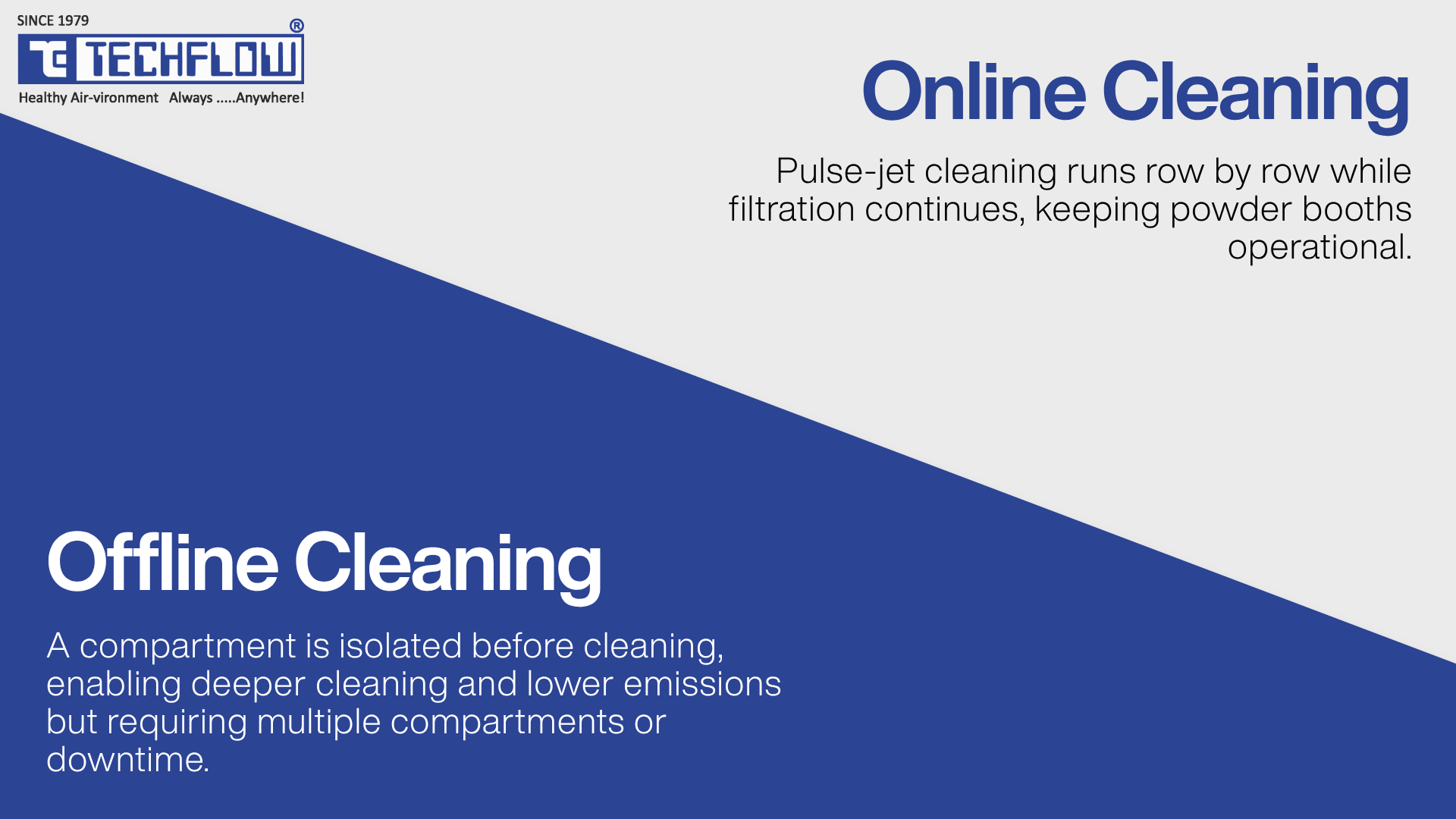
- Online cleaning fires pulse-jet air through individual rows of bags in sequence while the rest of the banks keep filtering. It is a brief, localised interruption on one row at a time rather than a full shutdown. This is the more common configuration for powder booths, because it allows continuous production with no pause for cleaning.
- Offline cleaning uses isolation dampers to close off an entire compartment from the main airflow before its bags are cleaned. That allows a more thorough clean of every bag in that section before it returns to service. It generally achieves lower overall emissions, but it requires either multiple compartments (so production continues on the rest) or accepting periodic downtime. That trade-off makes it more common on larger installations, or where emission-compliance margins are tighter.
How to Calculate CFM for Your Paint Booth
Filter sizing only makes sense in the context of the booth it serves. The exhaust airflow, measured in CFM or cubic metres per hour, has to be enough to hold adequate face velocity across the booth opening. That pulls overspray away from the operator and workpiece without being so aggressive that it destabilises the electrostatic spray pattern or wastes energy moving more air than needed.
Bag filter and cartridge systems for powder coating are commercially available across a very wide capacity range, from roughly 1,000 to 100,000 cubic metres per hour. That range reflects the reality that a small batch booth and a large conveyorised line have fundamentally different airflow needs. Sizing correctly means starting from the booth's required exhaust airflow and working backwards to the filter area needed to hit the target A/C ratio at that flow, not selecting a filter first and hoping the airflow matches.
Combustible Dust Safety: A First-Order Design Constraint
This is the parameter most often underweighted in filtration discussions that fixate on capture efficiency and cost. From a risk standpoint, it is arguably the most important.
Powder coating resins are combustible particulate solids. When suspended at sufficient concentration, they present a genuine flash-fire or explosion hazard. NFPA 652, the Standard on the Fundamentals of Combustible Dust, defines combustible dust as a finely divided combustible particulate solid that presents a flash-fire or explosion hazard when suspended in air over a range of concentrations. Dust collectors handling such material fall squarely within that framework.
NFPA 654 specifically addresses fire and dust-explosion prevention in the manufacturing, processing, and handling of combustible particulate solids. It requires facilities to implement defined protection methods, such as deflagration venting, deflagration pressure containment, deflagration suppression, or dilution with a non-combustible dust to render the mixture non-combustible. NFPA guidance also calls for explosion isolation devices on clean-air exhaust lines from dust collectors unless the clean air is directed outdoors to a safe location away from people.
For a powder coating operation, that translates into three practical requirements:
- Explosion venting or suppression on the collector housing.
- Conductive or antistatic media to remove static discharge as an ignition source.
- Explosion isolation on ductwork connecting the collector to the rest of the facility.
The takeaway for anyone specifying a bag filter for powder coating: efficiency and pressure-drop calculations are necessary but not sufficient. Combustible dust safety has to be evaluated as a first-order design constraint, not layered on once filtration performance is finalised. Because these standards are periodically revised, facilities should always confirm current applicable requirements with a qualified safety engineer. The U.S. Occupational Safety and Health Administration's guidance on combustible dusts is a useful starting reference for the underlying hazard.
How Bag and Cartridge Dimensions Drive Filter-Area Calculation
Total available filter area, the sum of the surface area of every bag or cartridge in the housing, is what the A/C ratio calculation ultimately rests on. For cylindrical pulse-jet elements, filter area is based on the surface area of the cylinder's side, since filtration happens on the exterior surface as dust-laden air passes from outside the bag inward, not on the capped circular top and bottom.
Two related calculations matter for a properly sized system:
- Gross A/C ratio assumes every bag in the housing is in service simultaneously.
- Net A/C ratio accounts for the reduced filter area when one compartment is offline for cleaning (relevant to offline-cleaning configurations). It is the more conservative, realistic figure to design against for those systems.
Bag spacing inside the housing also affects performance, because it sets the interstitial velocity, the upward air velocity between adjacent bags. As noted earlier, that velocity has to stay low enough for dislodged dust to fall into the hopper rather than being immediately re-entrained.
CPCB Emission Norms and What They Mean for Filter Selection
For facilities operating in India, filtration design is not only a performance and safety question. It is a direct regulatory obligation. The Central Pollution Control Board's general emission standard for particulate matter, set out under the Environment (Protection) Rules, 1986, caps concentration-based particulate emissions at 150 mg/Nm³ for most industries. Any powder coating exhaust system, filtration stage included, has to be designed to hold that limit consistently, not just on the day of commissioning.
That has a direct bearing on the media and cleaning decisions above. A system running comfortably inside the margin on day one can drift upward in outlet emissions over months if media degrades, the cleaning cycle is not maintained, or the A/C ratio was marginal to begin with.
The practical response is to treat the CPCB limit not as a one-time commissioning target but as an ongoing operating parameter, verified periodically through stack monitoring. A system technically capable of meeting the limit on a test day can still fall out of compliance under real operating conditions if the underlying design margins were too thin.
Common Design Mistakes That Undermine Paint Booth Filtration
A handful of recurring specification errors account for most underperforming installations:
- Sizing the A/C ratio at the top of the range to shrink the housing footprint, without accounting for the fine particle size and light bulk density specific to powder coating dust.
- Selecting media on cost alone, defaulting to basic cellulose blends where the finer capture and better cake release of polyester or PTFE membrane would meaningfully extend service intervals.
- Treating pulse-jet cleaning as a fixed-timer setting rather than tying it to measured pressure drop, which leads to either premature media wear or inadequate cleaning.
- Deferring combustible dust safety until after the core filtration is specified, instead of designing explosion protection and antistatic media in from the start.
- Undersizing filter area relative to actual booth airflow, usually discovered only after installation when pressure drop runs high, and throughput suffers.
- Skipping ongoing stack verification, assuming a system that passed commissioning will hold CPCB limits indefinitely without monitoring.
Maintenance Parameters That Extend Filter Life
Beyond initial design, several ongoing practices determine how long a well-specified system actually performs as intended:
- Regular pressure-drop logging. Tracking baseline and post-cleaning pressure drop over time reveals gradual media degradation long before it becomes a visible operational problem.
- Compressed-air quality. Moisture or oil in the compressed-air supply used for pulsing can saturate media and accelerate clogging.
- Hopper discharge inspection. A hopper that is not discharging properly lets material bridge and back up into the housing, effectively cutting available filter area.
- Antistatic media continuity checks. For combustible dust applications, periodically verifying that conductive media is properly grounded is a safety-critical item, not just a performance one.
- Performance-based replacement. Scheduling bag or cartridge changes on measured performance trends rather than a fixed calendar interval, since actual life varies with operating hours, dust loading, and cleaning tuning.
How TECHFLOW Engineers Bag Filters for Powder Coating
Everything in this guide points to the same conclusion: a powder coating filter succeeds or fails as a system, not as a spec sheet. That is the discipline TECHFLOW has built its work around.
The company was founded in Ahmedabad, Gujarat in 1979 by technocrat D. K. Parikh and has operated as Techflow Enterprises Pvt. Ltd. since 2008. Two credentials matter most for this application:
- Its quality system is certified to ISO 9001:2015 by TÜV SÜD.
- Its application engineering draws on an in-house database of 127 distinct forms of dust, the kind of reference base that separates a filter sized for a specific powder from one sized off a generic assumption.
How the five parameters translate into design choices
The parameters this guide treats as central are the same ones TECHFLOW engineers work against when specifying a powder coating system:
| Design parameter | How it is handled |
|---|---|
| Air-to-cloth ratio | Sized toward the lower-to-middle pulse-jet range for fine, light powder dust |
| Filter media | Antistatic and PTFE-membrane options matched to the powder chemistry and ignition risk |
| Cleaning mode | Online or offline pulse-jet configurations matched to a line's continuous-operation needs |
| Capacity | Systems built across a 1,000 to 100,000 m³/hr range, from batch booths to conveyorised lines |
| Compliance | Designed to hold the CPCB 150 mg/Nm³ limit as an ongoing operating parameter |
Field experience behind the design
The design thinking is grounded in what actually goes wrong in service. Executive Director Chintan Parikh has written directly on the maintenance side of this equation, identifying rising pressure drop and visible dust emissions as the two clearest signs a bag filter system needs troubleshooting, the same two operating parameters this guide treats as central to filtration health.
Go deeper
TECHFLOW's technical library covers adjacent ground worth exploring:
- Its explainer on how pulse-jet bag filter systems work covers the same air-to-cloth and pressure-drop fundamentals in a related application.
- Its bag filter for the boiler line shows how the same pulse-jet cleaning technology adapts to a different dust and temperature profile.
- Its full range of air pollution control systems spans dust collection, fume extraction, and centrifugal blowers built on the same engineering discipline applied throughout this guide.
Conclusion
A bag filter for powder coating is not a single component that either works or does not. It is a set of interlocking parameters, each of which either compensates for or undermines the others.
An excellent media choice paired with a poorly tuned cleaning cycle still fails early. A well-sized A/C ratio paired with inadequate combustible dust protection still creates a serious hazard, however efficiently it captures dust. Getting powder coating paint booth filtration right means treating airflow sizing, media selection, cleaning parameters, pressure-drop monitoring, and safety compliance as one design decision made together, not five separate boxes ticked in isolation.
The facilities that get the most from their filtration investment are rarely the ones that bought the most expensive media or the largest housing. They are the ones whose entire system was sized, specified, and maintained as a coherent whole from the start.
Ready to Specify a Bag Filter for Your Powder Coating Line?
Size it as a system, with air-to-cloth ratio, media, cleaning cycle, combustible dust protection, and CPCB compliance designed together rather than one at a time. TECHFLOW has engineered pulse-jet bag filter and dust collection systems for Indian and global industry since 1979, across a 1,000 to 100,000 m³/hr capacity range, in both online and offline cleaning configurations.
Talk to a TECHFLOW filtration engineer about your booth airflow, powder chemistry, and emission targets, and get a filtration package built to hold performance and compliance for the long run.
Frequently Asked Questions (FAQs)
Pulse-jet baghouses, the standard cleaning mechanism for powder coating filtration, generally operate within an air-to-cloth ratio of 2:1 to 10:1. Given the fine particle size and light bulk density of powder coating dust, designers typically target the lower-to-middle portion of this range rather than the upper limit, to keep pressure drop manageable and extend media life.
Dry powder coating particles are commonly cited in the 20 to 45 micron range in equipment design literature, though actual distribution varies by formulation. Media for this application is generally specified with a pore size in the 2 to 6 micron range, to capture the majority of overspray while maintaining adequate airflow.
Yes, under the right conditions. Most powder coating resins are combustible particulate solids, and when suspended in air at sufficient concentration, they present a genuine flash-fire or explosion hazard as defined under NFPA 652. That is why filtration systems for powder coating need to comply with combustible dust standards like NFPA 654, not just general dust-collection best practice.
Online cleaning fires pulse-jet air through individual rows of bags in sequence while the rest of the bank keeps operating, which allows continuous production. Offline cleaning isolates an entire compartment from airflow before cleaning it thoroughly, generally achieving lower emissions but requiring either multiple compartments or some downtime.
Media selection also affects safety and service life. Antistatic or conductive media is standard practice for powder coating specifically because the combustible, electrostatically charged dust makes static discharge a recognised ignition risk inside the housing, a consideration separate from and just as important as raw capture performance.
Rising pressure drop that does not return to baseline after cleaning typically means the media is loading faster than the cycle can manage, often from an air-to-cloth ratio that is too aggressive, a poorly tuned schedule, or media near end of life. TECHFLOW's own troubleshooting guidance identifies persistent high pressure drop as one of the clearest signs a filter needs attention, alongside visible dust emissions.
Commercially available pulse-jet bag filter systems for powder coating span roughly 1,000 to 100,000 cubic metres per hour, reflecting the difference in exhaust airflow between small batch booths and large conveyorised production lines.
The Central Pollution Control Board's general emission standard caps concentration-based particulate matter at 150 mg/Nm³ for most industries under the Environment (Protection) Rules, 1986. This should be treated as an ongoing operating parameter verified through periodic stack monitoring, not just a one-time commissioning target.
A PTFE membrane laminated onto polyester needle felt creates a continuous, very fine surface layer that stops particles from penetrating into the underlying fabric. This improves both filtration efficiency and cake release at the same time, since dust sits on the membrane rather than embedding in the fibres, though it typically costs more than standard polyester.
For cylindrical pulse-jet elements, filter area is based on the surface area of the cylinder's side, since filtration happens on the exterior surface as air passes inward, not on the capped top and bottom. The total filter area across all elements is what the air-to-cloth ratio calculation depends on, making bag and cartridge dimensions and quantity a direct input into correct sizing.


