


Key Takeaways
- An ESP removes fine dust from flue gas using an electric charge rather than a physical filter medium, so gas flows through almost unobstructed.
- A well-designed multi-field ESP routinely captures more than 99% of particulate, including sub-10-micron (PM10) dust, with design efficiencies quoted up to 99.9%.
- ESPs have among the lowest pressure drops of any dust collector, on the order of 25 mmWC, so your induced-draft (ID) fan draws far less power than it would with a bag filter.
- The four stages: Ionisation → particle charging → collection on grounded plates → rapping the dust into hoppers.
- Dry vs wet: Dry ESPs rap the plates and drop dry ash into hoppers; wet ESPs flush the plates with liquid and suit sticky, tarry, or acid-mist streams.
- Indian limits differ for power plants, industrial boilers, and Delhi-NCR; you design the ESP around your applicable limit, not a generic number.
- Adding electrical fields lets one ESP move from basic knockdown to sub-50 mg/Nm³ performance.
If you run a boiler, kiln, or furnace on coal, biomass, or rice husk, you already know the real cost of flue gas. It isn't just the ash on the roof or the haze over the plant. It's the consent condition on your file, the stack monitor feeding data to the pollution control board, and the very real possibility of a closure notice if your numbers drift out of range.
An electrostatic precipitator (ESP) is one of the few technologies that solves that problem at industrial scale without punishing your energy bill. It's the workhorse behind clean stacks at power stations, cement kilns, steel plants, and thousands of solid-fuel boilers.
This guide explains what an ESP is, how it actually works stage by stage, the difference between dry and wet units, how it compares to bag filters and scrubbers, and where it earns its place in Indian industry. It's written for the people who have to specify, buy, or operate one.
What Is an Electrostatic Precipitator?
Quick answer: An electrostatic precipitator (ESP) is an industrial air-pollution-control device that removes fine particulate matter from a flue-gas stream using electrostatic force. It charges the dust particles with a high-voltage corona, then attracts them onto grounded collection plates. Well-engineered ESPs achieve over 99% particulate removal at a very low pressure drop of roughly 25 mmWC, one of the lowest of any dust-collection technology.
The important idea is that an ESP doesn't strain the gas through anything. A bag filter forces flue gas through cloth. A scrubber drives it through water. An ESP lets the gas flow more or less straight through a set of parallel steel plates, and uses physics, not a barrier, to pull the dust sideways out of the stream.
That single design difference is the source of almost every advantage an ESP has: low resistance to flow, tolerance of high gas temperatures, and the ability to swallow enormous gas volumes without choking.
How Does an ESP Work? The Four-Stage Working Principle
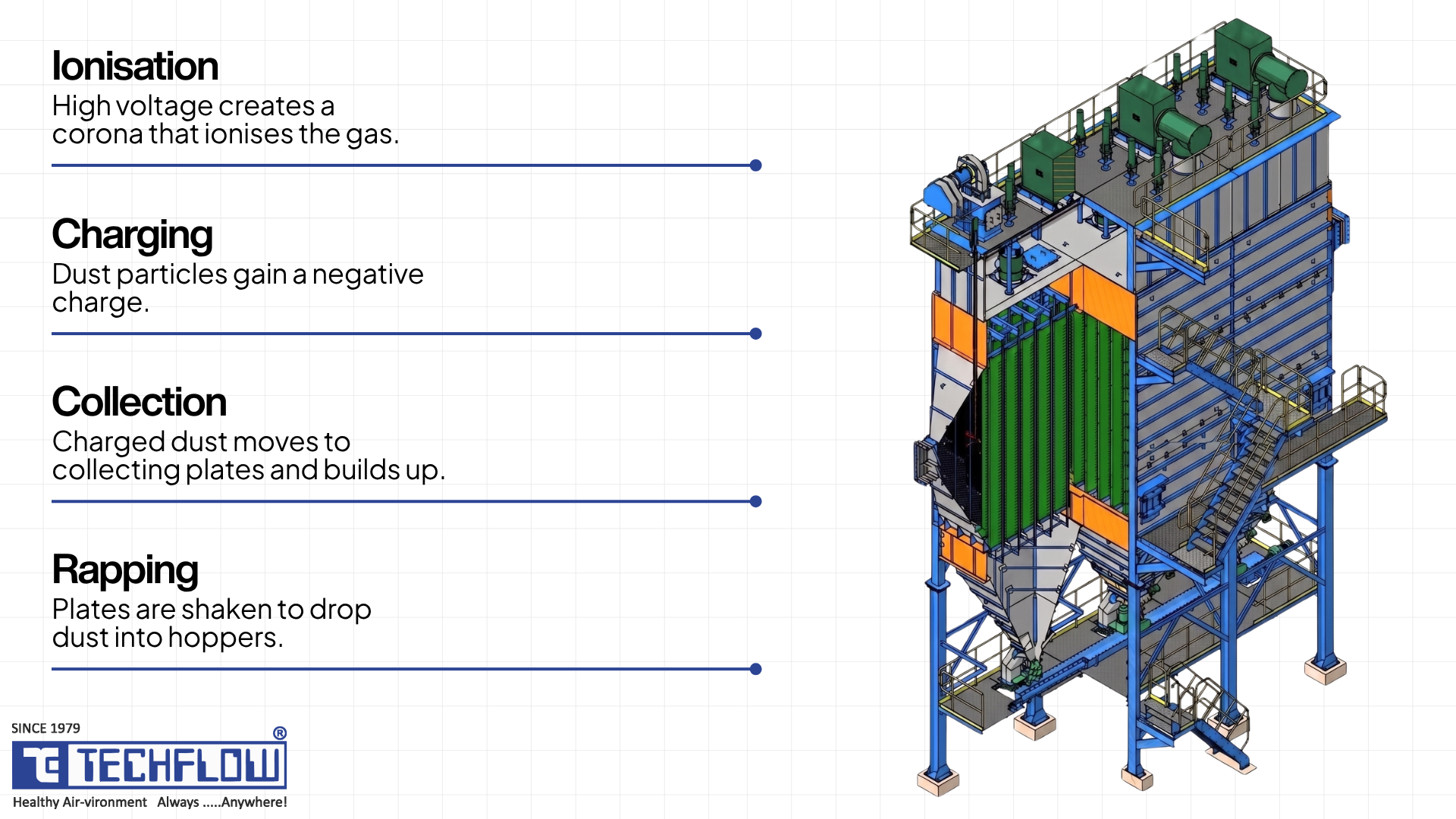
The whole process is a controlled, continuous chain reaction inside a steel casing. Here's what happens to a dust particle from the moment it enters.
| Stage | What happens | The physics |
|---|---|---|
| Ionisation | High-voltage discharge electrodes create a corona around themselves, releasing a cloud of free electrons and ionising the surrounding gas. | A strong, non-uniform electric field forms between the discharge electrodes and the plates. |
| Charging | Dust particles passing through the corona pick up those ions and take on a strong negative charge. | Charged particles now feel a sideways force pushing them toward the plates. |
| Collection | The charged dust drifts across the gas flow and lands on the grounded (positive) collecting plates, where it loses its charge and builds into a dust cake. | Migration velocity: the speed at which particles cross to the plate; governs how much gets caught. |
| Rapping | Timed rappers strike the plates; the caked dust breaks free and falls by gravity into hoppers below. | Mechanical shock dislodges the layer without re-entraining it into the gas. |
The engineering that makes it work
The four stages sound simple. Making them hold better than 99% efficiency, hour after hour, on fuel that changes every truckload- that's the engineering.
Migration velocity is the heart of ESP sizing: Designers use the Deutsch-Anderson relationship, which ties collection efficiency to the collecting-plate area, the gas flow rate, and the particle migration velocity. In plain terms: the slower and dirtier your gas, and the more plate area you provide, the cleaner the exit. This is why you can't shrink an ESP without paying for it in emissions; the plate area is the machine.
Corona without arcing: Discharge electrodes are spaced to build the strongest possible field just below the point where it sparks over. Push the voltage too high, and you get destructive arcing; too low and charging suffers. Modern controllers ride this line automatically.
Rapping timing is a balancing act: Rap too often and the dust cake never builds thick enough; fine dust gets swept back into the gas (re-entrainment). Rap too rarely and the cake insulates the plate, weakening the field and killing efficiency. Good systems tune rapping frequency per field, because the inlet field collects far more dust than the polishing fields downstream.
Gas distribution decides everything upstream: If gas rushes through unevenly, some passages see high velocity and blow dust straight out. Perforated distribution screens spread the flow to a uniform, gentle velocity across the whole cross-section; this is exactly what CFD (computational fluid dynamics) modelling is used to get right before a single plate is cut.
The Anatomy of an ESP: Core Components
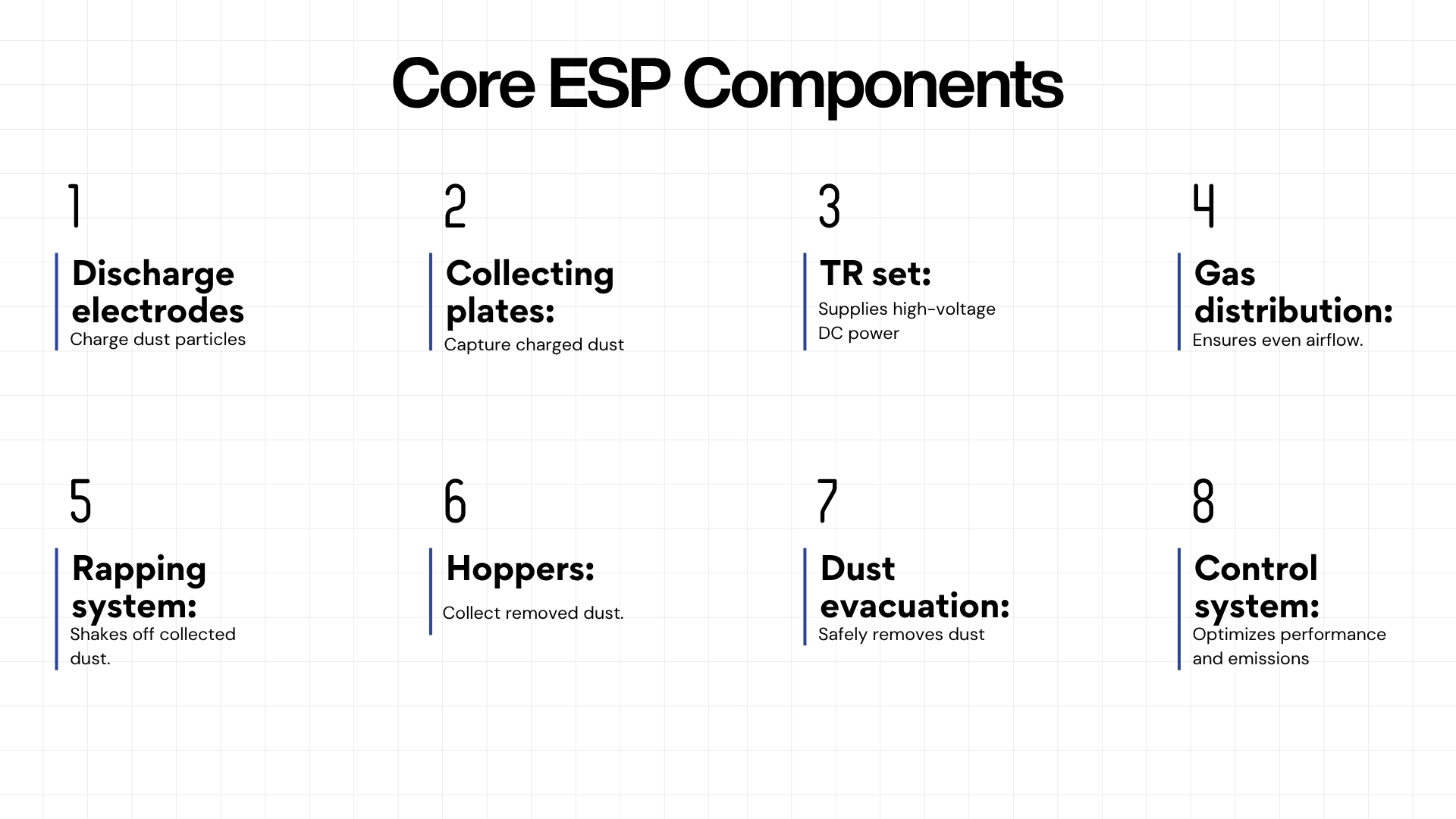
An ESP is a system of parts that all have to work together. The main ones:
- Discharge electrodes: the high-voltage emitting electrodes suspended down the centre of each gas passage. They generate the corona that charges the dust.
- Collecting plates (collecting electrodes): large grounded steel plates forming the passages the gas flows through. This is where the dust lands and the cake forms.
- Transformer-rectifier (TR) sets the power supply. It converts incoming AC into the high-voltage DC the discharge electrodes need, and holds the field steady as conditions change.
- Gas distribution system: perforated screens at the inlet (and usually the outlet) that even out the flow to a uniform treatment velocity, typically in the region of 0.4–1.2 m/s depending on the design.
- Rapping system: mechanical or electromagnetic devices that strike the plates and electrodes at set intervals to shed the dust cake. Common types include tumbling-hammer rappers and electromagnetic gravity-impact (MIGI) rappers.
- Hoppers: pyramid-shaped chambers under the fields that collect the dislodged dust before it's evacuated.
- Dust evacuation: airtight screw conveyors or dense-phase pneumatic conveying pull the ash away without letting air leak back into the unit.
- Control system (ESP management/automation): the brain. It monitors and adjusts field voltages and rapping cycles in real time against the actual dust load and stack reading, keeping emissions in spec while trimming energy use.
Dry ESP vs Wet ESP: The Two Main Types
Every ESP charges and collects dust the same way. They split into two families based on how the plates are cleaned, and that choice is dictated almost entirely by the nature of your dust.
Dry ESP
The dust cake is knocked off dry by rapping and falls as free-flowing ash into the hoppers. Dry ESPs suit hot process gases that stay comfortably above their dew point, so moisture never turns the ash into a paste on the plates. This is the standard configuration for coal, biomass, and rice-husk-fired boilers and thermic fluid heaters, and it's where multi-field designs shine.
Wet ESP
Instead of hammers, a wet ESP washes the plates with a continuous or periodic liquid film that carries the captured material away as a slurry. Wet units are the answer when the particulate is sticky, tarry, oily, or when the stream carries acid mist material that would smear rather than shed if you tried to rap it. In practice, wet ESPs are the tool for specialised streams such as tar and acid mist from coke-oven gas and producer gas in steel plants, and from copper, aluminium, and zinc smelters. They're typically cylindrical, single-field units, and their headline advantage is that they sidestep the dust-resistivity problems that challenge dry systems entirely.
Side-by-side
| Feature | Dry ESP | Wet ESP |
|---|---|---|
| Cleaning method | Mechanical rapping | Liquid (usually water) flushing |
| Discharge | Dry ash | Slurry/sludge |
| Best for | Free-flowing, dry particulate | Sticky, tarry, oily, or acid-mist streams |
| Operating temperature | High, above the gas dew point | Lower, saturated gas |
| Resistivity issues | Needs managing by design | Largely avoided |
| Typical use | Boilers, thermic fluid heaters, kilns | Coke-oven gas, producer gas, smelter gas cleaning |
ESP vs Bag Filter vs Cyclone
Plant managers usually weigh an ESP against three alternatives. The trade-off that matters most in day-to-day operation is pressure drop, because that's what your ID fan pays for every hour of every year. The figures below are typical orders of magnitude; actual values depend on design, load, and dust.
| Electrostatic Precipitator | Bag (Fabric) Filter | Multicyclone | |
|---|---|---|---|
| Collection efficiency | Up to ~99.9%, strong on sub-10 µm | Up to ~99.9%, strong on fine dust | Lower; coarse dust only |
| Typical pressure drop | ~25 mmWC (lowest) | ~150 mmWC (highest) | ~40 mmWC |
| Operating cost | Low | Higher (routine bag changes) | Low |
| Waste output | Dry ash, easy to convey | Dry dust | Dry dust |
| Temperature tolerance | Very high | Limited by fabric | High |
A practical read on this table:
Bag filters can match an ESP on efficiency and often beat it on cost when the target emission is very low and the gas volume modest, which is why the choice is rarely automatic. Where the ESP pulls decisively ahead is on large gas volumes, high temperatures, and volatile fuel the exact conditions that shred fabric bags and inflate fan power.
Why Industries Choose ESPs
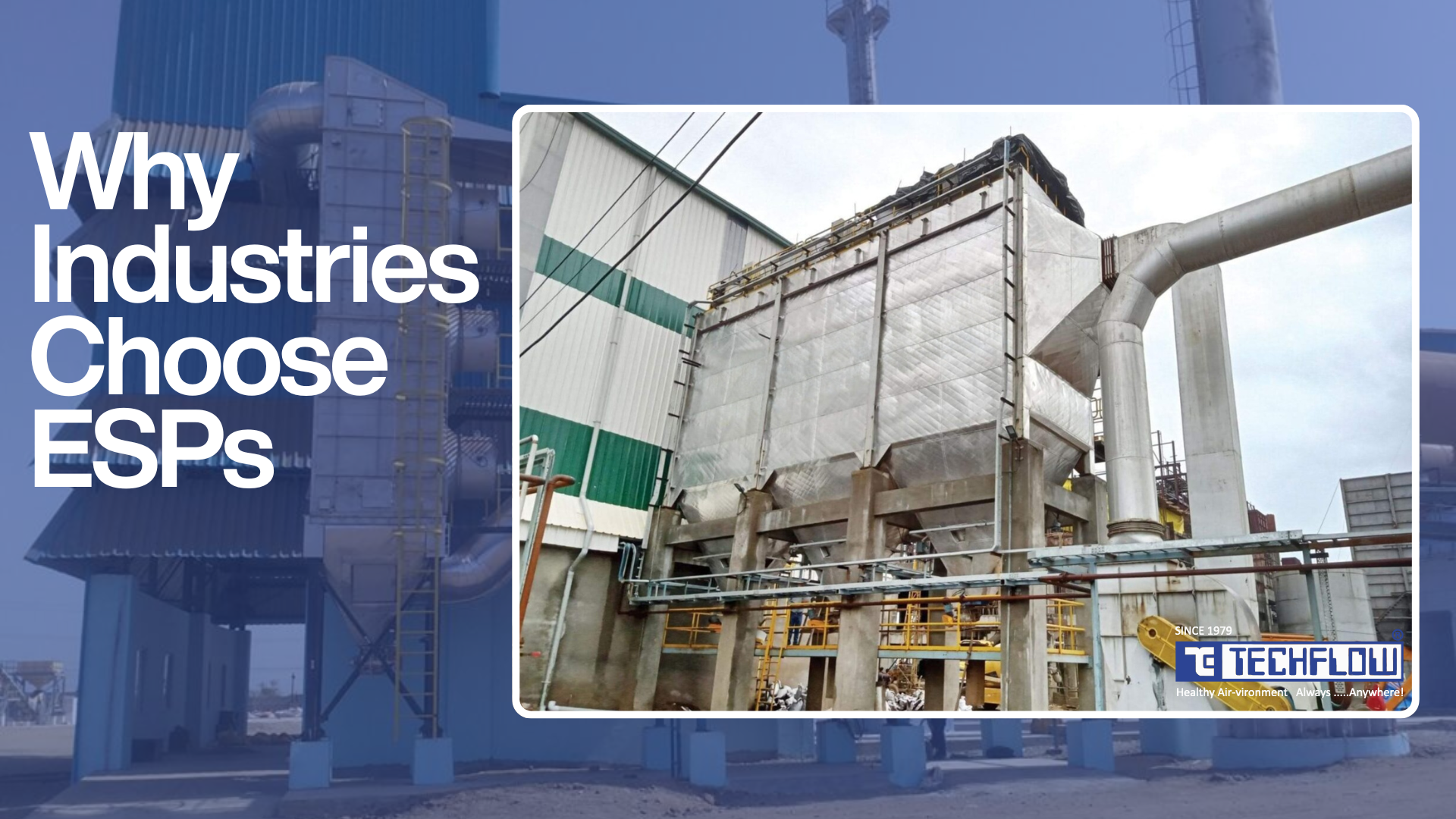
Strip away the marketing and an ESP's case comes down to four measurable things.
1. High, dependable collection efficiency. A properly sized multi-field ESP holds above 99% removal even for fine PM10 dust, the fraction regulators watch most closely because it travels deep into the lungs.
2. Low pressure drop, low energy. Because gas flows past open plates instead of through a barrier, the ESP adds very little resistance. That ~25 mmWC pressure drop keeps your ID fan power, one of the highest running costs in any dust-collection setup, low. Over a year of continuous operation, that difference in energy consumption against a bag filter is measured in real money.
3. Dry, reusable ash. A dry ESP produces free-flowing ash, not sludge. There's no wastewater to treat, and the ash is often sold on fly ash to cement and brick makers, for instance, rather than paid to dispose of.
4. Tolerance of heat and fuel swings. Solid-fuel plants rarely burn one clean, consistent fuel. Gas temperature and dust chemistry move with every fuel change. An ESP takes that in stride, where a fabric filter would blind or scorch, provided the design accounts for the resistivity range up front.
There's a fifth, increasingly important benefit: Scalability. Emission limits only tighten. An ESP built with room for additional fields or specified with them from the start can be pushed to sub-50 mg/Nm³ performance without ripping out the casing. That headroom is cheap insurance against the next revision of the norms.
ESP Compliance in India: What the Rules Actually Say
This is where a lot of published material gets sloppy, so it's worth being precise. India doesn't have a single particulate limit. Your applicable number depends on what kind of plant you run and where it sits, and it's enforced through your State Pollution Control Board (SPCB) consent under the Environment (Protection) Act, 1986. The framework is set by the Central Pollution Control Board (CPCB) and the environment ministry.
Three separate regimes matter:
Coal- and lignite-based thermal power plants: Under the MoEF&CC notification of December 2015, the particulate limit is tied to when the unit was commissioned: 100 mg/Nm³ for units installed before 2004, 50 mg/Nm³ for units installed between 2004 and 2016, and 30 mg/Nm³ for units installed from 1 January 2017 onward.
Industrial boilers and thermic fluid heaters (coal, lignite, pet coke, bagasse/agro-fuels). These are not held to the power-plant numbers. Larger industrial boilers have historically worked to a reference of around 150 mg/Nm³, and in 2022 the CPCB tightened the standard for very small "baby" boilers under 2 TPH to 500 mg/Nm³ (down from 1,200). Boilers of 10 TPH and above must install continuous emission monitoring systems (CEMS) on the stack.
The takeaway for anyone specifying an ESP: don't design to a number you read in an article; design to the limit on your consent. Two identical boilers, one in a non-attainment city and one elsewhere, can carry very different obligations. This is exactly why TECHFLOW asks for your consent conditions, fuel mix, and gas volume before quoting a field count. The emission limit on your file is what determines how many electrical fields the ESP actually needs.
For a fuel-by-fuel and industry-by-industry breakdown, TECHFLOW's comprehensive guide to ESPs for boilers and thermic fluid heaters is a useful reference.
Where Are ESPs Used? Industrial Applications
Anywhere solid fuel is burned, or fine process dust is generated at volume, you'll find an ESP.
Industrial boilers: Coal-, biomass-, and rice-husk-fired boilers throw off large volumes of fly ash and cope with wildly variable fuel quality. Multi-field ESPs handle both the volume and the swings.
Thermic fluid heaters: Same fuels, same headaches: high temperatures and fine dust. ESPs give these units a low-maintenance emission solution that doesn't clog.
Cement plants: Kilns and raw-material handling produce enormous quantities of ultra-fine dust; ESPs are a long-standing fixture here.
Power plants: Continuous, massive flue-gas flows from coal combustion are the classic ESP application, and the reason the technology exists at the scale it does.
Steel, metal, and sponge iron: Furnace fumes, sinter dust, and the abrasive process dust of DRI/sponge-iron production all call for robust collection, often with wet ESPs for coke-oven and producer-gas cleaning. (See TECHFLOW's work in steel and sponge iron plants.)
Foundries and ceramics: High-temperature kiln emissions and metallic fumes captured before they reach the stack.
Waste-to-energy plants: Highly variable particulate from mixed-waste combustion, where the ESP has to stay stable across a changing feedstock.
Common ESP Design Challenges (and How Engineers Solve Them)
An ESP that looks fine on the commissioning-day stack test can drift out of compliance months later. The difference is almost always in how these problems were handled at the design stage.
High-resistivity dust: Some ash, particularly from certain low-sulphur coals and biomass, resists giving up its charge on the plate. The cake insulates itself, the field collapses locally, and you get "back corona," which craters efficiency. The fixes are engineering ones: more fields, optimised field strength, controlled gas conditioning, and in stubborn cases a wet ESP instead.
Re-entrainment: Dust that's been collected getting blown back into the gas is a silent efficiency killer. It comes from rapping too aggressively, uneven gas flow, or high passage velocity. Correct rapping tuning and good gas distribution are the antidotes.
Poor gas distribution: Dead zones and high-velocity jets both hurt. This is why reputable OEMs model the inlet with CFD and place distribution screens deliberately rather than by rule of thumb.
Undersizing to hit a price: The single most expensive mistake. An ESP sized for yesterday's limit or specified with too few fields to save on capital will fail the next time the norms tighten or the fuel gets dirtier. Building in field headroom is far cheaper than retrofitting a casing.
Dew-point excursions: Run a dry ESP too cold, and moisture turns ash to paste. Insulation, hopper heating, and correct operating temperature keep the unit dry.
Hybrid and Multi-Stage Systems: When One Device Isn't Enough
For plants with extreme or unpredictable conditions heavy fuel switching, violent dust spikes, or very high inlet dust loads a single collector sometimes isn't the right answer. Multi-stage trains solve this by putting the right technology in the right place, and they draw on TECHFLOW's full range rather than the ESP alone:
- A cyclone or multi-dust collector (MDC) upstream of the ESP knocks out the coarse, heavy fraction first, so the ESP handles only the fine polishing duty. This is a standard TECHFLOW arrangement on high-dust-load boilers and furnace applications.
- An ESP followed by a pulse-jet bag filter pairs the ESP's bulk knockdown and heat tolerance with the bag filter's very low outlet emissions, useful where the consent limit is tight, and gas volumes justify the two-stage cost.
Because TECHFLOW manufactures cyclones, multi-cyclones, ESPs, and the full bag-filter range in-house, these stages are engineered as one integrated system: matched ductwork, a correctly sized ID fan, and unified controls rather than bolted together from separate suppliers.
How to Choose the Right ESP: A Short Buyer's Checklist
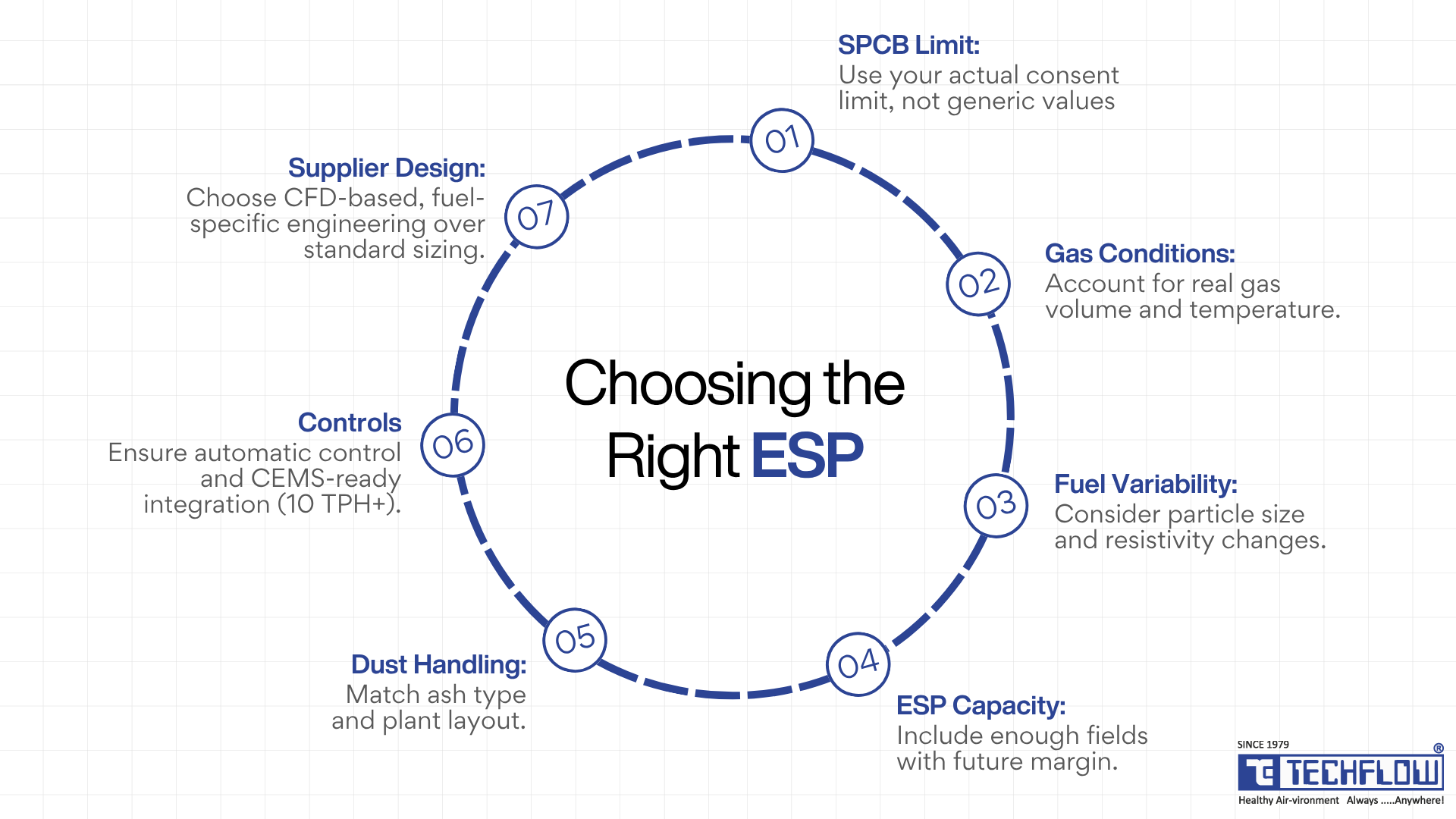
If you're specifying an ESP, work through these before you compare quotes:
- Your applicable emission limit from your SPCB consent, not a generic figure.
- Gas volume and temperature: the real operating range, including upsets, not just the nameplate.
- Fuel(s) and their variability: the resistivity and particle-size spread you'll actually see.
- Field count and headroom: enough fields for today's limit plus margin for the next revision.
- Dust handling screw or pneumatic evacuation matched to your ash and layout.
- Controls and monitoring: automatic voltage/rapping control and CEMS-ready integration if you're 10 TPH or above.
- The supplier's engineering: do they model gas distribution with CFD, and will they design around your fuel and consent? Off-the-shelf sizing is where field problems begin.
You can read more on the design factors that separate a compliant ESP from a marginal one in TECHFLOW's note on the key features of electrostatic precipitators.
Why TECHFLOW for Your ESP
TECHFLOW Enterprises Private Limited is an Ahmedabad-based OEM that has designed, manufactured, and supplied air-pollution-control and dust-collection systems since 1979, under the leadership of its founder-chairman, Mr D. K. Parikh. Over more than four decades, it has grown from a small Gujarat machine shop into a supplier serving 15-plus industries across India and export markets, with a stand at international fairs such as METEC in Düsseldorf.
For particulate control, TECHFLOW's core product is the dry horizontal plate-type ESP, built in single- and multi-field configurations for coal- and biomass-fired boilers, thermic fluid heaters, and process furnaces. Wet ESPs are offered for specialised tar and acid-mist streams, coke-oven gas, producer gas, and non-ferrous smelter gas. What sets the work apart is engineering discipline rather than a catalogue:
- Custom-engineered, not off-the-shelf. Every ESP is sized around the customer's fuel mix, gas volume, dust resistivity, and applicable emission limit.
- CFD-backed gas distribution. Inlet flow is modelled computationally so velocity is uniform across the cross-section, the single biggest lever on real-world efficiency.
- Multi-field scalability. Field count is set to hit today's consent limit with headroom for future tightening, so the casing doesn't need replacing when norms drop.
- In-house manufacturing and full-line integration. Because TECHFLOW also builds the cyclones, bag filters, ID fans, and conveying systems, an ESP can be delivered as part of one integrated, single-responsibility train.
- After-sales support. Commissioning, tuning, and ongoing service to hold performance over the life of the plant.
If you're evaluating ESP manufacturers in India, that combination an established OEM, in-house fabrication, application-specific design, and long-term support is what "the right supplier" on the buyer's checklist looks like in practice.
Conclusion
An electrostatic precipitator remains the most cost-effective way to clean high-volume, high-temperature flue gas from solid-fuel combustion. It captures the fine, health-critical dust that regulators care about; it does so at a fraction of the fan power a bag filter demands, and it hands you dry, saleable ash instead of sludge to dispose of.
But an ESP is only as good as its design. The efficiency headline means nothing if the unit is undersized for your fuel, sized to the wrong emission limit, or built without the field headroom to survive the next tightening of the norms. Match the machine to your gas, your fuel, and your actual consent condition, and it will keep your stack clean and your compliance file quiet for decades.
If you're planning a new installation or trying to bring an existing stack into spec, the fastest route is a proper site assessment: your gas volume, temperature, fuel range, and applicable consent limit. Share those with TECHFLOW's engineering team, and they'll size an ESP or a full multi-stage train around your actual conditions rather than a template. Get the design right, and the technology does the rest for decades. Reach the team through TECHFLOW.net.
Frequently Asked Questions (FAQs)
An ESP is an air-pollution-control device that removes fine dust from flue gas using electrostatic force. A high-voltage corona charges the dust particles, grounded plates attract and collect them, and rappers periodically knock the collected dust into hoppers. Well-designed units remove over 99% of particulate.
A properly engineered multi-field ESP captures more than 99% of particulate, with design efficiencies quoted up to 99.9%, including fine dust below 10 microns (PM10). Real-world performance depends on correct sizing, fuel consistency, and maintenance.
Because gas flows past open plates rather than through cloth. That gives an ESP a very low pressure drop (around 25 mmWC versus roughly 150 mmWC for a bag filter), so the ID fan works far less hard, which directly cuts electricity consumption.
A dry ESP raps the plates and drops dry ash into hoppers; it suits hot gas above the dew point. A wet ESP flushes the plates with liquid and suits sticky, tarry, oily, or acid-mist streams that would smear if rapped. Wet units also avoid the dust-resistivity problems that can affect dry ESPs.
Yes, that tolerance is one of its main advantages over fabric filters, which can blind or scorch when conditions shift. The design does need to account for the full range of dust resistivity and particle size you expect, so tell your supplier every fuel you burn.
Rappers strike the plates to shed the dust cake. Timing is a balance: rap too often and fine dust gets re-entrained into the gas; rap too rarely and the cake insulates the plate and weakens collection. Good systems tune rapping per field.
An ESP is divided into sequential electrical sections called fields. The first field drops the bulk of the dust; later fields polish the remainder. Adding fields is how you reach lower emission targets, which is why field count is the key scalability lever.
It depends. Coal/lignite power plants follow 100/50/30 mg/Nm³ by commissioning vintage; industrial boilers work to their own limits (around 150 mg/Nm³ generally, 500 mg/Nm³ for sub-2 TPH boilers after the 2022 revision); and Delhi-NCR enforces a uniform 50 mg/Nm³. Always confirm the exact figure on your SPCB consent; it governs the design.
In a dry ESP, ash falls into hoppers and is evacuated by airtight screw conveyors or dense-phase pneumatic conveying. Because it's dry, it can often be sold, for example, to cement or brick manufacturers, rather than disposed of as waste.
When conditions are extreme, or the inlet dust load is very high, heavy fuel switching, large dust spikes, or a tight consent limit on high gas volume. Putting a cyclone or multi-dust collector upstream of the ESP, or following the ESP with a pulse-jet bag filter, gives a layered system that stays in spec where a single device would struggle. TECHFLOW builds these stages in-house, so they integrate as one system.
TECHFLOW Enterprises, operating since 1979, is one established option; it specialises in dry horizontal plate-type ESPs for coal- and biomass-fired boilers and thermic fluid heaters, custom-engineered per fuel and emission limit, and also supplies wet ESPs for tar and acid-mist streams. When comparing manufacturers, look for in-house fabrication, CFD-based design, multi-field scalability, and after-sales support rather than a lowest-price standard unit.
As a rule of thumb, ESPs pull ahead on large gas volumes, high temperatures, and variable fuels; bag filters can be more economical for lower volumes and very low target emissions. The honest answer requires looking at your gas volume, temperature, target limit, and fuel; there's no universal winner, which is why a supplier that makes both can give unbiased advice.


