


Key Takeaways
- MIGI rapping vs tumbling hammer has no universal winner; the better ESP rapper depends on dust, emission limits, gas conditions, and maintenance capability.
- A MIGI (Magnetic Impulse Gravity Impact) rapper lifts a plunger with a solenoid, then gravity drops it on an anvil outside the casing.
- A tumbling hammer rapper uses hammers pivoted on a rotating shaft. The hammers work inside the casing, and a gear motor outside turns the shaft.
- MIGI gives electrical control of the intensity, timing, and sequence of each rapper. Tumbling hammers set intensity mainly through hammer mass and geometry.
- Rapping re-entrains some dust. The US EPA cites about 12 percent for coal fly ash, so tuning matters as much as hardware.
- External parts are easier to inspect on a MIGI system. Tumbling hammer parts sit in the gas path and usually need a shutdown to reach.
- Choose by emission limit, dust behaviour, downtime cost, maintenance skills and, for retrofits, available casing space.
If you are weighing a MIGI rapper against a tumbling hammer, you are really asking how best to keep an electrostatic precipitator (ESP) 's collecting plates and discharge electrodes clean without throwing dust back into the gas stream. That question affects collection efficiency, power consumption, and the emission figure you report.
The short answer is that no single mechanism wins everywhere. MIGI offers finer control and easier external access. Tumbling hammers offer a simple, rugged mechanical design. What decides the outcome is how well the chosen system is matched to your dust, your gas conditions, and your plant's maintenance routine.
This guide explains how each mechanism works, what the technical literature says about rapping performance, where each one fits, and how to decide.
Why Rapping Decides ESP Performance
An ESP charges dust particles and pulls them onto collecting plates. Dust also builds up on the discharge electrodes. A thick layer weakens the electrical field, increases sparking and lets emissions rise. Rapping delivers a mechanical shock that shakes the layer off so it falls into the hopper. If you want a refresher on the basics, read how an ESP works.
Rapping is never perfectly clean. According to the EPA Air Pollution Control Cost Manual, the rapping that dislodges the layer also projects some particles back into the gas, typically about 12 percent for coal fly ash. Dust thrown back in the last electrical field has no further chance of being recaptured and leaves through the stack.
Field data show how much this matters. Tests on six full-scale, high-efficiency precipitators found that roughly 30 to 70 percent of particle penetration occurred while the collecting plates were being rapped, according to a US Department of Energy report on plate rapping and reliability. Rapping is therefore a core efficiency parameter, not a housekeeping task.
Two things follow. A harder blow is not automatically better. Excessive rapping makes dust billow off the plate and escape, while insufficient rapping leaves dust in place. The goal is to snap the dust cake loose so it slides down in sheets.
How A MIGI Rapper Works
MIGI stands for Magnetic Impulse Gravity Impact. A slug normally rests on a surface such as a rod or anvil. An electromagnetic pulse lifts it, and when the pulse ends it drops by gravity and strikes the anvil. The rod carries the impact into the electrode frames, as described in US Patent 5,561,583.
Main features:
- Mounting: The rapper unit is usually mounted above the roof, outside the gas casing. A transmission rod passes through a seal into the precipitator.
- Control: The impact is triggered electrically, so a controller can set the sequence, intensity and duration of rapping for each rapper (US Patent 5,173,867).
- Direction: Gravity drives the blow, so it acts vertically downward. This suits plates and electrode frames that can be struck from above. It suits hoppers and inclined surfaces less well, where a horizontal or upward blow may be needed.
- Wear points: The coil, plunger, guide tube, rod and roof seal.
Typical faults include coil failure, a plunger that does not lift as designed, and seal leakage. Repeated unidirectional energising can leave residual magnetism in the plunger and anvil, which is why controller settings matter.
How A Tumbling Hammer Rapper Works
A tumbling hammer rapper has several hammers, each pivoted on an arm fixed to a rapper shaft. As the shaft rotates, each hammer is carried up, then falls and strikes an anvil connected to the collecting plates or discharge electrodes. The drive motor and gear reducer sit outside the precipitator wall (US Patent 4,502,870).
Main features:
- Mounting: Hammers, arms, and shaft run inside the casing. US Patent 4,183,735 notes that this requires a larger casing to house the hammers and limits access during operation.
- Intensity: The size and weight of the hammer set the maximum rapping intensity for a free fall. To reduce it, an attenuator plate can catch the hammer during its fall and release it later. A spring or drop hammer can raise it (US Patent 7,459,010).
- Strike control: Each strike re-entrains some dust. Control systems can limit each hammer to one strike per cycle and use a shaft feedback signal to raise an alarm if the shaft stops rotating.
- Wear points: Hammer pivots, anvils, shaft bearings, and seals operating in dust-laden gas.
MIGI Vs Tumbling Hammer: Comparison
| Factor | MIGI rapper | Tumbling hammer rapper |
|---|---|---|
| Operating principle | Solenoid lifts a plunger; gravity drops it on an anvil | Shaft rotation lifts hammers, which fall on anvils |
| Mounting | Unit outside the casing, rod passes through the roof | Hammers and shaft inside the casing, drive outside |
| Blow direction | Vertical, downward | Set by hammer and anvil layout |
| Intensity adjustment | Electrical, can be varied without interrupting operation | Mainly mechanical: hammer mass, geometry, attenuator or spring |
| Sequence and timing | Set per rapper by the controller | Set by shaft position and drive cycle |
| Inspection access | External parts reachable without entering the casing | Internal parts usually need a shutdown |
| Main wear points | Coil, plunger, guide tube, rod seal | Pivots, anvils, shaft bearings, seals |
| Dependence on electrics | High: supply, controller, and coils must be healthy | Low: motor and gearbox drive |
| Casing impact | Little internal space needed | Casing sized to house the hammer assembly |
No credible published figure supports a blanket efficiency percentage for either column. Efficiency depends on the dust, the gas, plate design and tuning, so this table compares features, not results. The ability to vary intensity without interrupting operation is described in US Patent 4,767,423.
What Actually Drives Rapping Performance
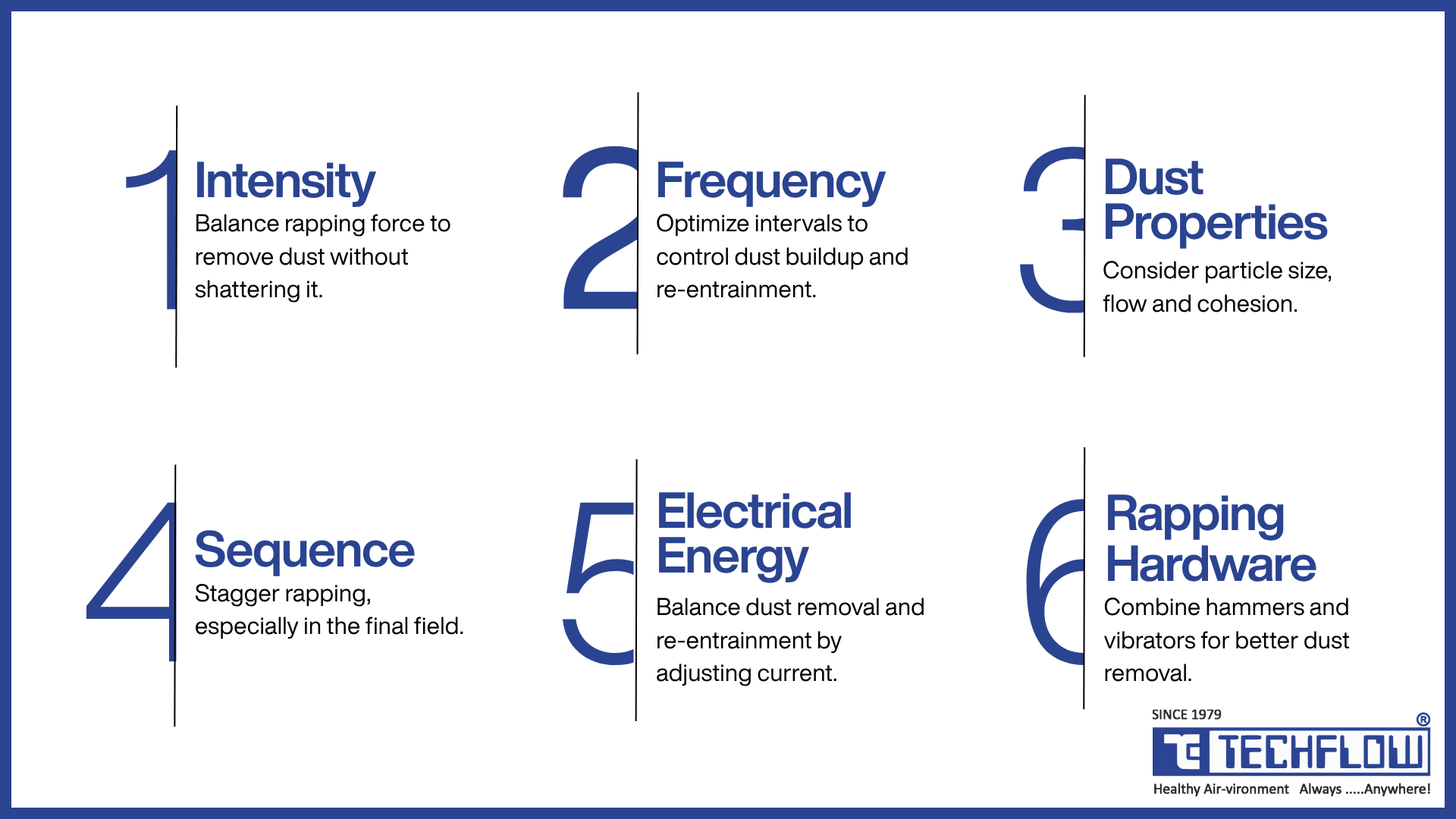
Intensity: Laboratory work on rapping found that rapping efficiency and re-entrainment both increase with greater rapping acceleration. A pilot test on a full-size plate screen measured the highest acceleration closest to the strike point, falling away along the plate (Neyestanak et al., 2014). Intensity must be high enough to detach the layer but not so high that it shatters.
Frequency: The same research found that longer intervals between raps raise both rapping efficiency and re-entrainment. A thicker layer tends to fall in larger pieces, but too thick a layer hurts the electrical field. Dust layers in practice can reach about 1 cm on plates around 10 m tall, so layer management is a real design task (US Patent 6,231,643).
Dust properties: Smaller dislodged pieces are more susceptible to re-entrainment than large ones, which tend to stay in the gas boundary layer next to the plate and slide into the hopper. Cohesive dust holds together and sheds in larger sheets. Fine, free-flowing dust breaks up more easily.
Sequence: Dust re-entrained in an upstream field can be recaptured downstream. The final field cannot recapture, so rapping there needs the most care. Staggering raps between fields limits direct losses to the outlet.
Electrical energy during rapping: Patent literature on rapping order reports that keeping current applied during rapping reduces re-entrainment, because particles stay attracted to the plate. It also leaves the plate less clean than rapping with the current off or low. This is a tuning trade-off, and it is easier to manage when each rapper can be controlled independently.
Rapping hardware combinations: One experimental study reported that a combined hammer and vibrator arrangement removed deposited particles better than hammers alone. This shows that mechanism choice is one variable among several.
The balance of intensity, duration and frequency is essential to precipitator performance. Inadequate cleaning of plates and electrodes is a dominating cause of poor performance, shown as more sparking, reduced power and higher emissions.
Maintenance And Failure Modes
MIGI systems
- Check each coil and plunger for correct lift and return.
- Inspect roof seals and transmission rods for leakage or looseness.
- Review controller logs, since settings drift with fuel, load and dust changes.
- Confirm the coil and wiring are rated for the temperature at the roof.
Tumbling hammer systems
- Inspect hammer pivots, anvils and shaft bearings at planned shutdowns.
- Confirm shaft rotation, and use a shaft feedback alarm where fitted.
- Check for hammer or anvil wear that changes blow intensity.
Both systems
- Rapping is repeated impact loading, so hammers, anvils, rods and plate suspensions are fatigue parts. Schedule inspection of the transmission path, not only the rapper itself.
- Verify that the shock actually reaches the plates. A rapper that fires but does not clean is a common cause of poor performance.
- Track opacity or outlet dust and compare it with rapping events.
Choosing Between MIGI And Tumbling Hammer
The points below are engineering judgement based on the mechanisms described above, not guarantees. Always confirm against your own plant data.
Industrial and power boilers: Fine fly ash and tight emission limits make the final field sensitive to re-entrainment. In Delhi-NCR, the Commission for Air Quality Management (CAQM) has set a 50 mg/Nm³ particulate limit for specified industries, including those with boilers and thermic fluid heaters. It applies from 1 August 2026 for large and medium units and from 1 October 2026 for the rest. Margins like this reward precise, per-rapper tuning. For more on this application, see TECHFLOW's guides on an ESP system for boiler dust, ESPs for boilers and thermic fluid heaters, and air pollution control norms in India, or browse boiler solutions.
Cement plants: Dust loading is high, and the dust may be cohesive. For cement plants, treat rapping as a design question tied to how the dust sheds, not as a default choice.
Steel, sponge iron, and DRI plants: Dust properties shift with feed and operating mode. In steel, metal, sponge iron, and DRI plants, intensity and timing that can be adjusted without stopping the unit help follow those shifts.
Waste-to-energy plants: Mixed fuel gives variable, sometimes sticky ash. At waste-to-energy plants, external access to rapper parts shortens maintenance windows.
Small or budget-led installations: Where dust is steady, planned shutdowns are available, and the crew is comfortable with mechanical upkeep, a tumbling hammer system is a sound, simple choice.
Selection checklist
- What emission limit must the ESP meet now and over its life?
- Is the dust sticky, cohesive, or free-flowing, and does it change with fuel or load?
- What does an unplanned shutdown cost, and how often can internal inspection be scheduled?
- Is the maintenance team stronger in electrical and instrumentation work or in mechanical work?
- Can outlet dust or opacity be monitored to confirm rapping settings?
- For a retrofit, do the casing, electrode suspension, and available space allow either option?
How Techflow Approaches Rapping Selection
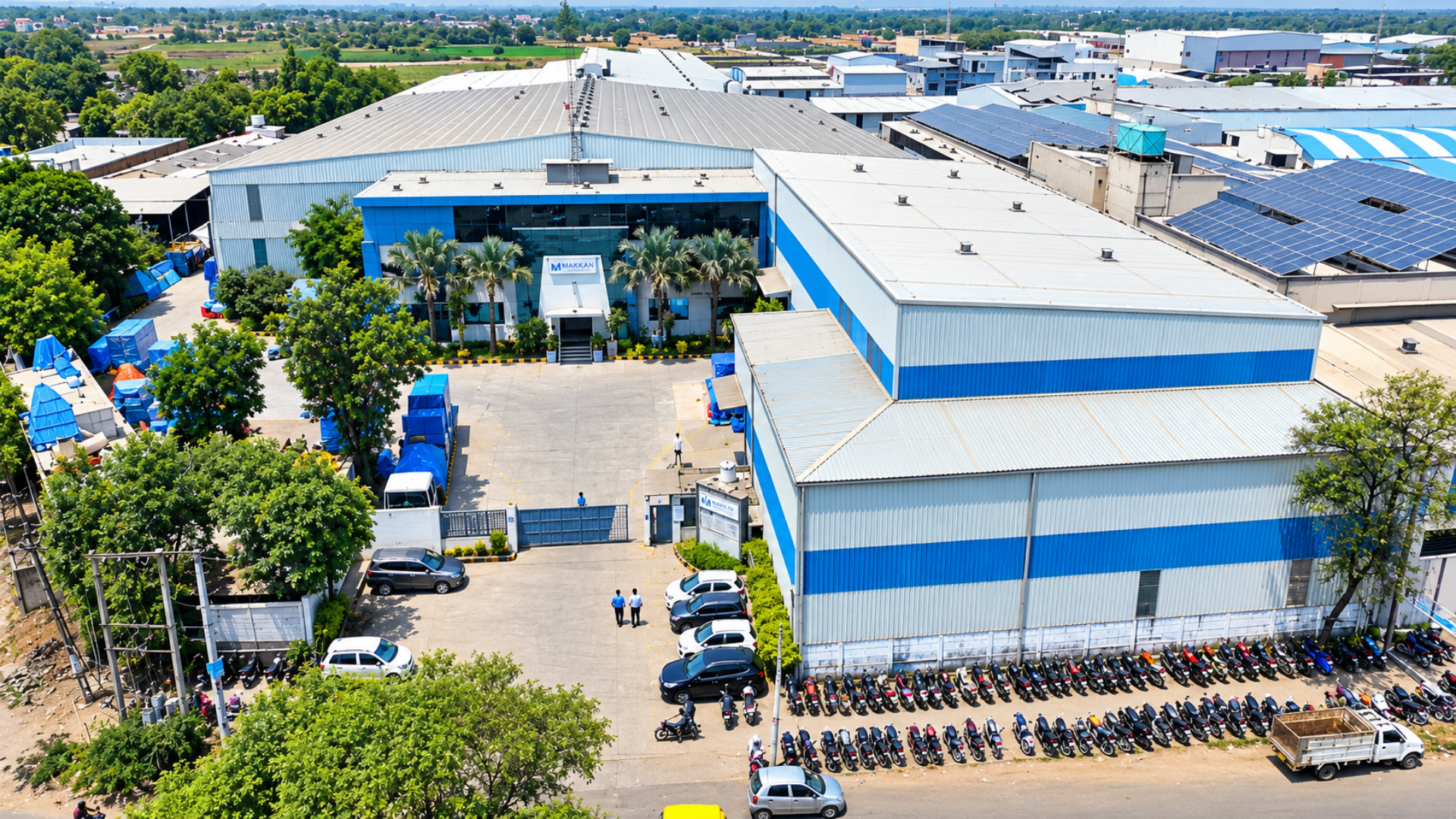
TECHFLOW has engineered air pollution control equipment from Ahmedabad, Gujarat since 1979. It designs and manufactures electrostatic precipitators for boilers and thermic fluid heaters and serves industries including cement, steel and sponge iron, foundry and waste-to-energy. TECHFLOW supplies ESPs with either MIGI or tumbling hammer rapping and also supplies ESP spares.
The starting point is plant data: flue gas volume and temperature, dust loading, fuel and dust characteristics, available space, and the emission limit. The rapping mechanism, intensity range, and sequence are then matched to those conditions. This follows the same logic as what engineers consider when designing air pollution control projects. For existing precipitators, TECHFLOW can review the current rapping setup and advise on tuning or upgrades.
Talk To Techflow's ESP Engineers
Choosing a rapping mechanism is easier with your own flue gas and dust data in front of you. Share your plant details with TECHFLOW and our engineers will recommend a rapping system for a new electrostatic precipitator or review the one you run today. You can also download the product catalogue.
Request a consultation: techflow.net/contact-us | sales@techflow.net | +91 88669 80744
Frequently Asked Questions (FAQs)
MIGI stands for Magnetic Impulse Gravity Impact. A solenoid lifts a plunger, which then drops under gravity onto an anvil. The impact travels through a rod to the collecting plates or discharge electrodes and dislodges dust.
A tumbling hammer rapper has hammers pivoted on arms fixed to a rotating shaft. Each hammer falls onto an anvil connected to the plates or electrodes. A gear motor outside the casing turns the shaft.
Neither is better in every case. MIGI offers independent electrical control of each rapper and external mounting. Tumbling hammers are mechanically simple. The right choice depends on dust behaviour, emission limits, maintenance skills, and downtime cost.
It can if it is poorly tuned. The EPA notes that rapping projects some collected particles back into the gas stream, typically about 12 percent for coal fly ash. Field tests have attributed 30 to 70 percent of particle penetration to the rapping of collecting plates.
There is no universal interval. Frequency depends on how fast the dust layer builds, how cohesive the dust is, and how the plant balances layer thickness against re-entrainment. It is set at commissioning and revisited when fuel or load changes.
On MIGI systems, it can be adjusted electrically without interrupting operation. On tumbling hammer systems, it is set mainly through hammer mass and geometry, so changes usually need access to internal parts.
Dust re-entrained in an upstream field can be recaptured by later fields. Dust re-entrained in the final field cannot be recaptured and leaves through the stack, so rapping there needs the most care.
Sometimes. It depends on the casing, electrode suspension, and available space, so the existing ESP should be reviewed before any conversion is planned.


