
Selecting a centrifugal blower in India comes down to four engineering decisions: (1) defining the duty point correctly at site-corrected air density, (2) matching impeller geometry to the gas medium (backward-curved for clean air, radial paddle-wheel for abrasive dust), (3) validating the supplier's testing and material standards against IS 4894, ISO 5801, and ISO 14694, and (4) comparing 10-year lifecycle cost not just purchase price. This guide gives you the technical checklist, the supplier evaluation matrix, and the compliance references to make that decision with confidence.
Why Centrifugal Blower Selection Is High-Stakes?
Specifying a centrifugal blower is one of those decisions where a 5% saving at the PO stage can cost 30% more over the next decade. A 22 kW blower running 8,000 hours a year and operating 15% off its Best Efficiency Point will burn roughly? 1.6 lakh in excess power every year (at ?7.50/kWh), and that's before bearing failures, impeller erosion, or the three-week lead time for a non-stocked spare.
The Indian industrial blower market reflects how central this equipment has become: the Asia-Pacific centrifugal blower market was valued at USD 868.9 million in 2025 and is projected to reach USD 1.46 billion by 2035 at 5.4% CAGR (Global Market Insights, 2026). India's share is rising sharply as cement, steel, pharma, and pollution-control investments accelerate.
This guide is built for the procurement head, project engineer, or maintenance manager who needs to specify and source a blower correctly the first time, and pick a supplier who will still take their call eighteen months after commissioning.
What Is a Centrifugal Blower?
In one line: A centrifugal blower is a rotating-impeller machine that moves air or gas at a 90° angle from intake to discharge, generating pressures from roughly 500 Pa to 30 kPa, the operating range most Indian process industries work in.
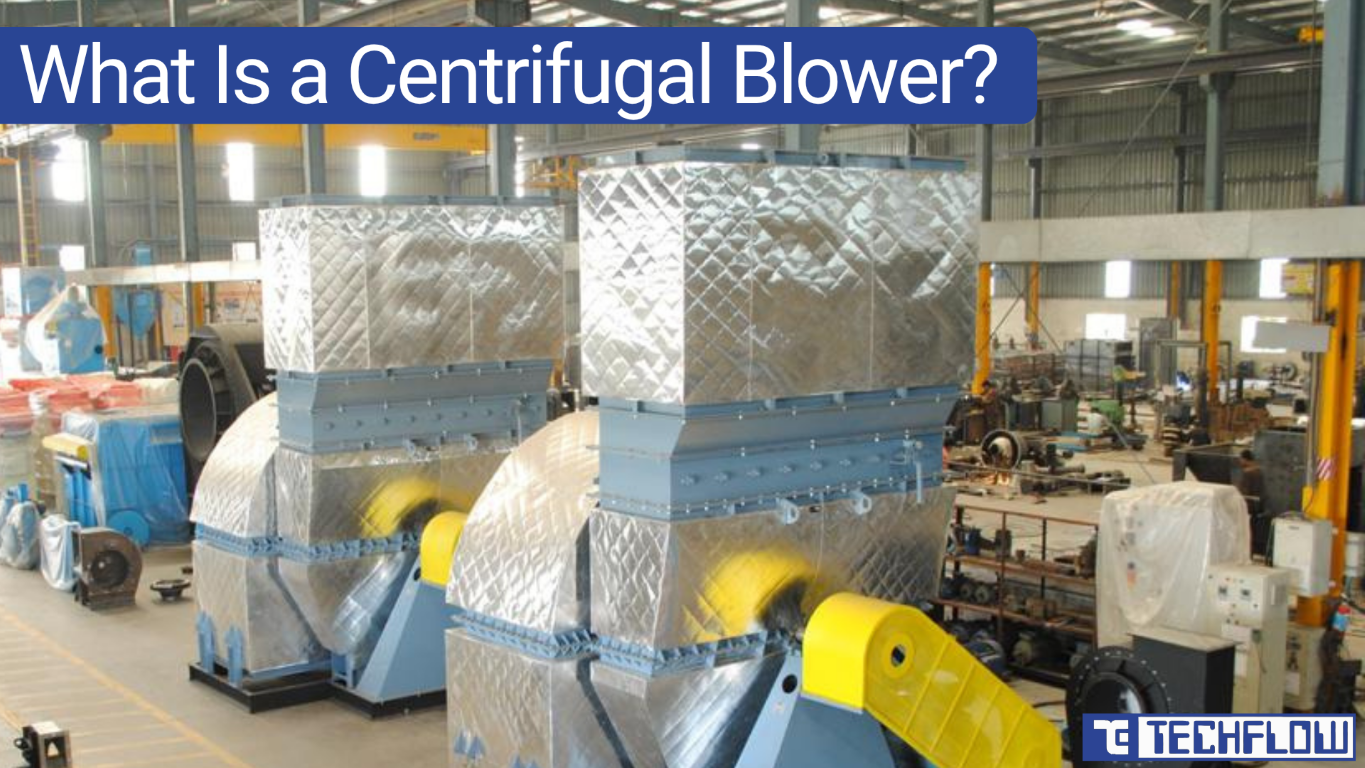
Unlike axial fans, which push air parallel to the shaft, centrifugal blowers convert the kinetic energy of a rotating impeller into static pressure. That makes them suited to systems with resistance: long duct runs, bag filters, scrubbers, pneumatic-conveying lines, and combustion-air supply to kilns and furnaces.
How Centrifugal Blowers Are Classified
By Impeller Design
|
Impeller Type |
Best For |
Key Characteristic |
Typical Efficiency |
|
Backwards Curved /Backwards Inclined |
Clean air, general ventilation |
Highest efficiency, non-overloading power curve |
75–85% |
|
Radial / Paddle Wheel |
Dusty, abrasive, sticky media |
Robust, self-cleaning, durable |
55–70% |
|
Airfoil |
Clean air, efficiency priority |
Best efficiency point (BEP) for clean process air |
80–90% |
|
Mixed Flow |
Medium pressure, high flow |
Combines axial and centrifugal characteristics |
70–80% |
By Pressure Class
- Low Pressure: Up to 500 Pa for general ventilation, cooling air
- Medium Pressure: 500–5,000 Pa process exhaust, filtration systems
- High Pressure: 5,000–30,000 Pa combustion air, pneumatic conveying, dense-phase transport
By Construction
- Single Inlet Single Width (SISW): Standard industrial duty
- Double Inlet Double Width (DIDW): Higher airflow capacity, balanced thrust loads
- Direct Drive vs. Belt Drive: Direct drive runs at motor speed (simpler, fewer wear parts); belt drive allows speed tuning to hit the duty point exactly
Industrial Applications of Centrifugal Blowers in India
Dust Collection and Air Pollution Control
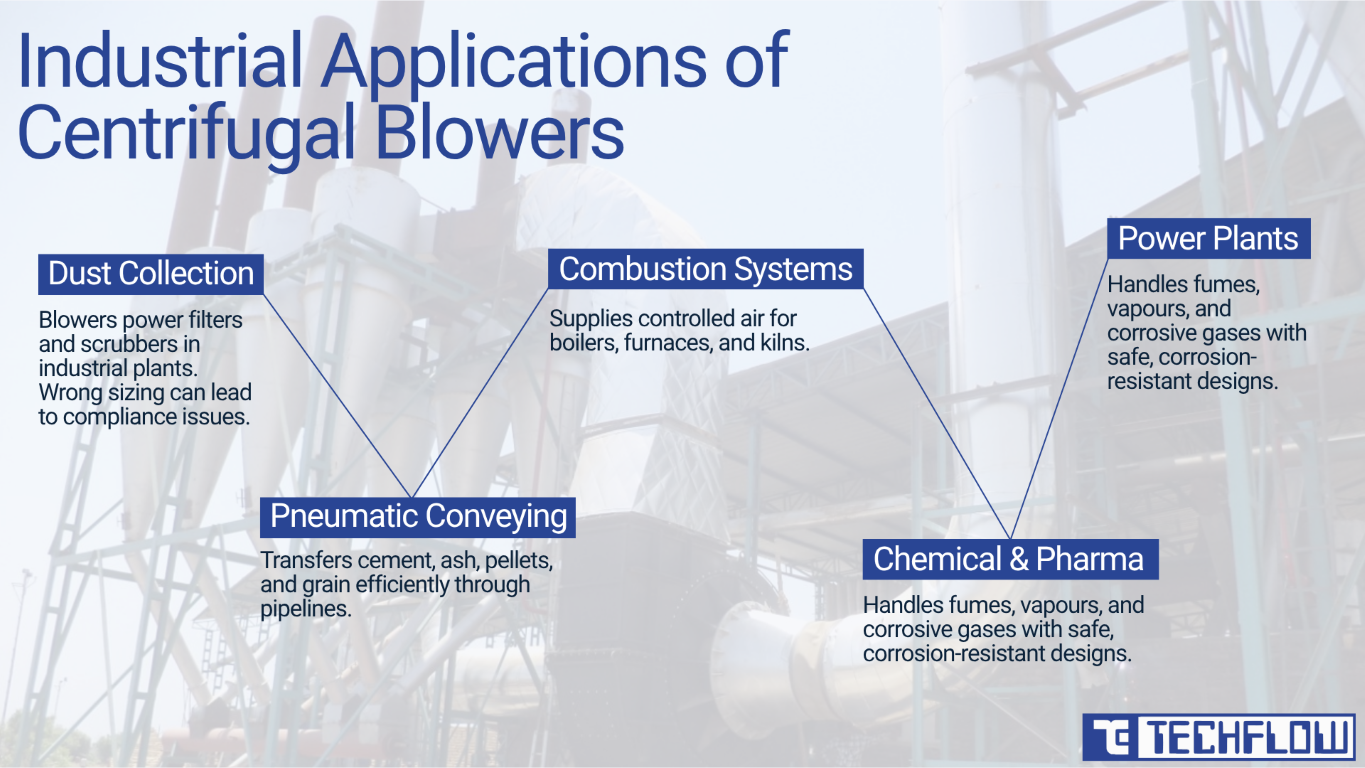
Cement, steel, foundries, and pharmaceutical plants rely on centrifugal blowers as the heart of bag filter systems, cyclones, and wet scrubbers. Under-sized or wrongly specified blowers are a fast route to compliance failure.
Pro tip: For bag filter applications, specify blower performance at the dirty filter pressure drop, typically 25–40% higher than clean-filter resistance. Sizing only at clean conditions starves the system at peak filter load.
For specifying dust-handling systems end-to-end, see TECHFLOW's Centrifugal Blowers & Fans.
Combustion Air and Furnace Systems
In forging, heat treatment, ceramic kilns, and boilers, blowers supply precisely metered combustion air. Air density correction is non-negotiable at the selection stage; a blower sized at 30°C ambient will under-deliver by 6–10% at 45°C summer conditions or at high-altitude plant sites.
Chemical and Pharmaceutical Processing
Fume extraction, solvent vapour handling, and inert gas circulation call for corrosion-resistant construction, typically SS304, SS316, MS, or Alloy Steel, with mechanical seals replacing standard lip seals. Where flammable vapours are present (alcohols, hydrocarbons, VOCs), ATEX or IECEx certification is mandatory, not optional.
Power and Utilities (FD/ID Fans)
Forced draft (FD) and induced draft (ID) fans in boiler systems are centrifugal blowers operating under continuous-duty conditions. Efficiency at partial loads, motor insulation class, vibration levels per ISO 14694, and noise limits are decisive parameters. TECHFLOW's Customised Centrifugal Blowers, ID Fans & FD Fans range covers this segment specifically.
The Real Cost of Choosing the Wrong Supplier
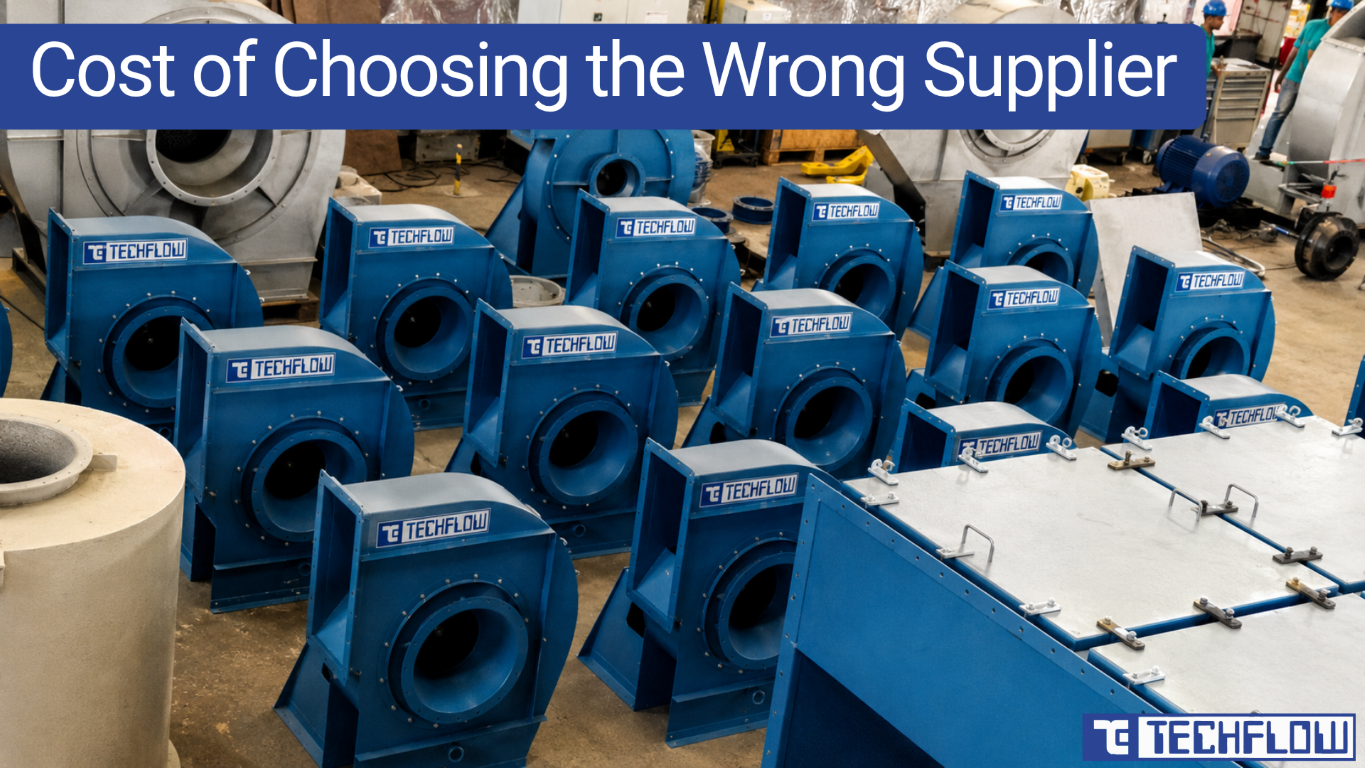
The real cost of buying cheap shows up in month 18, not month 1.
A pattern seen repeatedly in Indian cement and steel plants: a 75 kW ID fan procured at 12–15% below market rate arrives with a 5 mm MS impeller, where the specification called for an 8 mm hardened plate. For the first year, it runs. By month 14, leading-edge erosion is measurable. By month 18, two bearing failures have each taken the line down for 36–48 hours.
On a clinker production line running at? 4–6 lakh per hour of lost output, the first unplanned shutdown alone more than erases the? 1.2 lakh saved at the PO stage before you account for replacement parts, labour, and the next failure already in progress.
The procurement savings were real. The cost of it was just deferred.
A correct total-cost-of-ownership view looks like this:
|
Cost Element |
What It Captures |
|
Purchase Price |
Initial capital outlay (typically 10–15% of lifecycle cost) |
|
Energy Consumption |
Operating at BEP vs. off-curve = 15–30% efficiency difference; usually 60–70% of lifecycle cost |
|
Maintenance Frequency |
Bearing, seal, and impeller replacement cycles |
|
Spare Parts Availability |
Downtime cost when parts take 6–8 weeks to source |
|
Residual Life |
A well-built blower runs 15–20 years; a cheap one, 3–5 |
|
Compliance Risk |
Penalty exposure under SPCB emission norms if the blower underperforms |
Over a 10-year window, a blower that costs ?1.5 lakh more upfront but saves 12% in energy annually and avoids one unplanned shutdown is not an expense; it is an investment with a measurable IRR.
How to Choose the Right Centrifugal Blower: Technical Selection Checklist
Walk through this before finalising any specification.
Process Parameters (Define First)
- [ ] Required airflow rate (m³/hr or CFM) at operating conditions
- [ ] Static or total pressure requirement (Pa or mmWC)
- [ ] Inlet gas temperature, including upset/peak values
- [ ] Air density correction for altitude, temperature, humidity
- [ ] Nature of the medium: clean air, dusty, corrosive, humid
- [ ] Particulate loading (g/m³) and particle size distribution
- [ ] System resistance: duct lengths, bends, filters, dampers (sum to total system pressure drop)
Mechanical and Construction Requirements
- [ ] Impeller material (MS, SS304, SS316, Alloy Steel, Ni-Hard for abrasion)
- [ ] Casing construction, inspection door, drain ports
- [ ] Drive arrangement (direct coupled or belt drive)
- [ ] Motor specification: kW, voltage, frequency, IE class, IP rating, insulation class
- [ ] Bearing type and lubrication (grease vs. oil-bath for high-temperature duty)
- [ ] Inlet/outlet connection sizes and orientations (top, bottom, side discharge)
Performance and Efficiency
- [ ] Duty point efficiency (target ≥70% for medium-pressure industrial duty)
- [ ] Sound power level (dB) per ISO 3744 or equivalent
- [ ] Motor service factor and non-overloading characteristic
- [ ] Vibration acceptance per ISO 14694 (default category FV-3, ≤4.5 mm/s RMS)
Installation and Site Conditions
- [ ] Indoor/outdoor installation
- [ ] Ambient temperature range
- [ ] Floor space and maintenance access clearance
- [ ] Civil foundation design (mass, isolation)
- [ ] Electrical supply availability, starter type (DOL, star-delta, VFD)
Pro tip: Always ask for the actual fan curve at your specific duty point, not just catalogue data. A reputable manufacturer will provide an ISO 5801-compliant duty-point plot showing airflow, pressure, power, and efficiency at your operating condition, not just at the rated peak.
What to Look For in a Centrifugal Blower Supplier in India
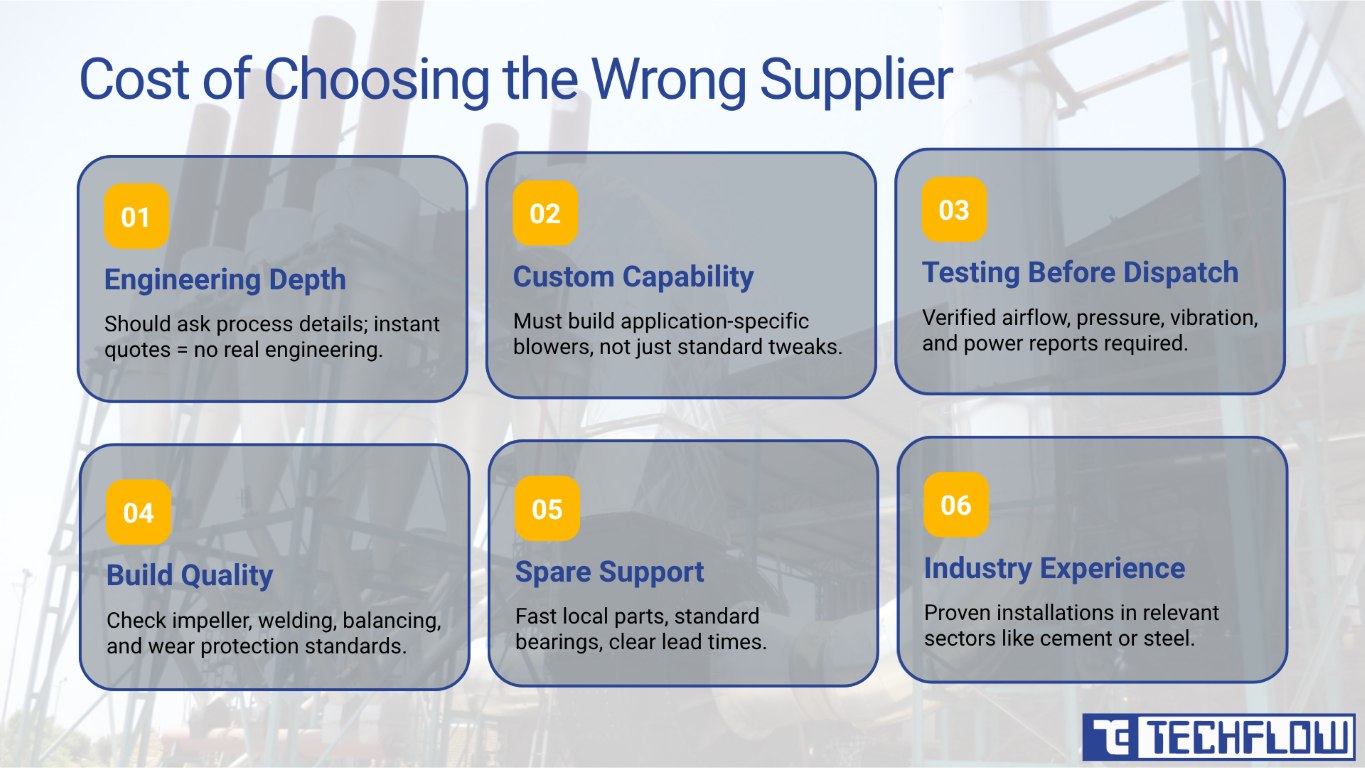
1. Engineering Depth, Not Just a Catalogue
A genuine supplier will ask about your duct layout, dust loading, process temperature, and altitude before quoting. If you receive a quotation within 10 minutes without a single technical question, that quotation is a price, not an engineering solution.
2. Custom Fabrication Capability
Many Indian applications, such as cement preheater fans, steel sinter plant ID fans, and ATEX-rated solvent extractors, require non-standard inlet configurations, refractory linings, or hardened impellers. Your supplier must be able to engineer custom centrifugal blowers from the ground up, not retrofit standard models.
3. Performance Testing Before Dispatch
Any serious centrifugal fan supplier should be able to provide:
- Static pressure and airflow verification against the duty point (per ISO 5801 or AMCA 210)
- Motor current measurement to confirm power consumption
- Vibration measurement on bearing housings (ISO 14694 FV categories)
- Sound power level test, if specified
Ask directly: "Can you provide a factory test report for this unit before dispatch?" The answer reveals the supplier's quality culture.
4. Material and Construction Quality
Impeller geometry separates an efficient blower from an energy-wasting one. Verify:
- Plate thickness of impeller blades and back plate
- Weld quality continuous fillet welds vs. intermittent tacking
- Dynamic balancing to ISO 14694 BV category (BV-3 / G 6.3 is industry default; BV-2 / G 2.5 for critical-service or high-speed fans)
- Casing tolerances and blade tip clearance affect efficiency and noise
For abrasive duty, ask about Ni-Hard liners, surface hardening, or hard-facing on impeller leading edges.
5. Spare Parts Support and Lead Times
The highest-risk moment in equipment ownership is the 2 AM bearing failure that halts production. Ask:
- Do you maintain a domestic spare parts inventory?
- What is your lead time for an impeller replacement?
- Are bearings standard interchangeable items from established manufacturers, or proprietary components?
Suppliers using proprietary components create a dependency that will cost you over the equipment's life.
6. References and Installed Base
A supplier with ten cement-plant installations knows the failure modes and maintenance requirements in ways a general-purpose vendor cannot replicate. Ask for installed-base references from your specific industry.
Compliance, Standards, and Certifications
For projects in pollution control, pharmaceuticals, food processing, or export-linked manufacturing, verify these:
|
Standard / Norm |
Scope |
Authority |
|
Indian Standard for centrifugal fans (design and tolerances) |
Bureau of Indian Standards |
|
|
International standard for fan performance testing using standardised airways |
ISO |
|
|
Industrial fans balance quality and vibration acceptance categories |
ISO |
|
|
Equipment for explosive atmospheres (flammable dust or vapour) |
EU / IEC |
|
|
Three-phase squirrel-cage induction motors with IE2/IE3/IE4 ratings |
BIS / BEE |
Pro tip: For government tenders and EPC projects, always confirm the supplier can provide test certificates, material traceability certificates (MTC), and third-party inspection reports. These become part of the project documentation and gate payment milestones.
Centrifugal Blower vs. Other Air-Movement Equipment
|
Equipment Type |
Pressure Range |
Best For |
Limitations |
|
Centrifugal Blower |
500 Pa – 30 kPa |
Dust collection, pneumatic conveying, ID/FD, combustion air |
Larger footprint than PD blowers for the same flow at high pressure |
|
Positive Displacement (Roots) Blower |
Up to ~100 kPa |
Wastewater aeration, dense-phase conveying |
Higher noise, lower efficiency, oil contamination risk |
|
Regenerative (Side-Channel) Blower |
Up to ~25 kPa, low flow |
Vacuum lifting, small-scale aeration |
Limited flow capacity |
|
Axial Fan |
Up to 500 Pa |
High-volume, low-pressure ventilation |
Cannot handle high system resistance |
|
Multi-Stage Centrifugal Blower |
25–150 kPa |
High-pressure aeration, conveying |
More complex, higher capex |
For most Indian process industries, cement, steel, pharma, chemicals, food, and power, single-stage centrifugal blowers handle 80%+ of duty points.
Conclusion
Choosing a centrifugal blower supplier in India is not a commodity purchase. It is an engineering decision that shapes your plant's energy consumption, uptime reliability, compliance posture, and maintenance burden for the next 15–20 years.
The buyers who get it right treat this as an engineering problem first and a price negotiation second. They define requirements precisely, shortlist technical capability, ask hard questions about testing and materials, and compare total lifecycle cost, not invoice value.
Use the checklists and frameworks in this guide as your starting point. Get your process engineer to calculate system resistance accurately. Then take that specification to a supplier who will engage with it seriously.
Talk to TECHFLOW's Engineering Team
Need help selecting the right centrifugal blower for your application?
Techflow Enterprises Pvt Ltd. has manufactured industrial centrifugal blowers, dust collection systems, and pneumatic conveying equipment from Ahmedabad, Gujarat, since 1979 across cement, steel, pharmaceuticals, chemicals, power, and food processing sectors.
Contact TECHFLOW's Engineering Team | View Centrifugal Fans & Blowers Range
Frequently Asked Questions (FAQs) :
1. What is the difference between a centrifugal blower and a centrifugal fan?
A centrifugal fan generates a pressure ratio below 1.11; a centrifugal blower generates 1.11 to 1.20; anything above 1.20 is classified as a compressor under ASME PTC 10/11 and IS conventions. In practical Indian usage, "fan" refers to low-pressure ventilation equipment (under 500 Pa), while "blower" refers to units delivering 500 Pa to 30 kPa. Both use the same centrifugal impeller principle; the distinction is duty point, not design family.
2. How much does a centrifugal blower cost in India?
For a standard direct-drive industrial centrifugal blower in MS construction, indicative 2026 prices range from ?1.2 lakh (5 kW class) to ?18 lakh (100+ kW class). SS304/SS316 construction adds 35–50%; ATEX certification adds 40–70%. Custom-engineered high-temperature or hazardous-area blowers are project-specific. See the price bands table above for detailed ranges.
3. How do I choose between backwards-curved and radial impellers for dust collection?
Use a radial (paddle-wheel) impeller when the air stream carries abrasive particles, fibres, or sticky materials. Radial blades are self-cleaning and resist clogging, with efficiency around 55–70%. Use backwards-curved impellers for clean or pre-filtered air, where they deliver 75–85% efficiency. For mixed or uncertain duty, share actual dust-loading data with your supplier and let them recommend based on installed-base experience.
4. What information should I give a blower supplier for an accurate quotation?
At minimum: airflow rate (m³/hr), required static pressure (Pa or mmWC), inlet gas temperature (including peak), installation altitude, nature of the gas (clean, dusty, corrosive, humid), particulate loading if applicable, and motor power supply (voltage, frequency, phase). The more you provide duct layout, system resistance calculation, and dust composition, the more application-specific the recommendation.
5. How much energy can I save by selecting a blower at its Best Efficiency Point (BEP)?
Operating 10–15% off the BEP on a centrifugal blower's performance curve typically increases power consumption by 10–25%. For a 22 kW blower running 8,000 hours a year at ?7.50/kWh, a 15% efficiency penalty costs roughly ?1.6 lakh per year in extra electricity alone, recovered many times over by correct duty-point selection at the PO stage.
6. What is the Best Efficiency Point (BEP) on a centrifugal blower?
The BEP is the operating point on a blower's performance curve where it converts the highest percentage of motor input power into useful airflow energy. For backwards-curved impellers, BEP typically falls at 75–85% of free-delivery flow. Operating well to the left or right of BEP increases power draw, raises noise and vibration, and accelerates wear.
7.Can centrifugal blowers handle hot gases? What are the temperature limits?
Standard mild-steel construction handles air up to roughly 150°C continuously, with bearing arrangements outside the gas stream. For 150–250°C, special high-temperature greases, oil-bath bearings, and expanded casing clearances are used. Above 300°C, refractory-lined casings, water-cooled bearings, stainless-steel impellers, and shaft cooling discs become necessary. Always specify the maximum operating temperature, including upset conditions, when inquiring.
8. What is the typical delivery timeline for a custom centrifugal blower in India?
Standard models from established Indian manufacturers ship in 3–6 weeks. Custom-engineered blowers, special materials, non-standard sizes, ATEX construction, and refractory-lined casings take 8–14 weeks, depending on complexity and material procurement. For EPC projects, build the delivery timeline into the schedule and lock it into the PO.
9. How long should centrifugal blower bearings last?
For continuous 24/7 industrial operation, the L10 bearing life target is typically 40,000 hours (about 4.5 years) per ISO 281. For an 8-hour-per-day operation, 20,000 hours is normal. Premature failure almost always indicates misalignment, over-greasing, contamination, or operation outside the design envelope. Keep a set of standby bearings on-site; standard interchangeable bearings from reputable manufacturers are usually under ?15,000 each, but save lakhs in downtime.
10. How do I calculate the BHP of a centrifugal blower?
Brake horsepower for a centrifugal blower follows: P (kW) = (Q × ?P) / (3,600,000 × ?), where Q is airflow in m³/h, ?P is total pressure rise in Pa, and ? is overall efficiency (typically 0.65–0.85 for industrial blowers). Always size the motor with a 15–20% service factor margin above the calculated BHP to handle density variations and system upsets.
11. Centrifugal blower vs. positive-displacement blower: which should I choose?
Choose a centrifugal blower when flow varies, and pressure is moderate (up to 30 kPa), typical for dust collection, dilute-phase conveying, and combustion air. Choose a positive-displacement (Roots) blower when constant volumetric flow is needed against variable backpressure, or when discharge pressure exceeds 30 kP, typical for wastewater aeration and dense-phase conveying. PD blowers are noisier and less efficient but maintain flow rate as backpressure rises; centrifugal blowers do not.
12. What does IE3 vs. IE4 mean for blower motors in India?
The IE (International Efficiency) classes are defined under IS 12615 and IEC 60034-30. IE2 is the current BEE minimum; IE3 (Premium Efficiency) is rapidly becoming the standard for industrial duty; IE4 (Super Premium) offers another 2–3% efficiency gain. Upgrading from a standard motor to an IE3 typically saves 20–30% on electricity consumption (BEE), with payback usually within 2–3 years for continuous-duty applications.
13. How do I reduce centrifugal blower noise?
Noise comes from blade-passing frequency, casing resonance, bearing wear, and aerodynamic turbulence. Tactics that work: select a backwards-curved or airfoil impeller (quieter than radial), specify lower tip speeds (<80 m/s where possible), add inlet/outlet silencers, isolate the foundation with anti-vibration mounts, and ensure ductwork has no acoustic short-circuits. Target sound power level (Lw) should be specified contractually.