

Advanced Filtration Solutions for Sugar Industry Dust Control
Selecting the right filtration technology is critical for efficient dust control, regulatory compliance, and long-term operational performance in sugar industries. Whether choosing between ESP or Bag Filters, understanding performance, cost, and application suitability ensures optimal results.
If you are searching for a top bag filter manufacturer, top bag filter supplier, top esp manufacturer, or top esp supplier, making the right decision depends on your process requirements, emission standards, and operational constraints.
TECHFLOW is a trusted engineering company and a top bag filter supplier in India and top esp supplier in India, delivering advanced air pollution control systems for sugar, cement, steel, and power industries.
Expert Insight
ESP (Electrostatic Precipitator) and Bag Filters are both used for dust collection in sugar industries. ESPs offer higher efficiency (up to 99.9%) and longer lifespan, while Bag Filters provide better emission control (below 5 mg/Nm³), lower cost, and easier operation. The choice depends on dust type, compliance requirements, budget, and space availability.
Introduction
Sugar production is a complex process that involves a number of steps, from harvesting the sugarcane to refining the raw sugar into a finished product. The sugar mills widely use boilers and thermic fluid heaters for steam generation. At every stage of the process, there is the potential for dust and other sub-micron particles to be generated. This dust can be a nuisance to workers and the surrounding community, and it can also pose a health hazard.
Two of the most common types of filters used in sugar production are electrostatic precipitators (ESPs) and bag filters. Both types of filters are effective at removing dust and other pariculate particles from the air, but they have different advantages and disadvantages.
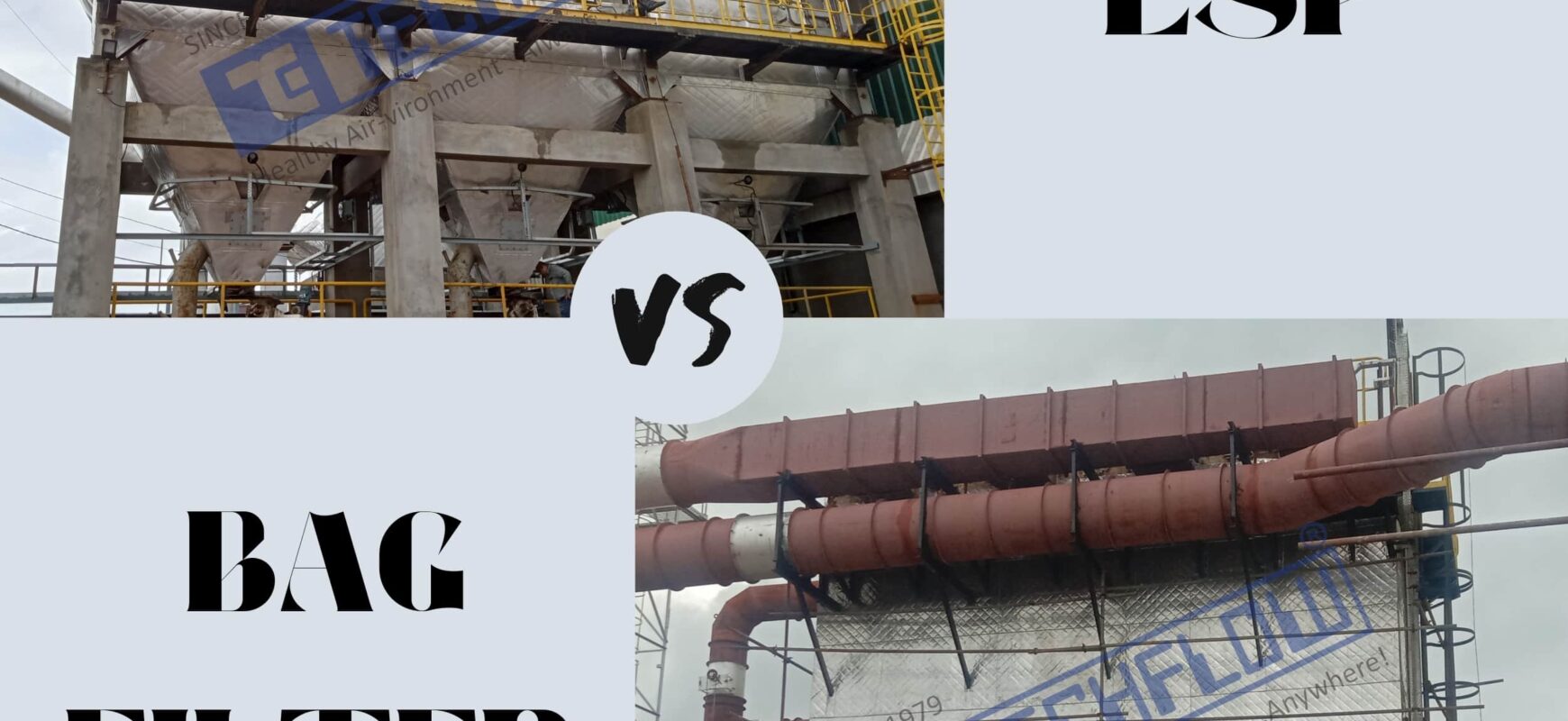
ESP vs Bag Filter
ESPs work by passing the dusty air through a strong electric field. The electric field charges the dust particles, which are then attracted to oppositely charged collection plates. The dust particles then fall off the collection plates into a hopper, where they can be collected and disposed of. ESPs are best suited for emission level less than 20 mg/Nm3, for lesser emission stnardards one has to go for Bag Filters
Bag filters work by passing the dusty air through a series of fabric bags. The dust particles are trapped in the fabric bags, and the clean air passes through the bags and out into the atmosphere. The fabric bags must be periodically cleaned or replaced to prevent them from becoming clogged with dust. Bag Filters can achieve emission control less than 5mg/Nm3 very effectively.
TECHFLOW is recognized as a top esp manufacturer and top esp supplier, delivering high-efficiency electrostatic precipitation systems for industrial applications.
Advantages and Disadvantages of ESPs
ESPs have a number of advantages over bag filters, including:
- Higher efficiency: ESPs can remove up to 99.9% of dust particles from the air, compared to 95-99% for bag filters.
- Longer lifespan: ESPs can last for 20 years or more, while bag filters typically need to be replaced every 1-2 years.
- Lower maintenance requirements: ESPs require less maintenance than bag filters, as the collection plates do not need to be cleaned as often.
However, ESPs also have some disadvantages, including:
- Higher upfront cost: ESPs are more expensive to purchase and install than bag filters.
- More complex operation: ESPs require more skilled operators than bag filters.
- Higher energy consumption: ESPs consume more energy than bag filters.
- Accident Risk: If not properly maintained the ESP possesses to cause major fatal accidents.
Advantages and Disadvantages of Bag Filters(Sugar Dust Collection System)
Bag filters have a number of advantages over ESPs, including:
- Emission Control: Bag filters can achieve emission standards up to 5mg/Nm3
- Lower upfront cost: Bag filters are less expensive to purchase and install than ESPs.
- Easier operation: Bag filters are easier to operate and maintain than ESPs.
- Lower energy consumption: Bag filters consume less energy than ESPs.
- Space requirements: Bagfilter needs less space requirement compared similar capacity of ESP
However, bag filters also have some disadvantages, including:
- Lower efficiency: Bag filters are not as efficient as ESPs at removing dust particles from the air.
- Shorter lifespan: Bag filters typically need to be replaced every 1-2 years, while ESPs can last for 20 years or more.
- Higher maintenance requirements: Bag filters require more maintenance than ESPs, as the fabric bags need to be periodically cleaned or replaced.
- Pressure Drop: Pressure drop in Bag Filter is drastic compared to ESP which leads to higher power selection in ID fans leading high motor selection.
Which Type of Filter Is Right for You?
Dust Type: The best type of filter for your sugar mill will depend on a number of factors, including the type of dust you need to remove, the required efficiency, the budget, and the available space.
Air Volume: If you need to remove a high volume of dust or you require very high efficiency, then an ESP for sugar industry is the best option. However, if you are on a tight budget or you have limited space, then a bag filter may be a better choice.
Statutory Compliance: The selection of filtration technology relies of the regulatory compliance. For example it is compulsory to have ESP for the plants having boilers over 8 tph capacity. It is important to consider the regional pollution control board compliance requirement before selecting the pollution control technology.
Capital Expenditure: Choosing the sophisticated technologies of ESP requires high capital expenditure for a company while Bag Filter would lessen this burden by cost effective solutions.
Industry Related Studies
A study by the Indian Institute of Technology Delhi found that ESPs are more effective at removing sugar dust from the air than bag filters. The study found that ESPs were able to remove up to 99.9% of sugar dust particles, compared to 95% for bag filters.
Another study, conducted by the University of Queensland, found that ESPs are also more energy-efficient than bag filters. The study found that ESPs consumed up to 50% less energy than bag filters.
Graph Details
The following graph shows the efficiency of ESPs and bag filters at removing sugar dust particles from the air:

Source: researchgate.net
Graph showing the efficiency of ESPs and bag filters at removing sugar dust particles from the air
As the graph shows, ESPs are more efficient at removing sugar dust particles from the air than bag filters. ESPs are able to remove up to 99.9% of sugar dust particles, while bag filters can only remove up to 95% of sugar dust particles.
How Techflow Can Help
Techflow is a leading manufacturer of ESPs and bag filters for sugar industry. We offer a wide range of sugar dust collectors to choose from, and we can help you select the right filter for your specific needs. Read more about how techflow helps in the sugar industry by clicking here.
We also offer a variety of services to help you keep your ESP or bag filter running smoothly, including:
- Installation and commissioning
- Maintenance and repair
- Training and support
Both ESPs and bag filters are effective at removing dust and other particles from the air. However, ESPs are more efficient and have a longer lifespan than bag filters. ESPs are also more energy-efficient than bag filters.
However, ESPs are more expensive to purchase and install than bag filters. ESPs also require more skilled operators and more maintenance than bag filters.
The best type of filter for your sugar mill will depend on a number of factors, including the type of dust you need to remove, the required efficiency, the budget, regulatory compliance and the available space.
If you need to remove a high volume of dust or you require very high efficiency, then an ESP is the best option. However, if you are on a tight budget or you have limited space, then a bag filter may be a better choice.
As a top bag filter supplier in India and top esp supplier in India, TECHFLOW provides end-to-end solutions tailored to industrial requirements.
Additional Considerations
In addition to the factors mentioned above, there are a few other things to consider when choosing between an ESP and a bag filter for your sugar mill:
- Filtration media: ESPs do not require any filtration media, while bag filters require fabric bags. The type of fabric bag you choose will depend on the type of dust you need to remove.
- Space requirements: ESPs are typically larger than bag filters. If you have limited space, then a bag filter may be a better option.
- Operating temperature: ESPs can operate at higher temperatures than bag filters. If you need to filter hot air, then an ESP may be the best option.
- Maintenance requirements: ESPs require less maintenance than bag filters. However, ESPs do require regular cleaning of the collection plates.
If you have any questions about the sugar dust collection system, ESPs or bag filters, or if you need help choosing the right filter for your sugar mill, please contact Techflow today.
Both ESPs and Bag Filters are effective air pollution control systems. ESPs offer higher efficiency and longer lifespan, while Bag Filters provide better emission control and cost advantages.
The right choice depends on:
- Dust characteristics
- Compliance requirements
- Budget
- Space availability
TECHFLOW continues to lead as a top esp manufacturer, top esp supplier, top bag filter manufacturer, and top bag filter supplier, delivering reliable and efficient solutions for industrial air pollution control.
FAQs:
1. What is the main challenge in sugar production that requires the use of filters like ESPs and Bag Filters?
Sugar production generates sugar dust and other airborne particles at various stages of the process. Controlling this dust is crucial to ensure a safe and productive environment, as sugar dust can pose health risks and create operational issues.
2. How do Electrostatic Precipitators (ESPs) work in the context of sugar dust collection?
ESPs work by passing dusty air through a strong electric field. This electric field charges the sugar dust particles, which are then attracted to oppositely charged collection plates. The collected dust particles are then removed from the plates and disposed of.
3. What is the operational principle of Bag Filters in sugar dust collection?
Bag Filters operate by passing dusty air through a series of fabric bags. The fabric bags trap the sugar dust particles, allowing clean air to pass through. Periodically, the bags are cleaned or replaced to prevent clogging.
4. How can sugar mills determine which filter type is right for their specific needs?
The choice between ESPs and Bag Filters depends on factors like the type of dust, required efficiency, budget, and available space. ESPs are suitable for high dust volume and high efficiency needs, while Bag Filters may be better for tighter budgets or limited space.
5. How can Techflow assist sugar mills with their air pollution control needs?
Techflow, a leading manufacturer, offers a wide range of ESPs and Bag Filters tailored to the sugar industry's specific requirements. They also provide services like installation, maintenance, repair, training, and support to ensure the smooth operation of these systems.
6. Are there any additional considerations for choosing between ESPs and Bag Filters in sugar dust collection?
Besides the factors mentioned earlier, consider aspects like filtration media, space requirements, operating temperature, and maintenance when making your decision. ESPs do not require filtration media, but they are typically larger and require regular cleaning of collection plates. Bag Filters need fabric bags and have lower operating temperatures but need periodic bag maintenance.
7. How can sugar mills get in touch with Techflow for assistance or further information?
Sugar mills can contact Techflow through their website or other provided contact information to inquire about their air pollution control solutions and get assistance in choosing the right filter for their specific needs.