

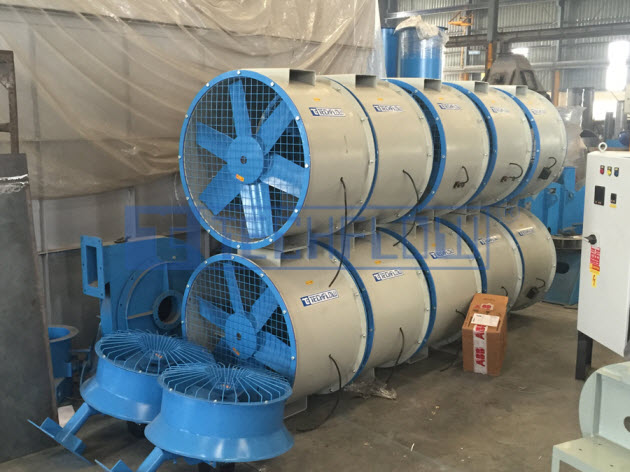
Axial flow fan is a device that is designed to be used in areas where there is a high rate of airflow. It is a relatively simple design and can be manufactured in a wide range of shapes and sizes. It is typically used in industries where there are noise issues, such as a medical setting or a manufacturing facility. However, there are several other applications where an axial flow fan can be useful.
What are the Applications of Axial Flow Fan?
Axial flow fans are commonly used to supply air to a variety of environments. They are particularly useful for cooling industrial equipment and removing heat energy from electronic systems. These types of fans have low power consumption and a compact footprint. However, they should not be used in highly contaminated air flows.
An axial flow fan is composed of cantilevered blades, an impeller, and a small motor. The impeller may have ball or sleeve bearings.
Axial fans are usually designed with a metallic impeller. This may lead to a high noise level. Metal impellers also have inconsistent dimensional stability and can have unsatisfactory aerofoil selection.
Axial-flow fans are often used in residential environments. They can be modified to meet specific needs.
How to Choose Axial Flow Fan?
These fans are capable of high efficiencies. However, they are not ideal for highly contaminated air flows. Therefore, it is important to choose an appropriate performance specification for your preferred supplier.
To determine the efficiency of an axial flow fan, the first step is to calculate the pressure difference. For a given capacity and a fixed outlet, the pressure difference is a measure of the total energy required to move the air.
A good way to estimate the pressure difference is by studying the circulation. This is usually done by measuring the velocities of the incoming and outgoing airflows. Assuming that the airflows are not turbulent, the average circumferential velocity can be calculated.
Performance Characteristics of Axial Flow Fan
The performance of an axial fan is affected by many factors. These include blade loading, pressure rise, and flow characteristics. An axial fan is also susceptible to surging, stalling, and unsteady flow.
Several reliable studies have been performed to study axial fan performance. Most of them focused on the meridional properties of the fan.
However, a more accurate characterization of the rotating part is becoming important for thermofluids engineers. Using a model-sized experimental test, computational fluid dynamics simulations were conducted to determine the flow fields produced by the axial mover. A grid system with 810,000 nodes was used for numerical analysis.
In addition to computational fluid dynamics simulations, an experimental test was performed to determine the performance of an axial fan. Three independent sources of fan data were used to generate a set of numerical curves. This was compared to the vendor's published testing data.
Lifespan of an Axial Flow Fan
The lifespan of an axial flow fan depends on several factors. However, if you choose a good quality product, you can expect the fan to last for a long time.
This type of fan is ideal for applications that require continuous operation, such as in an exhaust or cooling tower. Fans for this type of application need to be designed for the most efficient operation. They should be made from high quality materials and have a durable design.
Axial fans have a small footprint. They also work quietly and are capable of operating at high temperatures. They can also be easily customized to meet a variety of needs.
They are used in many applications, such as in wind tunnels and cooling towers. They are suitable for a wide range of operating temperatures, from -50 to 95 degrees Fahrenheit.
Reducing Noise Levels in Axial Flow Fan
Axial flow fans are used in a wide variety of applications. The design of an axial fan is typically concerned with noise reduction and efficiency.
To reduce the noise generated by axial flow fans, passive components are used to create a more quiet environment. In addition, aerodynamic blade design is considered, which can improve the laminar flow of the airstream. Lastly, special air inlet grilles are used to straighten the airflow.
Acoustic enclosures are also used to reduce noise. They are available in different materials and feature designs. Typically, acoustical enclosures are designed to meet specific fan application requirements. Using these features can significantly decrease the noise levels of an axial fan.
The Bottom Line
Axial flow fans can be used for a variety of applications. They are suitable for small to medium flow rates and can be incorporated easily into systems. Typical axial fans consist of six to twelve aerofoil section blades, and these fans are known for their benefits in different industrial and commercial settings.