


Key Takeaways
- A powder conveying system transports dry bulk powders and granules through an enclosed pipe, usually using air pressure or vacuum (pneumatic conveying).
- The two core pneumatic regimes are dilute (lean) phase, high velocity, low pressure, material fully suspended; and dense phase, low velocity, high pressure, material moving as gentle plugs or slugs.
- Dense phase is the preferred choice for abrasive, fragile, or moisture-sensitive powders because low velocity means far less product damage and pipe wear.
- Systems can be pressure-based (one source to many destinations, long distances) or vacuum-based (many sources to one destination, excellent for dust containment).
- Dense-phase transporters can be weight-based (mounted on load cells for accurate batching and dosing) or volume-based (level-controlled for straightforward bulk transfer).
- Correct selection depends on the material's properties, conveying rate, distance and layout, and safety requirements, never on price alone.
Moving dry powder from one point to another sounds simple until you actually have to do it at scale. Anyone who has run a cement plant, a spice unit, a pharmaceutical facility, or a foundry knows the reality: powders bridge in hoppers, cling to walls, absorb moisture, wear out equipment, throw dust into the air, and, if you get the design wrong, bring a whole production line to a halt.
A well-designed powder conveying system solves all of that quietly in the background. It transports bulk powders and granular materials through an enclosed pipeline, cleanly and repeatably, without spillage, contamination, or heavy manual handling.
This guide covers powder conveying from the ground up: what these systems are, how the main types work, where each one fits, how to size and specify one, and the safety and maintenance practices that separate a system that runs for a decade from one that becomes a maintenance headache. It's written for plant managers, process engineers, and procurement teams across India who need to make a confident, correct decision.
TECHFLOW Enterprises has designed and built material-handling and air-handling equipment from Ahmedabad since 1979, so much of the practical detail below reflects what actually works on Indian plant floors, not just textbook theory.
What Is a Powder Conveying System?
A powder conveying system is industrial equipment that moves dry bulk material powders, granules, flakes, or pellets from a source point (a silo, hopper, bag dump station, or reactor) to one or more destinations (a blender, mixer, mill, reactor, packing machine, or storage silo) through a fully enclosed route.
Broadly, there are two families of powder conveying technology:
- Mechanical conveying uses a moving physical element, such as a screw, belt, chain, bucket elevator, or vibrating trough, to carry material along. Vibrating conveyors, for example, are well suited to transferring fragile, wet, frozen, abrasive, or even explosive powders gently along a defined path.
- Pneumatic conveying uses a stream of air or gas moving through a pipe to carry the material. Because the route is a sealed pipeline rather than an open trough, pneumatic systems contain dust completely, protect the product from contamination, and route easily around obstacles, up vertical lifts, and across long distances.
Most modern powder-handling plants lean on pneumatic conveying for exactly those reasons: it is clean, flexible, low-maintenance, and it removes the need to gravity-charge vessels by hand. The rest of this guide focuses on pneumatic powder conveying, which is where the important engineering decisions live.
Quick definition: Pneumatic conveying is the transport of dry bulk solids through an enclosed pipeline using the energy of a moving gas, typically compressed air under either positive pressure or vacuum.
How Does Pneumatic Powder Conveying Work?
Every pneumatic conveying system, no matter how large, works on the same basic principle: a controlled stream of gas creates the force that carries solid particles along a pipe. What changes from system to system is how much gas is used relative to the amount of solids, and at what velocity and pressure that gas moves.
Two parameters describe this and determine almost everything else about a system's behaviour:
- Solids loading ratio: the mass of solids being conveyed divided by the mass of air conveying them. A low ratio means a lot of air for a little material; a high ratio means a little air moving a lot of material.
- Conveying (gas) velocity: how fast the gas travels through the pipe. This must stay above the material's saltation velocity, the minimum speed needed to keep particles moving rather than settling and piling up at the bottom of the pipe.
Get the balance between these two right, and material flows smoothly. Get it wrong, and you either shred the product with excessive speed or choke the pipe with a blockage. This single trade-off is why pneumatic conveying is split into two regimes: dilute phase and dense phase.
Dilute Phase vs. Dense Phase Conveying
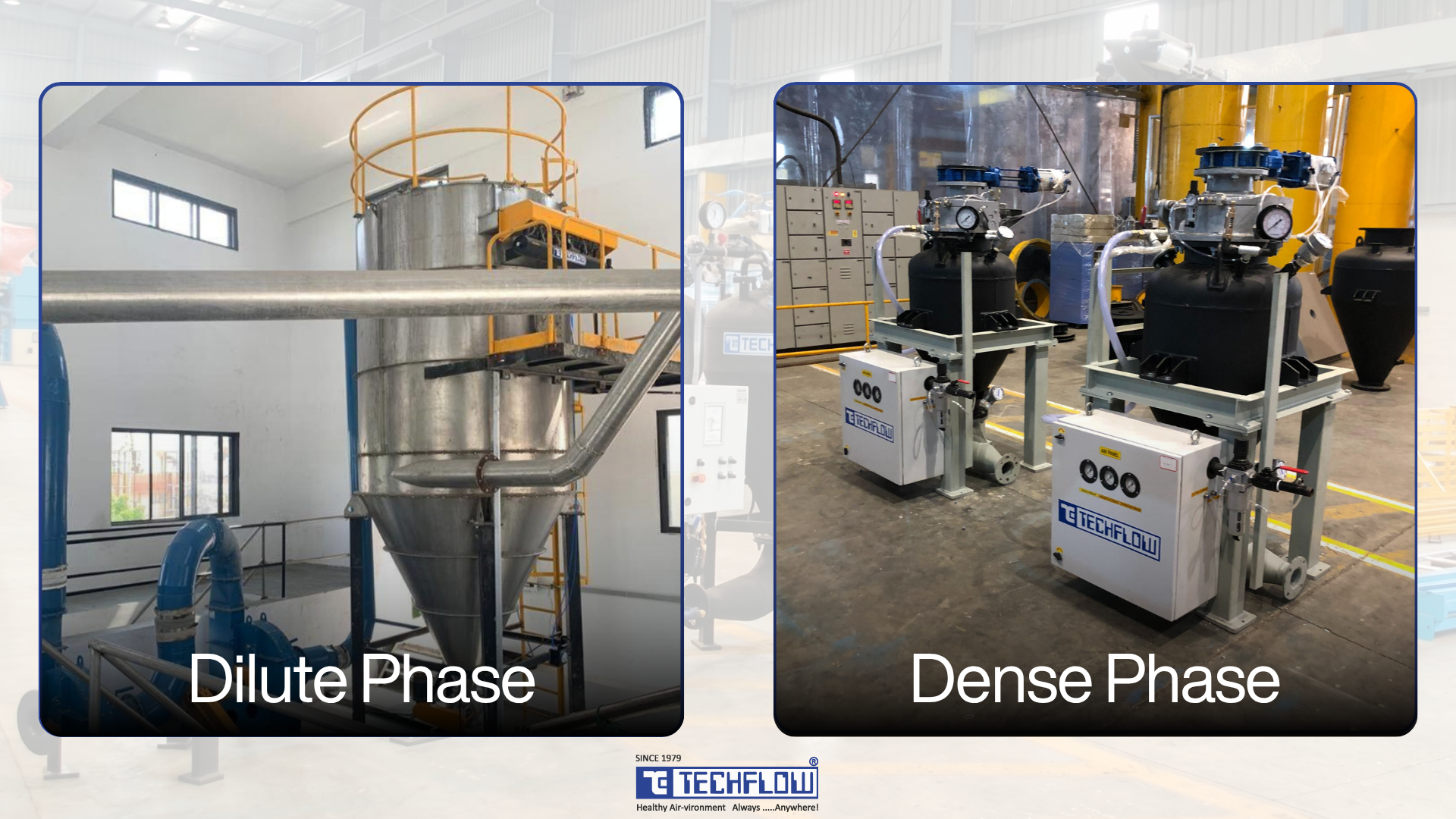
This is the most important distinction in the entire field, so it's worth understanding clearly.
Dilute (Lean) Phase Conveying
In dilute phase conveying, a large volume of high-velocity air keeps every particle fully suspended and dispersed in the gas stream; imagine dust floating in a fast-moving breeze. The solids loading ratio is low (generally up to about 15 kg of solids per kg of air), and conveying velocities are high, commonly in the range of roughly 15–30 m/s, at relatively low pressure (typically under 1 bar).
Almost any dry material can be moved in dilute phase, and the equipment is comparatively simple and inexpensive to install. The trade-off is speed: those high velocities mean more particle-on-pipe impact, which causes product degradation (fines, breakage) and accelerates wear on pipe bends when the material is abrasive. Dilute phase also uses a lot of air per tonne of product, so its energy cost per tonne tends to be higher.
Dilute phase suits: free-flowing, non-abrasive, robust materials at short-to-medium distances; many food powders, plastic pellets, and similar products where a little breakage is acceptable.
Dense Phase Conveying
In dense phase conveying, the picture is reversed. A small amount of higher-pressure air pushes the material along at low velocity in a "non-suspension" flow; the powder travels as compact plugs, slugs, or a slow-moving bed rather than as a suspended cloud. Solids loading ratios are high (well above 15, and often 100 or more), velocities are low (typically in the single digits, often around 1–10 m/s), and pressures are higher (commonly 2–6 bar, and up to around 10 bar in heavy-duty designs).
Because the material moves slowly and stays together, dense phase conveying is remarkably gentle. It minimises particle breakage, dramatically reduces wear on the pipeline, and generates far less dust and fewer fines. It also handles difficult materials abrasive, friable, cohesive, and moisture-sensitive powders that would suffer in a high-velocity dilute system.
Dense phase suits: abrasive materials (cement, fly ash, alumina, silica, foundry sand), fragile products that must not shatter, and hygroscopic or dust-prone powders typically at higher capacities and over longer distances.
TECHFLOW specialises in dense phase pneumatic conveying systems precisely because so many Indian industries cement, steel, foundry, chemicals, minerals handle exactly these kinds of demanding materials.
Dilute vs. Dense Phase: At a Glance
| Parameter | Dilute (Lean) Phase | Dense Phase |
|---|---|---|
| Flow pattern | Particles fully suspended in the air stream | Plugs, slugs, or moving bed (non-suspension) |
| Solids loading ratio | Low (up to ~15) | High (often 100+) |
| Conveying velocity | High (~15–30 m/s) | Low (~1–10 m/s) |
| Operating pressure | Low (typically < 1 bar) | Higher (typically 2–6 bar, up to ~10) |
| Air/energy per tonne | Higher | Lower |
| Product degradation | Higher (high-impact) | Very low (gentle) |
| Pipe wear with abrasives | Higher | Much lower |
| Best-suited materials | Free-flowing, non-abrasive, robust | Abrasive, fragile, cohesive, hygroscopic |
| Typical capital cost | Lower | Higher |
There is also an intermediate semi-dense regime that sits between the two, useful for aeratable materials at medium transfer rates, but the dilute/dense split covers the vast majority of real-world decisions.
Pressure vs. Vacuum Conveying: Which Way Does the Air Move?
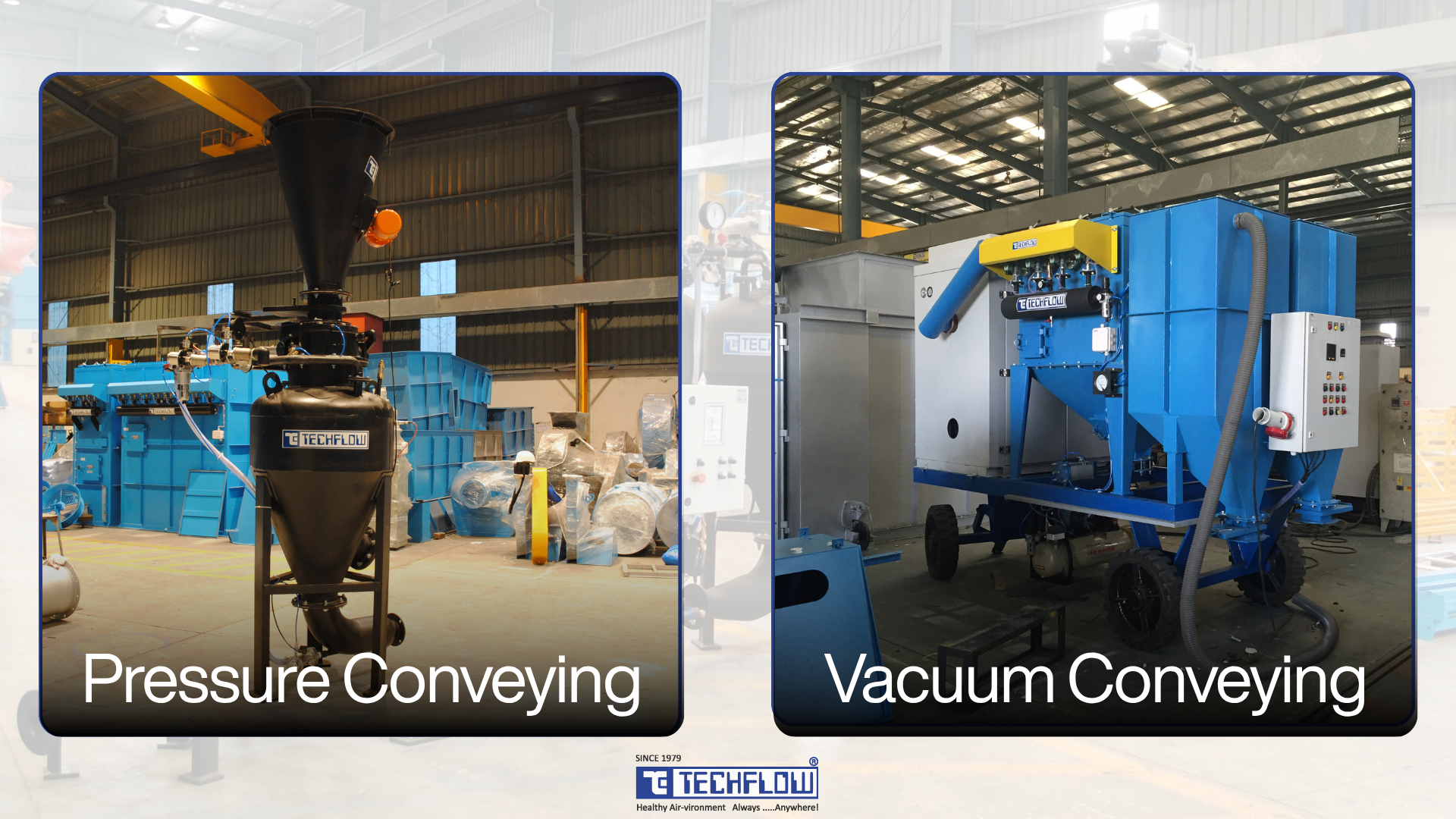
Independent of dilute or dense phase, a pneumatic system can be built to push or pull the material. This choice is driven by plant layout, specifically, how many source and destination points you have.
Pressure (positive-pressure) systems place the air mover at the start of the line and blow material downstream. Positive pressure is ideal for conveying from a single source to multiple destinations, for longer distances and higher capacities, because more pressure energy is available to push the material a long way.
Vacuum (negative-pressure) systems place the air mover at the end of the line and pull material through the pipe under suction. Vacuum shines when you need to draw from multiple sources into a single destination, over shorter distances. Because any pipe leak draws inward rather than blowing dust outward, vacuum systems offer excellent dust containment, a real advantage in hygienic environments such as food and pharmaceutical production, and for handling toxic or highly dusty powders.
| If you need to… | Choose |
|---|---|
| Convey far, or to several destinations from one source | Pressure |
| Collect from several sources into one destination | Vacuum |
| Maximise dust containment and hygiene | Vacuum |
| Move high tonnages over long distances | Pressure (often dense phase) |
Some plants combine both a vacuum "pull" to collect and a pressure "push" to distribute in a single integrated line.
Weight-Based vs. Volume-Based Dense Phase Systems
Once you've settled on a dense phase pressure system, there's one more design decision that has a direct impact on process accuracy: how the batch is measured. This is the difference between a weight-based and a volume-based system, and it's a distinction TECHFLOW builds into its dense phase range.
At the heart of a dense phase pressure system is a dense-phase transporter (DPT), also called a pressure vessel, blow tank, or blow pot. In batch operation, the vessel fills with a measured amount of material, seals, is pressurised with compressed air, and then opens its discharge valve to push that batch through the pipeline as a plug. When the plug reaches the receiver, the pressure is released, and the air separates from the material. The cycle then repeats.
The question is: how do you decide "how much" material goes into each batch?
Volume-based systems fill the vessel to a set level, detected by a level sensor or probe, or by a timed fill. Each batch is therefore a consistent volume of material. This approach is simpler and cost-effective, and it's the right choice for straightforward bulk transfer where you simply need to move a material reliably from A to B, and the exact mass per batch isn't critical.
Weight-based systems mount the transporter (or the receiving vessel) on load cells, so the control system knows the exact weight of each batch in real time. This enables accurate dosing, recipe batching, and inventory tracking; you can dispense a precise mass of one ingredient into a mixer or reactor. Weight-based control is the right choice when dosing accuracy and material accounting matter, such as feeding precise formulations in chemicals, food, or pharmaceutical processes.
| Feature | Volume-Based | Weight-Based |
|---|---|---|
| Batch measured by | Level/volume (level probe or timer) | Mass (load cells) |
| Best for | Reliable bulk point-to-point transfer | Precise dosing, recipe batching, inventory |
| Dosing accuracy | Good for straight transfer | High measured to the kilogram |
| Relative complexity/cost | Lower | Higher (instrumentation-rich) |
| Typical use | Moving one material between two points | Feeding metered ingredients into a process |
Choosing correctly here avoids two classic mistakes: over-specifying an expensive weight-batching system when you only need simple transfer, or under-specifying a volume system when your process actually depends on dosing accuracy.
Key Components of a Powder Conveying System
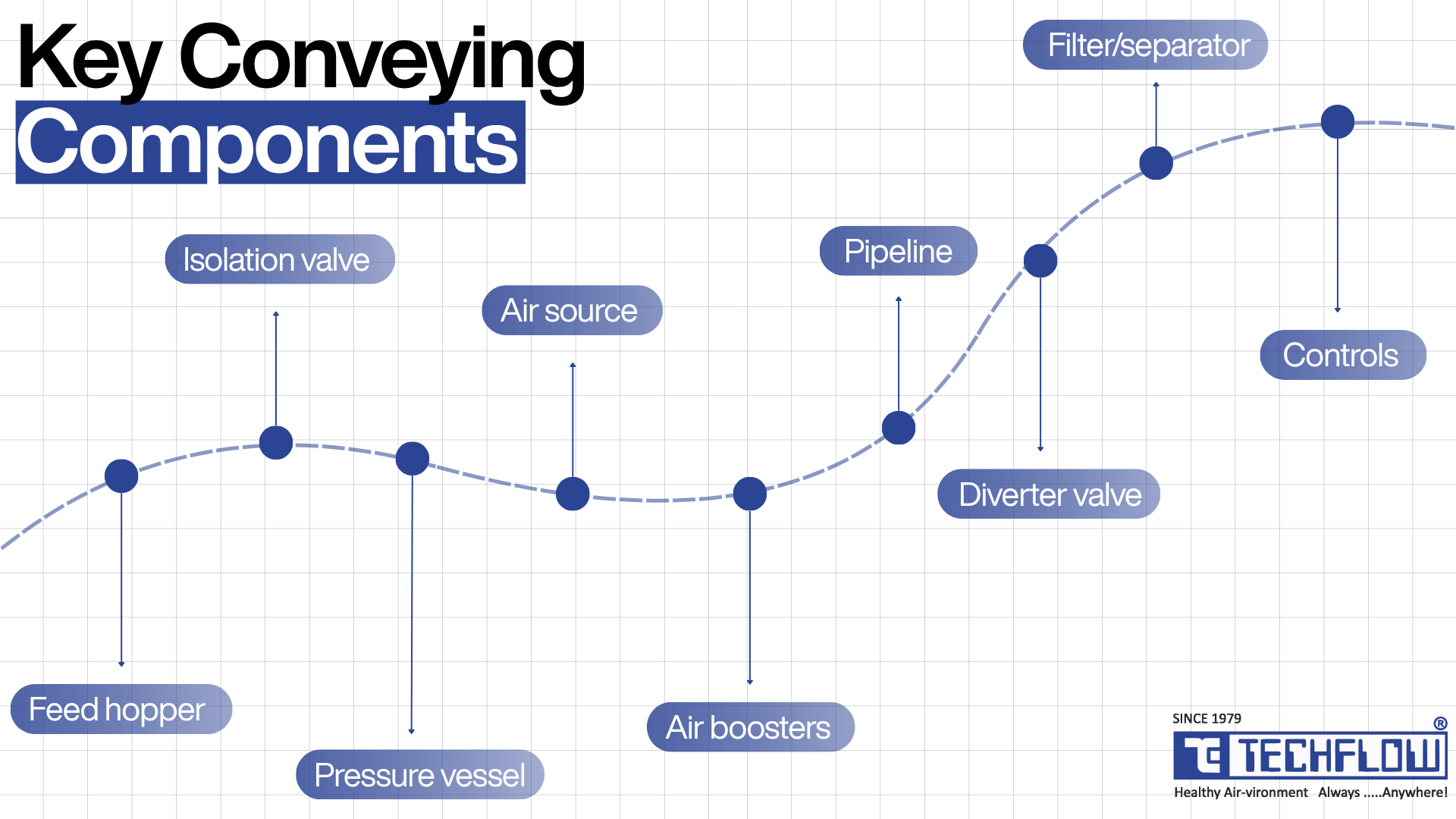
Understanding the main building blocks makes it much easier to specify a system and to talk clearly with an engineering supplier. A typical dense-phase pressure system includes:
- Feed hopper/silo: Holds the incoming material above the transporter and feeds it in.
- Isolation (dome) valve: Seals the transporter from the feed hopper during pressurisation so no material or pressure escapes upward. TECHFLOW's dome valves (Dome Tuff) are engineered exactly for this critical-service isolation duty, the point at which butterfly, ball, and slide-gate valves struggle and are available across a wide range of sizes for demanding material-handling applications.
- Dense-phase transporter/pressure vessel: The core of the system, where each batch is loaded, sealed, and pressurised before discharge.
- Compressed air source: Supplies the motive gas, usually a compressor or a positive-displacement (Roots) blower, depending on the pressure required.
- Aeration and air-boosting: Air injectors or boosters along the line help fluidise and keep the plug moving smoothly, preventing stalls.
- Conveying pipeline and bends: The route itself. Bends are wear-critical: for abrasive materials, hardened or ceramic-lined long-radius bends dramatically extend service life.
- Diverter valves: For multi-destination systems, these direct the flow to the correct receiving point.
- Receiving filter/separator: At the destination, a filter receiver, bin-vent filter, cyclone, or pulse-jet filter separates the conveying air from the material and vents clean air. TECHFLOW's pulse-jet bag filters are commonly paired with conveying systems to keep terminal emissions well within limits, often with automatic reverse-pulse air cleaning of the filter media.
- Instrumentation and controls: Level sensors, pressure transmitters, and (for weight-based systems) load cells feed a PLC that sequences the fill–pressurise–convey–vent cycle. SCADA integration is available where full plant automation and data logging are required.
Applications: Which Industries Rely on Powder Conveying?
Powder conveying is genuinely cross-industry; almost any process that handles dry bulk material uses it somewhere. Across the sectors TECHFLOW serves, common applications include:
- Cement and building materials: conveying cement, fly ash, lime, and raw meal, all highly abrasive and dust-prone, where dense phase's low wear is a major advantage.
- Foundry and steel: transporting foundry sand, additives, and dust-collector fines in demanding, high-temperature environments.
- Mining and minerals: moving abrasive mineral powders, alumina, silica, and processed ores.
- Chemicals: handling reactive, toxic, or hygroscopic powders in sealed lines, where containment and precise dosing matter.
- Food processing: conveying flour, sugar, starch, spices, and additives cleanly and hygienically, often with vacuum systems for dust control.
- Pharmaceuticals: gentle, contained, contamination-free transfer of active ingredients and excipients into blenders and reactors.
- Power and boilers: pneumatic ash handling, where reliable conveying of fly ash prevents costly boiler-side shutdowns.
- Plastics, glass, wood, and laminates: moving granules, cullet, and process powders.
In each case, the system is designed to keep both the operator and the material safe: dry powders move without leakage, dust exposure is controlled, and fragile or valuable materials arrive intact. TECHFLOW delivers these as turnkey projects design, manufacture, installation, and after-sales support which is why sectors from cement to spices rely on a single partner rather than assembling components piecemeal.
Benefits of Pneumatic Powder Conveying
Why do so many plants choose pneumatic conveying over mechanical alternatives? The advantages compound quickly:
- Fully enclosed and dust-free: The sealed pipeline contains the product completely, cleaner air, safer workplaces, and no cross-contamination.
- Flexible routing: Pipes run around obstacles, up walls, and across long distances that would be impractical for belts or screws, and they suit congested or awkward plant layouts.
- Small footprint: A compact transporter and a length of pipe replace bulky mechanical conveyors, freeing valuable floor space.
- Longer conveying distances: Pneumatic systems, especially dense phase under pressure, reach distances that mechanical transfer cannot economically match.
- Fewer moving parts, lower maintenance: With few wearing components along the line, breakdowns are rarer, and maintenance is often concentrated at a single point.
- Gentle on materials (dense phase): Low velocity means minimal breakage and degradation, critical for fragile or high-value powders.
- Low civil works: Systems often avoid the heavy foundations and structural steel that large mechanical conveyors demand, reducing installation cost.
- Easy automation: Sealed, sensor-driven systems integrate naturally with PLC/SCADA control and batching logic.
How to Choose the Right Powder Conveying System
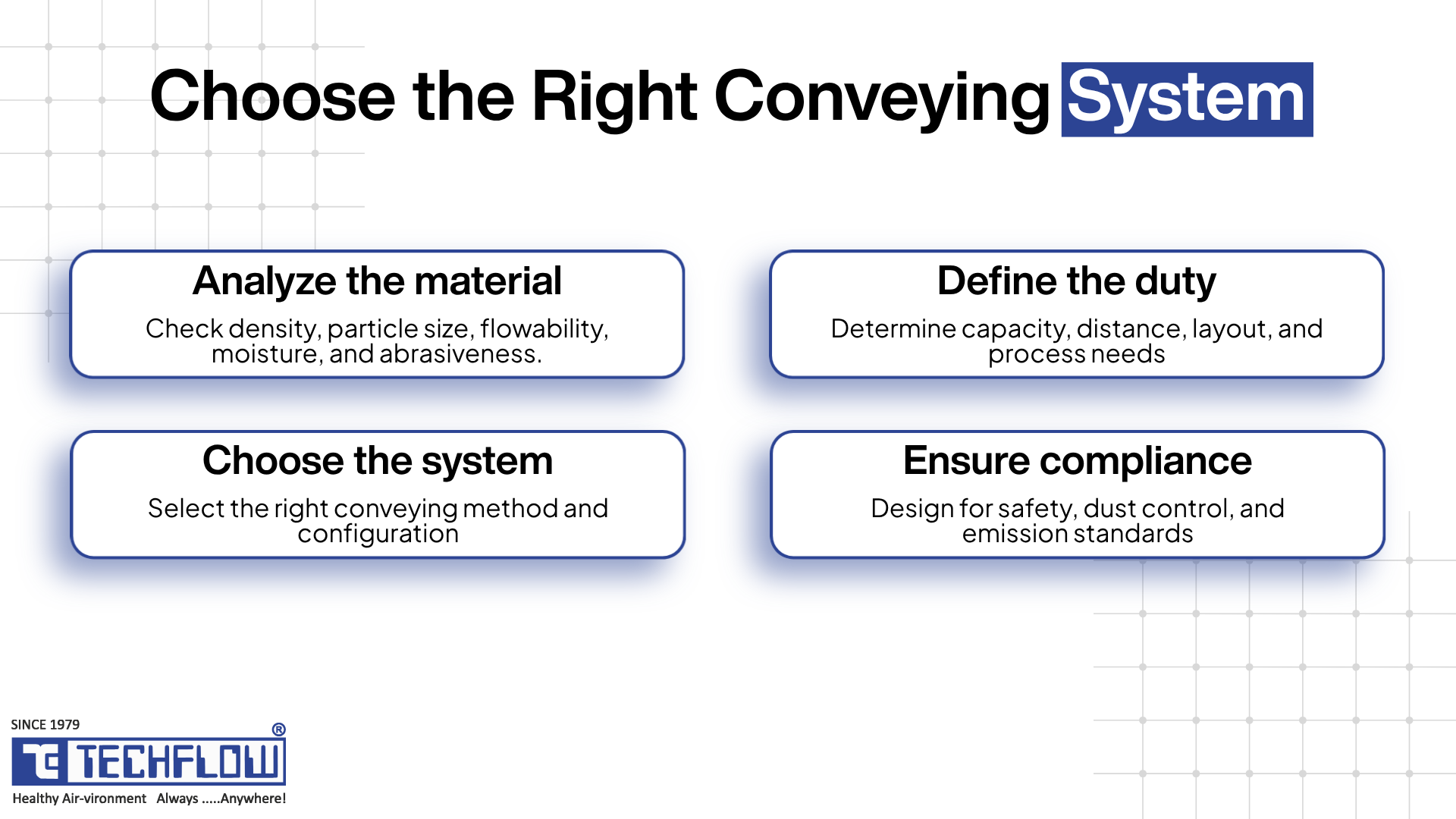
There is no single "best" system; only the best system for your material and process. A sound selection follows a clear order, starting with the material itself and ending with the hardware. Rushing to pick equipment before you understand the powder is the root cause of most conveying failures.
Step 1: Characterise the material (this comes first)
Before anything else, understand how the powder behaves:
- Bulk density: how heavy the material is per unit volume.
- Particle size and distribution: fine powders pack easily; mixed sizes can load unevenly.
- Abrasiveness: abrasive materials demand low velocity and wear-resistant bends.
- Friability: fragile materials need gentle, low-velocity dense phase.
- Moisture content and hygroscopicity: damp or moisture-absorbing powders are prone to sticking and bridging.
- Flowability and cohesiveness: cohesive powders may need aeration aids.
- Temperature and chemistry: hot, reactive, or corrosive materials affect material-of-construction choices.
Step 2: Define the duty
- Conveying rate: required (tonnes per hour), including peak demand, not just average.
- Distance and geometry: total run length, vertical lifts, and number of bends.
- Source and destination count: one-to-many (favours pressure) or many-to-one (favours vacuum).
- Process: need simple transfer (volume-based) or precise dosing/batching (weight-based).
Step 3: Select the regime and configuration
With the above in hand, the choice of dilute vs. dense, pressure vs. vacuum, and weight- vs. volume-based usually becomes clear. Abrasive or fragile materials point to dense phase; long distances and high tonnages point to pressure; dosing accuracy points to weight-based control.
Step 4: Design for safety and compliance
Factor in combustible-dust risk, pressure-vessel safety, and emission limits from the start (covered below) rather than bolting them on later.
Decision Checklist
Use this quick checklist when scoping a system or briefing a supplier:
- ☐ Have we tested/documented the material's bulk density, particle size, abrasiveness, friability, and moisture behaviour?
- ☐ Do we know the required conveying rate at peak, not just average?
- ☐ Have we mapped the full route distance, lifts, and bends?
- ☐ How many source and destination points are there?
- ☐ Do we need precise dosing (weight-based) or simple transfer (volume-based)?
- ☐ Is the powder combustible, toxic, or hygroscopic?
- ☐ Is dry, clean compressed air of adequate capacity available?
- ☐ What emission limits and safety standards apply to the site?
- ☐ Does the supplier offer turnkey design, installation, and after-sales support?
Troubleshooting Common Problems
When an established system starts misbehaving, the cause is usually one of a familiar set of issues.
Pipeline Blockage
The most common complaint. Blockages typically begin when the conveying velocity falls below the material's saltation velocity, so particles settle and build up until the pipe chokes. Frequent culprits:
- Conveying velocity or air volume too low (check the blower/compressor and settings).
- Wet compressed air raising the material's cohesiveness.
- Undersized compressor for the actual distance and bulk density.
- Overfeeding material fed faster than the air can carry it.
- Sharp bends or an unsuitable modified component causing accumulation.
- Foreign objects (rags, bolts, packaging) entering the feed and lodging in the line.
- Out-of-spec material: a change in particle size, bulk density, or moisture the system wasn't designed for.
Fixes: restore correct velocity and dry air, feed at a steady controlled rate, remove foreign material, and confirm the material still matches the original design basis. Dense-phase systems, running at low velocity, are inherently more resistant to this kind of choking at variable loads.
Product Degradation (Excess Fines / Breakage)
Usually a symptom of excessive velocity in a dilute system. Switching to dense phase, or where dilute is unavoidable, reducing velocity and using larger sweep-radius bends reduces impact damage and fines generation.
Accelerated Pipe Wear
Abrasive materials erode bends first. Direct wear into replaceable, hardened or ceramic-lined elbows and wear-resistant pipe sections rather than letting the line eat into structural pipe. Lowering velocity (dense phase) is the most effective long-term fix.
Material Caking or Sticking
Hygroscopic powders absorb moisture and clump. Day-to-night temperature swings can cause condensation inside the pipe, which the material then absorbs. Trace heating, insulation, and properly dried compressed air prevent this.
Dust Emissions at the Destination
Usually a filter or sealing issue at the receiving end. Correctly sized filter receivers or pulse-jet filters with functioning cleaning cycles keep terminal emissions within limits.
Maintenance Best Practices
A powder conveying system rewards a modest, consistent maintenance routine with years of reliable service:
- Keep compressed air dry and clean. Service dryers, filters, and after-coolers; moisture is the enemy of reliable conveying.
- Inspect bends and wear points. Check hardened/ceramic elbows on abrasive duties and replace before they fail; wear tends to concentrate predictably.
- Check valve seals. Isolation (dome) valves and discharge valves depend on good seals for correct pressurisation; inspect and replace seats and seals on schedule.
- Service the receiving filter. Keep filter media and the reverse-pulse cleaning system in good order to maintain airflow and control emissions.
- Verify instrumentation. Recalibrate load cells, pressure transmitters, and level sensors so batching and sequencing stay accurate.
- Watch for out-of-spec material and foreign objects. A change in the powder, or debris in the feed, is a frequent hidden cause of trouble.
- Log performance trends. Rising cycle times or pressures often signal wear or partial blockage before an outright failure; modern PLC/SCADA systems make this easy to track.
Future Trends in Powder Conveying
The direction of travel in bulk material handling is toward smarter, more efficient, and more self-aware systems:
- Advanced automation and control. Cheaper, better instrumentation and variable-frequency drives allow finer control of air velocity and feed rate, improving both efficiency and reliability.
- Data, diagnostics, and predictive maintenance. Real-time monitoring and trend logging increasingly flag wear and developing blockages before they cause downtime. TECHFLOW's own development of SMART-LINK software intended to connect equipment for automatic monitoring, parameter-setting, and energy savings reflects this shift.
- Energy optimisation. As energy costs rise, dense phase's low air-consumption profile and smarter velocity control become even more attractive.
- Tighter emission and safety compliance. Stricter dust and emission expectations continue to push enclosed, well-filtered conveying over open mechanical handling.
Choosing a Powder Conveying Partner in India
Selecting a supplier is about far more than a price list. The right partner understands your material, engineers the system correctly the first time, builds it to proper safety and pressure standards, and stands behind it with responsive after-sales support. Value for money comes from a system that runs reliably for years, not from the lowest quotation for hardware that chokes, wears out, or fails compliance.
TECHFLOW Enterprises has engineered material-handling and air-pollution-control equipment from Ahmedabad since 1979, delivering dense phase pneumatic conveying systems as complete turnkey projects from design and manufacture through installation, commissioning, and ongoing support. That in-house expertise across conveying, dome valves, dust collection, and filtration means every part of the system is designed to work together, tuned to the specific powder and the realities of your plant.
If you're evaluating a powder conveying system for a cement plant, foundry, chemical unit, food facility, or any process that handles dry bulk material, the most valuable first step is a conversation about your material and your duty because that's where a correct, durable design begins.
Call to Action
Ready to specify the right powder conveying system for your plant? Share your material and process details with TECHFLOW's engineering team for expert guidance on the ideal dense phase configuration. Explore TECHFLOW's dense phase pneumatic conveying systems or contact our specialists for a turnkey solution tailored to your material, capacity, and layout.
Frequently Asked Questions (FAQs)
A powder conveying system is industrial equipment that moves dry bulk powders and granules from a source to one or more destinations through an enclosed route, most commonly a pipeline using air pressure or vacuum (pneumatic conveying), which keeps the process clean, contained, and largely automated.
Dilute (lean) phase uses high-velocity, low-pressure air to keep particles fully suspended, suiting free-flowing, non-abrasive materials at lower cost. Dense phase uses low-velocity, high-pressure air to move material gently as plugs or slugs, suiting abrasive, fragile, or moisture-sensitive powders with far less product damage and pipe wear.
Neither is universally better; it depends on layout. Pressure systems suit conveying from one source to many destinations over long distances and high tonnages. Vacuum systems suit collecting from many sources into one destination over shorter distances and offer superior dust containment for hygienic or dusty materials.
It's used to gently transport abrasive, fragile, cohesive, or hygroscopic powders and granules such as cement, fly ash, foundry sand, minerals, chemicals, and food or pharmaceutical ingredients where minimal breakage, low dust, and low wear are important.
A weight-based system mounts the transporter on load cells to measure each batch by mass, enabling precise dosing, recipe batching, and inventory tracking. A volume-based system fills the vessel to a set level or time, measuring each batch by volume, simpler and cost-effective for straightforward bulk transfer.
Blockages usually occur when conveying velocity falls below the material's saltation velocity, or from wet compressed air, an undersized compressor, overfeeding, sharp bends, foreign objects, or out-of-spec material. Prevention includes maintaining correct velocity and dry air, steady controlled feeding, wear-resistant long-radius bends, and keeping the material within its design specification.
Yes, when properly engineered. Many powders are combustible when airborne, so systems handling them should be designed around a Dust Hazard Analysis with prevention, protection, and isolation measures (following frameworks such as NFPA 652/660 or ATEX). Dense phase conveying is inherently safer because its low velocity and enclosed flow generate much less airborne dust.
Cement and building materials, foundry and steel, mining and minerals, chemicals, food processing, pharmaceuticals, power generation and boilers, plastics, glass, and wood or laminate manufacturing all rely on powder conveying systems for clean, efficient bulk material transfer.
Start by characterising the material (bulk density, particle size, abrasiveness, friability, moisture), then define the duty (peak rate, distance, layout, number of source and destination points, and whether you need dosing accuracy). Those inputs determine the right regime (dilute or dense), configuration (pressure or vacuum), and control method (weight- or volume-based).


