
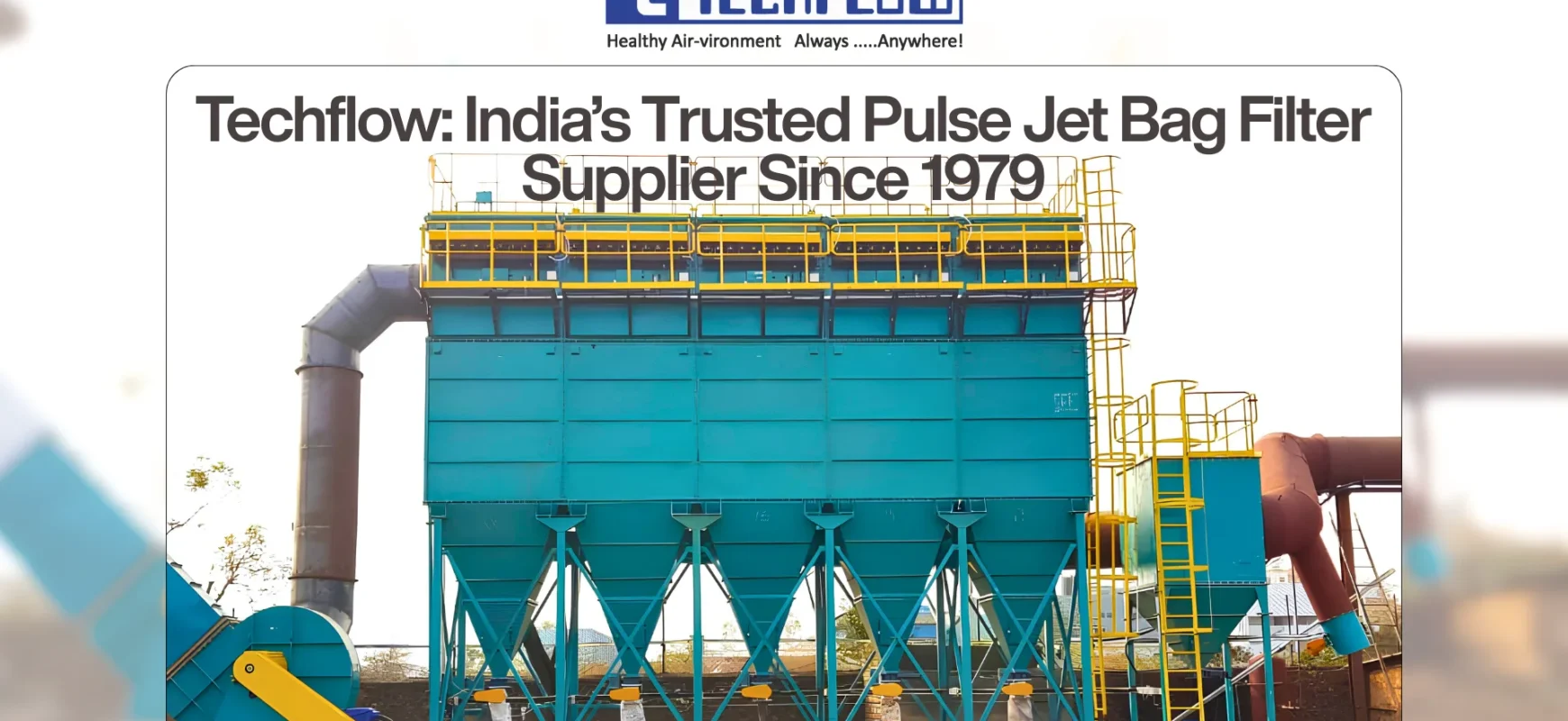
A pulse jet bag filter is an automatic, self-cleaning dust collector that captures fine particulate on fabric bags and clears them with short bursts of compressed air, allowing non-stop filtration. When buying one in India, the supplier's engineering judgment matters more than the price tag, because correct sizing of the air-to-cloth ratio, filter media, and cleaning cycle is what keeps emissions compliant and bags lasting for years. TECHFLOW Enterprises Pvt. Ltd has engineered application-specific dust collection systems from Ahmedabad since 1979, with a pan-India footprint and worldwide exports.
Key takeaways
- A pulse jet bag filter cleans its bags while it's still running, so the plant doesn't have to stop filtering during cleaning.
- Well-designed units routinely exceed 99% collection efficiency and help plants meet CPCB stack-emission limits.
- The two numbers that make or break performance are the air-to-cloth ratio and the can (interstitial) velocity.
- Filter media must be matched to gas temperature and chemistry, from polyester at lower temperatures to PTFE, P84, and fiberglass for hot, aggressive streams.
- Choosing a supplier is an engineering decision: weigh design capability, manufacturing quality, sector experience, and after-sales support over headline cost.
- TECHFLOW has designed and supplied custom pulse jet bag filters across cement, steel, foundry, chemicals, pharma, and more since 1979.
Specifying a dust collector looks simple on a purchase requisition: one "pulse jet bag filter, suitable capacity." In practice, two plants running the same process can buy filters that look identical on paper and get completely different results, one quietly meeting its emission limit for a decade, the other failing a stack test and chewing through filter bags every eight months. The difference is rarely the steelwork. It is the engineering behind the sizing and the experience of the company that did it.
That is why the search for a pulse jet bag filter supplier in India is really a search for an engineering partner. This guide explains how the technology works, the design variables that decide whether it performs, where it fits, and how to judge a supplier, before looking at why TECHFLOW has stayed a trusted name in industrial air pollution control since 1979.
What Is a Pulse Jet Bag Filter?
A pulse jet bag filter is an industrial baghouse that separates dust from an air or gas stream using fabric filter bags, then cleans those bags automatically with timed pulses of compressed air. Because cleaning happens while the unit keeps running, it filters continuously, which is why it has become the default pulse jet dust collector design across heavy industry.
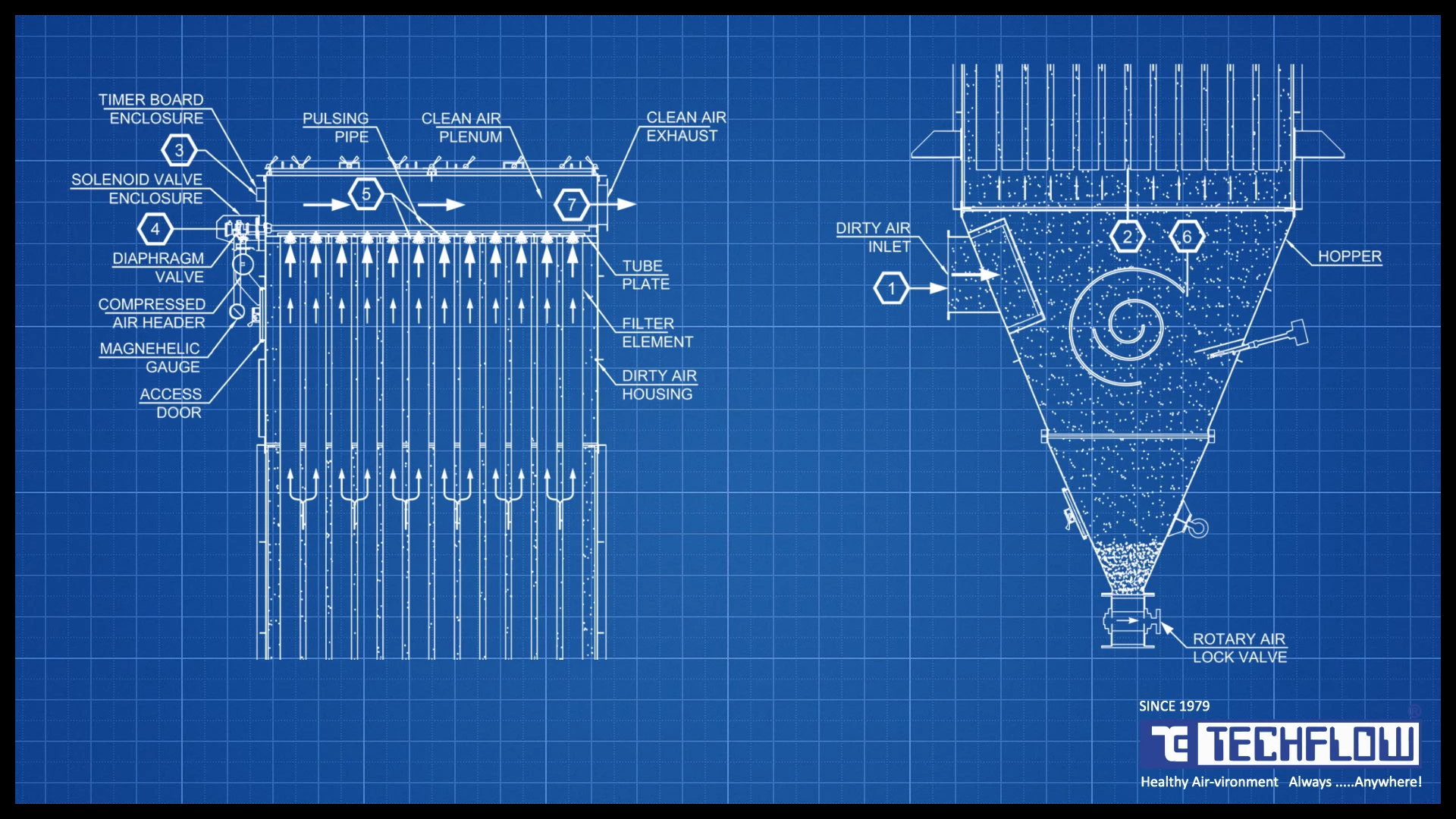
Inside the housing, rows of vertical bags sit over wire support cages. Dust-laden air enters, dust builds up on the outside of each bag, and clean air passes through and exits the top. A timed compressed-air pulse periodically knocks the dust cake off so the filter holds a stable pressure drop instead of slowly choking. That combination of high efficiency and hands-off, self-cleaning operation is what sets the industrial baghouse filter apart from older collectors.
How Does a Pulse Jet Bag Filter Work?
A pulse jet bag filter works by drawing dusty air through filter bags so dust collects on the outer surface, then firing a brief, high-pressure jet of compressed air down each bag to snap the dust cake loose into a hopper. Filtration and cleaning happen in the same vessel, so the process never has to stop.
The working cycle runs like this:
- Entry and pre-separation. Dusty air enters, usually through the hopper, where heavier particles drop out by gravity before reaching the bags.
- Surface filtration. Lighter particles rise to the bags. Air passes through the fabric, dust is trapped on the outside, and clean air leaves through the clean-air plenum.
- Cake formation. A dust cake builds on the bags. It actually increases the filtration but steadily raises resistance to airflow, seen as a rising pressure drop.
- Pulse cleaning. At set intervals (timed, or triggered by pressure drop), compressed air shoots through venturis via solenoid pulse valves and blow pipes. This drives a strong reverse flow that sends a shock wave down each bag, flexing it outward.
- Discharge. The shock dislodges the cake, which falls into the hopper and is removed by a rotary airlock valve or screw conveyor.
Only a small group of bags is pulsed at any moment, so the rest keep filtering. The result is a continuous, stable dedusting cycle, which is exactly the behaviour a process plant needs.
Pulse Jet vs Other Baghouse Cleaning Methods
Baghouses are grouped by how they clean their bags: mechanical shaker, reverse air, and pulse jet. The table below summarises the practical trade-offs.
|
Factor |
Pulse jet |
Reverse air |
Mechanical shaker |
|
Cleaning |
High-pressure compressed-air pulse |
Gentle reversed airflow |
Physical shaking of bags |
|
Operation during cleaning |
Online, continuous |
Usually online, compartmentalised |
Often needs to go offline |
|
Air-to-cloth ratio |
Highest (compact units) |
Low (larger units) |
Low to moderate |
|
Filter media |
Felted/needled |
Often woven |
Woven |
|
Best fit |
Most modern process dust |
High-temperature, gentle duty |
Simple, lower-cost duty |
|
Main trade-off |
Compressed-air energy cost |
Larger footprint, more cloth |
Wear, not for fine/explosive dust |
The reason pulse jet has become the dominant choice is structural: online cleaning means the full cloth area stays in service, the high air-to-cloth ratio shrinks the footprint, and aggressive pulse cleaning lets the unit hold a low, steady pressure drop while capturing very fine particulate.
What Makes a Pulse Jet Bag Filter Perform
Two filters can look identical on a drawing and behave nothing alike in service. The difference comes down to a handful of design decisions.
Why Pulse Jet Bag Filters Are Preferred in Industrial Dust Collection
- Continuous operation. Online cleaning means the filter runs around the clock without stopping the process.
- Cleaning on demand. Pulses can be triggered by pressure drop rather than a fixed clock, so compressed air and energy are spent only when needed.
- High filtration efficiency. A well-engineered unit comfortably exceeds 99% collection and can capture sub-micron particulate, helping plants stay inside tight emission limits.
- Lower downtime. Bag-and-cage construction makes inspection and bag changes fast.
- Long filter life. Correct air-to-cloth ratio, the right fabric, and gentle, well-timed cleaning are what stretch bag life and cut running cost.
- Compact footprint. A higher air-to-cloth ratio packs more throughput into less floor space than reverse-air or shaker designs.
These benefits are real, but they are conditional. They show up only when the unit is engineered correctly, which brings us to the numbers.
Air-to-Cloth Ratio and Can Velocity
Two variables separate a filter that lasts from one that blinds, wears out, or leaks dust.
Air-to-cloth (A/C) ratio is the volume of gas passing through each square metre of fabric. Pulse jet systems typically run higher A/C ratios than reverse-air units, commonly in the region of 1.0 to 3.0 m³/min per m² (roughly 3 to 10 ft/min) depending on the dust. Push it too high to save on cloth and capital cost, and you get higher pressure drop, more frequent cleaning, and premature bag failure. Set it conservatively, and the unit is larger but quieter on energy and gentler on bags. Getting this balance right for your specific dust is the single most important design call.
Can velocity ( interstitial velocity ) is the upward air speed in the gaps between bags in a hopper-inlet design. If it is too high, dust knocked off during a pulse gets re-entrained and carried straight back onto the bags instead of falling into the hopper, quietly defeating the cleaning system. Experienced designers size the casing so this stays in check, a detail that catalogue selection routinely misses.
Matching Filter Media to Your Process
Filter media must match gas temperature and chemistry. The wrong fabric is one of the most common causes of early bag failure.
|
Filter media |
Approx. max continuous temp |
Typical use |
|
Polypropylene |
~75–80 °C |
Low-temp, moist, chemically aggressive dust |
|
Polyester (PE) |
~130–135 °C |
Most common, cost-effective, dry ambient dust |
|
Aramid (e.g. Nomex®) |
~190–200 °C |
Abrasive dust, foundries, hot dryers, cupolas |
|
PPS (e.g. Ryton®) |
~190 °C |
Acid-bearing flue gas, power, waste-to-energy |
|
P84® (polyimide) |
~240–260 °C |
High-efficiency capture of fine particulate |
|
PTFE / ePTFE membrane |
~260 °C |
Sticky or chemically harsh dust, premium cake release |
|
Fiberglass |
~250–260 °C+ |
Cement kilns, hot flue gas (poor flex/abrasion) |
A membrane finish on the bag, such as an ePTFE laminate, can drive emissions very low and improve cake release on difficult dust, at higher cost. Matching all of this A/C ratio, can velocity, fabric, finish, and cleaning logic to the real process is the work that an engineering-led dust collector manufacturer in India does, and a box-shifter does not.
Where Pulse Jet Bag Filters Are Used
The same core design serves a wide spread of industries, and in India the choice is shaped as much by compliance as by the dust itself.
Industries That Use Pulse Jet Bag Filters
Pulse jet bag filters serve almost any process that throws off airborne dust or fume:
- Cement plants and clinker grinding, with heavy, abrasive dust loads.
- Minerals and mining, where abrasion and fine particulate dominate.
- Chemicals and process houses needing clean, compliant exhaust.
- Foundries and steel, handling furnace fume and shot-blasting dust.
- Food processing, where product dust must be controlled hygienically.
- Engineering workshops, with grinding, welding, and fabrication fume.
- Power plants and boiler flue-gas handling.
- Pharmaceuticals, where containment and air quality are tightly regulated.
- Material handling and pneumatic conveying, where transfer points release dust.
In many of these, the filter does double duty: it protects people and the environment while recovering valuable product that would otherwise be lost as dust.
Meeting India's Emission Norms
In India, particulate emissions are governed by the Central Pollution Control Board (CPCB) and the relevant State Pollution Control Board. A general particulate limit of around 150 mg/Nm³ applies to many boiler, furnace, and DG-set stacks, but several process industries face significantly tighter limits, often in the 30 to 50 mg/Nm³ band, with modern cement plants commonly held near 30 mg/Nm³. Exact limits depend on the industry and the state board, and they have trended steadily stricter.
The practical takeaway for a buyer: a pulse jet bag filter must be designed for the limit you will be held to, with headroom for the limit that is coming. A conservative A/C ratio and the right membrane media are usually what stand between a plant and a failed stack test, which is precisely the kind of judgement that comes from experience rather than a spec sheet.
How to Select the Right Pulse Jet Bag Filter Supplier in India
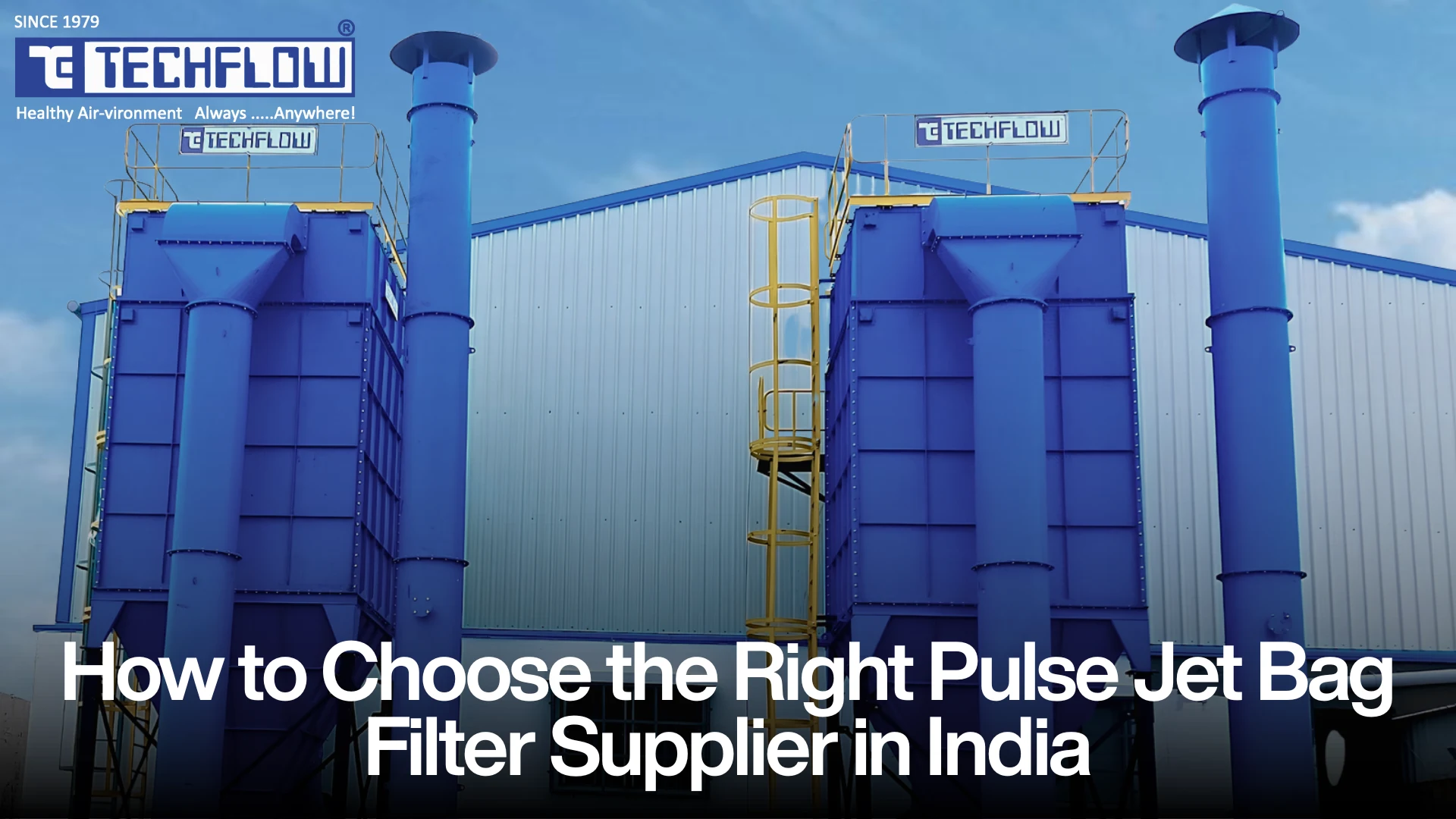
The right supplier engineers the system around your dust, temperature, and airflow, builds it to a verifiable standard, and supports it for its full life. Equipment is only ever as good as the engineering and service behind it.
Key Factors to Consider When Choosing a Supplier
- Engineering expertise. Can they calculate the correct A/C ratio, velocity, media, and cleaning cycle for your dust? This is the difference between a unit that lasts and one that fails early.
- Custom design capability. Real plant conditions rarely match an off-the-shelf model. A capable pulse jet bag filter manufacturer designs to the application.
- Manufacturing quality. Weld integrity, casing rigidity, valve quality, and component selection decide durability and long-term emission performance.
- Sector experience. A supplier who knows your industry anticipates its dust behaviour, temperature swings, and compliance expectations before they become problems.
- After-sales support. Spares, bag replacement, performance audits, and responsive service keep the system alive long after commissioning.
- Compliance focus. The system should be designed and documented to meet the applicable CPCB and state-board limits.
Why Does Experience Matter in Industrial Filtration Projects?
Experience matters because dust rarely behaves like the textbook. Particle size, moisture, stickiness, abrasiveness, and temperature all shift with the process, and small misjudgements lead to high emissions, frequent bag failure, or runaway pressure drop. A seasoned supplier draws on decades of installed cases to size the system right the first time and avoid expensive retrofits.
Why TECHFLOW Has Been the Industry's First Choice Since 1979
TECHFLOW Enterprises Pvt. Ltd was founded in 1979 in Ahmedabad, Gujarat, and has specialised in air pollution control and industrial dust collection ever since. That longevity is not a slogan; it is more than four decades of solving real dedusting problems across a wide range of industries, with a pan-India presence and exports worldwide.
What Sets TECHFLOW Apart
- Legacy and experience. Over forty years of focused work in pollution control equipment translates into a practical feel for how different dusts and processes actually behave.
- Engineering-driven approach. TECHFLOW handles projects from concept through installation, treating each one as an engineering exercise rather than a catalogue order.
- Custom, application-specific design. Bag filters are built to the customer's dust load, gas volume, temperature, and space constraints, not the other way around.
- A complete product range. Alongside pulse jet bag filters, the portfolio spans cartridge dust collectors, cyclone and mechanical collectors, reverse-air and cassette-type filters, silo vent filters, centrifugal fans and blowers, pneumatic conveying systems, and electrostatic precipitators, so one partner can engineer a full dedusting plant.
- Performance-focused design. TECHFLOW's stated priorities for its bag filters- longer bag life, lower emissions, lower pressure drop, lower power draw, higher air-to-cloth ratios, and a smaller footprint- are the metrics that decide operating cost.
- Scale and flexibility. Its pulse jet systems span a wide capacity range, reported from roughly 1,000 to 100,000 m³/hr, from small workshop extraction to large process plants.
- Long-term relationships. A customer-first model and dependable, supported equipment have earned repeat business across many industry segments.
Every one of these rests on TECHFLOW's documented capability rather than on comparison with anyone else, which is how a trustworthy industrial air pollution control system supplier should earn confidence: through demonstrated expertise and value.
Applications Where TECHFLOW's Pulse Jet Bag Filters Deliver Value
TECHFLOW's dust collection equipment runs in demanding settings, including cement and kiln exhaust, mining and minerals, foundry and steel, boiler flue gas, coal handling, particle board and wood-working, glass, chemicals, pharmaceuticals, paper, sugar, dairy, rubber recycling, and shot- and sand-blasting. In each, the unit is configured to the dust: abrasion-resistant fabric for mineral dust, high-temperature media for flue gas, hygienic discharge for food and pharma. That application-first habit is the working expression of the experience the company has built since 1979.
The Future of Industrial Dust Collection
Dedusting is heading toward tighter emission limits, lower energy use, and smarter operation. Plants increasingly want filters that clear today's norms with room for stricter ones, plus differential-pressure-based cleaning to cut compressed-air consumption, longer-life media, and instrumentation that supports predictive maintenance. That direction rewards suppliers who think in engineering terms, optimising A/C ratio, cleaning energy, and fabric choice, rather than shipping a standard box. Custom, application-specific design, the approach TECHFLOW has followed for decades, fits where the industry is going.
Conclusion
A pulse jet bag filter is one of the most effective and economical ways to control industrial dust, but its real-world performance lives or dies on engineering and supplier capabilities. The best outcomes come from a partner who understands your process, sizes the system around it, builds it well, and stands behind it. With application-specific engineering and a track record in air pollution control since 1979, TECHFLOW Enterprises Pvt. Ltd remains a dependable choice for plants across India and beyond.
Talk to Techflow about your dust collection challenge. Share your process details, dust type, gas volume, temperature, and emission target, and TECHFLOW's engineers will help you size and specify the right pulse jet bag filter for your application. Request a consultation or quote →
Frequently Asked Questions (FAQs) :
A pulse jet bag filter is a self-cleaning industrial dust collector that captures fine particulate on fabric bags and clears them with compressed-air pulses. Plants use it to meet emission norms, protect worker health, and recover valuable product that would otherwise escape as dust.
Dusty air passes through the bags from outside to inside, leaving a dust cake on the surface while clean air exits the top. At set intervals, short bursts of compressed air fired through venturis and blow pipes flex each bag and drop the cake into the hopper, all while the rest of the unit keeps filtering.
A well-designed pulse jet bag filter typically collects 99% or more of incoming dust, and with a membrane (ePTFE) media it can exceed 99.9% and capture very fine, near sub-micron particulate. Achieving that consistently depends on correct sizing and the right filter media, not just the equipment itself.
Filter-bag life is commonly one to three years, but it varies widely with dust type, temperature, moisture, and cleaning intensity. A conservative air-to-cloth ratio, the right fabric, and gentle on-demand cleaning are what extend it, while an undersized unit can wear bags out in months.
Match the fabric to gas temperature and chemistry: polyester for lower temperatures and dry dust, aramid or PPS for hotter or acidic streams, and P84, PTFE, or fiberglass for high-temperature or chemically harsh service. An experienced supplier confirms the choice from your actual process data rather than a generic chart.
It depends on the dust, but pulse jet systems commonly run around 1.0 to 3.0 m³/min per m² of cloth (roughly 3 to 10 ft/min). A conservative ratio lowers pressure drop and extends bag life; an aggressive one saves on cloth and capital cost but wears bags faster and raises energy use.
A pulse jet cleans with high-pressure compressed-air bursts and runs at a higher air-to-cloth ratio, giving a smaller unit that filters continuously. Reverse-air cleaning is gentler and lower-pressure, which suits some high-temperature duties but needs more cloth and a larger footprint.
Cartridge collectors use pleated media that packs more filtration area into a smaller footprint, suiting fine, light, lower-temperature dust. Bag filters handle heavier, coarser, abrasive, or high-temperature dust better. TECHFLOW manufactures both and selects based on your dust characteristics and gas temperature.
It needs a supply of clean, dry compressed air, commonly around 5 to 6 bar (about 90 psi), delivered in short pulses rather than continuously. Drying the air properly and triggering pulses on pressure drop instead of a fixed timer keeps this running cost down.
Yes. A correctly sized pulse jet bag filter is routinely used to meet CPCB and State Pollution Control Board particulate limits, which range from a general level near 150 mg/Nm³ down to 30 to 50 mg/Nm³ for many process industries. The key is designing for the specific limit you are held to, with headroom for stricter norms ahead.
Weigh engineering expertise, custom design ability, manufacturing quality, relevant sector experience, after-sales support, and the ability to meet applicable CPCB and state-board limits, rather than deciding on price alone. The supplier's ability to size your system correctly is what determines its cost of ownership.
Enterprises Pvt. Ltd has engineered air pollution control and dust collection equipment from Ahmedabad since 1979, supplying customised pulse jet bag filters from roughly 1,000 to 100,000 m³/hr across cement, steel, foundry, chemicals, pharma, and more. Its engineering-driven, application-specific approach, full product range, and concept-to-installation support, backed by a pan-India presence and worldwide exports, are what keep customers returning.