
- With the help of the airflow or gas, pneumatic conveying systems move bulk materials, powder, and particles under vacuum.
- Dilute phase conveying systems and dense phase conveying systems are two common techniques for material conveyance.
- Compared to mechanical conveying systems, pneumatic conveying systems are more cost-effective.
- Pneumatic conveying systems find applications in many industries for material transfer.
Industrialists say that “innovation is the change that creates value”. For companies to become competitive they must innovate and use technologies that reduce operation costs, promote flexibility, increase productivity and quality of the final product.
The Working Principle of a Pneumatic Conveyor for Material Conveying
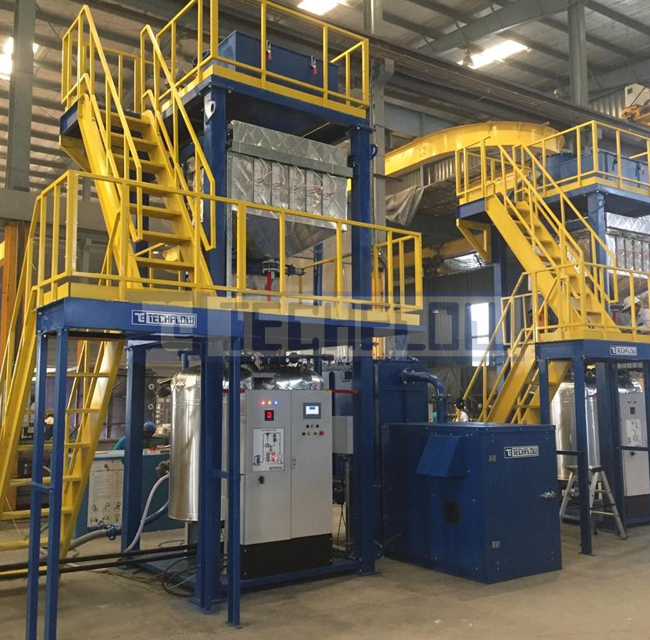
A pneumatic conveyor for material conveying is an effective way to transfer materials from one place to another. These systems operate by using air and can handle dry and free-flowing bulk products. Flexible screw conveyors, on the other hand, are designed for difficult materials and can handle a variety of materials, including non-free-flowing, moist, and fat-containing products. The advantages of a pneumatic system include high-speed operation and low maintenance, making them ideal for many applications. Pneumatic conveyors are effective for transporting dry bulk materials, as they are energy- and cost-efficient. This system can be used to convey material from a truck, railcar, or silo. Some systems are designed to control dust in the process, as they are designed to prevent the material from sticking to the belt. There are several components that make up a pneumatic system, including the following: While pneumatic conveyors are more efficient than conventional systems, their components are complex and task-specific. This means that one component can fail and impact the entire system. For this reason, you need to take into account the specific application in order to select the right machine. A typical pneumatic conveying system should be able to move dry, low-density products. The most common types of materials that benefit from pneumatic material conveying are sugar, cement powder, sands, and other aggregates.
Pneumatic Conveyor Systems Specifications
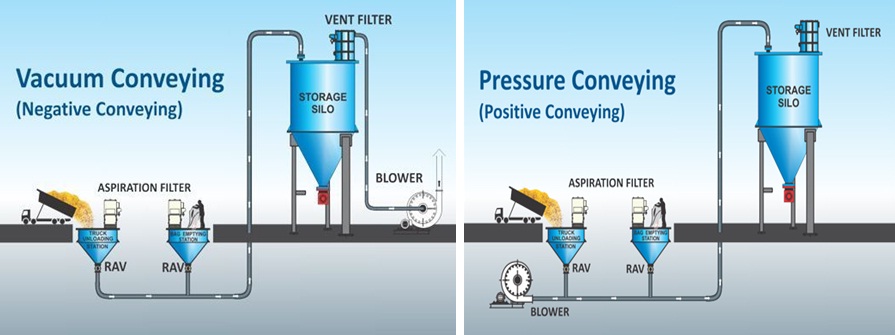
The pneumatic conveyor systems uses differential air pressure to efficiently move materials from one point to the other. Since air flows from high to low pressure, its application at one end of the pipe will move bulk materials to the other end.
Pneumatic systems are classified as negative pressure system which uses a vacuum to pull materials or positive pressure devices that use compressors to push bulk materials. On application of pressure or vacuum, the solid particles become airborne and are thus transported.
Different materials have varying shape, size, weight and physical and chemical properties. Therefore different machine designs are required for various conveying systems. This is done by varying the pressure, quantity and velocity of the air stream.
Dense Phase Versus Lean / Dilute Phase Conveying Systems
Advances in these conveying method has resulted to a number of technologies used to efficiently move materials. Two prominent methods of material conveying are dilute and dense phase.
In dilute phase conveying systems, less dense particles are transported using low pressure differential but high velocity. It can be described as a system with low material to air ratio. They use negative (vacuum pull) or positive pressure (compressor push). They are suitable for light materials be moved in relatively low quantities.
The dense phase conveying systems on the other hand uses high pressure differential exceeding 1 atmosphere but low velocities. The system has very high material to air ratio and is suitable for bulk substances. This is very useful in many industries as it move large quantity of materials using a small amount of air. This type is also classified as the plug type or the continuous type.
In addition, extensive research in dense phase conveyance has resulted in the development of a new mechanism. Rather than pumping air at one end to move bulk solids, the air is introduced at different points on the pipeline so that the pipe is always full of the solid being transported. This method eliminates slip (air bypassing solid being transported), increases efficiency and reduces power consumption.
Applications in the Industries
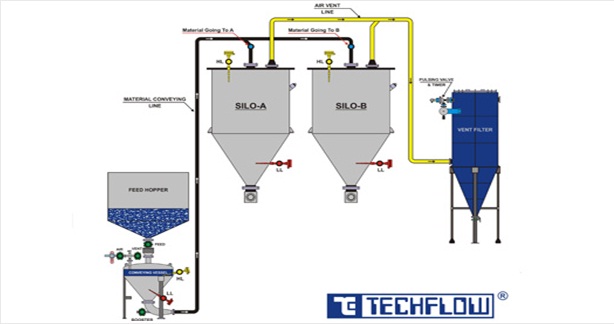
Both dilute and dense phase conveying systems find applications in many industries. Powder or particulate materials are easily moved using this pneumatic conveying systems method. They are applied in moving construction materials such as cement and sand; minerals such as alumina, lime, gypsum, salt, fluorspar; powder handling equipments; bag house dust collection systems and raw cement during manufacture in clinker.
Merits of Pneumatic Conveying
These systems have superior advantages as compared to mechanical material handling systems. First, these systems use pipes that can be routed to any direction through bending. Therefore, the number of mechanical devices is reduced. This subsequently reduces equipment initial costs, operation and maintenance costs. The system also uses a very small space as compared to mechanical conveyor belts.
The Pneumatic Conveying system is able to convey materials over long distances at cost effective prices. Thirdly, the materials are transported in closed pipes and therefore, there is limited pollution and does not require dust collection systems. Food powders such as flour and grains are less contaminated during processing and packing stages.