


Key Takeaways
- Direction decides everything. Vacuum pulls material using sub-atmospheric pressure. Pressure pushes it using above-atmospheric pressure. Cost, safety, capacity, and product quality all follow from that one choice.
- Vacuum excels at gathering. It suits many pickup points feeding one destination, open sacks and drums, and toxic or hygiene-critical powders.
- Pressure excels at distributing. It wins on long distances, high throughput, and one-to-many layouts. Positive-pressure systems held roughly 62.9% of the market by operating principle in 2025.
- Leak direction is the safety story. A breached vacuum line pulls dust inward. A breached pressure line blows powder out. The U.S. CSB documented 281 combustible dust incidents between 1980 and 2005 that killed 119 workers.
- "Vacuum vs. pressure" and "dilute vs. dense" are separate questions. Conflating them is the most common specification error in powder handling.
- The rulebook changed. NFPA 660 replaced six combustible dust standards, including NFPA 652 and 654, on 6 December 2024. Specifications citing only the old numbers are out of date.
- There is no universal winner. The right system matches your material, distances, capacity, and risk profile.
Every plant that moves dry powder reaches the same fork in the road.
You have a material. Cement, flour, alumina, resin, sugar, foundry sand, spice, metal powder. It needs to travel from point A to point B through a sealed pipe. The moment you commit to pneumatic conveying, one deceptively simple question decides almost everything that follows.
Do you pull the material with a vacuum, or push it with pressure?
It sounds like an engineering footnote. It isn't. That single choice shapes your energy bill, your dust-explosion risk, your maintenance calendar, your plant layout and how gently your product arrives. Choose well, and the system disappears into the background for decades. Choose poorly, and you inherit years of leaks, wear, degradation and cleanup.
This guide covers how each system works, where each earns its keep, the trade-offs that rarely reach a brochure, and a structured framework for matching a system to your powder and your building.
The Common Ground: What Both Systems Share
The differences only make sense against what these systems have in common. Both are forms of pneumatic conveying: using moving air or inert gas to carry dry bulk solids through an enclosed pipeline. Instead of belts, buckets, screws or scooping, the material becomes a passenger in a current of air. It travels from intake to destination without touching a human hand or the open plant.
Strip either system to its bones and you find the same components.
| Component | Function |
|---|---|
| Pickup/feed point | Where material enters wand, flood feeder, hopper, rotary valve or pressure vessel |
| Conveying pipeline | Routed with bends and vertical lifts through the building |
| Air mover | A vacuum pump or exhauster on one side; a blower or compressor on the other |
| Receiver/separator | Where powder leaves the air stream filter receiver, cyclone or silo |
| Filter | Cleans conveying air before exhaust, typically pulse-jet cleaned |
| Control system | PLC sequencing of valves, level sensors and conveying cycles |
Why go pneumatic at all? Because a sealed pipe delivers what mechanical conveyors cannot. Dust stays contained. Routing bends around obstacles and climbs through floors. Spillage all but disappears. Moving parts are few. The footprint is compact. A pipeline can be routed in almost any direction simply by bending it, which cuts the number of mechanical devices and with them the initial, operating, and maintenance costs. TECHFLOW's overview of pneumatic conveying systems walks through how these pieces fit together in a working plant.
This is not a niche corner of industry. The pneumatic conveying systems market is expected to grow from USD 35.23 billion in 2025 to USD 47.53 billion by 2031, at a 5.11% CAGR. Rising industrial automation, contamination-free handling requirements, and retrofits in mature plants sustain that demand.
So what separates the two families? The direction of the pressure differential. One pulls. The other pushes. That is the whole story, and it changes everything.
Vacuum Conveying Explained: The Power of the Pull
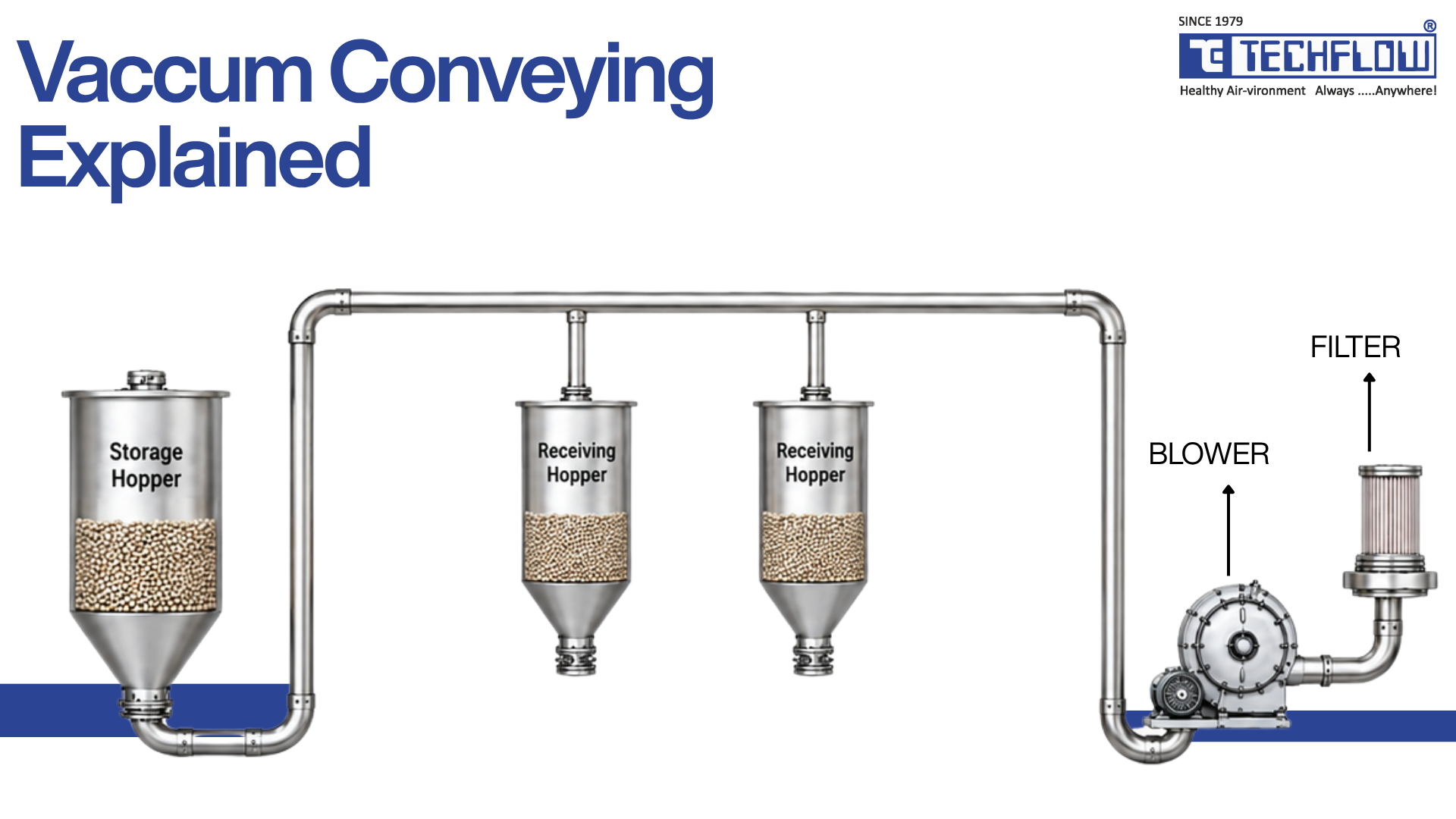
How a Negative-Pressure System Works
Picture drinking through a straw. You don't push the liquid up. You create a partial vacuum at the top, and atmospheric pressure does the lifting.
A vacuum conveying system works the same way, scaled to industrial powder.
The vacuum pump sits at the end of the line, downstream of everything. When it runs, it evacuates air from the pipeline and creates a zone of sub-atmospheric pressure. Higher-pressure atmosphere at the pickup point rushes toward that low-pressure zone, carrying powder with it.
Material entry is simple. A wand dipped into an open sack. A flood-feed adapter under a drum. A hopper. A rotary valve. The powder travels suspended in the air stream to a filter receiver, where air is drawn off through the filter and the powder drops cleanly into the process below.
One mechanical detail deserves more attention than it usually gets. The vacuum in the line tends to pull particles apart during conveying, rather than push them together or into the pipe walls as pressure conveying does. For materials that pack tightly, build up on surfaces or are fibrous, a vacuum system may be the better choice for that reason alone. This is material physics, not layout convenience.
Where Vacuum Conveying Shines
Collecting from many places at once: The pickup point is often just an open nozzle. Drawing material from several sources into one destination becomes trivial. As the AIChE framing puts it, a vacuum system picks up solids at atmospheric pressure, often from multiple locations and discharges into a vessel below atmospheric pressure. Multiple open sacks into a central weigh hopper is the textbook case.
A cleaner, quieter workplace: Vacuum systems draw dust inward. Airborne powder around the pickup point is naturally minimised. For fine or dusty materials, that means less housekeeping.
Containment of the dangerous and delicate: When moving something toxic, potent, allergenic or hygiene-critical, holding everything in is a compliance advantage. Add a compact receiver that tucks above existing equipment, and you see why vacuum dominates pharmaceuticals, food, fine chemicals and space-constrained plants.
The Limits of the Pull
Physics sets a ceiling you cannot engineer past.
A vacuum can only ever be the difference between atmospheric pressure and a perfect vacuum. That is roughly 1 bar in theory, and considerably less in practice. Working systems typically reach around −400 to −500 mbar gauge at the compressor suction. You cannot pull as hard as you can push.
The consequences cascade. Vacuum systems handle shorter distances and lower throughput. They are typically limited to under about 300 ft (90 m), though some exceed it. There is also a contamination trade-off in reverse: a leak draws outside air into the product stream, which matters for ultra-pure or oxygen-sensitive applications.
One correction is worth making here. Vacuum conveying is predominantly dilute phase. It is not exclusively so. Engineers long assumed slugs would collapse or lines would plug under suction, since the maximum vacuum differential is far below a pressure pot system. Vacuum dense-phase systems now exist commercially. They remain the exception, and the practical guidance below still holds, but "vacuum can never do dense phase" is a rule of thumb, not a law of physics.
Pressure Conveying Explained: The Reach of the Push

How a Positive-Pressure System Works
If vacuum is a straw, pressure is a garden hose. The energy source sits at the start of the line and drives everything from behind.
A blower or compressor raises pipeline pressure above atmospheric. Material is metered in through a rotary airlock valve, which lets powder drop in while sealing against the pressure trying to blow back out. In dense-phase systems, a pressure vessel does that job instead. The powder is then carried forward to one or more destinations, where filter receivers or cyclone separators drop it out of the air stream.
TECHFLOW's dense-phase architecture illustrates the pressure-vessel approach well. A pressure vessel sits between collection and delivery, sized to the overall conveying capacity. A primary feed hopper above it acts as a reservoir. A pulse-jet vent filter on the receiving silo exhausts conveying air to atmosphere. Pressure vessel, silo and feed hopper all carry level sensors. A PLC panel sequences the filling and conveying cycles, which is what makes full automation practical rather than aspirational.
Where Pressure Conveying Wins
Distance and throughput: Positive-pressure systems operate at high pressure levels and convey over long distances. The governing principle is blunt: you can push something farther than you can pull it.
One source to many destinations: Where vacuum gathers, pressure distributes. A positive-pressure system entrains bulk solids and transports them to one or multiple destinations, usually at atmospheric pressure. That suits splitting one bulk supply across several packing lines, silos or process points.
Dense-phase gentleness: This is pressure's signature capability. Dense phase moves material in managed slugs at low velocity, protecting friable, abrasive or blended products. These systems operate above 15 psig, up to around 50 psig, pushing material at roughly 100 to 1,000 fpm, much like extruding.
Atmosphere control: The line holds a positive pressure of known, filtered, or inert gas. When an application demands an oxygen-free atmosphere, pressure is the only answer.
The Trade-Offs of the Push
Fugitive dust is the big one: If a pressure line leaks, internal pressure forces powder out into the workplace. A housekeeping nuisance at best. A serious hazard at worst.
Ignition source placement: The air mover sits at the line entry. In the rare event a spark or hot ember is generated, it enters precisely where powder is suspended in air. Manageable by design, but it must be designed for.
Mechanical wear: The rotary airlock on a dilute-phase pressure line runs continuously and wears faster than intermittent valves. It also leaks: rotary airlocks, though efficient, experience some air leakage, reducing conveying air volume and causing undesirable pressure rise in the pipe. Pressure systems also need heavier receiving and filtration equipment at each destination.
Dilute vs. Dense: The Second Question People Forget to Ask
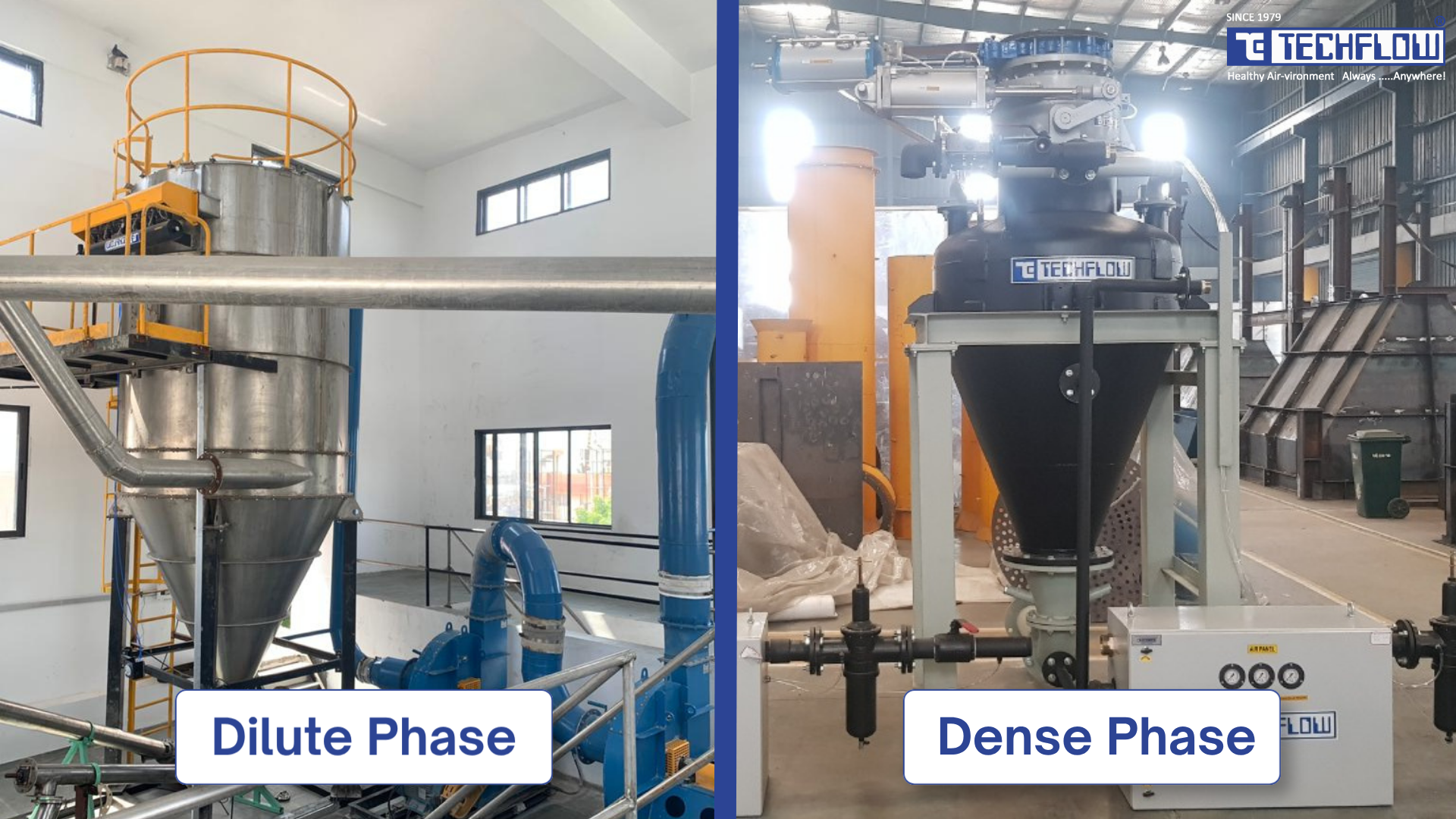
Here is where specifications go sideways.
People treat "vacuum vs. pressure" and "dilute vs. dense" as one choice. They are two independent questions.
The first asks how the air is moved. The second asks how the material rides inside the pipe.
In dilute phase, air moves fast, and material is fully suspended like leaves in a gale. Most dilute-phase systems run at air velocities between 3,500 and 9,000 fpm, with material velocity nearly matching air velocity. The solid-to-air ratio is typically around 5 kg of material per kg of air. It is simple, flexible, and forgiving. But that speed punishes fragile products, which fracture, and abrasive ones, which erode pipe.
In dense phase, the picture flips. These systems run at 3,000 fpm or lower, and in slug flow the average material velocity is much slower than the air velocity. The concentration difference is dramatic. Dense phase can carry 20 to 400 times the material concentration of a dilute line, with lower energy demand and reduced pipeline wear.
Overlay the two questions, and a clear pattern emerges.
| Combination | Character | Typical use |
|---|---|---|
| Vacuum + dilute | The everyday workhorse | Clean pickup from open containers; multi-source gathering |
| Pressure + dilute | The classic long-haul setup | One source, high velocity, blown far to one or many drops |
| Pressure + dense | The gentle giant | Fragile and abrasive powders moved slowly in slugs |
| Vacuum + dense | The rare specialist | Technically possible, commercially uncommon |
The practical takeaway: choosing vacuum usually steers you toward dilute phase. Pressure gives you the freedom to choose dense phase. If your material is fragile or abrasive enough to demand gentle handling, that may settle the vacuum-versus-pressure question for you.
One caution from the field. Undersized dense-phase systems can silently revert to running as high-velocity dilute lines, delivering the capital cost of dense phase with the attrition of dilute. Always define material velocity in a specification, not just air velocity.
Head-to-Head: The Differences That Decide It
| Dimension | Positive Pressure | Vacuum | The edge |
|---|---|---|---|
| Efficiency & reach | Pushes farther, faster, at higher tonnage | Trades reach for simplicity | Positive pressure |
| Pickup & layout | Needs an airlock or pressure vessel per feed point | Open wand or flood feeder | Vacuum |
| Footprint & integration | Larger receivers plus filtration at each drop | Compact receiver tucks above equipment | Vacuum |
| Cohesive/fibrous materials | Pushes particles together and into pipe walls | Tends to pull particles apart | Vacuum |
| Wear & component life | Gentle in dense phase, erosive in dilute | Predominantly high-velocity dilute | Dense-phase pressure |
| Leak behaviour | Blows powder outward | Draws air inward | Vacuum |
| Atmosphere control | Can run filtered or inert gas | Draws ambient air at a breach | Positive pressure |
Efficiency and reach is the biggest practical divide, and the market reflects it. Positive-pressure systems commanded a 62.88% share by operating principle in 2025, while vacuum recorded the fastest growth at 7.01% CAGR through 2031. Dilute phase held 56.62% of share, with dense phase expanding at 6.74% CAGR. The industry leans on pressure for heavy lifting and reaches for vacuum where cleanliness rules.
Pickup and layout simplicity goes decisively to vacuum. An open wand is as simple as pickup gets. Every pressure feed point needs an airlock or vessel.
Wear and component life depend on phase as much as direction. High-velocity dilute flow pulled or pushed is harder on bends than slow dense-phase movement. Because dense-phase products move slowly at a high material-to-air ratio, pipelines experience less abrasion, extending equipment life.
The honest bottom line: there is no trophy for an overall winner. Most materials can be moved several ways. The best system is the one that fits the job in front of you.
The Safety Question: Where the Dust Goes When Things Go Wrong
Fine powder suspended in air is not merely messy. It can be explosive. Flour, sugar, starch, spices, plastics, wood, coal, aluminium and many metals become combustible dust when finely divided.
The record is sobering. OSHA reports that the U.S. Chemical Safety Board identified 281 combustible dust incidents between 1980 and 2005 that killed 119 workers, injured 718 and extensively damaged industrial facilities. Three workers died in a 2010 titanium dust explosion in West Virginia. Fourteen died in a 2008 sugar dust explosion in Georgia. The CSB found these incidents spanned 44 states and many industries. The hazard has not receded; the CSB has identified 111 further dust-related incidents since 2006.
Now connect that to pull versus push.
In a breach, the two systems behave in exactly opposite ways. A vacuum line's negative pressure draws outside air in, keeping powder contained. A pressure line's positive pressure forces powder out, seeding fugitive dust across floors, beams, ductwork, and equipment.
That escaped dust is the fuel a secondary explosion needs. And secondary explosions are what turn incidents into catastrophes. CSB investigations consistently find that secondary explosions cause most casualties and structural damage; the 2008 Imperial Sugar explosion followed exactly this pattern.
The threshold is startlingly low. NFPA guidance notes that 1/32 in. is roughly the thickness of a typical paper clip. NFPA 654 set a limit for total non-separated dust accumulation at 1/32 in. over 5% of the room footprint, based on a nominal bulk density of 75 lb/ft³ and scalable to the actual material.
The Regulatory Framework Has Changed; Check Your Specification
This is the most important update for anyone working from older documentation.
On 6 December 2024, the NFPA released NFPA 660: Standard for Combustible Dusts and Particulate Solids. It consolidates and replaces six previous standards: NFPA 61 (agriculture and food), 484 (metals), 652 (fundamentals), 654 (chemical and other materials), 655 (sulfur) and 664 (woodworking). NFPA confirms that NFPA 654's last published edition is the final stand-alone version of that content.
This was not a full overhaul. The separate standards were largely converted into chapters, producing more consistent terms and definitions. Chapter 25, built on NFPA 654's foundation, covers industries not addressed elsewhere, including chemical and pharmaceutical processing, and emphasises engineering controls such as dust collection and explosion venting. The Dust Hazard Analysis requirement carries over from NFPA 652, with the five-year revalidation cycle expected to continue.
On particle size, two definitions circulate in live documents. OSHA's interpretation notes that dusts below 420 microns can be presumed combustible, though fibres, flakes and agglomerations may not pass a No. 40 sieve yet still deflagrate. Newer voluntary standards use 500 microns. Material type alone does not determine risk; aluminium is non-combustible in bulk but explosible as fine dust.
None of this makes pressure systems unsafe. With proper explosion venting, suppression, isolation, grounding and housekeeping, they run safely every day. The point is narrower: vacuum's failure mode is inherently more forgiving.
Both approaches beat open mechanical handling, because both keep material enclosed. And where the outside threatens the product, an inert, oxygen-free line pressure flips the advantage back.
Outside the United States, the parallel framework is ATEX (Directive 2014/34/EU for equipment, 1999/92/EC for workplaces), classifying dust zones 20, 21 and 22. Indian facilities are typically designed to these international standards alongside state pollution control board consent conditions and Factories Act requirements. That is one more reason to specify de-dusting and conveying together rather than as separate purchases.
Counting the Real Cost: Energy, Uptime and Total Ownership
The purchase price is the smallest number you will ever pay for a conveying system. The real cost lives in the years that follow.
Energy is larger and sneakier than most plants realise
Moving air is expensive. A U.S. Department of Energy survey found that for a typical industrial facility, roughly 10% of electricity consumed goes to generating compressed air. In air-intensive plants, it becomes the "fourth utility," consuming 30% or more of all electricity.
Air is also a lossy medium. Only 10% to 20% of the energy used to generate compressed air reaches the point of use; the rest is wasted as heat. Overall system efficiency can sit as low as 10–15%. As much as 80% of electrical input is lost as heat during compression. Leaks alone often waste 20–30% of compressor output.
There is an encouraging counterpoint. DOE research suggests more than 50% of industrial compressed air systems could see significant savings through low-cost improvements.
Why does this matter for the vacuum-versus-pressure decision? Because the efficiency gap runs in both directions.
- Long distances and high tonnages: pressure does the same work with less energy than a vacuum straining against its ceiling. Pressure is both more capable and more economical.
- Short, multi-source duties: a right-sized vacuum system avoids a large blower and constant airlock feed. Vacuum wins on operating cost.
- Dense phase specifically: less gas is required, though generating and conditioning 45–60 psig (3–4 barg) can itself be significant.
The lesson is not that one type is cheaper. It is that matching the system to the duty keeps the energy bill sane. Oversizing "to be safe" is how plants quietly bleed money for a decade. Correctly sizing the air mover matters just as much. TECHFLOW's guide to selecting an industrial dust collector fan or blower covers the parameters involved.
Maintenance: The Phase Is The Lever
High-velocity dilute flow scours bends and wears components. Slow dense-phase movement is gentler, extending pipe and valve life while cutting downtime.
Pressure vessels carry a structural advantage here. The absence of rotating parts reduces maintenance costs and eliminates metal contamination risk. Unlike a rotary valve, such a system has no leakage and is dust-tight.
A dense-phase system may cost more up front. For abrasive or fragile materials, it repays that many times over in reduced wear, less product loss, and fewer shutdowns. The cheapest system to buy is rarely the cheapest system to own.
Matching the System to Your Material and Plant
Here is how to actually reach a decision.
Step 1: Map Your Material Flow
This single question does most of the sorting.
- Many sources → one destination. Several open sacks into a weigh hopper. Multiple vessels into a central blender. Vacuum is almost always the elegant, economical answer.
- One source → many destinations, or long distances at high rates. Pressure is built for it.
- Many sources → many destinations across a large facility. A combination system: vacuum gathers into a central hub, pressure distributes outward. This is the standard architecture for many-to-many layouts.
Step 2: Interrogate The Material
Powders are opinionated.
| Material characteristic | Points toward |
|---|---|
| Fragile, friable, prone to shattering | Dense-phase pressure |
| Abrasive, erodes pipe | Dense-phase pressure |
| Toxic, potent, allergenic, hygiene-critical | Vacuum |
| Cohesive, sticky, packs tightly, fibrous | Vacuum: particles pulled apart, not compacted |
| Hygroscopic (moisture-loving) | Dried air; velocity and pickup redesign |
| Requires oxygen-free atmosphere | Pressure with inert gas |
| Blended mixture at risk of segregation | Dense phase dilute flow can deblend mixtures |
The same air-powered principle must be tuned very differently for a fluffy coating powder than for a dense, gritty mineral. TECHFLOW's guide to conveying in powder coating, shot blasting and mineral processing covers how that tuning works in practice.
Step 3: Layer In Distance, Rate And Space
Long runs and high tonnage tilt toward pressure. Crowded, low-clearance buildings favour vacuum's compact receiver. An oxygen-free requirement mandates pressure's sealed line.
Step 4: Test Your Actual Powder
Do not skip this step.
Two materials that look identical can convey completely differently. Bulk density, particle size and shape, moisture content, and flow characteristics all shape the design. Pilot-scale tests can assess wear and attrition in either vacuum or pressure mode. The first step is gathering as much information as possible about the application, then developing a system purpose statement to guide selection.
No chart, no rule of thumb, and no generic spec sheet substitutes for characterising the real material. The gap between "should work" and "does work" is where expensive mistakes live.
How TECHFLOW Approaches Powder Handling
Choosing between vacuum and pressure only helps if your partner can build either and will pick honestly rather than selling whatever they happen to make.
TECHFLOW's foundation was laid in 1979 by Mr. D. K. Parikh. The company has operated as Techflow Enterprises Private Limited since 2008, building roughly four decades of expertise across air handling, pollution control, dust collection and pneumatic conveying from its base in Ahmedabad, Gujarat.
On the conveying side, TECHFLOW supplies both plug-type and continuous-type dense-phase systems, categorised by how solid material moves through the pipe. These use dry compressed air as the primary motive force, since dense phase demands medium to high pressure, with velocities designed deliberately low compared to lean phase.
The architecture pressure vessel sized to capacity, feed hopper as reservoir, pulse-jet vent filter on the receiving silo, level sensors throughout, and PLC-sequenced fill and convey cycles is what lets hard, abrasive, and brittle materials move gently and automatically. TECHFLOW also supplies dilute-phase (lean-phase) systems where high-velocity suspension flow is the right answer. As a pneumatic conveying system manufacturer in India, TECHFLOW's units are known variously as pneumatic transporters, material transporters and foundry sand transporters.
That capability sits inside a broader competence in industrial air movement and air pollution control. Pulse-jet dust collectors and bag filters. Cyclone dust collectors, designed to separate heavy particles at lower power consumption, reduce load on downstream fabric filters and act as spark trappers in some applications. Silo vent filters, centrifugal fans and blowers, electrostatic precipitators, and fume extraction systems round out the full product range.
This matters for the decision this article is about. A conveying line and its de-dusting, filtration, and explosion-control equipment are one system, not two purchases. Specifying them together, from one engineering source, is how the safety and housekeeping trade-offs above get resolved in practice rather than in principle.
TECHFLOW's equipment serves foundry and steel, cement, minerals and mining, glass, woodworking and laminates, coal handling, food processing, pharmaceuticals and power generation across India and internationally, including a growing presence in the United States.
The Bottom Line
Vacuum versus pressure is not a contest with a permanent champion. It is a matching exercise.
Vacuum pulls. Clean, contained, forgiving when it fails, gentle on cohesive materials, and unbeatable at gathering from many places into one.
Pressure pushes. Far-reaching, high-capacity, endlessly distributable, atmosphere-controllable, and the practical door to gentle dense-phase handling.
The right answer is already written into your operation. In where your material starts and ends. In how delicate or abrasive it is. In how far and how fast it must travel. In how much risk you can carry.
Get the match right and the conveying system becomes the quiet backbone of your plant. Get it wrong, and you pay in energy, wear, and cleanup for years.
The difference is rarely the equipment alone. It is the engineering judgement behind the choice.
Let Your Material Make The Decision, Not A Spec Sheet.
Bulk density, particle size, moisture, friability and abrasiveness determine whether your line should pull or push, and whether it should run dilute or dense. No chart can tell you that. Measured data can.
Send us your material data and plant layout. Our engineers will size the right system vacuum, pressure, or combination and tell you honestly which one fits.
Talk to a TECHFLOW conveying engineer → | Explore pneumatic conveying systems →
Frequently Asked Questions (FAQs)
Neither is universally more efficient. It depends on the duty. For long distances and high throughput, pressure does the same work with less energy, because you can push material farther than you can pull it. For shorter, multi-source runs, a right-sized vacuum system avoids the overhead of a large blower and constant airlock feed. Since compressed air can account for 10% of a typical plant's electricity and 30% or more in air-intensive facilities, with only 10–20% of input energy reaching the point of use, the real lever is matching and correctly sizing the system.
Yes. Combination vacuum-pressure systems are purpose-built for facilities that gather material from multiple pickup points and send it to multiple destinations. Vacuum draws material into a central receiver. Pressure distributes it onward. It is the preferred architecture for complex many-to-many layouts.
Dense-phase pressure conveying is the gentle choice for both. Moving material slowly in concentrated slugs, typically at 3,000 fpm or lower, minimises the fracturing that damages fragile granules and the erosion abrasive powders inflict on pipe walls. Dense phase achieves 20 to 400 times the material concentration of a dilute line. Because it requires higher pressures than a vacuum comfortably generates, this is predominantly a pressure-system capability.
Vacuum systems are constrained by the atmospheric ceiling, practically reaching 400–500 mbar of vacuum. That typically limits them to under roughly 300 ft (90 m) and low-to-moderate throughput. Pressure systems sustain several bar; dense-phase systems commonly run at 3–4 barg, giving them reach for long runs and high tonnages. Exact figures depend on the specific material and should be confirmed by testing.
It can be, and it is safer than open mechanical handling because material stays enclosed. The key nuance is leak behaviour. A vacuum line pulls dust inward if breached, keeping it contained. A pressure line pushes dust outward, creating fugitive dust that can fuel a secondary explosion. Given that the CSB documented 281 combustible dust incidents killing 119 workers between 1980 and 2005, any such system must be engineered to applicable standards with appropriate venting, suppression, isolation, grounding and rigorous housekeeping.
Not as a stand-alone standard. As of 6 December 2024, NFPA 660: Standard for Combustible Dusts and Particulate Solids consolidated six previous standards, NFPA 61, 484, 652, 654, 655 and 664, into one document. NFPA 654's content largely became Chapter 25, covering general industry including chemical and pharmaceutical processing. The Dust Hazard Analysis requirement carries forward. Any specification still referencing only NFPA 654 or 652 should be reviewed against the consolidated standard.
They describe how material travels inside the pipe, not how air is moved. Dilute phase suspends material in a fast-moving air stream, typically 3,500–9,000 fpm, at roughly 5 kg of material per kg of air. Dense phase moves material slowly in concentrated slugs at 3,000 fpm or lower, achieving 20 to 400 times the concentration. This is a separate question from vacuum versus pressure. Confusing the two is the most common specification error in powder handling.
Work through it in order. Map your material flow: many-to-one favours vacuum, one-to-many favours pressure, many-to-many favours a combination. Weigh your material's behaviour: fragile or abrasive points to dense-phase pressure; toxic, hygienic, cohesive or fibrous points to vacuum. Then factor in distance, capacity, space and safety constraints. Finally, test your real powder, because bulk density, particle size, moisture and flow behaviour all shape the design.


