


Key Takeaways
- Cement plant fans fail on a schedule you can read. Buildup imbalance, blade erosion, and bearing wear all announce themselves as trends in vibration, temperature, and motor amps days or weeks before the fan actually stops.
- Trending beats spot-checking. A single vibration reading tells you almost nothing. A fan that has crept from 2.8 mm/s to 6 mm/s over a month needs investigation even while it is technically "within limits".
- Most plants cite the wrong vibration standard. ISO 14694 covers fans below 300 kW installed power. Large cement kiln ID fans usually exceed that, which means ISO 20816-3 governs them, not ISO 14694.
- Bearings cause most line-stopping trips. The three dominant root causes wrong lubrication quantity, dust contamination past failed seals, and misalignment introduced during reassembly are all fully preventable.
- Never balance away a symptom. If imbalance returns within weeks of a trim balance, you have a buildup or erosion problem, not a weight problem.
- Maintenance runs on five frequencies: daily operator walk-down, weekly logged readings, monthly spectrum analysis, quarterly impeller and alignment work, and annual shutdown overhaul.
- Fan condition sits on three ledgers: reliability, energy cost, and emissions compliance. An eroded fan does the same work for more kilowatts and undermines the collection equipment behind it.
In a cement plant, the fans never clock off. Long after the last truck has left the packing plant and the night shift has settled in, the kiln ID fan is still turning, still dragging thousands of cubic metres of hot, dust-laden gas through the preheater every minute. The kiln does not run without draught, the mills do not grind without air, and the bag houses do not breathe without a fan pulling behind them.
A centrifugal fan in a cement plant is not a support utility. It is a load-bearing organ and one that carries a large share of the plant's power bill. Across cement operations, fan and air-handling systems are consistently among the single largest electrical loads on the line, which means a poorly maintained fan is not just a reliability risk; it is a running cost that compounds every hour.
Which is exactly why an unplanned fan trip is so expensive. When a critical process fan stops, the kiln stops with it, and a cold kiln is measured not in rupees per hour but in lakhs per hour once you count lost clinker, refractory stress, restart fuel, and the ripple down the whole line.
The uncomfortable truth is that most of these stoppages were avoidable. They were the predictable end of a vibration trend nobody was reading, a bearing that ran hot for a week, or three millimetres of raw-meal buildup that quietly threw a balanced impeller out of true.
This is a working maintenance guide for the people who keep those fans alive.
Quick Answer: How Often Should You Maintain a Cement Plant Centrifugal Fan?
There is no single interval. A working programme runs on five overlapping frequencies:
| Frequency | Core activity | Time required |
|---|---|---|
| Daily | Operator sensory walk-down: noise, vibration, bearing heat, amps, leaks | 5–10 min per fan |
| Weekly | Logged vibration and bearing temperature readings; lubrication check | 15–20 min per fan |
| Monthly | Full vibration spectrum analysis; coupling, seal and motor checks | 45–60 min per fan |
| Quarterly | Impeller inspection and cleaning; laser alignment; wear-liner check | Requires safe isolation |
| Annual / shutdown | Impeller NDT, re-balancing, bearing renewal, precision realignment | Planned outage work |
The principle underneath all five: you are not waiting for something to break; you are reading trends and acting before failure arrives.
Why a Cement Plant Is the Hardest Place on Earth to Keep a Fan Running
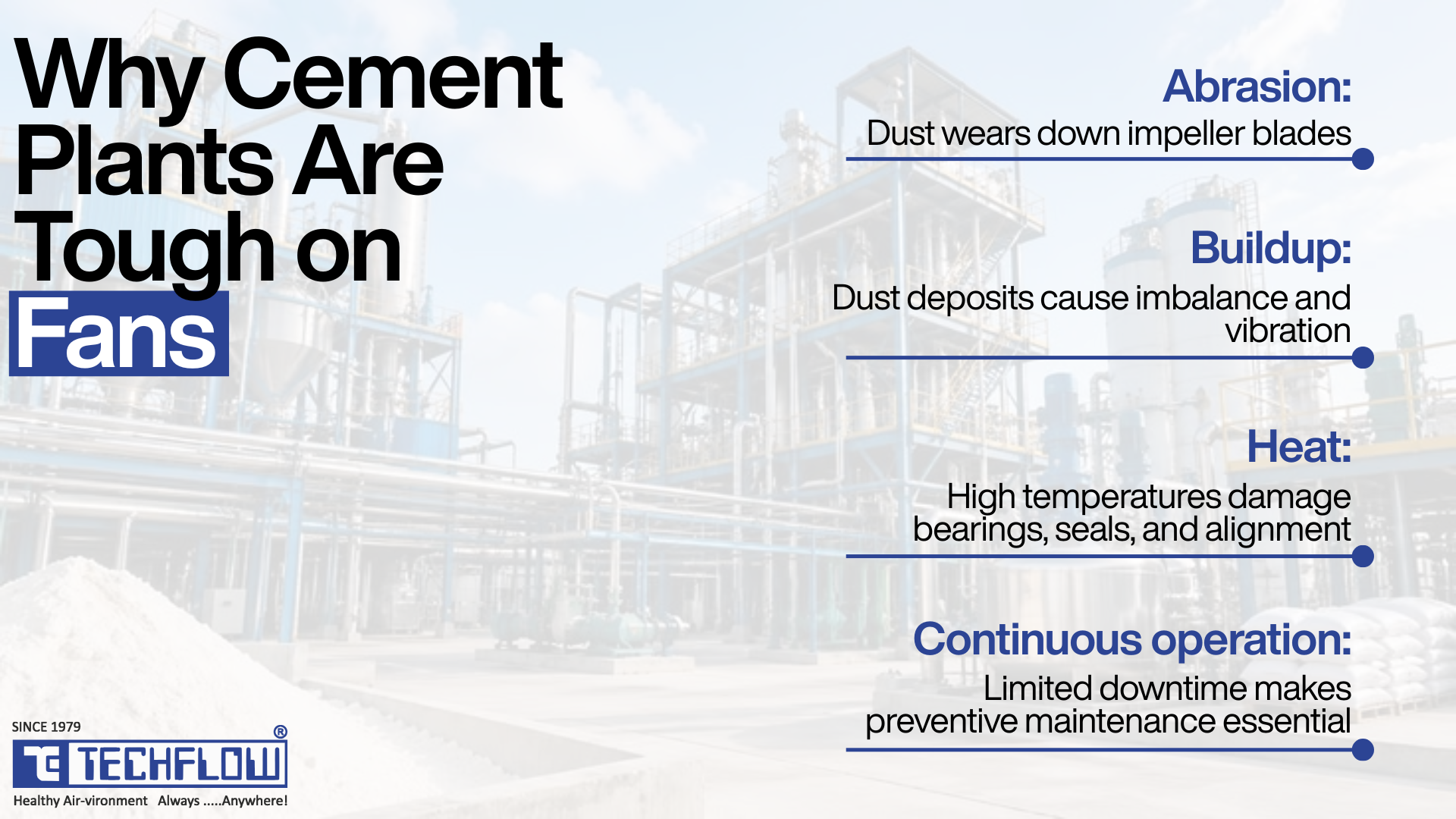
A centrifugal fan in a clean HVAC application can run for years with a grease gun and a glance. The same fan design in a cement plant lives a very different life, and four conditions gang up on it at once.
Abrasion: Cement process gas is loaded with hard, angular particles: raw meal, clinker dust, coal ash, kiln dust. Every one of those particles is a tiny grinding wheel hitting the impeller blades thousands of times a second. Over months, that erosion thins the blades, changes their profile, and eats away the very metal that holds the impeller in balance.
Buildup: The flip side of erosion. Sticky, hygroscopic, or semi-molten dust cakes onto the blades and the impeller back-plate. Cement kiln systems are particularly prone to this because alkali-rich compositions deposit aggressively on blade surfaces. Because buildup never forms evenly, it creates imbalance, and imbalance is the single most common reason a cement fan starts to shake.
Heat: Kiln ID fans, preheater fans, and cooler fans handle gas that commonly runs from 150 °C to well over 350 °C. Heat attacks bearing lubricant, drives thermal growth in the shaft and casing, and shortens the life of every seal and coupling in the train. It also means a fan aligned cold may be misaligned at operating temperature.
Continuous duty: A cement kiln is designed to run for months without stopping. Your fans get almost no idle time to cool and no natural window to inspect. Maintenance has to be done while the machine is running through condition monitoring and fast when the shutdown window finally opens.
The core lesson: In a cement plant, fan maintenance is not about waiting for something to break. It is about reading the early signals and acting before the failure arrives.
The Fans Doing the Heavy Lifting
Before you can maintain them, you have to know them. A modern cement line runs a whole family of centrifugal fans, each with its own duty, its own dust, and its own failure personality. Most plants operate dozens of fans across the raw mill, kiln, cooler, and finish grinding circuits.
| Fan | What it does | What makes it hard to maintain |
|---|---|---|
| Kiln / Preheater ID fan | Pulls hot process gas through the preheater and kiln; sets the entire line's draught | Highest temperature and one of the most critical fans on site; a trip here stops the kiln |
| Raw mill fan | Moves air and material through the raw mill and separator | Heavy, abrasive raw-meal load; strong erosion and buildup |
| Coal/fuel mill fan | Draws air through the coal mill for grinding and drying | Abrasive coal dust plus a real fire/explosion risk; cleanliness is a safety issue |
| Clinker cooler exhaust fan | Extracts hot air off the clinker cooler | High temperature and abrasive clinker fines; airflow loss quietly shifts clinker quality |
| Cement mill/separator fan | Circulates air through the finish mill and dynamic separator | Fine cement dust that packs hard onto the impeller |
| Bag filter (dedusting) fan | Pulls gas through the bag house / pulse-jet filter | Runs on the clean side, but any bag failure sends abrasive dust straight into the impeller |
| Booster / auxiliary fans | Support draught at specific points on the line | Often overlooked until they fail and starve a section of air |
A maintenance plan that treats "the fan" as one thing is already behind. The kiln ID fan and the bag filter fan share a name and share almost nothing else. Each deserves its own inspection frequency and its own wear-part strategy.
What Actually Kills a Cement Plant Fan: Five Failure Modes
Nearly every centrifugal fan failure in a cement plant traces back to one of five root causes. Learn to recognise them, and most of your maintenance decisions make themselves.
| Failure mode | What it looks like | What it does if ignored |
|---|---|---|
| Imbalance from buildup | Vibration that rises gradually, dominant at running speed (1× RPM) | Hammers the bearings, cracks the shaft, loosens the foundation |
| Erosion/blade wear | Thinning blades, changed impeller profile, falling airflow at the same amps | Sudden imbalance as metal is lost unevenly; eventual blade or impeller failure |
| Bearing degradation | Rising bearing temperature, high-frequency vibration, audible noise, grease discolouration | Seizure: the classic cause of a catastrophic, line-stopping fan trip |
| Misalignment | Vibration at 2× RPM, high axial vibration, coupling and seal wear | Chews couplings, overheats bearings, wastes motor power |
| Mechanical looseness | Erratic vibration, loose hold-down bolts, cracked grout | Amplifies every other problem and accelerates fatigue |
Bearing-related problems are heavily represented in fan breakdown statistics, and the dominant root causes wrong lubrication intervals, dust contamination past degraded seals, and misalignment introduced during reassembly are all preventable with disciplined routine work.
Start Here: The One Habit That Prevents Most Fan Failures
If you take only one thing from this guide, make it this: establish a vibration and temperature baseline for every critical fan, then trend it.
A single vibration reading tells you almost nothing. A trend tells you everything.
Take readings at the bearings drive end and non-drive end, in horizontal, vertical, and axial directions, record them, and watch the direction of travel. ISO guidance is explicit on this point: readings at the fan bearings are the most important measurement location, and for normal quality grading they are sufficient.
A fan that has crept from 2.8 mm/s to 6 mm/s over a month is talking to you, even if it is still "within limits." Combine that with a fortnightly bearing-temperature log and a weekly look at motor amps, and you will catch the large majority of failures before they become failures.
Everything below is the structured version of that one habit.
The Cement Plant Fan Maintenance Checklist
Print it. Assign owners. Log every entry; those logs are also your evidence during a pollution-control or safety audit.
Daily: the operator's walk-down
These are the "eyes, ears, and hands" checks a running plant does every shift. No tools, just attention.
| # | Check | What you're looking for |
|---|---|---|
| 1 | Listen | New rumble, whine, rubbing, or knocking near the bearings or casing |
| 2 | Feel for vibration | Any obvious shake in the casing, base, or guards that wasn't there yesterday |
| 3 | Bearing temperature | Hot spots by hand-feel or fixed sensor; note anything trending up |
| 4 | Motor current (amps) | Reading drifting up (buildup/erosion) or hunting (unstable flow) versus the normal band |
| 5 | Oil/grease | Visible leaks, low sight-glass level, dripping seals |
| 6 | Dust leaks | Fugitive dust from casing joints, inspection doors, or shaft seals |
| 7 | Guards & fasteners | Guards in place, no visibly loose hold-down bolts |
Weekly
| # | Check | What you're looking for |
|---|---|---|
| 1 | Record vibration readings | Log the numbers at each bearing and compare against the baseline trend |
| 2 | Bearing temperature log | Written record, not just a feel; trend it week over week |
| 3 | Lubrication check | Top up per the OEM schedule; never over-grease |
| 4 | Belt drives (if fitted) | Tension, wear, cracking, and pulley alignment |
| 5 | Damper/actuator operation | Inlet and outlet dampers moving freely and seating correctly |
| 6 | Foundation & base | Cracks in grout, gaps under the base, tell-tale rust streaks from movement |
Monthly
| # | Check | What you're looking for |
|---|---|---|
| 1 | Full vibration analysis | Spectrum reading, not just overall level; identify what the vibration is telling you |
| 2 | Coupling inspection | Wear, backlash, missing or perished elements |
| 3 | Shaft seal condition | Leakage of dust out or air in; seal wear |
| 4 | Motor check | Terminal box, cooling fins clean, winding temperature, insulation health if instrumented |
| 5 | Grease/oil sampling (critical fans) | Contamination, water ingress, metal particles |
| 6 | Fastener torque audit | Re-torque hold-down and bearing-pedestal bolts to spec |
Quarterly
| # | Check | What you're looking for |
|---|---|---|
| 1 | Impeller inspection (through access door, fan stopped and isolated) | Erosion, blade thinning, cracks, and critically uneven buildup |
| 2 | Impeller cleaning | Remove caked dust; even a few millimetres of uneven deposit destroys balance |
| 3 | Alignment check | Verify shaft-to-motor alignment with a laser tool, not a straightedge |
| 4 | Wear-liner inspection | Check casing and inlet-cone liners on abrasive-duty fans |
| 5 | Bearing housing internal check | Grease condition, seal integrity, end-float |
Annual/major shutdown
The shutdown window is short, and the queue is long, so plan the fan work and have parts staged.
| # | Task | Notes |
|---|---|---|
| 1 | Full impeller strip and inspection | Dye-penetrant or NDT on blades, welds, and hub for fatigue cracks |
| 2 | Dynamic re-balancing | Re-balance the cleaned/repaired impeller to the specified grade |
| 3 | Replace bearings on condition/hours | Don't wait for a critical bearing to fail between shutdowns |
| 4 | Rebuild or replace worn liners & wear parts | Hardfacing renewal on eroded blade edges where applicable |
| 5 | Recondition couplings, replace elements | Fresh flexible elements; verify bore and fit |
| 6 | Motor overhaul | Bearings, insulation resistance test, cooling path cleaning |
| 7 | Precision realignment on restart | Cold and, where possible, hot alignment checks |
| 8 | Update the baseline | Take fresh vibration and temperature baselines after the overhaul |
Vibration Monitoring and Balancing: What the Standards Actually Say
If maintenance is about reading early signals, vibration is the loudest signal you have. It is worth understanding precisely what "good" looks like, and here most plant guides get the detail wrong.
The standards, and one scope limit that catches plants out
Industrial fan balance and vibration are governed by ISO 14694, Industrial fans: Specifications for balance quality and vibration levels, prepared by ISO Technical Committee TC 117. It defines fan application categories (BV categories) that set both a balance quality grade and recommended vibration levels, and it is designed to remove the ambiguity of interpreting general-purpose machinery standards for fans.
But note the scope carefully. ISO 14694 applies to fans installed with a power of less than 300 kW (or a standard electric motor up to 355 kW). For fans of greater power than this, the applicable limits are those given in ISO 10816-3, now superseded by ISO 20816-3:2022, which merges the housing-vibration and shaft-vibration approaches into one framework.
This matters enormously in cement. A large kiln ID fan is frequently well above 300 kW, which means the standard your specification should be citing for that fan is ISO 20816-3, not ISO 14694. Where an installation has fans both above and below 300 kW under a single contract, ISO 14694 states that the manufacturer and purchaser shall agree which standard applies, normally based on the majority of units.
ISO 14694 also explicitly excludes installations involving severe forces, impacts, or extreme temperatures; another reason hot, heavily loaded kiln fans need their limits agreed contractually rather than assumed.
Balance grades in practice
Balance quality grades come from the ISO 1940-1 / ISO 21940 system. A useful mental model, direct from the standard: balance grade G 6.3 corresponds to a shaft vibration of 6.3 mm/s peak velocity at the rotor's operating speed if it were running in free space.
| Balance category | Grade | Typical application |
|---|---|---|
| BV-3 | G 6.3 | The default for the majority of industrial fans where no category is contractually specified |
| BV-4 | G 2.5 | Heavier-duty and higher-power fans; commonly specified above ~37 kW |
Many fan manufacturers specify BV-3 for smaller fans and step up to BV-4 for larger units. The practical point for a maintenance head: the balance category should be written into the purchase specification and the post-overhaul acceptance test not assumed.
Rigid vs flexible support: the classification people get wrong
Both ISO 14694 and ISO 20816-3 set different limits depending on how the fan is supported, and the definition is not "concrete = rigid."
- Rigid support: the first natural frequency of the system is well above the operating speed of the fan.
- Flexible support: the first natural frequency is well below the operating speed.
ISO 14694 offers a practical test: a foundation may be considered rigid and of sufficient mass if the vibration amplitude of the foundation in any direction near the machine's feet is less than 25% of the maximum amplitude measured at the adjacent bearing housing in any direction. A foundation can also be rigid in one direction and flexible in another.
Reading the spectrum
Overall vibration tells you something is wrong; the frequency spectrum tells you what.
| Spectrum signature | Most likely cause |
|---|---|
| Dominant at 1× running speed | Imbalance; usually buildup or uneven erosion |
| Dominant at 2× running speed, high axial | Misalignment |
| High-frequency, non-synchronous energy | Bearing degradation |
| Erratic, multiple harmonics | Mechanical looseness |
A spectrum reading turns "the fan is shaking" into "the drive-end bearing is failing", the difference between a planned parts swap and a 3 a.m. emergency.
Three measurement mistakes worth avoiding
- Peak instead of RMS. ISO assessment uses RMS. Peak ≈ 1.414 × RMS, so quoting peak values against RMS limits overstates severity by roughly 40%.
- Wrong frequency range. A standard 10–1000 Hz filter misses the running frequency of a slow fan entirely; a 400 rpm machine turns at 6.67 Hz. Use a low-frequency-capable range on slow-speed fans.
- Ignoring background vibration. In a dense cement plant, adjacent machinery transmits through the floor. Where readings are suspect, measure with the fan stopped to establish the background contribution.
In-situ balancing and its limits.
In-situ dynamic balancing is the corrective tool. Rather than pulling the impeller to a workshop, a technician measures imbalance on the installed fan and adds trim weights to correct it. ISO 20806 covers criteria and safeguards for in-situ balancing of medium and large rotors.
On a cement fan that fouls between overhauls, periodic re-balancing can restore smooth running without a full strip. But persistent, fast-returning imbalance is a symptom, not a problem, usually caused by buildup or lost metal. Cleaning or repairing the cause beats endlessly chasing the weights.
The Cement-Specific Enemy: Erosion and Impeller Wear
General fan guides underplay this because most fans don't face it. A cement fan does. Abrasive dust doesn't just dirty the impeller; it machines it away.
As blade metal is lost, three things happen:
- Airflow drops for the same power draw; your process starves quietly, and nobody connects a clinker quality drift to a fan for weeks.
- Blade profile changes, and efficiency falls; you pay for it on the electricity bill every hour.
- Metal is rarely lost evenly, so the impeller drifts out of balance.
Left unchecked, an eroded impeller can shed a blade section at speed, both a machine-wrecking and a personnel-safety event.
The established defences
Correct impeller metallurgy for the duty: Heat-resisting alloy steels such as 13CrMo4-5 are used for hot ID fan service, but material grade alone does not solve abrasion. Where dust loading is heavy, hardfacing is the answer, not a higher base alloy.
Hardfacing on leading edges and high-wear zones: High-chromium-carbide hardfacing deposits reach hardness in the region of 700 HV and are standard practice for abrasive fan duty. Expect to renew hardfacing on wear points periodically on heavily loaded cement ID fans; annually is common.
Replaceable wear liners in the casing and inlet cone, so erosion attacks a sacrificial part rather than the structure.
Scheduled blade thickness measurement at known reference points, so you are trending wear rather than discovering it.
Healthy upstream filtration. On a bag-filter fan, a single burst bag sends a plume of abrasive dust into an impeller designed to run on clean gas. Fan wear and filter condition are the same conversation. If you are seeing unexplained erosion on a clean-side fan, inspect the bag filter before you inspect the impeller.
Lubrication and Bearings: Where Most Trips Actually Start
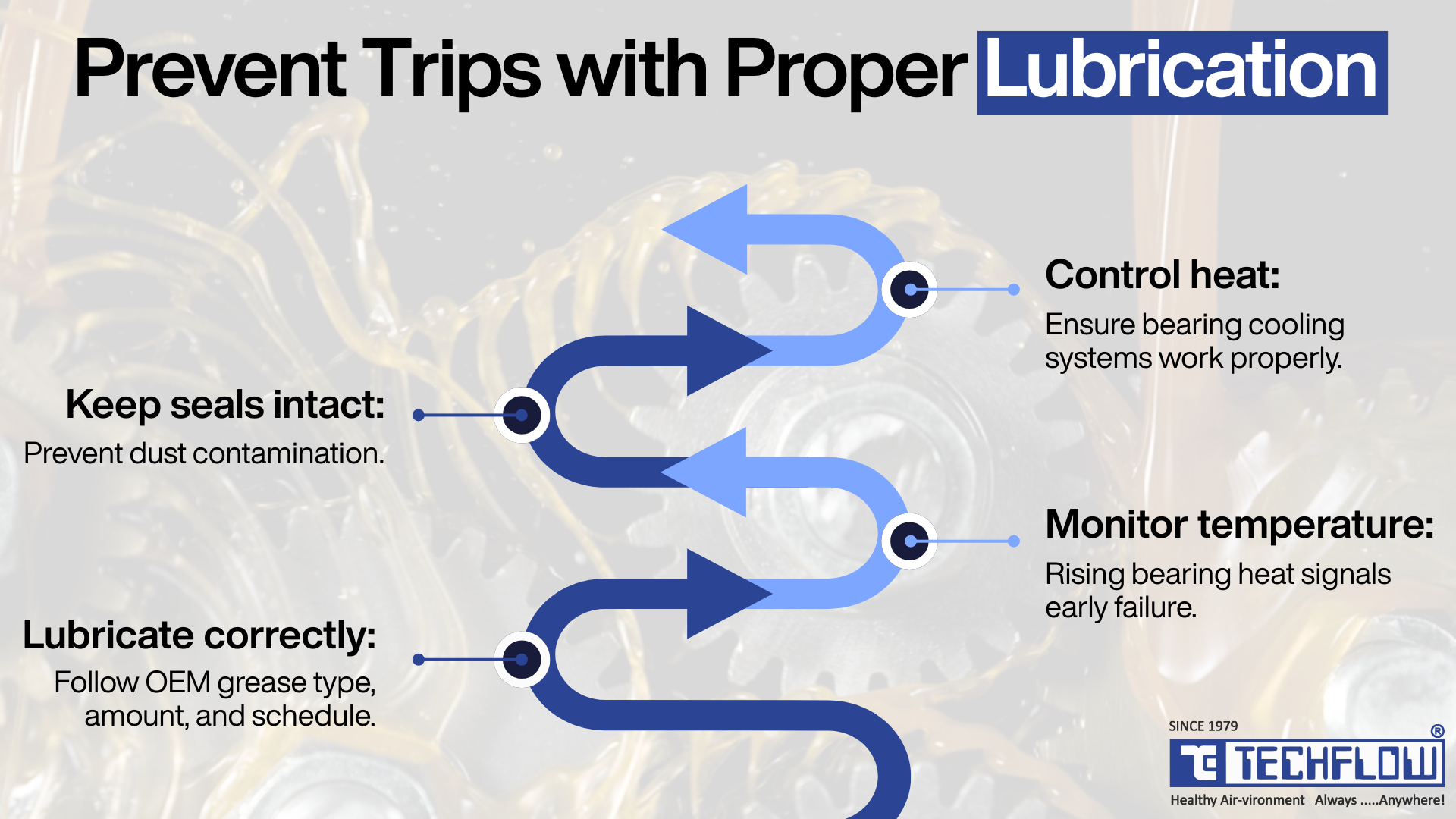
The bearing is the component that most often turns a maintainable problem into a stopped kiln. Treat it accordingly.
Lubricate to the OEM schedule, by quantity, not by feel: Over-greasing is a leading cause of bearing overheating; excess grease churns and generates heat. Use the specified grease and the specified amount. Both over- and under-greasing show up repeatedly in fan failure investigations.
Watch temperature as a leading indicator: A bearing that has started to climb 5–10 °C above its normal running temperature is warning you before it fails. Fixed temperature sensors on critical fans pay for themselves the first time they save a kiln.
Keep contamination out: In a dust-heavy environment, seal integrity is everything. Grease purges and effective seals stop abrasive dust reaching the raceways, a documented top-three cause of fan bearing failure.
Manage heat conduction from the process: On hot fans, the bearing arrangement and any cooling provision cooling discs, water jackets, or heat slingers exists to protect the lubricant from process heat travelling up the shaft. Confirm it is actually working, not just fitted.
Alignment, Couplings, and Drives
Misalignment is quiet, cumulative, and completely preventable. A coupling a fraction of a millimetre out will run and will steadily destroy bearings, seals, and the coupling itself while wasting motor power.
- Use laser alignment, not a straightedge and feeler gauge, on critical fans. The precision difference translates directly into bearing life.
- Check hot alignment where you can. Thermal growth means a fan aligned cold may be misaligned at operating temperature a real and significant effect on hot cement fans.
- Inspect flexible coupling elements for wear and replace on condition. A perished element transmits shock straight into the bearings.
- On belt drives, maintain correct tension and sheave alignment. ISO 14694 references ISO 254 for pulley quality, finish and balance; unbalanced pulleys are a genuine and often-missed vibration source.
- Re-check alignment after any reassembly. Misalignment introduced during post-maintenance rebuild is one of the most common bearing-failure root causes.
Safety First: Never Open a Fan That Isn't Truly Dead
Every internal inspection, cleaning, or balancing task on this list assumes the fan is completely and verifiably stopped and isolated. A centrifugal impeller stores enormous energy and can windmill on draught long after power is cut.
Before anyone opens an access door or reaches inside a casing:
- Full lock-out / tag-out (LOTO) of the motor and drive, verified at the point of isolation.
- Confirm the impeller has completely stopped. Do not rely on it "looking" stopped; process draught can keep it turning.
- Isolate against back-draught so the stopped fan cannot be spun by a still-running section of the line.
- Treat every surface as hot on process fans until proven otherwise.
- Follow confined-space procedure where the casing qualifies.
- Coal mill fans carry additional fire and explosion risk. Cleanliness and ignition-source control are safety requirements, not housekeeping.
No vibration reading, cleaning job, or balancing task is worth an operator's hand. Build LOTO into the checklist, not around it.
Common Maintenance Mistakes to Avoid

Waiting for the vibration to hit the alarm. By the alarm point, damage is already done. Act on the trend, not the trip level.
Over-greasing bearings. More grease is not more protection; it's more heat. Follow the quantity, not the instinct.
Cleaning the impeller but ignoring why it fouled. If buildup returns within weeks, the process condition or upstream filtration is the real problem.
Balancing away a symptom of erosion. Persistent imbalance on an old impeller often means lost metal, not a weight problem. Inspect before you trim.
Citing the wrong standard. Applying ISO 14694 limits to a 500 kW kiln ID fan is outside that standard's stated scope. Above 300 kW, ISO 20816-3 governs.
Comparing peak readings to RMS limits. A ~40% overstatement that triggers unnecessary interventions and erodes trust in the monitoring programme.
Skipping the log. Undocumented readings can't be trended and can't defend you in a safety or emissions audit. The log is the maintenance.
Treating every fan the same. The kiln ID fan and the bag-house fan need different frequencies, different wear parts, and different urgency.
Deferring bearing replacement to "next shutdown." Bearings fail on their own schedule, not the plant's.
Troubleshooting Guide: Symptom to Root Cause
| Symptom | Likely causes | First diagnostic step |
|---|---|---|
| Vibration rising gradually over weeks | Buildup imbalance; progressive erosion | Spectrum analysis: check 1× RPM dominance |
| Vibration appeared suddenly | Lost blade section, thrown balance weight, foreign object | Stop, isolate, inspect impeller visually |
| High axial vibration | Misalignment; bearing problem | Laser alignment check at operating temperature |
| Bearing temperature climbing steadily | Over-greasing; contamination; misalignment; heat from process | Review lubrication records before re-greasing |
| Airflow down, amps unchanged | Blade erosion; system/duct restriction; damper fault | Measure blade thickness against baseline |
| Amps rising, airflow unchanged | Buildup adding mass and disturbing flow | Inspect impeller through access door |
| Imbalance returns weeks after balancing | Ongoing buildup or active erosion | Root-cause the process condition and filtration |
| Erratic vibration, no clear frequency | Mechanical looseness; cracked grout; loose bolts | Torque audit and foundation inspection |
Repair, Rebalance, or Replace? A Decision Framework
| Situation | Sensible action |
|---|---|
| Vibration rising, impeller fouled, blades sound | Clean and re-balance in situ |
| Vibration rising, blades visibly thinned/eroded | Measure thickness; hardface/repair or plan impeller replacement |
| Bearing temperature or high-frequency vibration climbing | Plan bearing replacement at the next window; don't wait for seizure |
| Airflow dropping at the same amps, no buildup | Suspect erosion or a system/duct problem; investigate before re-balancing |
| Repeated imbalance returning within weeks | Root-cause it: process, upstream filtration, or lost metal |
| Cracks found on blades, welds, or hub during NDT | Do not run. Repair to procedure or replace the impeller |
| Impeller repeatedly repaired, efficiency never recovers | Replace with a rotor specified for the actual duty |
Maintenance, Emissions Compliance, and Energy Cost
Fan maintenance is often filed under reliability. In a cement plant, it sits on two other ledgers as well.
Compliance: Indian cement plants operate under the Environment Protection Act, holding Consent to Establish and Consent to Operate from their State Pollution Control Board, with monitoring and reporting obligations set by the CPCB framework, including Continuous Emission Monitoring Systems on major stacks. A dedusting fan that has lost draught capacity to erosion undermines the collection efficiency of the equipment behind it. Your maintenance logs are part of the audit trail.
Energy: Fans are among the largest electrical consumers on a cement line. An eroded, fouled, or misaligned fan does the same work for more kilowatts, every hour of every day. Efficiency loss is invisible on a trip report and very visible on an annual energy bill.
This is why fan condition, dust collection system performance, and emissions compliance are best treated as one engineering conversation rather than three separate departments.
Building the Programme: A Practical Rollout
If you are starting from reactive maintenance, sequencing matters more than ambition.
Step 1: Criticality ranking. List every fan. Rank by what stops if it stops. The kiln ID fan and coal mill fan sit at the top; a local booster fan does not. Inspection frequency follows criticality.
Step 2: Establish baselines. Take triaxial vibration readings at every bearing on every ranked fan, plus bearing temperatures and normal-band motor amps. Without a baseline, no trend exists.
Step 3: Fix the standard per fan. For each fan, record whether ISO 14694 or ISO 20816-3 governs based on installed power, and record the support classification (rigid or flexible) using the 25% foundation test. Write the resulting limits into the fan's record.
Step 4: Assign ownership. Daily checks belong to operators; weekly and monthly to the maintenance team; quarterly and shutdown work to planned outages. Named owners, not departments.
Step 5: Instrument the critical few. Fixed vibration and temperature sensors on top-ranked fans convert a weekly snapshot into a continuous trend. Start with the kiln ID fan.
Step 6: Close the loop on root causes. Every intervention should end with a recorded cause, not just a recorded repair. "Re-balanced" is not a root cause; "re-balanced after buildup traced to raw meal moisture" is.
Where Fan Engineering Meets Fan Maintenance
A maintenance programme can only preserve the engineering that was designed in. A centrifugal fan built for a cement plant with appropriate impeller metallurgy, hardfacing, wear liners, a bearing arrangement matched to the gas temperature, and a rotor balanced to a specified grade is a fan a maintenance team can actually keep running. A generic fan dropped into an abrasive, high-temperature duty will fight its maintainers for its whole short life.
This is where a specialist manufacturer earns its place. TECHFLOW was founded in Ahmedabad in 1979 by Mr D. K. Parikh, beginning in an 80 sq. m workshop and growing into a manufacturing facility spread across 14,000 sq. m, incorporated as TECHFLOW Enterprises Pvt. Ltd. in 2008. Over four decades, the company has designed, supplied, and commissioned air pollution control systems, pneumatic conveying systems, and centrifugal fans and blowers for cement plants, power plants, steel and sponge iron units, waste-to-energy facilities, and other heavy industries across India and export markets.
That combination matters. Because TECHFLOW engineers both the fan and the dust-collection train it works alongside ESPs, bag filters, fume extraction, and pneumatic conveying systems the fan can be specified for the real gas condition it will face: temperature, dust load, and abrasion, rather than a catalogue average.
For a plant maintenance head, the value of that engineering shows up in exactly the details that decide fan life: impellers specified and hardfaced for the abrasive duty, bearing arrangements built for the process temperature, rotors balanced to a defined grade, wear parts designed to be serviceable, and support from engineers who understand what a cement kiln's fans are actually up against.
When a fan is designed for its duty and maintained to a disciplined checklist, unplanned trips stop being a fact of life and become a rare exception.
Frequently Asked Questions (FAQs)
On a rhythm, not a single interval. Operators run daily visual and sensory checks; vibration and bearing temperatures are logged weekly; full vibration spectrum analysis and coupling checks are monthly; impeller inspection, cleaning, and laser alignment are quarterly; and a full strip, re-balance, bearing renewal, and precision realignment happen at the annual major shutdown.
Two dominate: imbalance caused by uneven dust buildup on the impeller, and bearing degradation. Bearing failures are heavily driven by incorrect lubrication intervals, dust contamination through degraded seals, and misalignment introduced during reassembly. Both failure modes develop as trends you can catch early through vibration and temperature monitoring.
It depends on the fan's installed power, application category, and support rigidity; there is no universal number. ISO 14694 covers fans below 300 kW installed power (or standard motors up to 355 kW) and sets balance and vibration categories; above that, ISO 20816-3 (which replaced ISO 10816-3) applies. Because many cement kiln ID fans exceed 300 kW, the correct standard for them is usually ISO 20816-3. Operationally, the trend matters most: a fan climbing steadily above its own established baseline needs investigation even while still "within limits."
Check installed power. ISO 14694 applies below 300 kW. At or above that, use ISO 20816-3. Where a single contract covers fans on both sides of the threshold, ISO 14694 requires the manufacturer and purchaser to agree which standard applies, normally based on the majority of units.
Balance grades follow the ISO 1940-1 / ISO 21940 system through ISO 14694's BV categories. BV-3 (G 6.3) is the common default for general industrial fans, with BV-4 (G 2.5) frequently specified for larger and more critical units. The right answer for any given fan should be written into the purchase specification and the post-overhaul acceptance test rather than assumed.
Because cement process gas carries hard, abrasive particles that erode blades like countless tiny grinding wheels. Erosion thins the blades, cuts airflow, and, because metal is lost unevenly, throws the impeller out of balance. Wear-resistant materials, high-chromium hardfacing on leading edges, and replaceable liners are the standard defences.
Yes. In-situ dynamic balancing lets a technician measure imbalance on the installed fan and add trim weights to correct it, avoiding a full strip-down; ISO 20806 provides criteria and safeguards for in-situ balancing of medium and large rotors. It is the right fix for a fouled impeller, but if imbalance keeps returning quickly, the real cause is usually buildup or erosion, which should be corrected rather than repeatedly balanced around.
A support is rigid when the system's first natural frequency is well above the fan's operating speed, and flexible when it is well below. As a practical field test, ISO 14694 treats a foundation as rigid and of sufficient mass if vibration measured on the foundation near the machine's feet is less than 25% of the maximum amplitude at the adjacent bearing housing. A foundation can be rigid in one direction and flexible in another.
Full lock-out / tag-out of the motor and drive verified at the isolation point, confirmation that the impeller has completely stopped (process draught can keep it windmilling), isolation against back-draught from a still-running line, and treating all surfaces as hot until proven otherwise. Confined-space procedure applies where the casing qualifies, and coal mill fans carry additional fire and explosion precautions.
Directly. On a bag-filter fan, a single failed bag sends a plume of abrasive dust into an impeller designed to run on clean gas, accelerating erosion sharply. Fan condition and upstream filtration condition are the same maintenance conversation.
Yes. Indian cement plants operate under CPCB and State Pollution Control Board consent conditions with continuous and periodic stack monitoring obligations. A dedusting fan that has lost draught capacity to erosion or fouling undermines the performance of the collection equipment it serves, and maintenance logs form part of the audit trail.


