


Key Takeaways
- Dense phase moves material as low-velocity plugs at high pressure; lean (dilute) phase suspends it fully in a fast, lower-pressure airstream.
- Solids loading ratio is the dividing line: dilute phase carries under ~15 units of solids per unit of gas, dense phase far more.
- Dense phase's biggest advantage is gentleness; its low velocity minimizes particle attrition, pipe wear, and dust for fragile or abrasive materials.
- Lean phase wins on cost and flexibility: lower CAPEX, minimal footprint, and easy routing around bends for free-flowing, non-fragile powders.
- The cost trade-off is CAPEX vs. OPEX: dense phase costs more upfront but uses far less air, cutting long-run energy and wear costs.
- Combustible or toxic dust can override the choice; run a dust hazard analysis first; vacuum systems contain hazardous dust by leaking inward, not out.
- There's no universal "better" system, only a better fit. TECHFLOW engineers both dense and lean phases in-house, so the recommendation follows your material.
Two systems. Both called "pneumatic". Both move dry bulk solids through a sealed pipe using air. Yet choose the wrong one, and you will spend the next decade replacing worn elbows every few months, or paying for compressed air you never needed to generate. Choose the right one and the conveying line becomes the quietest, most forgettable part of the plant, which, for anyone who has ever been paged about a blocked transfer line at 2 a.m., is the highest compliment a system can earn.
The decision between dense phase and dilute phase (which TECHFLOW, like much of Indian and global industry, also calls lean phase) is one of the most consequential a process or facility engineer makes, and one of the least formally taught. This guide settles it. We cover the physics that separates the two, the equipment behind each, the true cost picture, the safety constraints that can override everything else, and a structured framework for matching a system to your material rather than to whatever a single-product vendor happens to sell.
The Short Answer (For the Engineer in a Hurry)
Dense phase conveying pushes material along the pipe as slow-moving plugs or a sliding bed at low velocity and higher pressure, using very little air relative to the mass of solids moved. It is the gentle option built for fragile, abrasive, or friable materials where impact damage, particle attrition, and pipe wear must be minimized.
Dilute (lean) phase conveying suspends material fully in a high-velocity airstream at lower pressure, keeping every particle airborne from pickup to discharge. It is the simple, low-capital-cost option ideal for free-flowing, non-fragile powders and granules, and forgiving of complex pipe routing.
The technical line between them is solids loading ratio (SLR), the mass of solids conveyed per unit mass of gas. As the American Institute of Chemical Engineers (AIChE) defines it, a dilute phase line typically carries fewer than about 15 units of solids per unit of gas at pressures under roughly 15 psig, while a dense phase line carries more than about 15 units of solids per unit of gas at higher pressures. There is no universal "better" system, only a better fit for your material's abrasiveness, particle size, fragility, permeability, and your plant's balance between up-front capital (CAPEX) and lifetime operating cost (OPEX).
At a glance
- Dense phase → low velocity, high pressure, high solids loading, gentle handling, higher CAPEX, lower air use, longer distances.
- Lean (dilute) phase → high velocity, low pressure, low solids loading, simpler and cheaper to install, higher air use, more particle and pipe wear.
- The deciding variable is your material's behavior, not the equipment catalogue.
What Pneumatic Conveying Actually Is and Why "Phase" Is the Decisive Variable
A pneumatic conveying system moves powders, granules, pellets, and other dry bulk solids through a fully enclosed pipeline using a controlled flow of air or inert gas, instead of belts, screws, drag chains, or bucket elevators. That closed-pipe design is exactly why the technology has displaced open mechanical handling across the process industries over the past several decades: it contains dust, protects product from contamination and moisture, keeps the plant floor clean, and routes around obstacles that a rigid conveyor cannot.
But "pneumatic conveying" is not a single design. It is a spectrum, and where a system sits on that spectrum is set at the design stage by two interacting variables: the volume of air moved and the pressure applied. Get the combination right for the material, and it conveys efficiently. Get it wrong, and the line either blocks or shreds the product.
The formal dividing line is saltation velocity: the gas velocity at which particles that were fully suspended in a horizontal pipe begin dropping out of the airstream and settling on the pipe floor. Convey above the saltation velocity and every particle stays airborne: that is dilute phase, sometimes called stream flow or suspension flow. Convey below it, and the material can no longer be held in suspension, so it travels as slower plugs or a moving bed along the bottom of the pipe: that is dense phase. Saltation velocity is not a fixed number it is governed primarily by the size, shape, and density of the particles, which is precisely why material characterization comes before equipment selection.
The Physics: Solids Loading, Saltation Velocity, and Drag Force
Three concepts explain everything downstream. Understanding them turns system selection from guesswork into engineering.
1. Solids loading ratio (SLR):
This is the mass flow rate of solids divided by the mass flow rate of conveying gas. It is the single most useful number for classifying a system. Industry and academic references (including ScienceDirect's engineering reference works) generally treat an SLR up to about 15 as dilute phase; dense phase operates well above that, often in the range of 20 to 150 depending on the material. A low SLR means you are moving a lot of air to carry a little material, the defining inefficiency of dilute phase. A high SLR means you are moving a lot of material on very little air, the defining efficiency of dense phase.
2. Saltation velocity:
As above, this is the threshold gas velocity below which suspended particles fall out of the airstream. In practical terms, minimum conveying air velocity for dilute phase is commonly around 15 m/s (roughly 3,000–5,000 ft/min for typical powders and granules), while dense phase can run as low as 3 m/s for materials with good air retention. Drop below the material's minimum conveying velocity and the pipeline is likely to block the failure mode every operator fears.
3. Drag force is the real mover:
It is a common misconception that "vacuum" or "pressure" is what pushes solids along the pipe. It is not. The force acting on each particle is aerodynamic drag, which depends on the drag coefficient, gas density, the particle's projected area, and critically the square of the gas velocity. AIChE illustrates the velocity dependence with a simple analogy: a leaf blower at idle barely moves a leaf, but the same blower at full throttle sends it flying.
This is also why dense phase works despite its low velocity. At the higher pressures dense phase operates under, gas density rises substantially. Denser gas exerts more drag per unit velocity, and particle-on-particle contact forces in the concentrated solids stream assist transport. The result is efficient conveying at velocities far too low to keep material suspended in the thinner, lower-pressure air of a dilute phase line.
Lean (Dilute) Phase Conveying: How It Works
In lean phase, material rides fully suspended in a high-velocity airstream from source to destination. The system achieves throughput not by concentrating solids, but by moving a larger volume of air at speed. The majority of pneumatic conveyors in service worldwide operate in dilute phase, largely because almost any material can be conveyed this way provided it feeds reliably into the line, and enough air is supplied to keep it airborne.
Within lean phase, systems are classified by how the solids move through the pipe:
- Plug type material advances in discrete slugs pushed by pressurized air pockets.
- Continuous type material stays uniformly distributed throughout the airstream for the full run of the pipeline.
TECHFLOW's own lean phase conveying range splits this further into Empty Pipe Conveying Systems and Full Pipe Conveying Systems, each matched to different throughput, routing, and pickup-point requirements. Lean phase systems are also commonly known as pneumatic transporters, material transporters, or foundry sand transporters, reflecting the industries they serve most heavily.
Where lean phase genuinely wins:
- Minimal wearing parts and low maintenance. The mechanical footprint is simpler than a pressure-vessel-based dense phase setup, with fewer heavy-duty components to service.
- Small installation footprint. Very little floor space and civil work is needed, and the system copes well with difficult layouts, multiple bends, elevation changes, and tight routing.
- Flexible multi-point transfer over long runs. Material can move from single or multiple feed points to numerous destinations in a closed loop that eliminates fugitive dust by design.
- Lower CAPEX. No pressure vessels, no heavy-duty rotary valves, no flanged high-pressure piping; up-front equipment cost stays down.
Where it struggles: the high conveying velocity is the trade-off, and it is not a small one. That same velocity that keeps material airborne also drives particle attrition (breakage and fines generation) and pipeline wear, especially at bends. If your material is fragile, friable, or abrasive, dilute phase is the wrong starting point; the kinetic energy that suspends the particles is the same energy that degrades them and erodes the pipe.
Dense Phase Conveying: How It Works
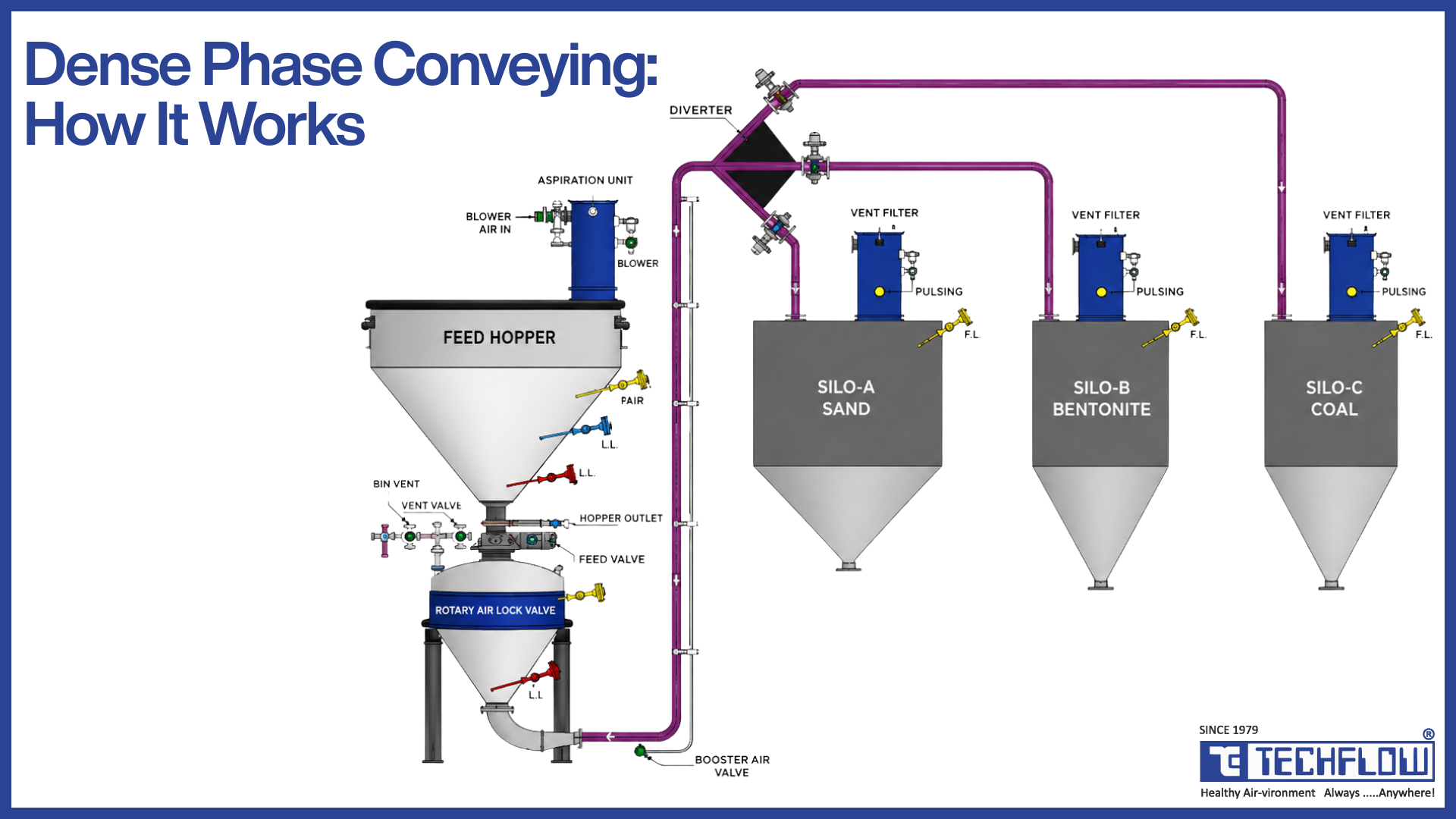
Dense phase inverts the approach entirely. Instead of suspending material in fast air, it drives the material along the pipe as a controlled, low-velocity plug or moving bed, using a small mass of gas relative to the mass of solids. It has earned its reputation as the proper method for moving hard, abrasive, and brittle materials, gently pushing material through an enclosed pipe in plug form on tiny quantities of gas, at lower velocity but medium-to-high pressure.
The reason it works comes back to the physics above: at elevated pressure, gas density climbs, drag per unit velocity rises, and particle-to-particle forces in the dense solids stream help carry material forward at speeds that would cause an immediate blockage in a lean phase line.
The two dense phase flow modes and why picking the wrong one fails
Not every material conveys in dense phase, and among those that do, the mode matters. AIChE identifies two:
- Piston/plug flow is best for coarse, permeable bulk solids such as plastic pellets or catalyst beads, where gas can pass through the plug itself. These correspond broadly to Geldart Group D ("spoutable") materials.
- Moving bed flow is best for fine, air-retentive bulk solids, with cement the textbook example: it fluidizes uniformly and deaerates slowly, letting it travel as a sliding bed. These correspond broadly to Geldart Group A ("aeratable") materials.
The instructive counter-example is beach sand. Intuition says sand should convey easily in dense phase; it is granular and free-flowing. In practice, it is a poor candidate: it deaerates almost instantly (so it will not hold a fluidized moving bed) yet packs tightly enough to choke a permeable plug. Sand is a classic "looks easy, isn't" material, and it is exactly why two solids that appear similar on paper, sand and cement, can land on opposite sides of the dense phase decision purely because of how they fluidize and retain air.
Core Dense Phase Equipment
A TECHFLOW dense phase system is built around a few key components working on a controlled fill-and-convey cycle:
- A pressure vessel (transporter) that receives and pressurizes each batch of material.
- A feed hopper above the vessel, with an isolating dome valve between the two to seal the vessel during conveying.
- A terminal pulse-jet filter at the receiving end to separate and vent the conveying air cleanly.
- An electrical control panel with a PLC managing the filling and conveying sequence, offered in both weight-based and volume-based configurations.
Where dense phase wins decisively: reduced conveying velocity means far less pipeline wear and particle damage, lower gas consumption, lower operating energy cost per tonne, and the ability to convey over longer distances and at higher capacities; reference works place dense phase capacities as high as ~300 tonnes per hour, versus the far lower ceilings typical of dilute phase.
The trade-off: higher CAPEX (the pressure vessel and heavy-duty valving are not cheap), and a hard "no" for certain materials. Fibrous or interlocking solids wood chips, straw, chopped fiberglass do not feed reliably from dense phase pressure vessels. They bunch and compress into an immobile plug rather than advancing as a piston or bed. For these, lean phase (or mechanical conveying) remains the better option regardless of any abrasiveness concerns.
Dense Phase vs. Lean Phase: Side-by-Side Comparison
| Parameter | Dense Phase | Lean (Dilute) Phase |
|---|---|---|
| Conveying mode | Low-velocity plugs / moving bed (non-suspension) | Full suspension in airstream (stream flow) |
| Conveying velocity | Low (as low as ~3 m/s for air-retentive materials) | High (~15 m/s and above) |
| System pressure | Medium to high (typically >~2 barg / >30 psig) | Low (typically <~1 barg / <15 psig) |
| Solids loading ratio (SLR) | High (~20–150) | Low (up to ~15) |
| Air consumption | Low per tonne conveyed | High per tonne conveyed |
| Material degradation/attrition | Minimal gentle | Higher impact and abrasion |
| Pipeline wear | Low | Higher, especially at bends |
| Capacity (typical ceiling) | Higher (up to ~300 t/h) | Lower |
| CAPEX | Higher (pressure vessels, heavy-duty valves, flanged pipe) | Lower (simpler mechanical footprint) |
| OPEX / energy | Lower gas use, but higher-pressure air generation | Higher air volume = higher specific energy |
| Footprint & civil work | Larger (vessel foundations, reinforced supports) | Smaller, flexible routing |
| Best-fit materials | Fragile, abrasive, friable; permeable (pellets) or air-retentive (cement, fly ash) | Free-flowing, non-fragile powders and granules; fibrous/interlocking solids |
| Poor-fit materials | Fibrous/interlocking solids; sand-like, fast-deaerating materials | Highly abrasive or fragile materials at scale |
Ranges above are widely cited engineering rules of thumb (AIChE, IChemE, and standard bulk-solids references); exact figures depend on the specific material, distance, and pipeline layout, which is why bench or pilot conveying trials are recommended for unproven materials.
Pressure vs. Vacuum: The Variable That Applies to Both Systems
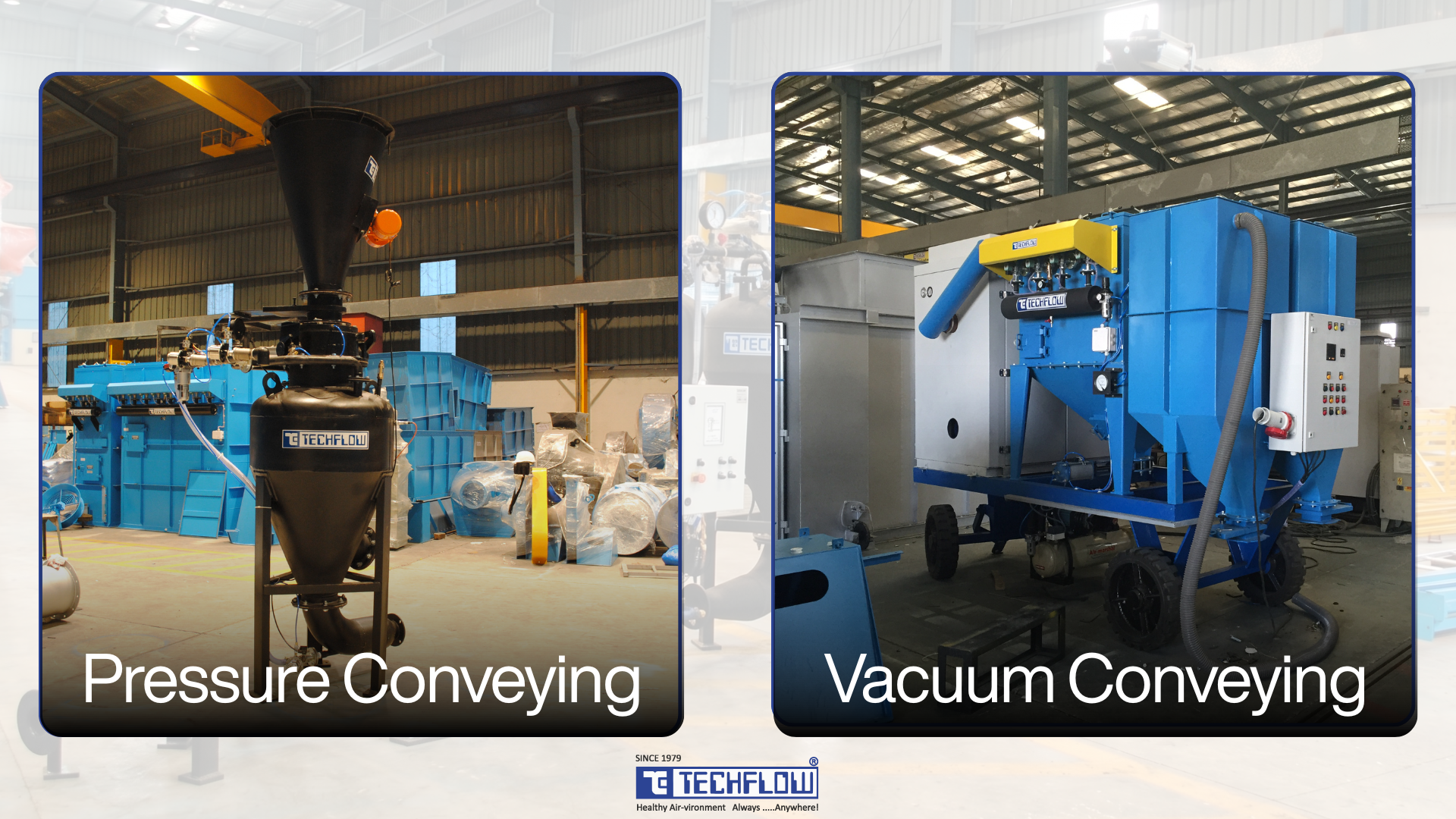
Phase (dense vs. lean) is only one axis of the design. The other is pressure vs. vacuum, and it applies independently to both.
A positive pressure system uses gas above atmospheric pressure to entrain and drive solids, and can push material long distances to one or multiple destinations. Positive pressure conveying is the largest technology segment of the market precisely because of this long-distance, high-capacity, contamination-free capability.
A vacuum system works the opposite way: it draws solids in at atmospheric pressure, often from several pickup points, and discharges into a vessel held below atmospheric pressure. Because the achievable pressure drop is limited, vacuum systems are generally restricted to shorter runs (commonly cited around 300 ft / ~90 m).
The decisive practical difference shows up with hazardous materials. In a vacuum line, any leak draws inward, keeping dust and product inside the system. In a pressure line, a leak blows outward, releasing a dust cloud into the plant. That is why the National Fire Protection Association (NFPA) treats vacuum conveying as the preferred approach for many combustible and toxic dusts, a consideration a facility manager should weigh separately from the dense-vs-lean decision, not as part of it.
Combustible & Toxic Dust: The Safety Constraint That Can Override Everything
For any combustible or toxic powder, safety classification can and should override the mechanical "best fit" for the material. Many solids that seem inert in bulk become explosive when finely divided and dispersed in air, which is exactly the condition a conveying line creates.
The governing concept is the dust explosion pentagon: five elements that must coexist for a dust explosion:
- Fuel (combustible dust, typically finer than ~40 mesh)
- Oxidizer (oxygen in air)
- Ignition source (spark, ember, static discharge, hot surface)
- Dispersion (dust suspended in a cloud)
- Confinement (an enclosure that lets pressure build)
Remove or suppress any single element and an explosion is averted. Pneumatic conveying is well suited to this because a properly designed, enclosed system controls dispersion and confinement, and because gentle dense phase or vacuum handling produces less dust in the first place by minimizing particle breakage.
This is where TECHFLOW's core discipline matters. As a specialist in air pollution control and dust management since 1979, TECHFLOW engineers conveying systems alongside the containment, filtration, and venting hardware bag filters and dust collection systems, silo vent filters, and rotary airlock valves that keep combustible dust within the pentagon's safe boundaries. Compliance frameworks continue to tighten: NFPA has consolidated several long-standing standards (including NFPA 61, 652, 654, 655, and 664) into the unified NFPA 660 Standard for Combustible Dusts and Particulate Solids.
Under these standards, the facility owner/operator is responsible for determining a dust's explosive characteristics through a Dust Hazard Analysis (DHA), a step that must precede final phase selection whenever combustibility or toxicity is in play, because inerting-gas or vacuum-vs-pressure requirements can constrain the design regardless of what suits the material mechanically.
Matching Material to Method: A Characterization-First Framework
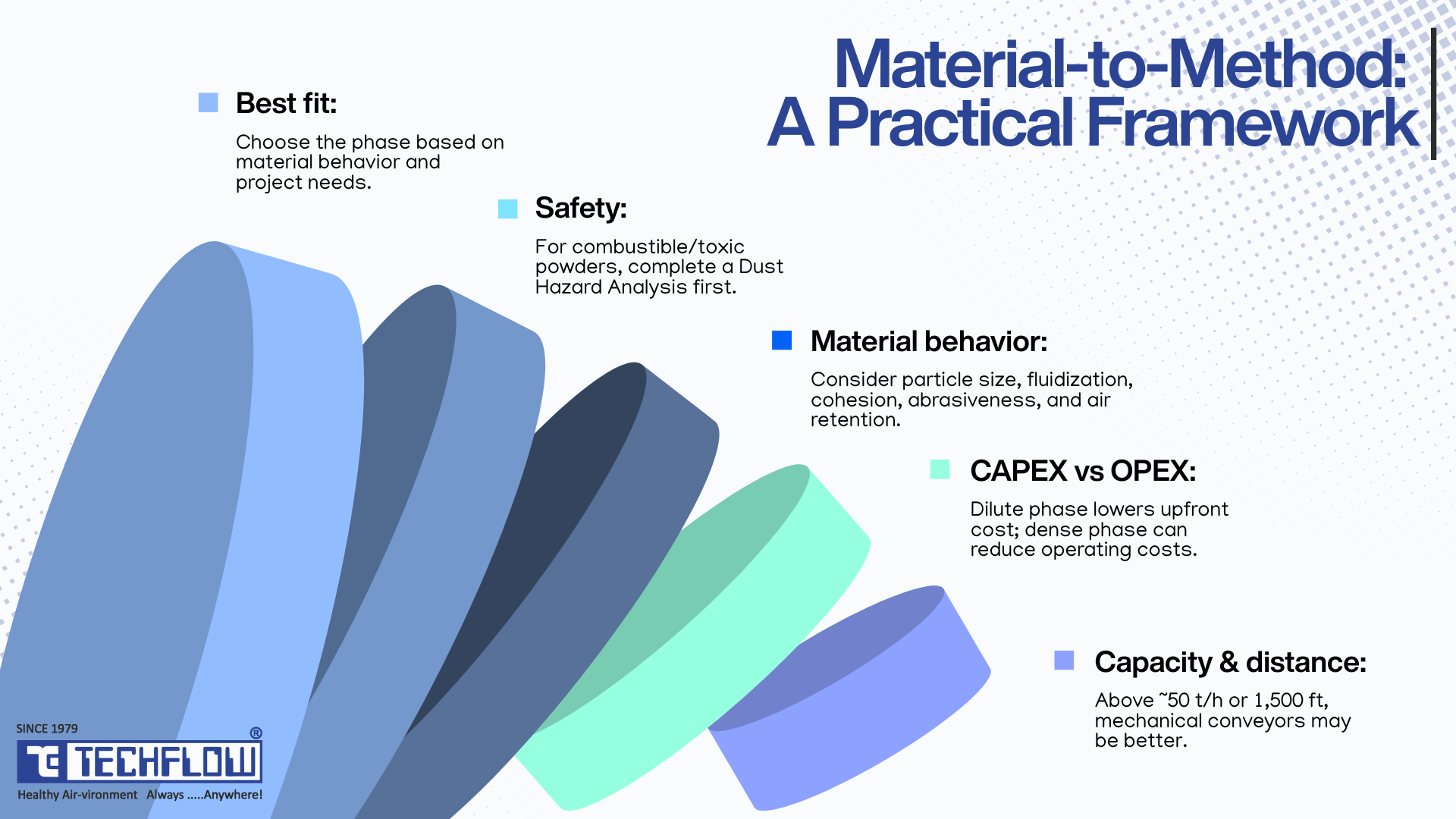
The most expensive way to choose a conveying system is trial and error after commissioning. A structured approach starts with the material, not the equipment catalogue, and works through four gates.
Gate 1: Capacity and distance thresholds
Pneumatic conveying carries the highest specific energy consumption of the major conveying technologies. Beyond roughly 50 t/h or ~1,500 ft, a mechanical conveyor often becomes the more sensible choice. Establish required throughput and distance first; if they exceed pneumatic's efficient envelope, the phase question may be moot.
Gate 2: CAPEX vs. OPEX priority
If the project is CAPEX-limited, dilute phase is frequently the prudent choice it avoids pressure vessels and heavy-duty valves. If OPEX is the binding constraint (long service life, high running hours), dense phase becomes attractive because it uses far less gas per tonne. The caveat: generating and conditioning higher-pressure air is not free, so the compressor and air-treatment cost must be weighed against the conveying savings, not assumed away.
Gate 3: Material behavior, not material type
Bulk solids are classified across several axes that jointly determine phase suitability:
- Particle size and shape
- Permeability and fluidization behavior (often summarized via the Geldart classification Groups A, B, C, and D)
- Air retention vs. deaeration rate
- Cohesion and friction
- Compressibility
- Abrasiveness
- Attrition resistance (friability)
The sand-versus-cement contrast is the canonical lesson: two granular solids that look interchangeable behave oppositely in dense phase because one retains air and one sheds it instantly.
Gate 4: Safety classification
For combustible or toxic powders, run the Dust Hazard Analysis and evaluate the explosion pentagon before finalizing phase and pressure/vacuum choices, as covered above. Safety can override mechanical fit.
This is precisely where TECHFLOW's dual manufacturing capability becomes a genuine engineering advantage rather than a sales line. Because TECHFLOW builds both Lean Phase Conveying Systems (Empty Pipe and Full Pipe) and Dense Phase Pneumatic Conveying Systems (weight-based and volume-based) in-house, the recommendation you receive is driven by how your material actually behaves, not by which single product line a vendor is trying to move.
Common Mistakes Plants Make When Choosing Between the Two
Even experienced teams fall into a recurring set of traps:
- Choosing dense phase because it "sounds more advanced." A fine, non-fragile, free-flowing powder often runs perfectly well and far more cheaply in lean phase. Advanced is not the same as appropriate.
- Ignoring particle size distribution. A material can be "coarse" on average yet carry enough fines to behave unpredictably in dense phase plug flow, causing intermittent blockages that only surface after commissioning.
- Underestimating dense phase's energy cost at the compressor. Dense phase uses less air volume, but generating higher-pressure air is not free. Budgeting for the conveying savings while ignoring the compressor upgrade is a classic miscalculation.
- Running a dense phase system as if it were dilute phase. A documented failure mode: a dense phase system operated with insufficient pressure or excessive velocity effectively degrades into an inefficient dilute phase line, surrendering the very wear-reduction and energy benefits it was bought for.
- Overlooking fibrous or interlocking materials. Wood chips, straw, and chopped fiberglass get pushed toward dense phase by default, then fail to feed from the pressure vessel, an avoidable mismatch that an upfront material assessment catches every time.
Industry Applications: Where Each Phase Earns Its Keep
Both phases serve overlapping but distinct materials across the process industries. TECHFLOW supports cement and clinker, foundry and steel, mining and minerals, coal handling, glass, particle board, sugar and food processing, and more. TECHFLOW's lean phase application list alone spans ash, alumina, barite, baghouse dust, calcium carbonate, cornstarch, fluorspar, clay, cement, bentonite, gypsum, foundry minerals, food powders, sand, soda ash, salt, lime, perlite, carbon black, cement clinker, diatomaceous earth, silica, foundry sand, and manganese ore.
A useful heuristic when mapping material to method:
- Cement, fly ash, fine mineral powders (air-retentive, fine) → dense phase, moving-bed mode.
- Plastic pellets, catalyst beads, coarse granules (permeable) → dense phase, plug-flow mode.
- Foundry sand, soda ash, salt, free-flowing non-fragile powders → lean phase.
- Abrasive minerals and friable food products conveyed gently to protect the product and the pipe → dense phase.
- Fibrous or interlocking feedstocks → lean phase or mechanical handling.
Because TECHFLOW also engineers the surrounding air pollution control and dust collection systems, the conveying line is designed as part of a complete, compliant material-handling and emissions envelope, not as an isolated component bolted onto someone else's dust system.
Conclusion: Match the Material to the Method
The dense phase versus lean phase decision comes down to matching your material's behavior to your plant's priorities, not to whichever system sounds more sophisticated. Lean phase wins on low CAPEX, small footprint, and flexible routing for free-flowing materials. Dense phase wins on gentleness and long-run energy savings for fragile or abrasive ones. Get it wrong, and the cost surfaces later as blocked lines, unplanned compressor upgrades, or premature pipe wear. The fix is unglamorous but reliable: characterize your material's particle size, permeability, air retention, and abrasiveness upfront, then let those properties choose the system.
With TECHFLOW engineering both dense and lean phase systems in-house and the dust collection, filtration, and emissions hardware around them, the recommendation starts with your material and your application, not with a single product line.
Frequently Asked Questions (FAQs)
Dense phase moves material as low-velocity plugs or a moving bed at high solids-to-air loading and higher pressure. Lean (dilute) phase fully suspends material in a high-velocity airstream at lower pressure and low solids loading. The core distinction is whether particles travel below or above the material's saltation velocity; below it, they move as plugs (dense phase); above it, they stay airborne (lean phase).
Dense phase, by a clear margin. Its lower conveying velocity is precisely what reduces pipeline wear and particle attrition compared with the high-speed airstream lean phase needs to keep material suspended. If your material is abrasive or fragile, dense phase protects both the product and the pipe.
Up-front capital cost is usually higher for dense phase because of the pressure vessels and heavy-duty valves it requires. But operating cost can be lower, since dense phase uses far less air per tonne of material moved. Which system is cheaper overall depends on your conveying distance, tonnage, and how energy-intensive the higher-pressure air requirement turns out to be; total cost of ownership, not sticker price, is the right measure.
No. Fibrous or interlocking materials such as wood chips, straw, and chopped fiberglass do not feed reliably from dense phase pressure vessels and tend to compress into an immobile plug rather than move. Fast-deaerating, sand-like materials are also poor dense phase candidates. These are usually better suited to lean phase or mechanical conveying.
Solids loading ratio (SLR) is the mass of solids conveyed per unit mass of conveying gas. It is the clearest way to classify a system: an SLR up to about 15 indicates dilute (lean) phase, while dense phase runs well above that, often 20 to 150. A high SLR means you are moving a lot of material on very little air, which is the efficiency advantage of dense phase.
Vacuum suits multiple pickup points and toxic or dusty materials, because any leak draws inward and keeps dust inside the system, but it is limited to shorter distances (commonly around 300 ft). Pressure conveying handles longer distances and higher throughput but discharges best at or near atmospheric conditions and leaks outward, so it requires careful dust management. This choice is separate from, and interacts with, the dense-vs-lean decision.
For combustible or toxic powders, safety can override the mechanical best fit. A Dust Hazard Analysis and assessment of the dust explosion pentagon (fuel, oxidizer, ignition source, dispersion, confinement) should come before final phase selection. Gentle dense phase or vacuum handling generates less dust to begin with, and NFPA standards (now consolidated under NFPA 660) increasingly favor enclosed, low-dust approaches.
Yes. TECHFLOW engineers Lean Phase Conveying Systems in both Empty Pipe and Full Pipe configurations, alongside Dense Phase Pneumatic Conveying Systems built on weight-based and volume-based designs. Building both in-house means the system recommendation is based on your material and application rather than a single product line, and it can be integrated with TECHFLOW's dust collection and air pollution control equipment for a complete solution.
Yes. IMARC Group values the global market at USD 34.5 billion in 2025, projected to reach USD 50.8 billion by 2034 (about 4.27% CAGR), driven by rising automation, food and pharmaceutical safety requirements, energy-efficiency priorities, and continued industrial expansion across Asia Pacific.


