


Key Takeaways
- An electrostatic precipitator's long-term performance is set by the engineering done before fabrication (dust characterisation, gas flow modelling, and electrical field sizing), not by the hardware you can see.
- Dust resistivity is a primary design input, not a footnote. Dust that is either too resistive or too conductive is hard to collect efficiently, and the workable range shifts with gas temperature and moisture.
- Uneven gas flow across the ESP cross-section causes re-entrainment and dead zones that quietly wreck efficiency, even when the electrical design is correct on paper. Aerodynamic modelling deals with this before steel is cut.
- India's emission floor has tightened. CAQM Direction No. 98 sets a uniform 50 mg/Nm³ particulate matter limit for identified Delhi-NCR industries, applicable to all covered units from 1 October 2026 after a July 2026 timeline amendment.
- Dry ESPs suit standard dry particulate loads. Wet ESPs are built for streams carrying tar or acid mist, such as coke oven gas. Choosing wrong at the design stage means building the wrong category of machine.
- Fabrication quality is part of design. Weld integrity, dimensional accuracy in plate spacing, and correct steel-grade selection decide whether a good design survives years of thermal cycling and rapping.
- The clearest signal of a competent ESP design team is the specificity of the questions it asks about your gas stream before it quotes, not the length of its installation list.
- India's ESP market is projected to grow from roughly USD 3.5 billion in 2025 to USD 5.9 billion by 2031 (about 9.4% CAGR), driven by retrofits of ageing plants and new cement, steel, and waste-to-energy capacity.
Two electrostatic precipitators can leave a workshop looking almost identical. Same steel casing, same rows of plates, same control cabinet. Put them on two plants, and they behave nothing alike. One holds its emission number for fifteen years. The other slips out of compliance under eighteen months. And the whole difference was settled long before either machine was fabricated, in a stack of engineering calculations most buyers never see and rarely ask to see.
That gap is what this guide is about. Not "what does an ESP do", but the more expensive question: what does it actually take to design one well, and how do you separate a capable design team from a catalogue vendor before you've committed the capital?
Why the Design Team Matters More Than the Machine
An electrostatic precipitator charges particulate matter in a flue gas stream, drives it onto grounded collecting plates, and periodically raps that dust down into hoppers for removal. The physics is well understood and more than a century old. What isn't standardised is the judgment that turns one specific, messy gas stream into a physical machine that will keep hitting the emission numbers for two decades.
This matters more in India today than it has in years. The country's electrostatic precipitator market is projected to grow from about USD 3.5 billion in 2025 to USD 5.9 billion by 2031, a compound annual growth rate near 9.4%, driven by retrofits of ageing installations and new capacity across cement, steel, and waste-to-energy plants. Sitting on top of that demand is a regulatory floor that keeps moving.
In February 2026, the Commission for Air Quality Management (CAQM) issued Statutory Direction No. 98, prescribing a uniform 50 mg/Nm³ particulate matter limit for a broad set of Delhi-NCR industries. That is a materially stricter floor than the roughly 80 mg/Nm³ that applied to many of these units before. A subsequent amendment in July 2026 revised the schedule so the limit applies to all covered industries from 1 October 2026.
So a plant owner buying an ESP today isn't only buying equipment. They're buying a design team's judgment about how that equipment will behave against a target that keeps getting stricter.
What an ESP Design Team Actually Does
It's tempting to picture ESP design as a fabrication job: take a standard casing, scale it, weld in plates. That's backwards. Fabrication is the last step. What comes first is process engineering that has very little to do with steel and almost everything to do with characterising the gas the unit will handle for the next fifteen to twenty years.
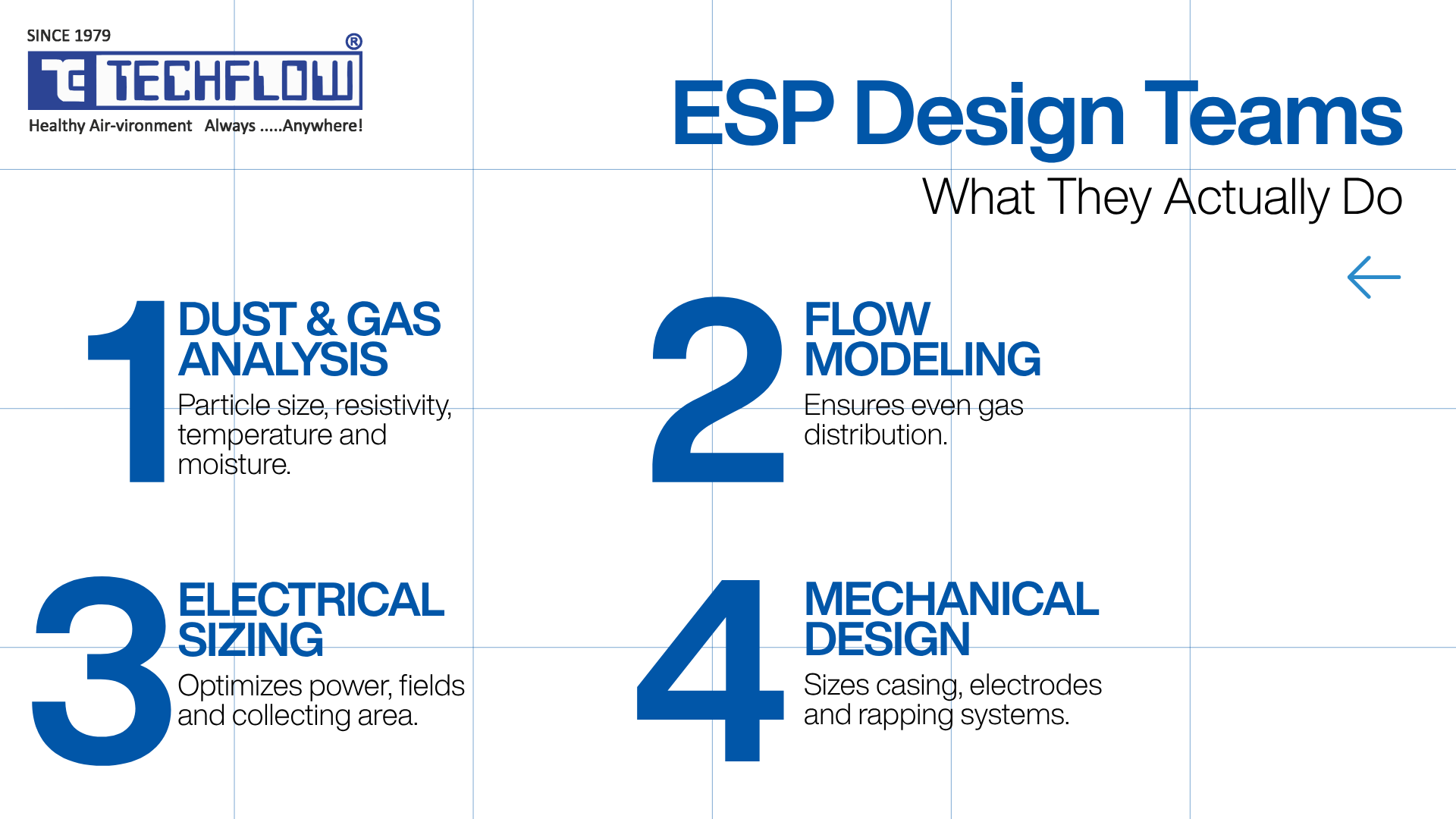
The real job is translating operating reality (variable fuel, seasonal load swings, dust of unpredictable resistivity) into an exact number of electrical fields, a defined plate spacing, and a calculated gas residence time. That work runs in a fixed sequence:
- Dust and gas characterisation: Particle size distribution, dust resistivity, gas temperature, moisture. These decide how many electrical fields the unit needs and how it should be sectionalised.
- Aerodynamic and flow modelling: Simulating how gas actually spreads across the cross-section, because uneven flow degrades efficiency even when every other parameter is right.
- Electrical field sizing: Corona power, field count, and specific collecting area calculated for this dust and this gas, not an industry average.
- Mechanical and structural design: Casing, electrode frames, and rapping systems sized for the real temperature, pressure, and vibration of the plant.
Only when all four are locked does fabrication begin. Skip or rush any one, and the guess shows up as underperformance months after commissioning, usually right around the time the warranty conversation starts.
Why Process Engineering Has to Come Before the Steel Is Cut
The most common ESP failure traces back to one shortcut: sizing the unit off a generic rule of thumb instead of the plant's actual dust and gas properties.
Dust resistivity is the input people underweight most often, and it behaves in ways that catch teams out. Dust that is too electrically resistive is hard to collect, and so is dust that is too conductive, and the workable middle range moves with gas temperature and moisture. Highly resistive dust can trigger back corona, where charge building up in the collected layer disrupts the electrical field and drags efficiency down. Treat resistivity as a line item rather than a measured design driver, and you've built a performance ceiling in before construction even starts.
Fuel variability makes this worse, especially on boilers and thermic fluid heaters running on shifting fuel mixes (coal grades, biomass, agro-residue) that change by season and by supplier. Each fuel throws off dust with different resistivity and particle size. A precipitator sized tightly around a single fuel spec will often sail through its commissioning test and then fall short the moment the plant switches to a cheaper blend six months later. TECHFLOW's guide to ESPs for boilers and thermic fluid heaters works through this fuel-variability logic in more detail.
This is also where the dry-versus-wet ESP call gets made, and it's driven by process chemistry, not preference.
When to Choose a Wet ESP Over a Dry One
| Factor | Dry ESP | Wet ESP |
|---|---|---|
| Gas condition | Dry flue gas | Saturated or moist gas |
| Dust removal | Mechanical rapping into hoppers | Liquid film or water wash |
| Best suited to | Standard particulate loads | Tar, acid mist, sticky or condensable pollutants |
| Typical applications | Boilers, cement, power, general dust | Coke oven gas, certain non-ferrous smelter off-gas |
| Key design concern | Dust resistivity, rapping timing | Corrosion-resistant materials, liquid handling |
Get this classification wrong, and it isn't a spec error. It's the wrong category of machine.
How Gas Flow Decides Whether an ESP Works in Reality or Only on Paper
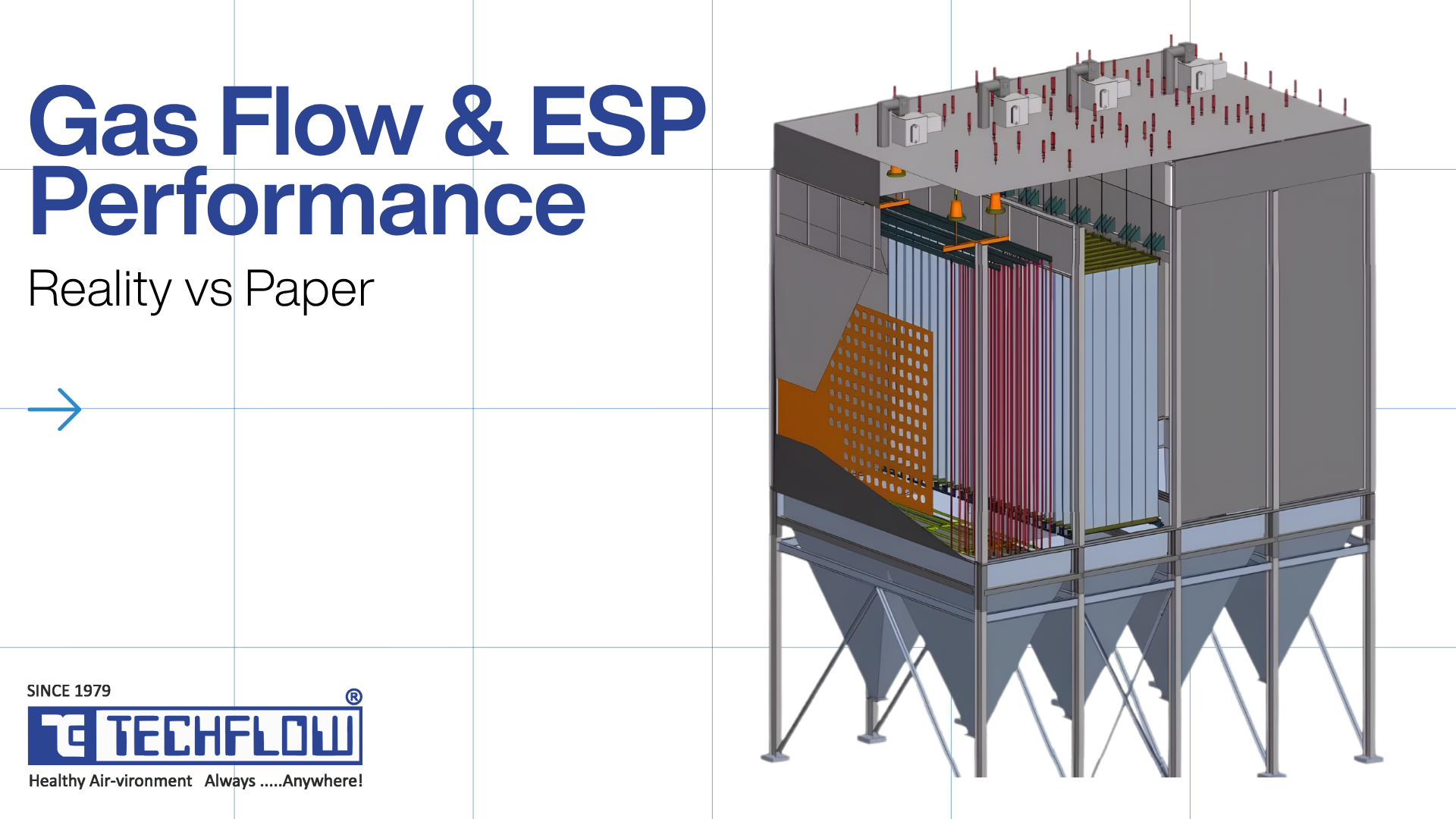
Two ESPs can share identical electrical specs (same field count, same specific collecting area, same corona power) and still perform differently, purely because of how evenly the gas spreads across the collection zone. This is the part of the design least visible in a quotation and most responsible for the gap between the number promised and the number delivered.
Uneven flow creates two problems at once. In high-velocity zones, it causes re-entrainment, physically tearing already-collected dust off the plates and back into the stream. In low-velocity zones, it creates dead zones, wasting collection capacity the design assumed was productive. Neither shows up on a spec sheet. Both show up in a stack test, by which point the fix means retrofitting gas distribution devices into a structure that's already built, which costs far more than getting it right on the drawing board.
A design team with real aerodynamic capability handles this with computational modelling before fabrication, using engineered gas distribution screens, perforated plates, and turning vanes at the inlet to force even flow across the full cross-section before the gas reaches the fields. Whether a team runs this on every project or saves it for the big jobs is one of the clearest tells of how seriously it takes real-world performance.
Electrode Geometry and Rapping: Where Good ESPs Become Great
Once flow and field sizing are locked, the collecting hardware comes down to two linked choices.
Discharge electrodes have moved well past plain wire. Modern profiles are engineered to produce stable, uniform corona along their length while standing up to the mechanical stress of continuous high-voltage operation and repeated rapping. Collector plates balance competing demands: rigid enough to stay flat under thermal and mechanical load, light enough that the structure doesn't become prohibitively heavy to fabricate and erect.
The rapping system is where a lot of underperforming units quietly fail, because it depends on correct timing as much as correct hardware. Rap too often and dust re-enters the gas before it can drop into the hopper. Rap too seldom and an insulating dust cake builds on the plate and cuts collection. Tumbling-hammer and similar mechanisms need tuning to the specific dust's cohesive behaviour, and that decision belongs in the original design with adjustability built in. It shouldn't be something a commissioning engineer is left to solve by trial and error on site.
Why a Design Team Needs India's Regulations as Well as Its Electrostatics

Strong electrostatics paired with weak regulatory awareness produces sound equipment aimed at the wrong target. In India, the risk has grown because the legal floor keeps shifting and two separate legal streams apply at the same time.
The Factories Act, 1948 treats dust and fume as an occupational-health matter, protecting workers inside the plant, which is where a well-designed fume extraction and filtration system earns its place. The Environment (Protection) Act, 1986 and its rules set the stack-level emission limits that protect the environment outside the boundary. A design that satisfies one and not the other isn't half-compliant. It carries two distinct kinds of legal exposure. TECHFLOW's sourcing guide for de-dusting system manufacturers in India covers this worker-and-environment framework in a related context.
Above these baseline statutes sit the specific numeric limits, and those have tightened sharply. CAQM's Direction No. 98 shows the pace. It sets a uniform 50 mg/Nm³ limit for identified Delhi-NCR industries: 17 categories of highly polluting industries identified by the CPCB, red-category medium and large air-polluting units, food and food-processing and textile units with boilers or thermic fluid heaters, and metal industries with furnaces. It replaced the older standard and, after a July 2026 amendment, applies to all covered units from 1 October 2026. Sector-specific and historical limits for steel, foundries, ceramic units, lime kilns, glass plants, reheating furnaces, and boilers are documented on the CPCB's emission-standards pages. A team that quoted against the old number even a year ago could deliver equipment that's already out of step with the target it has to meet at commissioning. Regulatory fluency has to be a live competency, refreshed continuously, not a qualification an engineer picked up years ago and never revisited.
How Fabrication Quality Turns a Design Into a Reliable Machine
A design is only a promise until it's built. The gap between the drawing and the finished plant is where fabrication either honours the engineering or quietly undoes it, and it's easy to overlook because it happens on a shop floor, not in a CAD file.
- Weld quality on casing and electrode frames isn't cosmetic. A poor weld becomes a stress point that fails under years of thermal cycling and rapping vibration, long after the commissioning test came back clean.
- Dimensional accuracy in plate spacing and alignment governs field uniformity. Small deviations from tolerance create localised weak points where corona behaves inconsistently and efficiency drops.
- Steel-grade selection has to match the actual gas temperature and corrosivity of the application. Undersizing this spec is a common way projects shave cost, and it's the kind that only surfaces years into operation.
Manufacturers with owned fabrication facilities hold a structural advantage over loosely supervised subcontracting, because QC-controlled welding, dimensional checks, and traceable steel sourcing are far easier to enforce under one roof than across a chain of vendors. Third-party certification such as ISO 9001, ideally audited by an internationally recognised body, is a useful outside signal precisely because it forces documentation and process discipline that's hard to fake on a website.
Why Commissioning and Aftersales Support Are Part of Design
The most underrated test of a design team's confidence shows up after installation, not before. Commissioning is where every design-stage assumption (the resistivity estimate, the fuel range, the flow model) meets reality for the first time. A team that treats this as somebody else's job is taking a real gamble with the owner's compliance outcome.
Aftersales capability tells the same story from another angle. A team that's sure of its engineering has every reason to offer proper ongoing support: tuning corona power as conditions shift, supplying original-spec parts, catching performance drift before it becomes a violation. That support reinforces a track record they're proud of. A less certain team tends to treat the sale as the end of the relationship.
This is also where pan-India service reach becomes a technical consideration, not just a convenience. A plant in a remote industrial zone whose design team and spares sit a thousand kilometres away faces materially longer downtime on any fault, and unplanned ESP downtime often means unplanned non-compliance.
How to Evaluate an ESP Design Team Before You Sign
The clearest signal of competence rarely turns up in a brochure. It turns up in how specific a team gets before it quotes anything. A team probing your fuel-blend variability, your dust resistivity range, your seasonal gas-temperature swings, and your exact regulatory target is doing genuine process engineering upfront. A team that jumps straight to a standard size based on gas volume alone is telling you the deeper work isn't happening.
Five checks worth running before you commit:
- Ask how they characterise dust resistivity for your process. Is it measured, or assumed from a generic table?
- Ask whether gas flow modelling is standard on every design or reserved for large projects. The physics of uneven flow doesn't scale down with project size.
- Ask which specific regulatory limit the design targets, and confirm it matches the current directive for your location and sector, not an older baseline.
- Ask where fabrication actually happens (owned facility or subcontracted) and what certifications govern its welding and dimensional control.
- Ask what happens if performance drifts after commissioning, and whether that support is built into the relationship or negotiated separately later.
None of these takes deep technical expertise to ask. The specificity of the answers tells you more than any case-study list.
How TECHFLOW Approaches ESP Design in India
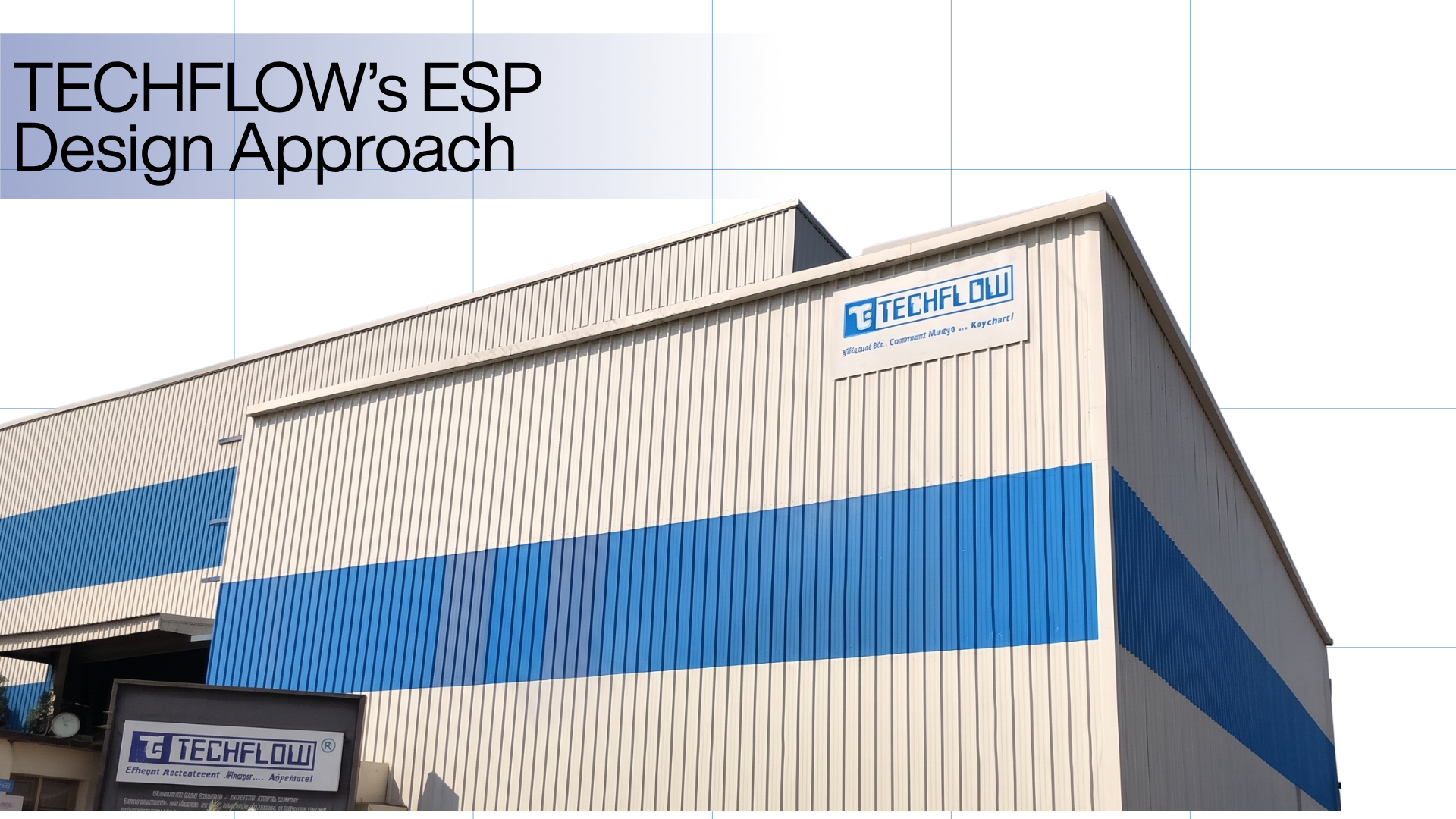
TECHFLOW's practice is built around the sequence above: process characterisation before fabrication, not the reverse. The foundation was laid in 1979 by technocrat Mr D. K. Parikh, with the present corporate entity, TECHFLOW Enterprises Pvt. Ltd., in place since 2008 and led today by Managing Director Mr Monil D. Parikh and Executive Director Mr Chintan D. Parikh. Its manufacturing base sits at Kubadthal, Ahmedabad, across a facility of roughly 35,000 square metres, and its work spans air pollution control across more than 15 industries: bag filters, electrostatic precipitators, wet scrubbers, furnace fume extraction, and centrifugal fans and blowers.
Quality discipline is externally audited. TECHFLOW's manufacturing is maintained in accordance with ISO 9001:2015, audited by the German institute TÜV-SÜD, the kind of documented QC rigour that separates a fabrication process built on traceable steps from one built on informal habit. For readers who want to go deeper, TECHFLOW's electrostatic precipitator product overview, its boiler and thermic fluid heater ESP guide, and its de-dusting system sourcing guide are useful next stops.
The Bottom Line on ESP Design in India
A great ESP design team in India isn't defined by brochure size or installation count. It's defined by decisions made in a specific order: characterise the dust and gas, model the flow, size the fields, then cut steel, with real quality control at every fabrication step and a current, working grasp of exactly which regulatory number the design has to hit. That number has been moving fast, and as of 1 October 2026, the room to engineer to an outdated target has narrowed considerably for covered industries.
None of this shows up in a quotation's headline price, which is exactly why the evaluation belongs in the questions you ask before the contract, not the promises made after it. Understand the sequence, ask for evidence of it, and you're far more likely to end up with a precipitator that performs on day one thousand the way it did on the day it was commissioned.
Frequently Asked Questions (FAQs)
Accurate dust resistivity and gas characterisation at the design stage. These set the field count, specific collecting area, and plate spacing. Get this input wrong, and you build a performance ceiling that no amount of later tuning fully corrects.
It sets a uniform 50 mg/Nm³ particulate matter limit for identified Delhi-NCR industries, replacing older standards. After a July 2026 amendment, the limit applies to all covered industries from 1 October 2026. Designs for projects in or supplying this region have to be engineered to this current figure.
Dry ESPs collect particulate from dry flue gas and clear it by rapping into hoppers, which suits standard dust loads. Wet ESPs are built for gas carrying tar or acid mist, such as coke oven gas, and use a liquid medium for collection. The choice is dictated by gas chemistry, not preference.
Uneven flow re-entrains collected dust in high-velocity zones and wastes capacity in low-velocity dead zones, even when the field design is correct. That's why aerodynamic modelling and gas distribution devices belong in the original design, not as a fix after underperformance shows up.
Dust resistivity measures how readily collected dust gives up its charge on the plate. Very high resistivity can cause back corona and slash efficiency; very low resistivity lets dust lose charge and re-entrain. The workable range shifts with gas temperature and moisture, so it has to be treated as a primary, measured design input.
It should be tuned to the specific dust's cohesive properties rather than left at a factory default. Rapping too often re-entrains dust; too seldom lets an insulating cake build. A good design builds adjustability in rather than assuming one fixed setting fits every condition.
Boilers and thermic fluid heaters often run on shifting blends of coal, biomass, and agro-residue, and each produces dust of different resistivity and particle size. A unit sized around a single fuel can pass commissioning and then underperform once the actual fuel supply changes.
ISO 9001:2015, ideally audited by a recognised international body, is a baseline signal of documented quality control across welding, dimensional checks, and material traceability. It doesn't prove design quality on its own, but its absence is a meaningful gap.
It was valued at roughly USD 3.5 billion in 2025 and is projected to reach USD 5.9 billion by 2031, growing at about 9.4% a year, driven by retrofits of ageing plants and new cement, steel, and waste-to-energy capacity.
Often, yes. Upgraded gas distribution devices, additional electrical fields, or modernised controls can bring an ageing unit closer to a tighter target without full replacement. Whether retrofit or replacement makes sense depends on structural condition, remaining design margin, and how far the new limit sits from the original spec.
Ask how they measure dust resistivity, whether gas flow modelling is standard, which exact emission limit they're designing to, where fabrication happens and under what certifications, and what post-commissioning support is included. The specificity of the answers is the real diligence.


