
Industrial fans and blowers are both commonly used in a variety of industrial applications for moving air and gases. Despite their frequent interchangeability, the designations of "fan" and "blower" are denotatively exclusive and pertain to divergent categories of machinery.
When seeking a device to serve in your industrial setting, it is vital to grasp the distinctions and workings between a fan and a blower. Fans are designed to circulate air, while blowers are used to increase pressure. Blowers are more powerful than fans, and they can move larger volumes of air per minute.
What are Industrial Fans?
Industrial fans are devices that are designed to move air or gases in a specific direction. They typically consist of a rotating impeller or blade, which generates airflow by creating a pressure difference. The impeller or blade can be driven by an electric motor, diesel engine, or steam turbine. Industrial fans can be classified into several categories, including centrifugal fans, axial fans, and mixed-flow fans.

A. Centrifugal Fans
Centrifugal fans are the most common type of industrial fan. They are characterized by their ability to generate high static pressures, making them ideal for applications where a large volume of air needs to be moved against resistance. Centrifugal fans consist of a rotating impeller that is surrounded by a housing or volute.
B. Axial Fans
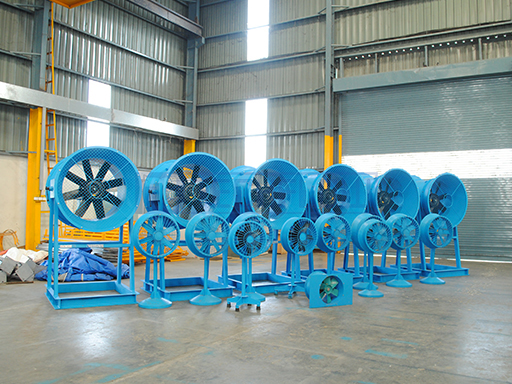
Axial fans are another type of industrial fan that is commonly used in a variety of applications. Distinguished from centrifugal fans that induce air circulation by producing a variance in air pressure, axial fans operate by instigating an airflow that runs parallel to the fan's axis. Axial fans are typically used in applications where a high volume of air needs to be moved at relatively low pressure.
C. Mixed Flow Fans
Mixed flow fans are a hybrid between centrifugal and axial fans. A mixed flow fan combines the high static pressure of a centrifugal fan with the high flow rate of an axial fan. Mixed flow fans are typically used in applications where a moderate volume of air needs to be moved against moderate resistance.
What are Industrial Blowers?
Industrial blowers are devices that are designed to move air or gas through a duct or pipe. Unlike fans, blowers are capable of generating a higher flow rate at a lower pressure. Industrial blowers are typically classified into two categories: centrifugal blowers and positive displacement blowers.
A. Centrifugal Blowers
Centrifugal blowers are similar to centrifugal fans in that they use a rotating impeller to generate airflow. In contrast, dissimilar to centrifugal fans that prompt air movement through the establishment of a pressure discrepancy, centrifugal blowers induce air circulation by initiating an airflow perpendicular to the impeller's axis. This creates a lower pressure zone at the centre of the impeller, which draws air into the blower and accelerates it outward.
B. Positive Displacement Blowers
Positive displacement blowers, otherwise referred to as rotary blowers, pertain to a classification of industrial blowers which employ a duo of rotating lobes for the purpose of propelling air or gas through a duct or pipe. The lobes trap a volume of air or gas between them and carry it from the inlet to the outlet. Positive displacement blowers are capable of generating a high flow rate at relatively low pressure.
Applications of Industrial Fans and Blowers
Industrial fans and blowers are used in a wide range of applications across various industries. Industrial fans are widely employed for an array of functions, with common usages including the facilitation of ventilation and exhaust systems, the implementation of dust collection systems, the regulation of air conditioning and refrigeration systems, as well as the execution of process cooling and drying systems. Industrial blowers are commonly used in pneumatic conveying systems, wastewater treatment systems, combustion air systems, and fluidization systems.
Choosing the Right Fan or Blower for Your Needs
A judicious selection of an appropriate fan or blower tailored to your particular application warrants prudent evaluation of numerous factors, such as the requisite airflow volume and pressure, the size and configuration of the conduit, in addition to the characteristics of the air or gas to be conveyed.

A. Airflow Volume and Pressure
The required airflow volume and pressure are critical factors in choosing the right fan or blower. Centrifugal fans are ideal for applications where a high-pressure difference is required to move air or gas against resistance. Axial fans are best suited for applications that require a high volume of air to be moved at relatively low pressure. Positive displacement blowers are deemed appropriate for applications necessitating a considerable volume of airflow at low pressure, conversely, centrifugal blowers are best suited for applications necessitating a moderate volume of airflow at moderate pressure.
B. Size and Shape of the Duct or Pipe
The size and shape of the duct or pipe through which air or gas will be moved is another important consideration. The fan or blower must be able to fit within the available space and be compatible with the duct or pipe dimensions. In some cases, custom ductwork or adapters may be required to ensure proper airflow.
C. Properties of the Air or Gas Being Moved
The properties of the air or gas being moved are also critical in choosing the right fan or blower. For example, corrosive or explosive gases require specialized materials and designs to prevent damage to the equipment or safety hazards. In the same vein, gases that exhibit elevated temperatures may necessitate the implementation of specialized cooling systems to avert potential overheating.
D. Energy Efficiency
Energy efficiency is an important consideration when choosing a fan or blower. Increased efficacy shall yield lesser energy consumption, thereby culminating in a decline in overhead expenses in the long term. Look for fans or blowers that are Energy Star certified or that have a high-efficiency rating.
E. Noise Level
The noise level of the fan or blower is another consideration, particularly if it will be installed in a residential or noise-sensitive area. Look for fans or blowers that have low noise levels or consider adding silencers or acoustic enclosures to reduce noise.
F. Maintenance Requirements
Consider the maintenance requirements of the fan or blower. It is fundamental to ensure peak performance and extended lifespan of the equipment by conducting routine maintenance activities, such as cleaning, lubrication, and substitution of deteriorated components. Choose fans or blowers that are easy to access and maintain, and that have a long service life.
Industrial fans and blowers are essential equipment in a wide range of applications. A thoughtful selection of a suitable fan or blower for your distinct application mandates meticulous scrutiny of various factors, such as the mandatory volume of airflow and pressure, the configuration and dimensions of the conduit, the characteristics of the air or gas conveyed, the energy efficiency, noise level, and maintenance prerequisites. By understanding these factors and selecting the right fan or blower, you can ensure optimal performance and long-term cost savings for your industrial application.