

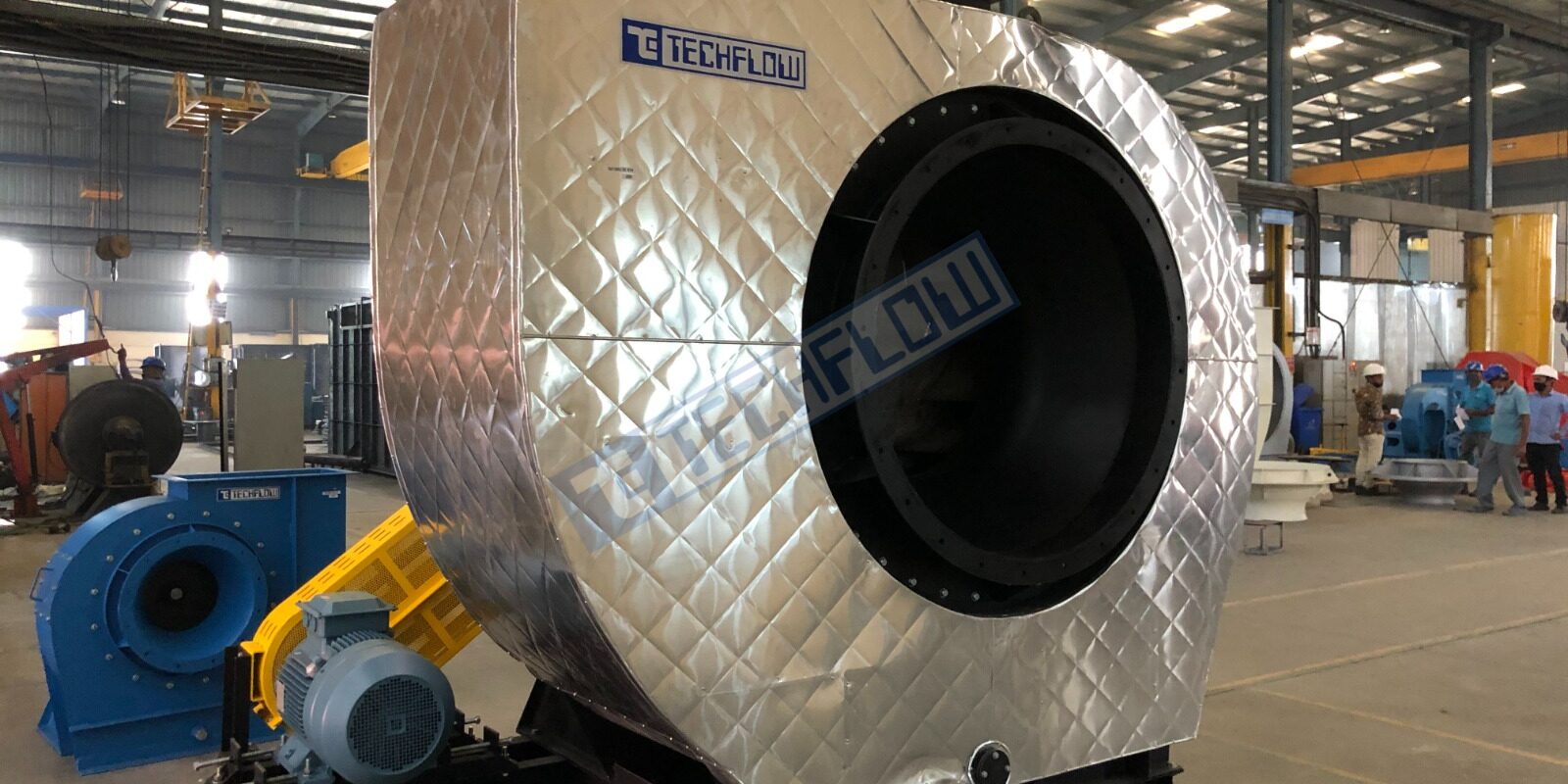
When discussing prominent air circulation equipment employed within industrial contexts, the centrifugal blower emerges as a paramount contender. Its significance is rooted in its ability to facilitate the seamless movement of air across diverse operational scenarios. These robust machines find widespread utilization across various industries, spanning from manufacturing processes to ventilation systems aimed at introducing fresh air. To attain a comprehensive understanding of their operational mechanics, let's closely examine the five primary components that converge to enable the centrifugal blower's functionality: the impeller, the surrounding housing structure, the apertures governing air inflow and outflow, the induction motor, and the bearings that ensure smooth rotational motion.

1. Impeller: The Heart of the Centrifugal Blower
Impellet of a centrifugal industrial fan is the most crucial part of the assembly. Comprising a set of blades, the impeller gives wings to the air passing through. With a touch of centrifugal magic, it propels the air outward, enhancing its speed and power. The impeller's design – including the number, shape, and arrangement of blades – holds the key to unlocking the blower's performance potential. The height, width, curves, numbers of blades, degree of inclination defines how well air will be discharged and how efficient the pressure is increased.
Generally there are 4 major types of blade in centrifugal blower
- Aerofoil Impeller
- Backward Curved Impeller & Backward Inclied Impeller
- Forward Curved Impeller & Forward Inclined Impeller
- Radial type Impeller
2. Housing/Casing: Containment and Direction
Think of the impeller like the conductor of an airflow orchestra. It plays a crucial role in controlling how air moves. Made up of a bunch of blades, the impeller pushes the air forward. By using centrifugal force, it makes the air go faster and stronger. How the impeller is made – how many blades it has, their shape, and how they're arranged – determines how well the blower will work. This design is what makes the blower perform better or worse.
Depending on the size, the casing can be designed and manufactured in two or single parts. To ease the manufacturing and assembling, split cage design is suggested for big impeller size above 1500 mm. The material of consturction depends on the nature of fluid to be handled.
3. Inlet and Outlet: Entry and Exit Points
Now, let's focus on the inlet and outlet – these are the places where the blower connects with the outside. The inlet brings air into the blower, and the outlet lets out the high-pressure air that the impeller has created. These parts are designed carefully to make things work better. A well-designed inlet reduces turbulence, making sure the air comes in smoothly. And the shape of the outlet affects how the high-pressure air comes out at the end.
Inlet and outlet are provided with important accessories like guide vanes, silencers, suction filters & air dampers
4. Motor: Powering the Blower
Let's introduce the motor, the powerhouse that makes the blower work. The motor gives the impeller the energy it needs to move the air around. In the world of industrial blowers, these motors need to be strong, with good torque. They have to overcome the resistance from the impeller and the weight of the air. Picking the right size and type of motor is as important as choosing the main actor in a play – it's key to a great performance and the blower's durability.
Techflow offers blowers with motor capacity upto 1500 kW power. The motor is designed as per the engineering standard and application of end use. The motor is coupled with a VFD drive for frequency control.
5. Bearings: Enabling Smooth Rotation
Now, let's explore the world of bearings – these are the essential parts that keep the impeller spinning smoothly. Bearings have an important job; they help the impeller rotate really fast with as little friction as possible. Keeping the bearings well-oiled and properly taken care of is what keeps the blower working well for a long time. Plus, bearings also help absorb any unexpected forces while the blower is running, sort of like backstage workers making sure everything goes smoothly during a show.

In the dynamic world of industrial fans and blowers, the centrifugal blower stands out as the dependable workhorse. Think of it as the behind-the-scenes wizard, creating its magic through a combination of different parts. The impeller, housing, inlet and outlet, motor, and bearings team up to produce a robust airflow that serves various industries.
Understanding these five essential parts is crucial for anyone entering the realm of centrifugal blowers – whether you're choosing one, using it, or keeping it running smoothly. As industries keep advancing, these parts remain the core of effective air circulation. Whether it's improving manufacturing processes or maintaining comfortable indoor environments, these components continue to play a vital role in driving progress.
Centrifugal Blower Applications in Modern Industries
Centrifugal blowers play a crucial role in industrial air movement systems where controlled airflow, pressure generation, and ventilation are required. These machines are commonly used in air pollution control systems, industrial ventilation, pneumatic conveying, dust collection systems, and process cooling applications.
Industries such as cement plants, pharmaceutical manufacturing, steel processing, food production, chemical plants, and power generation facilities rely heavily on centrifugal blowers to maintain safe operating conditions and efficient production environments.
Because every industry has different airflow requirements, selecting the right Centrifugal blower supplier becomes critical. A well-designed blower ensures optimal airflow efficiency, lower power consumption, and long operational life.
Choosing the Right Centrifugal Blower Supplier
When selecting a reliable Centrifugal blower supplier in India, companies should consider several engineering and operational factors:
-
Airflow capacity (CFM / CMH)
-
Static pressure requirements
-
Impeller design and efficiency
-
Motor power and energy efficiency
-
Construction material for corrosive environments
-
Maintenance accessibility and durability
Working with an experienced engineering company ensures that the blower system is designed specifically for the industrial application rather than using a generic solution.
TECHFLOW – Industrial Centrifugal Blower Engineering
Industrial manufacturers across multiple sectors rely on TECHFLOW for advanced airflow engineering and air pollution control solutions. The company designs and manufactures high-performance blowers for demanding industrial applications.
Recognized as a trusted Centrifugal blower supplier in India, TECHFLOW provides engineered blower systems that meet modern industrial requirements including high efficiency, durability, and environmental compliance.
For companies operating internationally, TECHFLOW also serves as a Centrifugal blower supplier in Global markets by delivering customized blower solutions suitable for various industrial environments.
These systems are designed to deliver reliable airflow performance for industries requiring consistent ventilation, dust extraction, and process air movement.
Why Centrifugal Blowers Are Essential for Industrial Air Systems
Centrifugal blowers remain one of the most widely used air movement devices in industrial engineering because they offer:
-
High pressure airflow generation
-
Efficient air handling for dust and gas movement
-
Reliable operation in continuous industrial environments
-
Compatibility with dust collectors, bag filters, and pollution control equipment
-
Long operational life with proper maintenance
Due to these advantages, centrifugal blowers are a fundamental component in many modern industrial air management systems.
FAQs about Centrifugal Blower Components
Q1: What is a centrifugal blower, and why is it important?
A centrifugal blower is a device used in industries to move air efficiently. It's crucial for processes like manufacturing and maintaining comfortable indoor environments.
Q2: What's the main part of a centrifugal blower?
The heart of a centrifugal blower is the impeller. In order to increase pressure at desired temperature, the design of the blower is crucial.
Q3: How does the housing/casing contribute to the blower's functionality?
The housing encloses the impeller and guides the airflow. Its special shape helps transform fast air into strong airflow, essential for various applications. It also gives rigidity and damping against internal vibration.
Q4: What role do the inlet and outlet play in a centrifugal blower?
Inlet and outlet are usually connected to ducting or left open in the atmosphere depending on the application. It has additional accessories placed on it like filter, guide vanes and dampers.
Q5: How does the motor fit into the blower's setup?
The motor is the blower's engine and responsible for quick start and impeller rotations. It is electrically connected with panels and mounted on a pedestal.
Q6: Why are bearings important in a centrifugal blower?
Bearings help the impeller spin smoothly and reduce friction. They also handle forces that arise during operation, contributing to the blower's stability.
Q7: How do these components work together in a centrifugal blower?
The components work in harmony: the impeller creates airflow, the housing guides and transforms it, the inlet and outlet manage the entry and exit, the motor powers the whole process, and bearings ensure smooth operation.