


Key Takeaways
- NFPA 660 (2025) replaced NFPA 61 as the governing combustible dust standard; food and agricultural requirements now sit in its agricultural and food chapter.
- India has no NFPA equivalent, but FSSAI Schedule 4 requires food premises sited away from excessive dust, fumes, and pollutants.
- The Factories Act duty to exhaust dust at its point of origin now sits under the OSH Code, effective 21 November 2025.
- Filter media follows the dust, not the collector: PTFE membrane for fine or sticky powders, spunbond polyester for abrasive grain dust.
- EPA design data gives pulse-jet air-to-cloth ratios of roughly 12 for flour, 13 for sugar, and 8 for starch (acfm/ft²).
- Source capture at hoods beats ambient collection: it prevents settling, protects allergen segregation, and satisfies point-of-origin extraction duties.
- Flour dust is a respiratory sensitiser; the UK exposure limit is 10 mg/m³ over eight hours, with under 2 mg/m³ achievable.
- Most food dust collector failures trace to layout, not the collector: hood placement, ducting, zoning and discharge-valve sealing decide real performance.
Stand near the intake of a flour sifter or a spice blender for ten minutes, and you will see the real problem. A fine haze hangs in the air at chest height, settles on the frame of the machine next to it, and is still there when the next product changeover starts. That haze is simultaneously a product contamination route, a worker health exposure, an allergen carry-over path, and, in the right concentration, a fuel, which is why the dust collector on a food line is not a utility bought at the end of a project. It is a food-safety control, and it has to be specified like one.
This guide covers what the 2026 regulatory position actually is (it changed, and most published material has not caught up), how to match filter media to the specific dust you are handling, how to size the system using published design data rather than guesswork, and where food plant dust systems most often fail after commissioning.
Why Dust Control in a Food Plant Is a Hygiene Control
In a foundry or a machine shop, dust collection protects people and equipment. In a food plant, it also protects the product, and that changes the specification.
Fine particles released during weighing, mixing, blending, milling, sifting, and pneumatic transfer do not simply dilute into the room. They settle on horizontal surfaces, on the top of machines, on light fittings and cable trays, and they return to the product later during the next batch, during cleaning, or when someone opens a door and changes the airflow in the room. A flour particle that leaves a sifter at 10 a.m. and lands on a mixer lid can end up inside an allergen-free batch at 4 p.m.
US food regulation makes this connection explicitly. Under the FDA's current good manufacturing practice rules in 21 CFR Part 117, plants must provide adequate ventilation or control equipment to minimise dust in areas where it could cause allergen cross-contact or contaminate food, and must locate and operate fans and other air-moving equipment so that they do not spread contamination. The same rule lists airflow systems alongside location, time and physical partition as recognised means of separating operations where cross-contact is likely.
Read that carefully, because it cuts both ways. Air-moving equipment is named as a control and as a risk. A badly placed collector intake, or a return air path that crosses from an allergen line to a free-from line, is not neutral. It is a contamination route the regulator has already anticipated.
The 2026 Regulatory Picture
What FSSAI Actually Requires
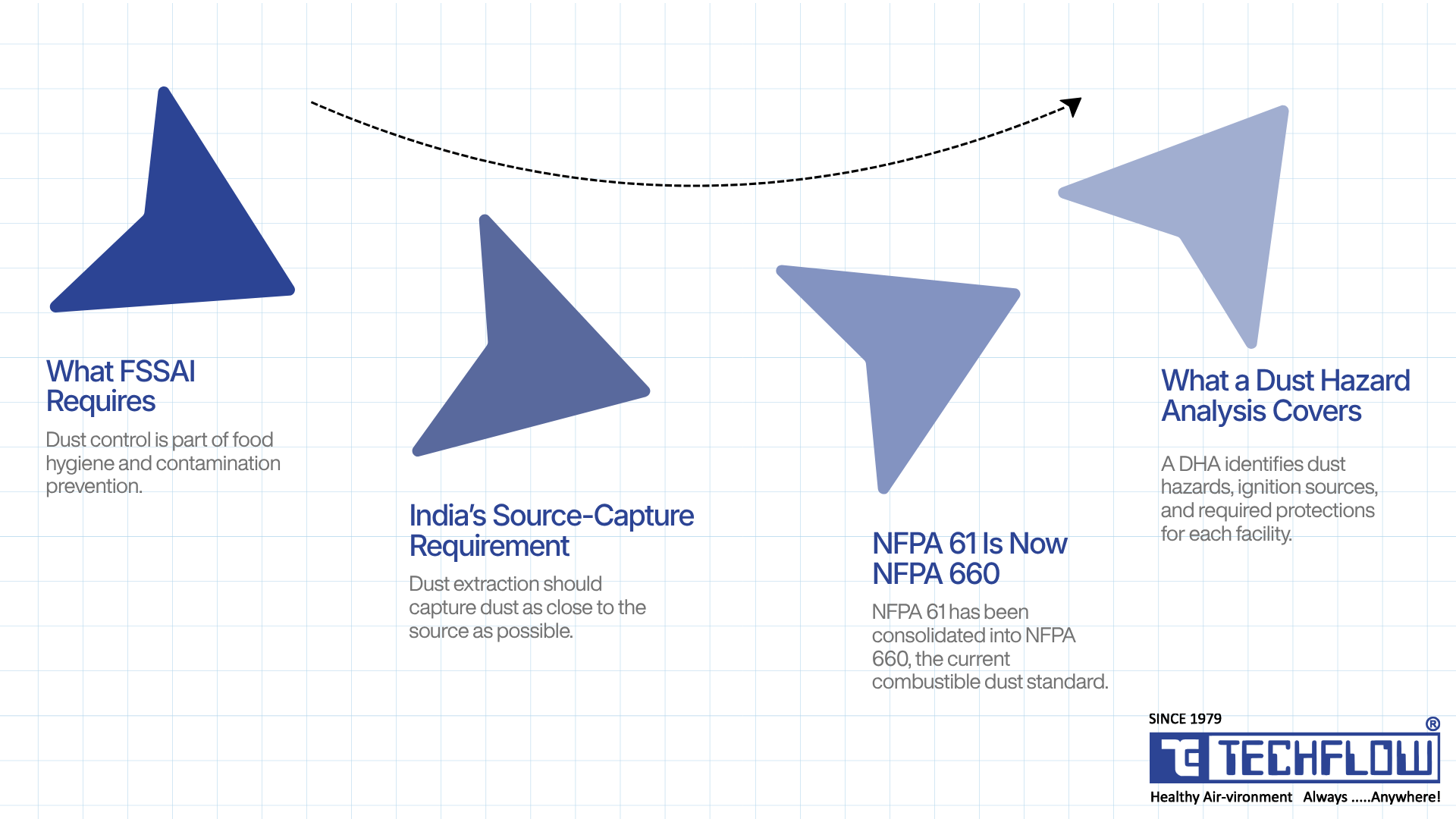
For an Indian food business, the operative document is not a combustible dust standard. It is the hygiene schedule attached to the licence. Schedule 4 of the Food Safety and Standards (Licensing and Registration of Food Businesses) Regulations, 2011 states that a food establishment should ideally be located away from environmental pollution and from industrial activity producing disagreeable or obnoxious odour, fumes, excessive soot, dust, smoke, or chemical and biological emissions that threaten to contaminate food. The same schedule requires that where a polluting industry is nearby, appropriate measures be taken to protect the manufacturing area from potential contamination.
Two practical consequences follow. First, dust control is licence-relevant, not optional good practice. Second, the obligation is written in terms of outcome: the food must not be contaminated, which means an auditor is entitled to look at your internal dust generation as well as what blows in from outside.
The Indian Statutory Duty Most Dust Specifications Miss
There is a second Indian legal requirement that specifically prescribes where extraction must be applied, and it is routinely absent from dust collection tenders.
Section 14 of the Factories Act, 1948 required that where a manufacturing process gives off dust likely to be injurious or offensive to workers, or dust in substantial quantities, effective measures be taken to prevent its inhalation and accumulation in any workroom and that where an exhaust appliance is necessary, it be applied as near as possible to the point of origin of the dust, with that point enclosed so far as possible.
That is a statutory description of source capture, written in 1948.
The legal container has since changed. The Factories Act is one of thirteen central labour laws subsumed into the Occupational Safety, Health and Working Conditions Code, 2020, and the Government of India brought all four labour codes into effect from 21 November 2025, rationalising 29 existing labour laws. Central rules under the codes will follow in 2026, and state rules vary in their stage of notification. For a plant engineer, the sensible reading is this: the source-capture principle has been settled Indian law for more than seventy years; the statutory instrument carrying it has changed, and the applicable state rules under the OSH Code should be checked before finalising a hood and duct layout.
NFPA 61 No Longer Exists as a Standalone Standard
This is the single most out-of-date claim in circulation on this topic, including in material published within the last year.
NFPA 61, Standard for the Prevention of Fires and Dust Explosions in Agricultural and Food Processing Facilities, has been consolidated into NFPA 660, Standard for Combustible Dusts and Particulate Solids. The 2025 edition was issued by the NFPA Standards Council in November 2024 with an effective date of 6 December 2024, and it absorbs six previously separate documents, NFPA 61, 484, 652, 654, 655, and 664, into one standard. The opening chapters cover the fundamentals that used to live in NFPA 652, and the industry-specific requirements follow in later chapters, including agricultural and food processing.
What this means in practice:
- Specifications, DHAs and insurance documents that reference "NFPA 61 (current edition)" are now referencing a retired document.
- The technical expectations have not been abandoned. A facility already aligned to NFPA 652 plus its commodity standard will recognise most of NFPA 660.
- Terminology is now defined once across commodities, which removes a common source of argument between a plant, its insurer and its equipment supplier about what counts as a combustible dust.
India has not adopted an equivalent mandatory domestic standard. The physics is unaffected by that, which is why export-oriented Indian plants, plants owned by multinationals, and plants carrying international insurance are increasingly specified against NFPA 660 voluntarily.
What a Dust Hazard Analysis Covers
A Dust Hazard Analysis is a documented, facility-specific assessment that identifies where combustible dust can accumulate or be suspended, what could ignite it, and what protection is required, carried out for the actual process, and kept current as the process changes. NFPA 660 retains the DHA requirement that came in with NFPA 652 and keeps it central to the framework.
The reason a DHA cannot be inherited from a sister plant is that the answers are geometric. Two mills running identical product can have completely different risk profiles because one has an enclosed transfer conveyor and the other does not.
Is Flour Dust Really Explosive?

Yes, and the incident record is specific enough to be worth reading rather than summarising.
The US Chemical Safety Board identified 281 combustible dust incidents between 1980 and 2005 that killed 119 workers and injured 718, as summarised in OSHA's hazard communication guidance for combustible dusts. The CSB's underlying Combustible Dust Hazard Study found that food products sat among the four industry sectors accounting for the bulk of those incidents, and that food-related materials, wood and metals each accounted for over 20 per cent of explosions.
The study also identified something that ought to change how a food plant thinks about the equipment in this article. Across all industries, the CSB found dust collectors to be the equipment most frequently involved in combustible dust incidents, citing published research attributing more than 40 per cent of dust explosions to them. Grinders, silos, hoppers, and mixers follow.
That finding is not an argument against dust collection. It is an argument about where the concentrated risk ends up. A collector works by deliberately gathering the finest, most readily suspended fraction of your dust into one enclosed vessel. Which is precisely why explosion protection belongs on the collector rather than only on the process, and why siting it outside the production hall is a safety decision before it is a hygiene one.
The case most relevant to a food plant is Imperial Sugar. On 7 February 2008, a series of sugar dust explosions at the Port Wentworth refinery in Georgia killed 14 workers and injured dozens more. The CSB's investigation report traced the first explosion to an enclosed steel belt conveyor beneath the sugar silos, where recently installed cover panels allowed sugar dust to accumulate above its minimum explosible concentration inside the enclosure. The primary event then shook accumulated dust off overhead surfaces throughout the packing buildings, and those secondary explosions caused most of the deaths.
Three design lessons sit inside that sequence, and all three are about dust collection rather than firefighting:
- Enclosing a transfer point without venting or extracting it can create the hazard. Containment concentrates dust. Containment plus extraction removes it.
- Settled dust on overhead surfaces is the amplifier. Whatever your primary risk, the severity is set by how much dust has been allowed to accumulate where nobody cleans. That is a source-capture and housekeeping outcome.
- Familiarity is not safety. The refinery had run for over eighty years. The material was ordinary refined sugar.
There is also a slower, less dramatic hazard that food plants under-weight. Flour dust is a respiratory sensitiser and a leading cause of occupational asthma. The UK Health and Safety Executive has set a workplace exposure limit for flour dust of 10 mg/m³ averaged over eight hours and 30 mg/m³ over fifteen minutes, and notes that with good control practice less than 2 mg/m³ is usually achievable. India does not enforce that specific figure, but it is a useful engineering target, and the gap between 10 and 2 is almost entirely a function of whether dust is captured at source or left to disperse.
Filter Media: Match the Media to the Dust
The most common specification error in this category is assuming that a food-grade collector body arrives with the correct filter inside it. The body determines cleanability and corrosion resistance. The media determines whether the system works.
| Dust type | Behaviour in the airstream | Media approach | Why |
|---|---|---|---|
| Sugar dust | Sticky, hygroscopic, cakes onto the surface | PTFE membrane or PTFE-coated media | Surface filtration resists blinding; cake releases cleanly on pulse |
| Flour and starch | Fine, combustible, moderately abrasive | Spunbond polyester or cellulose-polyester blend | Balance of cost, cake release and dust holding; polyester tolerates higher temperature than cellulose |
| Grain, cereal, nut dust | Coarse, abrasive, high volume | Needlepunched or spunbond polyester, cyclone ahead of it | Durability against abrasion; pre-separation keeps the fine media alive |
| Milk powder, protein powders | Very fine, hygroscopic, unstable in humidity | PTFE (ePTFE) membrane, sealed discharge | Sub-micron capture at the surface; membrane prevents deep loading that cannot be pulsed out |
| Spice dust | Fine, allergen-sensitive, often warm process air | Polyester with membrane where carry-over matters | Polyester handles process temperatures cellulose cannot; membrane limits fine carry-over |
What a PTFE Membrane Actually Does
The mechanism is worth stating precisely, because "high efficiency" claims obscure it.
The US EPA's design manual for baghouses and filters describes PTFE membrane laminates as having pore sizes in the range of one to two micrometres and below, against roughly 10 to 100 micrometres for woven fabrics and nonwovens. The consequence is that a membrane filter starts collecting fine particles almost immediately, while a conventional fabric allows particles to penetrate until a dust cake re-forms after each cleaning pulse. The manual notes that overall mass collection efficiency may not look dramatically different, but efficiency on fine particles is.
For a milk powder or spice plant, that post-pulse penetration window is the whole argument. Every cleaning cycle on conventional media is a brief period of elevated fine-particle carry-over.
Membrane media is not free. The same EPA manual puts membrane bag prices at roughly three to four and a half times the base fabric price. That premium is justified where the dust is sub-micron, sticky, hygroscopic, or allergen-critical. It is hard to justify on coarse grain dust behind a cyclone.
Temperature Limits Are a Media Constraint, Not a Collector Constraint
Published continuous operating limits for common filter fabrics run roughly as follows: cotton around 180°F (82°C), polypropylene around 200°F (93°C), polyester around 275°F (135°C), Nomex around 375°F (190°C), and fibreglass around 500°F (260°C), with PTFE membrane limited by whatever backing it is laminated to.
Two practical notes for food lines. Cartridge collectors are usually limited below the media's own rating by the adhesives sealing the media to the end caps, with around 200°F a common working ceiling. And the gas stream must stay above its dew point: condensation will plug filter pores within hours, and in a food plant it also creates exactly the moist, nutrient-rich deposit that microbiological control is designed to prevent.
Protect the Primary Filter
The cheapest life-extension measure in this entire category is pre-separation. The EPA manual notes that where a substantial part of the loading is above roughly 20 micrometres, mechanical collectors such as cyclones are used to reduce the load reaching the fabric filter. On grain, cereal, nut and husk dust, a cyclone dust collector ahead of the fine filtration stage removes the coarse, abrasive fraction before it can wear or blind expensive media. Cyclones have no moving parts, which keeps their own maintenance demand close to zero.
Sizing: Air-to-Cloth Ratio Sets Everything Else
If you read only one technical section before writing a specification, make it this one. Air-to-cloth ratio (also called gas-to-cloth ratio, or filtration velocity) is the volume of air passing through each unit of filter area. Set it too high, and you get higher pressure drop, higher fine-particle penetration, more frequent cleaning, and shorter media life. Set it too low, and you have paid for a collector larger than the duty requires.
The EPA manual publishes design values by dust type. The figures below are actual cubic feet per minute per square foot of net cloth area.
| Dust | Shaker / reverse-air, woven fabric | Pulse-jet, felt |
|---|---|---|
| Flour | 3.0 | 12 |
| Starch | 3.0 | 8 |
| Sugar | 2.0 | 13 |
| Feeds, grain | 3.5 | 14 |
| Spices | 2.7 | 10 |
| Cocoa, chocolate | 2.8 | 12 |
Source: US EPA Air Pollution Control Cost Manual, Section 6, Chapter 1 (Sixth Edition), Table 1.1. The EPA describes these as generally safe design values requiring consideration of particle size and grain loading. These are long-established reference values rather than recent test data, and they remain the most widely used published starting point for fabric filter sizing, but they are a starting point, not a substitute for sizing against your measured dust loading and particle distribution.
Two things in that table deserve comment.
Starch sits materially lower than flour on pulse-jet duty, despite the two being handled in adjacent parts of the same plant. Sugar sits high on pulse-jet felt but is the lowest of the group on woven fabric. This is precisely why "we already have a flour collector, use the same sizing" is a mistake.
The manual's factor-based pulse-jet sizing method reinforces the point. Its material factors run from 15 for flour, grain, feeds, and cocoa, through 10 for sugar and 9 for starch, down to 6 for powdered milk, the lowest band, which the manual footnotes as covering solids that are unstable because they are hygroscopic. A milk powder collector sized at flour velocities is not conservative. It is wrong.
The same manual's horizontal-cartridge sizing table carries a further caution: the listed factors for sugar, cake mix, and cocoa apply only under controlled humidity of around 40% RH and room temperature. If your sugar-handling area is not humidity controlled, that assumption does not hold.
Choosing the Collector Type for a Food Line
Most plants end up with a mix, because the duties differ.
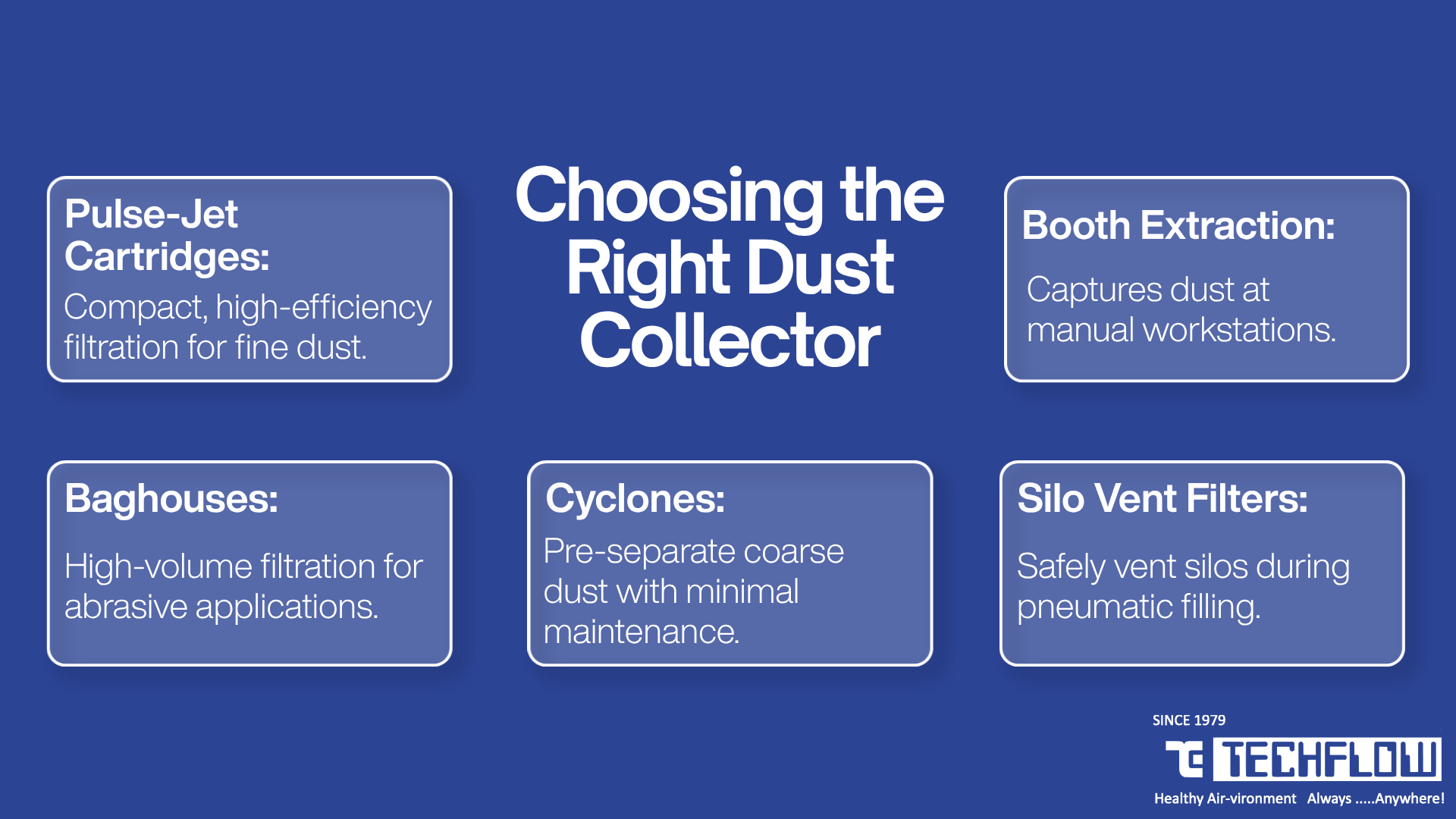
Pulse-jet cartridge collectors. Pleated media in a compact footprint, giving high filter area per unit volume and good access for maintenance. The standard choice for mixers, weigh stations, sifters and packing lines where space is tight, and the dust is fine. TECHFLOW's pulse jet cartridge filter range sits in this category.
Baghouses (pulse-jet bag filters). Higher volume, longer bag life on abrasive duty, and easier to build in large sizes. Suited to continuous, high-volume milling and grain handling.
Cyclones and multi-cyclones. Pre-separation of coarse and heavy particulate ahead of fine filtration, and sometimes product recovery in their own right. Low maintenance, no moving parts.
Silo vent filters. A specific duty rather than a general collector: they vent displaced air when a silo is filled pneumatically, returning the entrained material to the silo rather than to atmosphere. Essential for flour, sugar, starch and grain storage. See TECHFLOW's silo vent filter range.
Booth and workstation extraction. Where manual decanting, tipping or weighing happens, the capture geometry matters more than the collector. Enclosure plus extraction beats a hood alone. TECHFLOW builds dust collection systems with integrated work stations for exactly this duty.
Whatever the body, the discharge deserves attention it rarely gets. A rotary airlock valve discharges collected material from the hopper without breaking the pressure or vacuum the collector depends on. If that seal degrades, the collector's designed airflow degrades with it, and on a food line, a leaking airlock is also an open route between collected allergenic dust and the room.
System Design: Layout Decides More Than the Collector
A well-built collector on a badly designed system underperforms every time. This is where most food dust projects lose their money.
Source Capture Versus Ambient Collection
The decisive question is where the dust is captured, not how it is filtered afterwards.
Ambient collection, a large collector pulling general room air, is the intuitive answer and the wrong one. By the time dust reaches a room-level intake, it has already crossed the room, already settled on surfaces, and already had the opportunity to migrate to an adjacent line. In a plant running allergen and allergen-free products under the same roof, ambient collection makes cross-contact close to structural.
Source capture means hoods at the point of generation: on mixer inlets, at sifter discharges, as high-velocity slot hoods behind weigh stations, at conveyor transfer points, on tipping stations. Dust enters ducting before it can disperse. This is also, as noted above, what Indian law has required since 1948 and what the FDA's CGMP rule contemplates when it names airflow systems as a separation method.
Hygienic Zoning, Wet and Dry
Good system design starts with a zoning map, not a duct size: which products, which allergens, which microbiological risk level, and which areas are wet-cleaned.
Wet and dry zones must stay separated. Moisture carried into a dust-heavy dry area creates exactly the conditions that microbiological control is meant to prevent, and it also blinds filter media. Ducting should not create a shared air path between zones that the cleaning regime treats as separate; where it must cross, the design needs a documented justification and appropriate isolation.
Collector Placement and Explosion Protection
Site the collector away from the active production floor wherever the layout allows, ideally outdoors or in a dedicated plant room. Three reasons: collected dust can be discharged and handled without opening a hopper inside a hygienic zone; maintenance does not interrupt production; and if the dust is combustible, the highest concentration of it in the whole facility is now outside the occupied building.
That last point is not incidental, and the CSB equipment data above is the reason. The collector is where dust is deliberately concentrated. For combustible food dusts, explosion protection venting, isolation, suppression, spark detection, grounding and bonding, as determined by the DHA and the applicable standard, belong on the collector and its ducting, not only on the process. A rotary airlock is a material discharge device; it should not be assumed to be a certified isolation device unless it is specified and certified as one.
Materials and Hygienic Construction
Stainless steel is the default for hoods, ducting and collector surfaces in food service, and for good reasons: it resists corrosion, survives sanitiser chemistry, and does not develop the flaking failure mode that painted or coated mild steel eventually shows in a washdown environment.
It is worth being precise rather than absolute, though, because blanket specifications waste money. Hygienic design guidance treats stainless steel as the logical choice for wet-cleaned plant, while recognising that other metals can be appropriate in genuinely dry, non-product-contact environments. The useful discipline is to let the hygienic zoning map decide: product-contact and wet-cleaned surfaces get stainless; a dry, external, non-contact fan casing may not need to.
Where surfaces are product-contact, both 3-A Sanitary Standards and EHEDG converge on a maximum surface roughness of around Ra 0.8 µm, since cleaning time rises with roughness. Welds ground flush, no dead legs, no horizontal ledges inside ducting, and access for inspection matter as much as the alloy certificate.
Process-by-Process Application Guide
| Process area | Primary dust concern | Recommended approach |
|---|---|---|
| Flour milling and sifting | Fine combustible dust, high volume, continuous duty | Source-captured pulse-jet collection, DHA-informed explosion protection, collector sited outside the production hall |
| Sugar handling and mixing | Sticky, hygroscopic, caking; humidity-sensitive | PTFE membrane media, humidity considered in sizing, sealed discharge, rigorous housekeeping above head height |
| Spice grinding and blending | Fine, allergen-sensitive, warm process air | Enclosed hoods at grinders, polyester-based media rated for the process temperature, dedicated ducting per allergen zone |
| Milk and protein powder handling | Very fine, hygroscopic, prone to deep media loading | ePTFE membrane cartridges, conservative air-to-cloth ratio, sealed rotary airlock discharge |
| Grain and cereal handling | Coarse, abrasive, very high volume | Cyclone pre-separation ahead of baghouse or cartridge collector |
| Silo filling and pneumatic transfer | Displaced dust-laden air at fill | Silo vent filter returning material to the silo, level-linked controls |
| Weighing, tipping and packing | Intermittent bursts of fine dust at operator height | High-velocity slot hoods or enclosed workstations, local capture rather than room extraction |
Maintenance, Running Cost and What Actually Fails
An efficiency rating on a datasheet says nothing about performance in year three. These are the variables that decide it.
Pressure drop is the energy bill:
Typical fabric filter system pressure drop runs in the range of 5 to 20 inches of water column, including ductwork. The EPA manual gives a usable estimating relationship for fan energy: annual kWh ≈ 0.000181 × airflow (acfm) × pressure drop (in. w.c.) × operating hours. Run that number at tender stage. On a continuously operating system, the energy difference between a well-designed duct run and a badly designed one will dwarf the difference in collector price.
Compressed air is a real operating cost:
Pulse-jet systems consume roughly 2 scfm of compressed air per 1,000 cfm of gas filtered, at cleaning pressures generally between 60 and 100 psig. For cartridge collectors with nonwoven media, the manual gives around 10 scfm per 1,000 ft² of media per pulse at 60 psig, rising to about 14 scfm at 90 psig. Cleaning on differential pressure rather than a fixed timer cuts this materially.
Filter life:
Bag and cartridge life of roughly two to four years is a reasonable planning assumption, against a system life of around twenty years. Budget media replacement as a recurring cost, not a warranty event.
Pleat geometry decides cleanability:
Closer pleat spacing buys more area in the same cartridge but increases the risk of dust bridging permanently across the bottom of the pleats and taking that area out of service. Published guidance puts paper media at around 12 to 16 pleats per inch and nonwovens under more difficult conditions at 4 to 8. On sticky or fine food powders, fewer and more open pleats outperform a higher nominal area.
Discharge components fail quietly:
A rotary airlock that no longer seals bleeds air into the hopper, changes the pressure balance across the media, and degrades collection without triggering any alarm. Put it on the inspection schedule.
Access decides cleaning frequency:
A collector that is awkward to open gets opened less often. In a food plant, that is a hygiene failure as much as a performance one.
Common Mistakes in Food Processing Dust Collector Selection
- Specifying the collector after the process layout is frozen. Hood positions, duct routes, and zoning have to be designed with the line, not fitted around it.
- Choosing media from the collector model rather than the dust. The body and the media are two separate decisions.
- Reusing air-to-cloth ratios across different food dusts. Flour, starch, sugar, and milk powder have materially different published design values.
- Relying on ambient collection. It permits settling, cross-contact, and secondary dust accumulation.
- Citing NFPA 61 in a 2026 specification. It has been consolidated into NFPA 660.
- Skipping the DHA because "it's only flour." Flour, starch, and sugar are precisely the materials the standards were written for.
- Ignoring wet/dry zone separation. Moisture in a dry dust zone undermines microbiological control and blinds media.
- Treating the rotary airlock as an afterthought. It sets the pressure integrity of the entire system.
- Buying on collector price alone. Fan energy and compressed air over twenty years exceed the capital difference between most competing units.
What to Ask a Dust Collection Supplier
A supplier who can answer these quickly is engineering the system. One who cannot is selling a box.
- What air-to-cloth ratio have you used, and what published or measured basis supports it for this dust?
- What filter media, in what construction, and why that rather than the cheaper alternative?
- What is the predicted pressure drop across the collector and across the full duct system, and what annual fan energy does that imply?
- What is the compressed air demand at the proposed cleaning frequency?
- Is cleaning initiated on differential pressure or on a timer?
- What capture velocity is assumed at each hood, and at what distance from the source?
- What is the materials specification for hoods, ducting, collector body, and discharge, zone by zone?
- If the dust is combustible, what explosion protection is proposed, and what does the DHA require?
- How is the hopper discharged, and how is that seal maintained and verified?
- What is the expected media life on this duty, and what does replacement cost?
Where TECHFLOW Fits

TECHFLOW Enterprises Pvt. Ltd. was founded in 1974 in Ahmedabad by technocrat entrepreneur Mr. D. K. Parikh, starting as a small-scale production machine shop under the Gujarat government-assisted New Entrepreneur Scheme, a programme intended to develop technocrat-led SMEs in the state. The business is now run by Mr. Parikh alongside his sons, Mr. Monil Parikh and Mr. Chintan Parikh, from a greenfield manufacturing site at Kubadthal village near Ahmedabad, where a new fabrication facility was established in 2011.
The company's dust collection and air pollution control range covers the equipment categories discussed throughout this guide: pulse jet cartridge and bag filters, cyclone dust collectors, silo vent filters, rotary airlock valves, centrifugal fans and blowers, pneumatic conveying systems and electrostatic precipitators, along with components and spares.
TECHFLOW maintains a dedicated food processing, grain and flour plant category within its range, a reflection of the fact that food-grade dust collection is a distinct specification problem rather than a scaled-down industrial system. For related reading on the company's site, see its overview of dust collector types for the food industry, the technical piece on industrial cyclone dust collector design and benefits, and the note on silo vent filter applications.
Plants working through a specification for a mill, spice unit, bakery ingredient line, dairy powder plant or grain handling facility can take the question list above straight to the TECHFLOW engineering team.
The Bottom Line
Food plant dust collection is a sequence of dependent decisions, and skipping any one of them undermines the rest. Establish what the dust actually is and whether it is combustible. Get the regulatory position right for 2026, which now means NFPA 660 rather than NFPA 61, and the OSH Code rather than the Factories Act. Match media to dust rather than to the collector body. Size on published design data for that specific material. Capture at source. Zone the plant before routing a single duct. Seal the discharge.
Do all of that and the system becomes invisible, which is the point. The air stays clean, the product stays uncontaminated, the audit is uneventful, and nobody thinks about the collector again until the media is due for replacement.
Frequently Asked Questions (FAQs)
Yes. Flour, along with sugar, starch, cocoa, powdered milk, and many spices, forms a combustible dust when suspended in air above its minimum explosible concentration. This is why agricultural and food processing facilities have been covered by dedicated combustible dust standards for decades, now consolidated into NFPA 660.
Yes. NFPA 61 has been consolidated into NFPA 660, Standard for Combustible Dusts and Particulate Solids, whose 2025 edition took effect on 6 December 2024. NFPA 660 absorbs six previous standards, NFPA 61, 484, 652, 654, 655, and 664, into one document, with agricultural and food processing requirements appearing as an industry-specific chapter.
Schedule 4 of the Food Safety and Standards (Licensing and Registration of Food Businesses) Regulations, 2011 requires that a food establishment be located away from environmental pollution and industrial activity producing excessive dust, fumes, soot, smoke, or emissions that could contaminate food, and that protective measures be taken where such sources are nearby. There is no separate mandatory Indian combustible dust standard equivalent to NFPA 660.
It has statutory backing. Section 14 of the Factories Act, 1948 required exhaust appliances to be applied as near as possible to the point of origin of dust, with that point enclosed so far as possible. The Factories Act has since been subsumed into the Occupational Safety, Health and Working Conditions Code, 2020, which took effect on 21 November 2025, so plants should confirm the current position under their applicable state rules.
PTFE membrane or PTFE-coated media, because sugar dust is sticky and hygroscopic and cakes onto conventional media. A membrane collects at the surface rather than within the media depth, so the cake releases on the cleaning pulse instead of progressively blinding the filter and driving pressure drop up.
Published EPA design data gives about 12 actual cfm per square foot of net cloth area for flour on pulse-jet felt media, and about 3.0 on woven fabric with shaker or reverse-air cleaning. These are starting values: actual selection must account for particle size, inlet dust loading, temperature and humidity, and differs significantly for starch (8), sugar (13) and grain (14).
Source capture draws dust into ducting at the point it is generated, using hoods at mixers, sifters, weigh stations, and transfer points. Ambient collection pulls dust out of general room air after it has already dispersed and settled. Source capture is more effective, uses less airflow for the same result, and is the only approach compatible with allergen segregation between adjacent lines.
It is not a mandatory Indian requirement, but it is the accepted international baseline for any facility handling combustible dust and is increasingly expected by insurers, export customers, and multinational parent companies. The analysis is facility-specific by design, so it cannot be copied from another site, even one running an identical process.
Because it maintains the pressure or vacuum boundary at the collector hopper while discharging collected material. A worn or poorly sealing airlock leaks air into the hopper, changes the airflow distribution across the filter media, and reduces collection efficiency without generating an obvious fault. In a food plant, it is also a potential escape route for collected allergenic dust.
Outside the production hall, wherever the layout permits, outdoors or in a dedicated plant room. This keeps the highest concentration of collected dust away from occupied hygienic zones, allows the hopper to be discharged without opening a vessel inside a production area, and lets maintenance happen without interrupting production or breaching zoning. The CSB's finding that dust collectors are the equipment most frequently involved in combustible dust incidents makes this a safety decision as much as a hygiene one.
Membrane media typically costs several times base fabric. EPA design data puts PTFE membrane bags at roughly three to four and a half times the base fabric price. That premium is justified for sub-micron, sticky, hygroscopic, or allergen-critical dusts, and difficult to justify on coarse grain dust running behind a cyclone.


